Automated Dental Insurance Verification Software, Minus the Hold Music
Hello, and a warm welcome to every coordinator who knows the insurance hold music by heart.
If your coordinator has the hold music memorized by Tuesday, this guide is for you.
Most dental offices still verify benefits one patient at a time, through a portal or a phone call, and type the answers into the practice software by hand.
Automated dental insurance verification software does that lookup on its own before the visit and hands your team a finished breakdown.
Short answer: Automated dental insurance verification software checks each scheduled patient’s coverage 2 to 3 days ahead, using electronic 270/271 eligibility requests, payer portal bots or both, and writes deductibles, maximums and coverage percentages into Dentrix, Open Dental or Eaglesoft. Your staff only works the patients it could not finish.
What is automated dental insurance verification software?
Automated dental insurance verification software is a program that asks the insurance company about a patient’s benefits without a person dialing or logging in.
It reads tomorrow’s or next week’s schedule, sends a request for each insured patient, reads the answer, and saves it where your team already looks: the coverage table or the patient’s document center.
The good tools work in batches overnight. The front desk arrives to a list that says who is verified, who is inactive and who still needs a human, instead of a stack of calls to make.
- Eligibility answers
is this plan active today?
- Benefits answer
what will it pay?
: deductible, annual maximum, coverage percentages by category. - History and limits answer
can we do it today?
: frequencies, waiting periods, missing-tooth clauses.
Most software handles the first line well, the second line fairly well, and the third line only sometimes. That gap decides which product you need.
Why does an out-of-network or cash-pay clinic still verify insurance?
An out-of-network or cash-pay clinic still verifies insurance because patients want to know what their plan will send back to them.
A patient who pays your full fee at the desk still asks how much will I get reimbursed?
, and the honest answer depends on the plan’s out-of-network percentage, its usual, customary and reasonable (UCR) allowance and the remaining annual maximum.
Out-of-network offices also need one detail in-network offices rarely think about: who gets the check. If the plan pays the patient instead of the office, your courtesy claim turns into a collections call.
| Detail | Why an OON or cash-pay office needs it | Usually in a basic 271 response? |
|---|---|---|
| Plan active on the visit date | No coverage means no reimbursement talk at all | Yes |
| Out-of-network coverage percentages | The patient’s reimbursement estimate starts here | Sometimes |
| UCR or maximum allowable fee | The plan pays a percentage of its allowance, not of your fee | Rarely |
| Deductible and annual maximum remaining | Tells the patient whether anything is left this year | Often |
| Frequencies and history | A second cleaning in five months may get nothing back | Rarely |
| Assignment of benefits honored | Decides whether the check goes to the office or the patient | No |
The “usually” column is our summary of the ADA study described below and of what the practice software makers say their tools return. Your payers may do better or worse.
How many hours does manual dental insurance verification really cost?
Manual dental insurance verification usually costs a front desk several hours a week, and often a few hours a day.
In a 2022 survey by Weave, 55% of dental offices spend 6 or more hours a week verifying insurance eligibility
, as Dental Products Report reported.
Vendors such as Intake.dental put a single check at 12 to 20 minutes on a portal and 30 to 45 minutes when a call and hold time are involved; those are their numbers, not ours.
| Patients verified a day | Minutes each | Hours a day | Hours a month (21 workdays) | Monthly cost at $22 an hour |
|---|---|---|---|---|
| 8 | 15 | 2.0 | 42 | $924 |
| 15 | 15 | 3.75 | 79 | $1,733 |
| 25 | 15 | 6.25 | 131 | $2,888 |
| 15 | 30 | 7.5 | 158 | $3,465 |
Assumptions: 15 minutes sits inside the vendor portal range above, 30 minutes stands for a day of phone calls, 21 working days a month, and $22 an hour as a rough loaded cost for a front desk coordinator. Swap in your own numbers.
Here’s the catch: the hours are not the whole cost. While one person is on hold with a carrier, line two rings, and that caller may be a new patient booking somewhere else.
Now the other side. If automation finishes four patients in five and each of those needs a one-minute glance, while the fifth still takes 15 minutes, 15 patients a day drops from 3.75 hours to about 57 minutes. That is an example with stated assumptions, not a promise.
How does automated dental insurance verification work, step by step?
Automated dental insurance verification follows the same five steps a careful coordinator follows, two or three business days before the appointment.
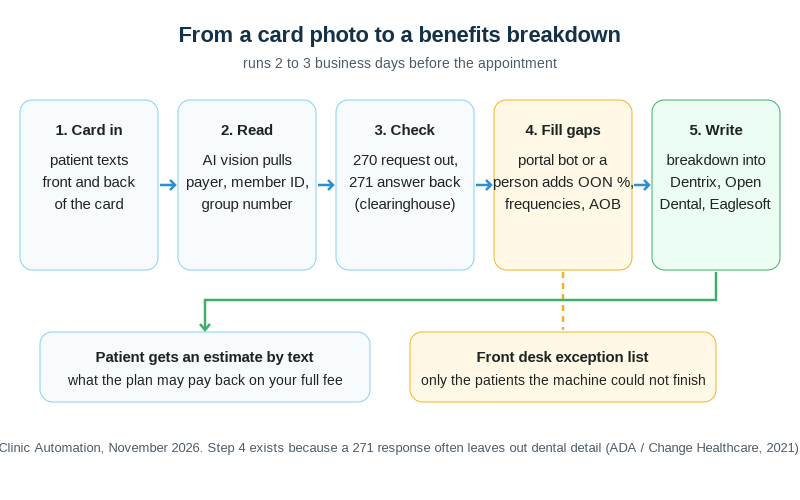
- Card in. New patients text or upload a photo of the front and back of the insurance card with their intake forms. Returning patients skip this unless the plan changed.
- Read. An AI vision model or a trained card reader pulls the payer name, payer ID, member ID, group number and subscriber name into fields, and flags anything blurry.
- Check. The software sends an electronic eligibility request (an X12 270) through your clearinghouse and reads the payer’s answer (a 271), the HIPAA-standard pair set by X12.
- Fill gaps. Where the 271 is thin, a portal bot logs in to the payer’s website, or the patient lands on a short call list for a person. This is where out-of-network percentages, frequencies and assignment of benefits get added.
- Write. The breakdown goes into the patient’s coverage table or document center, the schedule shows a verified mark, and the patient can get a plain estimate by text.
In words, the diagram shows: card photo in, AI reads payer and member ID, 270 out and 271 back through the clearinghouse, a portal bot or a person fills the out-of-network percentage, frequencies and assignment of benefits, and the breakdown lands in Dentrix, Open Dental or Eaglesoft.
Anything unclear goes to the front desk exception list; the patient receives a reimbursement estimate.
Why does an “active” eligibility result still leave gaps?
An “active” eligibility result leaves gaps because many dental payers send back only part of the benefit detail in their electronic 271 answer.
The American Dental Association hired Change Healthcare to study the problem. Its 2021 report, Eligibility and Benefits Verification: Current State Review and Feasibility Analysis, found that the top 25 payers by claims volume returned, on average, less than 50% of the elements recommended by the NDEDIC Top 56 guidelines.
Version 5010 of the 270/271 transaction does have gaps in support of dental services, but many of these limitations can be circumvented within the structure of the transaction.
ADA and Change Healthcare, Eligibility and Benefits Verification, July 2021
The same report gives the clearest number on the payer side: one large dental payer said that of the 25,000 calls it receives each day, nearly 19,000 are eligibility calls. Your coordinator is not the only one stuck on hold; most of the line is.
The report also names the front desk’s other complaint. Leaving the practice software to use a portal or make a call disrupts the workflow, and retyping the answer raises the chance of a data-entry mistake.
- Payers’ 271 detail
- Top 25 dental payers returned under 50% of the recommended elements on average (ADA/Change Healthcare, 2021)
- Eligibility share of payer calls
- Nearly 19,000 of 25,000 daily calls at one large dental payer (same report)
- Offices spending 6+ hours a week
- 55% (Weave survey, 2022)
- Dental vs medical electronic eligibility use
- 64% vs 84% (CAQH 2020, cited in the ADA report)
That is why the strongest tools combine two sources: the electronic 271 for speed, and a portal bot or a person for the dental details the 271 leaves out.
Which automated dental insurance verification software works with Dentrix, Open Dental and Eaglesoft?
All three big practice management systems now include some automated verification, and add-ons like Weave and Vyne Trellis sit on top of them.
The quiet win here is not speed. It is your front desk looking up at the patient in front of them instead of at a phone tree.
| Tool | How it checks | Ahead of time? | What the maker says it saves or returns |
|---|---|---|---|
| Open Dental Ins Batch Verify | 270/271 through a clearinghouse, for carriers marked trusted for real-time eligibility | Yes, as a scheduled process | Patients whose insurance matches the 271 leave the verification list; the rest stay for manual checks |
| Dentrix Eligibility Pro | Real-time checks from multiple payer sources | Status shows on the schedule as color-coded “E” icons | Populates deductibles, maximums and co-insurance into Dentrix coverage tables |
| Dentrix Ascend eligibility | Automatic and manual checks, primary plans | Nightly batch for appointments in the next four days (help center) | Some payers show Does not accept Automated Eligibilities |
| Eaglesoft Real-Time Eligibility | Electronic eligibility, a paid eServices option | On demand, before or during the visit | Deductibles and maximums; responses saved to the patient’s account |
| Weave Insurance Eligibility | Robotic process automation that pulls details from payer portals | Yes, before appointments | Weave claims at least 30%of staff time saved (vendor claim) |
| Vyne Trellis | Electronic eligibility inside a billing platform | Batch and real-time | Eligibility alongside claims to over 800 payers |
Read the table as a map, not a ranking. Features change by version and contract, so ask each maker to run your own next-week schedule before you pay.
For an out-of-network office, the deciding question is plain: does the tool return out-of-network percentages and frequencies for your top five payers, or only “active”? If only “active”, you need the portal step, from the vendor or from a custom setup.
Can AI read a patient’s insurance card photo?
Yes, AI can read a patient’s insurance card photo and return the payer, member ID and group number as fields.
Microsoft’s Azure AI Document Intelligence health insurance card model (model ID prebuilt-healthInsuranceCard.us) is built for US cards and accepts phone photos, scans and PDFs. A general vision-capable AI model can do the same when asked to return structured fields.
The card reader removes the most error-prone typing: a member ID with a swapped digit makes the whole 270 request fail, and the coordinator only finds out after the third retry.
Two guards keep it honest. A blurry photo goes back to the patient with a friendly could you retake this?
text, and any card from a payer the office has never seen goes to a person first.
What does HIPAA require from dental insurance verification software?
HIPAA requires a signed business associate agreement with every company whose software handles your patients’ insurance and health information.
The HHS sample business associate agreement provisions show what that contract covers. Microsoft, for example, says it offers a HIPAA BAA for in-scope Azure services through its Product Terms.
The text messages count too. The SMS service that collects card photos and sends estimates must also be covered, and its messages should avoid treatment details unless the patient agreed to them.
What does automated dental insurance verification software cost?
Automated dental insurance verification software usually costs a monthly subscription, and most makers ask you to contact sales for a quote.
The public numbers we found in November 2026 were few. DentalAI Assist lists $299 a month flat for unlimited verifications, and Vyne describes Trellis as one monthly fee. Dentrix, Weave and Eaglesoft quote through their sales teams.
Compare any quote to the time table above. An office verifying 15 patients a day at 15 minutes each spends about 79 staff hours a month on it, so even a partial cut is easy to price.
What should you ask before you buy verification software?
Ask every vendor these seven questions, and ask them to answer with your own next-week schedule.
- Does it work with our exact version of Dentrix, Open Dental, Eaglesoft or our other system?
- Does it write results into the coverage table, or only into a separate dashboard?
- Does it return out-of-network percentages, frequencies and history for our top five payers?
- Does it check secondary insurance, or primary plans only?
- How far ahead does it run, and does it re-check a patient whose plan changed?
- What happens to a patient it cannot verify, and who is told?
- Will you sign a business associate agreement, and where are card images stored?
How do you start automated verification without breaking the schedule?
Start in shadow mode, where the software verifies in the background while your team keeps checking by hand.
- Days 1 and 2: list your top ten payers and the fields your breakdown form needs, out-of-network ones included.
- Days 3 to 7: the software runs on every appointment two to three days out; a coordinator compares its answers with a manual check for a sample.
- Days 8 to 10: trusted payers go straight to “verified”; everything else lands on the exception list.
- End of week two: count the hours saved and the errors caught, and decide whether to keep it.
If it does not save real hours on your own patients in two weeks, it is not the right tool for your payer mix. That is the honest test.
And if it does, your front desk gets its mornings back for the patients standing in front of it, not the hold music.
Try it on one week of your own schedule, and see what your team does with the mornings it gets back.
Sources and further reading
- ADA and Change Healthcare: Eligibility and Benefits Verification, Current State Review and Feasibility Analysis (July 2021)
- Open Dental manual: Scheduled Processes (Ins Batch Verify)
- Dentrix: Dental insurance eligibility verification
- Dentrix Ascend: Dental insurance eligibility verification
- Dentrix Ascend help: Verifying eligibility statuses
- Patterson Eaglesoft: eServices eligibility
- Weave: Introducing Weave Insurance Eligibility (vendor claims)
- Vyne Dental: Vyne Trellis platform
- Dental Products Report: Weave adds insurance verification (July 19, 2022, survey figure)
- Microsoft Learn: Document Intelligence health insurance card model
- Microsoft Learn: HIPAA and Azure (business associate agreement)
- HHS: Sample business associate agreement provisions
- X12: the standards body behind the 270/271 eligibility transaction
- DentalAI Assist: published price and per-call time estimate (vendor claim)
- Intake.dental: minutes per verification (vendor claim)
Questions and answers
Can I use AI to automate dental insurance verification?
Yes. AI can read the patient’s insurance card photo, send the electronic eligibility check, pull missing details from payer portals and write the breakdown into your practice software. Keep a person on the exception list for unfamiliar payers, unclear plans and out-of-network details the payer did not return.
Does automated verification work for out-of-network benefits?
Partly. Electronic 271 answers often confirm that a plan is active but leave out out-of-network percentages, UCR allowances and frequencies. Tools that add a payer portal step, or a short call list for a person, fill those gaps.
How far ahead should dental insurance be verified?
Two to three business days before the appointment works well, which is why many tools run in nightly batches. Re-check on the morning of the visit for new patients and anyone whose plan changed.
Does it verify secondary insurance?
Not always. Some built-in tools, such as Dentrix Ascend’s automated eligibility, cover primary plans only. Ask each vendor directly and plan a manual step for secondary coverage if needed.
Will we still need to call insurance companies?
Sometimes. Automation handles the routine checks, but unusual plans, missing frequencies and payers without electronic eligibility still need a call or a portal visit. The goal is a short exception list, not zero calls.