Can You Put Frozen Meat in a Crock Pot? What the USDA Says
Disclosure: this page contains Amazon affiliate links. As an Amazon Associate we earn from qualifying purchases, at no extra cost to you.
Hey there, freezer-to-feast planner! We’ve all stood at the open freezer at 7 in the morning, holding a rock-hard roast and wondering if the crock pot could just… handle it. No — you shouldn’t put frozen meat in a crock pot: the U.S. Department of Agriculture says to thaw meat and poultry first, then let the slow cooker do the rest. The two tools that make thawing painless are a box of leakproof gallon freezer bags for a quick cold-water thaw and an instant-read meat thermometer (both on Amazon) to check that the finished dinner reached a safe temperature.
Short answer: No. The USDA says to always thaw meat or poultry before putting it into a slow cooker. Frozen meat can sit too long between 40 and 140 °F, where bacteria multiply rapidly. Thaw it in the fridge (about a day), in cold water (1-3 hours), or cook from frozen on the stove, in the oven or a pressure cooker.
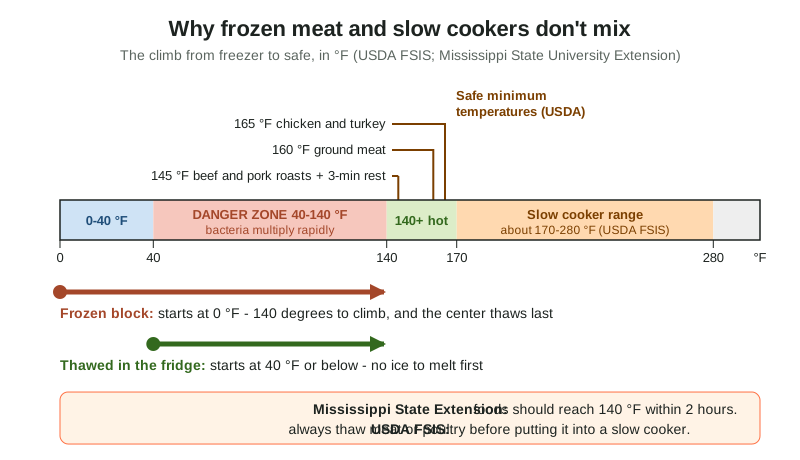
The diagram’s facts, as text (from the USDA Food Safety and Inspection Service fact sheets and Mississippi State University Extension, read November 16, 2026):
- Freezer to fridge: 0 °F to 40 °F. Meat thawed in the refrigerator starts the slow cooker at 40 °F or below.
- Danger zone: 40 to 140 °F, the range where bacteria multiply rapidly (USDA FSIS, The Big Thaw).
- Frozen meat: starts at about 0 °F, so it has 140 degrees to climb before it leaves the danger zone, and the center thaws last.
- Safe minimum temperatures: 145 °F for beef and pork roasts with a 3-minute rest, 160 °F for ground meat, 165 °F for chicken and turkey (USDA).
- Slow cooker range: generally between 170 °F and 280 °F (USDA FSIS, Slow Cookers and Food Safety).
- The time limit: foods should reach 140 °F within 2 hours (Janet Jolley, Mississippi State University Extension).
Can you put frozen meat in a crock pot?
No, you shouldn’t put frozen meat in a crock pot or any slow cooker: the USDA’s Food Safety and Inspection Service tells cooks to Always thaw meat or poultry before putting it into a slow cooker.
The rule covers raw beef, pork, chicken, turkey and ground meat alike, and it appears twice in the agency’s Slow Cookers and Food Safety fact sheet — once in the text and once in its three-line reminders box, next to Make sure the cooker is plugged in and turned on
and Keep the lid in place
.
The same fact sheet explains why the slow cooker is otherwise a safe way to cook: The direct heat from the pot, lengthy cooking and steam created within the tightly-covered container combine to destroy bacteria.
The catch is the start. A slow cooker heats gently by design, and the USDA warns that it may take several hours to reach a safe, bacteria-killing temperature
— which is why the agency wants the food to go in already cold from the refrigerator, not frozen.
Why is frozen meat unsafe in a slow cooker?
Frozen meat is unsafe in a slow cooker because it spends too long in the danger zone, 40 to 140 °F, while the low, gentle heat first melts the ice and then warms the meat. The USDA’s The Big Thaw fact sheet calls 40 to 140 °F the temperatures where bacteria multiply rapidly
, and notes that a thawing package can have its outer layer in that zone while the center is still frozen.
Extension food-safety agents put a time on it. Mississippi State University Extension quoted Janet Jolley, its family and consumer science agent in Marshall County, in 2022:
Foods should reach 140 degrees within two hours. Frozen foods will take a long time to move from 0 degrees to 140 degrees, giving bacteria plenty of time to multiply.
UW-Madison Extension’s Winnebago County office says the same thing in plain words: If frozen meat is used, it may not reach above 140°F quickly enough
. A thawed roast starts that climb at refrigerator temperature; a frozen one starts about 40 degrees colder, with ice to melt before the warming even begins.
Does it matter if it’s chicken, ground beef or a roast?
No — the thaw-first rule applies to every kind of raw meat and poultry in a slow cooker: frozen chicken breasts and thighs, a frozen block of ground beef, a frozen chuck roast or pork shoulder, and a frozen turkey breast. The USDA’s wording is simply “meat or poultry”. What changes from cut to cut is the safe temperature to check at the end, and how long the thaw takes (see the thaw planner below).
| Meat in the slow cooker | Thaw first? | Safe minimum internal temperature (USDA) |
|---|---|---|
| Chicken breasts, thighs, drumsticks; turkey breast | Yes | 165 °F (74 °C) |
| Ground beef, ground pork, ground turkey or chicken | Yes | 160 °F (71 °C); ground poultry 165 °F |
| Beef chuck roast, pork shoulder, pork loin | Yes | 145 °F (63 °C) with a 3-minute rest (pot roast is cooked far past this to turn tender) |
| Stew meat, cubed beef or pork | Yes | 145 °F (63 °C) with a 3-minute rest |
Compiled by Crockpot Recipes, November 16, 2026, from USDA FSIS Slow Cookers and Food Safety (thaw rule) and the USDA Safe Minimum Internal Temperature Chart (as republished). Check the thickest part with a food thermometer.
Who says what about frozen meat in a slow cooker?
Every U.S. food-safety source we read says to thaw meat before it goes into a slow cooker, and so does slow-cooker maker Hamilton Beach; Crock-Pot is the one maker whose FAQ says frozen meat can be cooked in its slow cookers. The table lines up their exact positions.
| Source | Frozen raw meat in a slow cooker? | In their words |
|---|---|---|
| USDA Food Safety and Inspection Service: Slow Cookers and Food Safety (revised February 2012) | No — thaw first | Always thaw meat or poultry before putting it into a slow cooker.Commercially frozen slow-cooker meals: follow the maker’s instructions. |
| Mississippi State University Extension (2022, updated 2025) | No — thaw first | Foods should reach 140 °F within 2 hours; frozen foods take a long time to get there (Janet Jolley). |
| Clemson Cooperative Extension, HGIC 3585 (updated 2022) | No — thaw first | Always defrost meat or poultry before putting it into a slow cooker. |
| UW-Madison Extension, Winnebago County (2020) | No — thaw first | Frozen meat may not reach above 140°F quickly enough; use high for at least the first hour. |
| Michigan State University Extension, E3255 | No — thaw first | Thaw meat or poultry first; frozen vegetables may be added (as republished). |
| Hamilton Beach FAQ | No — thaw first | Do not use frozen, uncooked meat in the Slow Cooker.On multi-cookers: pressure cook from frozen, but not in Slow Cook mode. |
| Crock-Pot Food Safety FAQ | Yes, with more time | You can cook frozen meat in a Crock-Pot® Slow Cooker, but suggested cook time may need to be increased. |
Compiled by Crockpot Recipes, November 16, 2026, from each source’s own page or fact sheet as listed in Sources (Michigan State’s bulletin as republished; the others read that day).
Six of the seven say thaw first. That is the rule we follow on every recipe on Crockpot Recipes, because it comes from the federal agency in charge of meat and poultry safety and it costs nothing but a little planning.
Why does Crock-Pot say you can cook frozen meat?
Crock-Pot’s Food Safety FAQ answers whether its slow cookers get hot enough to cook food safely, and says frozen meat can be cooked if you allow more time and use a meat thermometer
to make sure it is cooked through. That answer is about the end of cooking — reaching a safe, tender finish. The USDA’s concern is the start: how long the meat sits between 40 and 140 °F while it thaws in the pot, and a thermometer at the end can’t tell you that.
How do you thaw meat for a crock pot?
Thaw meat for a crock pot in the refrigerator if you have a day, in cold water if you have 1 to 3 hours, or in the microwave if you’ll cook it on the stove or in the oven right away. Those are the three safe ways to thaw food named in the USDA’s The Big Thaw fact sheet; the counter, hot water, a garage or a car are not.
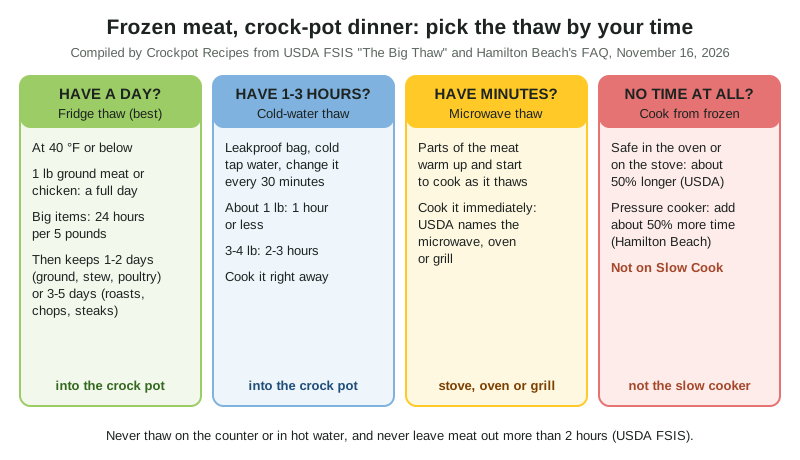
The planner’s facts, as text (USDA FSIS The Big Thaw, revised July 2010; Hamilton Beach FAQ; read November 16, 2026):
- Have a day — refrigerator thaw: at 40 °F or below; a pound of ground meat or boneless chicken breasts takes a full day; a large item takes at least 24 hours for every 5 pounds. Afterwards ground meat, stew meat and poultry keep 1 to 2 more days, and roasts, chops and steaks 3 to 5 days. Then into the crock pot.
- Have 1 to 3 hours — cold-water thaw: a leakproof bag in cold tap water, changed every 30 minutes; about 1 pound in an hour or less, 3 to 4 pounds in 2 to 3 hours. Cook it right away.
- Have minutes — microwave thaw: parts of the meat warm up and start to cook, so cook it immediately; the USDA names microwave cooking, a conventional oven or grilling.
- No time at all — cook from frozen: safe in the oven or on the stove, taking about 50% longer (USDA); a pressure cooker needs about 50% more time (Hamilton Beach). Not in a slow cooker.
Here is the thaw planner for the cuts people put in crock pots most often. The refrigerator and cold-water times come from the USDA’s figures; where a weight falls between the USDA’s examples, the time is our arithmetic and marked so.
| Frozen cut | Fridge thaw (40 °F or below) | Cold-water thaw | Keeps in the fridge after thawing | Move it to the fridge |
|---|---|---|---|---|
| 1 lb ground beef, pork or turkey | A full day (USDA) | 1 hour or less (USDA) | 1 to 2 days | The morning before |
| 1 1/2 to 2 lb boneless chicken breasts or thighs | About a full day (USDA, 1 lb example) | About 1 to 2 hours (our estimate between the USDA’s 1 lb and 3-4 lb figures) | 1 to 2 days | The morning before |
| 2 lb stew meat | About a full day | About 1 to 2 hours (our estimate) | 1 to 2 days | The morning before |
| 3 to 4 lb beef chuck roast | About a full day (24 h per 5 lb, and never less than a day) | 2 to 3 hours (USDA) | 3 to 5 days | The morning before |
| 4 to 5 lb pork shoulder (Boston butt) | About 1 day (24 h per 5 lb) | About 2 to 2 1/2 hours (our arithmetic, 30 min per lb) | 3 to 5 days | The morning before; a day earlier for a thick one |
| 6 to 7 lb bone-in turkey breast | About 1 1/4 to 1 1/2 days (our arithmetic, 24 h per 5 lb) | About 3 to 3 1/2 hours (our arithmetic, 30 min per lb) | 1 to 2 days | Two mornings before |
Thaw planner compiled by Crockpot Recipes, November 16, 2026, from USDA FSIS The Big Thaw — Safe Defrosting Methods
(revised July 2010). Our arithmetic: fridge hours = 24 x pounds / 5, never less than a full day; cold water = the USDA’s 30 minutes per pound (its whole-turkey rule) where the weight is past its 3-4 lb example. A fridge set at 35 °F thaws slower than one at 40 °F, so give thick cuts extra time.
How long does it take to thaw meat in the fridge?
Thawing meat in the fridge takes a full day for small packages and at least 24 hours for every 5 pounds of a large item, according to the USDA’s The Big Thaw: Even small amounts of frozen food — such as a pound of ground meat or boneless chicken breasts — require a full day to thaw.
For a crock-pot dinner, that means moving the meat from the freezer to the refrigerator the morning before — two mornings before for a big turkey breast.
Fridge-thawed meat also gives you slack: the USDA says ground meat, stew meat and poultry stay safe and good for an extra day or two, and roasts, chops and steaks 3 to 5 days. Meat thawed in the refrigerator can even go back into the freezer uncooked, with some loss of quality.
Can you thaw meat in cold water for the slow cooker?
Yes, you can thaw meat in cold water for the slow cooker, as long as it then goes straight into the pot. The USDA’s method: seal the meat in a leakproof bag, submerge it in cold tap water, and change the water every 30 minutes; about a pound thaws in an hour or less, and a 3- to 4-pound package in 2 to 3 hours. The USDA adds that If thawed completely, the food must be cooked immediately.
Cold water is the method for the morning you forgot: put the bagged chuck roast in a big bowl in the sink while you chop the onions and carrots, change the water twice, and it’s ready by the time everything else is.
Can you microwave-thaw meat and then slow cook it?
Microwave-thawed meat should be cooked immediately, and the USDA’s examples are microwave cooking, a conventional oven or grilling — not a slow cooker. The Big Thaw explains that parts of the meat may become warm and begin to cook
during microwave defrosting, which brings them into the danger zone. Because a slow cooker may take several hours to reach a safe, bacteria-killing temperature
, we’d cook microwave-thawed meat on the stove or in the oven instead.
What can you do if the meat is still frozen at dinner time?
If the meat is still frozen when it’s time to start dinner, cook it from frozen on the stove or in the oven, or use a pressure cooker — all safe, the USDA says, as long as you allow more time. The Big Thaw puts a number on it: cooking from frozen will take approximately 50% longer than the recommended time for fully thawed or fresh meat and poultry.
Honest moment: it’s a little funny that the one rule everybody wants to skip is the one that only asks you to move a package from one shelf to another the night before. The fridge does all the work — you just have to remember.
- Frozen ground beef for chili or sloppy joes: brown it from frozen in a skillet, scraping off the cooked layer as it thaws, until it reaches 160 °F; then it can go into the crock pot with the beans and sauce, already cooked.
- Frozen chicken breasts: bake or simmer them, allowing about 50% longer than the thawed-chicken time, to 165 °F.
- A frozen roast: roast it in the oven, about 50% longer than a thawed one, or move the slow-cooker plan to tomorrow and start the thaw now.
Can you cook frozen meat in an Instant Pot or pressure cooker?
Yes, frozen meat can be pressure cooked, but not slow cooked in the same appliance. Hamilton Beach’s FAQ says frozen meat and poultry can be cooked from frozen in Pressure Cooking modes, with about 50% more cooking time than the recipe recommends, and to not use frozen meat or poultry in Slow Cook Mode.
The same split applies to any multi-cooker with both a pressure and a slow-cook setting: pressure from frozen, thaw first for slow cook.
Can you put frozen vegetables or frozen slow-cooker meals in a crock pot?
Yes to both, with conditions: frozen vegetables thaw quickly and can go into a slow cooker, and a store-bought frozen slow-cooker meal should be cooked exactly as its package says. The USDA’s Slow Cookers and Food Safety fact sheet makes the exception for meal kits: If using a commercially frozen slow cooker meal, prepare according to manufacturer’s instructions.
For vegetables, Michigan State University Extension’s bulletin E3255 says frozen vegetables may be added because they thaw more quickly than meat (as republished). Fresh vegetables are the slow ones: the USDA notes that vegetables cook slower than meat and poultry in a slow cooker, so fresh potatoes, carrots and onions go in first, at the bottom, with the thawed meat on top.
How do you start a crock pot safely once the meat is thawed?
Start a crock pot safely by keeping the thawed meat in the refrigerator until you load the pot, putting vegetables in first, adding the liquid, closing the lid, and — if you can — running it on HIGH for the first hour before switching to LOW. Those steps all come from the USDA fact sheet, which also says it is safe to cook on LOW the entire time when you are leaving for work.
- Keep it cold until it goes in. The USDA says to keep perishable food refrigerated until preparation time, so bacteria don’t get a
head start
. If you prep the night before, Hamilton Beach says the filled crock goes into the refrigerator. - Vegetables first, then meat and liquid. Then keep the lid in place, opening it only to stir or check doneness.
- Fill it right. Mississippi State’s Natasha Haynes notes that some makers recommend filling the stoneware one-half to three-quarters full; your cooker’s booklet gives the meat sizes it is built for.
- HIGH for the first hour if you can, then LOW or the setting your recipe calls for (USDA). Times vary by slow cooker, so check doneness with a thermometer: 165 °F for poultry, 160 °F for ground meat, 145 °F plus a 3-minute rest for roasts.
- Leftovers within 2 hours. Store them in shallow covered containers in the refrigerator. The USDA says
Reheating leftovers in a slow cooker is not recommended
: reheat on the stove, in the microwave or in the oven to 165 °F, then the slow cooker can keep them hot (at least 140 °F) for serving.
Not sure your old crock pot still heats properly? Clemson Cooperative Extension’s HGIC 3585 gives a simple check: fill it with 2 quarts of water, heat on LOW for 8 hours, then measure the water with an accurate thermometer — it should be 185 °F. A lower reading may mean the cooker doesn’t heat food high enough to be safe.
Frozen meat and crock pots at a glance
Every rule for frozen meat and slow cookers in one list (USDA FSIS, Mississippi State, Clemson and UW-Madison Extension, Hamilton Beach, Crock-Pot):
- Frozen raw meat in a slow cooker
- No. Thaw meat or poultry first (USDA FSIS); Crock-Pot’s FAQ is the one source that allows it.
- Why
- Frozen meat lingers in the 40-140 °F danger zone; food should reach 140 °F within 2 hours (Mississippi State).
- Fridge thaw
- A full day for about 1 lb; 24 hours per 5 lb for big items; then 1-2 days (ground, stew, poultry) or 3-5 days (roasts).
- Cold-water thaw
- Leakproof bag, cold water changed every 30 minutes; 1 lb in an hour or less, 3-4 lb in 2-3 hours; cook right away.
- Still frozen?
- Stove, oven or pressure cooker, about 50% longer — not the slow cooker.
- Safe temperatures
- 165 °F poultry, 160 °F ground meat, 145 °F roasts with a 3-minute rest.
- Leftovers
- Refrigerate within 2 hours; reheat to 165 °F on the stove, in the microwave or oven, never in the slow cooker.
Picture coming home to that smell at the door — a pot roast that went in properly thawed this morning, falling apart under a fork, with the thermometer reading right where it should.
So here’s the whole trick: freezer to fridge the morning before, crock pot the next morning, thermometer at the end. Stick a note on the freezer door if you have to — future you, walking into a house that smells like dinner, will be very grateful.
Sources and further reading
- USDA Food Safety and Inspection Service: Slow Cookers and Food Safety (fact sheet, revised February 2012, via govinfo.gov) — "Always thaw meat or poultry before putting it into a slow cooker"; 170-280 °F; "several hours to reach a safe, bacteria-killing temperature"; high for the first hour or low all day; commercially frozen meals per maker; power out; leftovers within 2 hours, reheating in a slow cooker not recommended, 165 °F / 140 °F (all quoted)
- USDA Food Safety and Inspection Service: The Big Thaw — Safe Defrosting Methods — read in FSIS’s own fact sheet (revised July 2010; the web page refuses automated fetches): danger zone 40-140 °F; refrigerator 24 h per 5 lb, a full day for 1 lb; keeps 1-2 / 3-5 days; cold water every 30 min, 1 lb in an hour or less, 3-4 lb in 2-3 h, 30 min per lb for turkeys; microwave then cook immediately; cooking from frozen about 50% longer
- USDA Food Safety and Inspection Service: Safe Minimum Internal Temperature Chart — poultry 165 °F, ground meat 160 °F, beef and pork roasts 145 °F with a 3-minute rest (as republished; the page refuses automated fetches)
- Mississippi State University Extension: Use slow cookers properly to avoid food-borne illness (Susan Collins-Smith, January 31, 2022, updated August 8, 2025) — Janet Jolley: foods should reach 140 °F within 2 hours, frozen foods take a long time to get there (quoted); Natasha Haynes: 170-280 °F, some makers say fill one-half to three-quarters full
- Clemson Cooperative Extension, Home & Garden Information Center: Slow Cooker Food Safety (HGIC 3585, E.H. Hoyle, updated February 8, 2022) — "Always defrost meat or poultry before putting it into a slow cooker"; 2-quart water test, 8 hours on low, 185 °F
- UW-Madison Extension Winnebago County: Tips for Cooking Safely in a Slow Cooker (January 15, 2020) — frozen meat "may not reach above 140°F quickly enough"; high for at least the first hour (quoted)
- Michigan State University Extension: Cooking Safely with a Slow Cooker (bulletin E3255) — thaw meat or poultry first; frozen vegetables may be added because they thaw more quickly (as republished; the bulletin would not load for us)
- Hamilton Beach: Frequently Asked Questions (slow cookers and pressure cookers) — "Do not use frozen, uncooked meat in the Slow Cooker"; pressure cook from frozen with about 50% more time, not in Slow Cook mode; crock into the refrigerator when prepping the night before (all quoted)
- Crock-Pot: Food Safety FAQ — "You can cook frozen meat in a Crock-Pot® Slow Cooker, but suggested cook time may need to be increased"; use a meat thermometer (quoted)
Questions and answers
Can you put frozen chicken in a crock pot?
No — thaw frozen chicken before it goes into a crock pot. The USDA says to always thaw meat or poultry before putting it into a slow cooker, because frozen chicken can stay too long between 40 and 140 °F. Thaw it in the fridge (about a day for a pound) or in cold water (about an hour per pound), then cook it to 165 °F.
Can you put a frozen roast in the slow cooker?
No. A frozen roast is the slowest thing of all to warm through in a slow cooker, so the USDA’s thaw-first rule matters most here. Move a 3- to 4-pound chuck roast to the fridge the morning before (about 24 hours), or thaw it in cold water in 2 to 3 hours, changing the water every 30 minutes.
Can you put frozen ground beef in a crock pot?
Not raw and frozen. Thaw the ground beef in the fridge (a full day per pound) or in cold water (an hour or less per pound), or brown it from frozen in a skillet to 160 °F and then add the cooked beef to the crock pot for chili or sauce.
How do you thaw meat quickly for a slow cooker?
Use cold water: seal the meat in a leakproof bag, submerge it in cold tap water and change the water every 30 minutes. The USDA says about a pound thaws in an hour or less and a 3- to 4-pound package in 2 to 3 hours; cook it right away. Never use hot water or the counter.
Can you cook frozen meat in a pressure cooker instead?
Yes. Pressure cooking from frozen is fine, with about 50% more cooking time than the recipe recommends, according to Hamilton Beach’s FAQ. On a multi-cooker, use a Pressure Cooking mode for frozen meat, not Slow Cook mode, and check the final temperature with a thermometer.