Hunting games › Wind, scent and sound
Wind, Scent and Sound in Hunting Games: How Animals Detect You
Disclosure: this page contains Amazon affiliate links. As an Amazon Associate we earn from qualifying purchases, at no extra cost to you.
Real deer trust their noses more than anything else, and good hunting games copy that. In most of them, the fastest way to blow a stalk isn't a missed shot - it's letting the wind carry your scent straight to the animal. This one's about how theHunter: Call of the Wild and Way of the Hunter (both on Amazon) handle wind, scent and sound, and how to use that to get close.
Short answer: animals in these games notice you three ways - by smelling you when the wind carries your scent to them, by hearing you, and by seeing you. Keep the wind in your face or crossing your path, move slowly and quietly (crouch, avoid running and thick brush), and stay low and still in cover. Call of the Wild shows wind, noise and visibility right on the HUD.
What the developers say
Neither developer publishes a detailed "how detection works" rulebook, but their store pages tell you what they built:
- theHunter: Call of the Wild (Expansive Worlds): "highly realistic acoustics, and scents carried by the wind", and a wild that "reacts to your every move".
- Way of the Hunter (Nine Rocks Games): a "24-hour day/night cycle with changing wind and weather" and animal "reactions when sensing the player's presence".
So in both, the wind moves your scent and animals react to what they sense. The details below come from playing the games and from the community.
Scent and wind
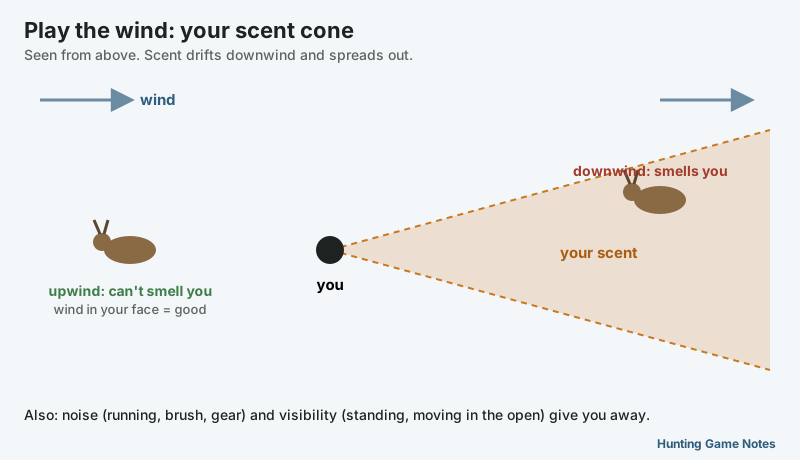
Picture your scent as a cone drifting downwind from you. Any animal inside that cone can smell you; animals upwind can't. That's why the oldest rule in real hunting works in these games too: approach with the wind in your face.
- Call of the Wild shows wind direction on the HUD. Players describe a cone showing where your scent is travelling, and many guides simply say: reposition so the wind blows into your face, not your back.
- Way of the Hunter lets you see your scent trail on the map - one guide describes a purple trail coming out from your marker that follows the wind. (That guide is a few years old, so check it in your version.)
- Scent sprays and eliminators reduce your scent in Call of the Wild, but players report they don't make you invisible to a nose, and they wear off.
Noise
Everything you do makes some noise, and animals hear it. In Call of the Wild a noise meter on the HUD shows how loud you are - more bars, more noise. Players commonly report:
- running is much louder than walking, and walking is louder than crouching or crawling;
- pushing through thick brush is louder than moving along open paths;
- carrying more gear makes you noisier.
Way of the Hunter works the same way in spirit: reviewers and guides describe movement noise alerting animals, and running both making noise and spreading your scent. Its "Hunter Sense" mode can also highlight the source of a noise you heard.
Visibility
Call of the Wild has a separate visibility meter. Players report it drops a lot when you crouch or lie down in trees or tall grass, and that standing still matters as much as cover. Moving in the open, especially across a skyline, is how you get spotted.
Side by side
| Call of the Wild | Way of the Hunter | |
|---|---|---|
| Wind and scent | "Scents carried by the wind"; wind and scent shown on the HUD | Changing wind; scent trail you can check on the map (per guides) |
| Noise | Noise meter on the HUD; brush, speed and gear matter (community) | Movement noise alerts animals; Hunter Sense shows noise sources |
| Visibility | Separate visibility meter; stance and cover matter (community) | Animals react when they sense you |
| Scent tools | Sprays and eliminators reduce scent for a while | Check current gear in your version |
How to play the wind
- Check the wind before you move, and again every few minutes - it changes.
- Circle so the wind is in your face or blowing across your path, never at your back toward the animals.
- Slow down near animals. Walk on paths when you can, crouch as you get close, crawl the last bit.
- Stop often. Standing still in cover lowers your visibility and lets you listen.
- Set up downwind of a need zone before animals arrive (see need zones and animal routines).
Sound matters for you too: a good gaming headset makes it much easier to hear animals moving, calling or stepping on sticks before you see them.
Frequently asked questions
How does scent work in theHunter: Call of the Wild?
Your scent drifts downwind. Animals downwind of you can smell you; animals upwind can't. The HUD shows the wind, so approach with the wind in your face or crossing your path.
What makes the most noise in Call of the Wild?
Players consistently report running, pushing through thick brush and carrying a lot of gear. Crouching and crawling are quieter. The noise meter on the HUD shows how loud you are.
Does Way of the Hunter have wind and scent?
Yes. Its store page lists changing wind, and guides describe a scent trail you can check on the map that follows the wind.
Do scent eliminators make you undetectable?
No. Players report they reduce your scent for a limited time. Playing the wind is still the main defense.
Sources and further reading
- theHunter: Call of the Wild on Steam - "scents carried by the wind", "highly realistic acoustics"
- Way of the Hunter on Steam - changing wind and weather; reactions when sensing the player
- TouchTapPlay: how to check your scent trail in Way of the Hunter - community guide
- GameGrin: Way of the Hunter review - Hunter Sense and noise
- Call of the Wild Steam discussion: noise and visibility - community findings
How this was written: Based on the games' official Steam store pages, a published review, and community guides and Steam discussions. The developers don't publish exact detection numbers, so anything specific that comes from players is labeled that way.