
Small, Medium or Large Moving Box: What Goes in Each? Sizes, Weights and Prices (2026)
Disclosure: this page contains Amazon affiliate links. As an Amazon Associate we earn from qualifying purchases, at no extra cost to you.
Every moving-box thread ends the same way: one person says a box holds 65 pounds, the next says never pack past 50.
I spent Sunday morning, November 29, 2026, reading U-Haul’s four box pages and Mayflower’s packing tips instead of the blogs that quote each other.
You probably won’t find this on Reddit, but the Wikipedia entry on Robert Gair says the flat folding carton began in 1879, when a metal ruler that creased paper bags at his printing business shifted and cut one.
Three things stood out.
U-Haul rates all four sizes at 65 pounds, so a large box gets only a third of the weight per cubic foot that a small one does.
Home Depot’s medium shows up as three different sets of inches, all near 3 cubic feet.
And U-Haul’s single boxes run from $1.85 to $3.99 on its pages today.
If you’re not sure which box goes with which stuff, small moving boxes on Amazon for the heavy things and large moving boxes for the light ones will carry most of a house.
Short answer: Put heavy, dense things (books, tools, canned food) in small boxes, kitchenware and toys in medium boxes, and light, bulky things (pillows, bedding, lampshades) in large or extra-large ones. U-Haul rates all four standard sizes at 65 pounds, so keep the big boxes for light things.
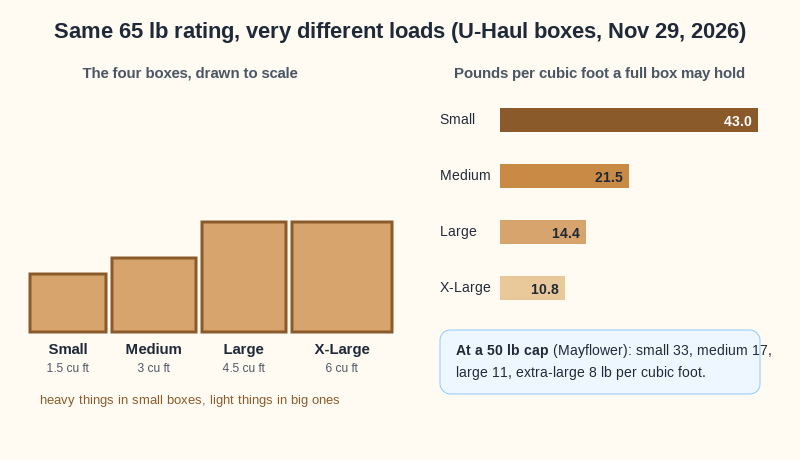
What the picture shows, as text (U-Haul product pages, November 29, 2026; the per-cubic-foot numbers are our arithmetic, 65 lb divided by the cubic feet):
- Small: 1.5 cubic feet, 65 lb, so up to 43.0 lb per cubic foot (33 at a 50 lb cap).
- Medium: 3 cubic feet, 65 lb, so 21.7 lb per cubic foot (17 at 50 lb).
- Large: 4.5 cubic feet, 65 lb, so 14.4 lb per cubic foot (11 at 50 lb).
- Extra-large: 6 cubic feet, 65 lb, so 10.8 lb per cubic foot (8 at 50 lb).
What size moving box should you use for what?
Choose the box by the weight of what goes in it, not by the room it came from: the heavier the item, the smaller the box. That keeps every box liftable, and it’s the rule U-Haul, Mayflower and MoveBuddha all repeat.
- Small (1.5 cu ft): books, tools, canned food, records, sheet sets.
- Medium (3 cu ft): kitchenware, toys, small appliances, home decor, office supplies.
- Large (4.5 cu ft): lamp shades, board games, pillows, clothing, stuffed animals.
- Extra-large (6 cu ft): comforters, large pillows, towels, winter clothing.
Mayflower puts the same rule in one sentence: Because books are heavy, be sure to use small cartons.
MoveBuddha’s guide says heavy items belong in small boxes and light items in large ones.
How big is a small, medium, large and extra-large moving box?
U-Haul’s standard boxes measure about 16 x 12 x 12 inches (small, 1.5 cubic feet), 18 x 18 x 16 (medium, 3), 18 x 18 x 24 (large, 4.5) and 24 x 18 x 24 (extra-large, 6). All four are single-wall, 32 ECT, and rated to hold 65 lb.
| Box | Size (L x W x H) | Cubic feet | ECT | Holds up to | Empty weight | Price: single / bundle |
|---|---|---|---|---|---|---|
| Small | 16 3/8 x 12 5/8 x 12 5/8 in | 1.5 | 32 | 65 lb | about 1.15 lb | $1.85 / 25 for $37.25 |
| Medium | 18 1/8 x 18 x 16 in | 3 | 32 | 65 lb | about 1.7 lb | $2.39 / 20 for $39.80 |
| Large | 18 x 18 x 24 in | 4.5 | 32 | 65 lb | about 2.2 lb | $3.16 / 15 for $41.70 |
| Extra-large | 24 x 18 x 24 in | 6 | 32 | 65 lb | about 2.6 lb | $3.99 / 10 for $37.80 |
The empty weights come from the product pages’ own Q&A answers, so treat them as rough. U-Haul’s small-box page lists its size as internal dimensions, and says the box ships flat and must be taped top and bottom.
ECT is the edge crush test, how much stacking force the cardboard edge takes. The same ECT 32 and 65 lb rating on all four is why size, not strength, is the thing you choose. For the single-box prices at Home Depot, see where to buy just a few moving boxes.
Are moving box sizes the same at every store?
No. Stores use the same names and about the same cubic feet, but the inches differ, and the published numbers for even one store disagree. A “medium” is about 3 cubic feet almost everywhere; its shape is not fixed.
| Box | Size (inches) | Cubic feet | Where it comes from |
|---|---|---|---|
| U-Haul medium | 18 1/8 x 18 x 16 | 3.0 | uhaul.com product page |
| Home Depot heavy-duty medium with handles | 18 x 18 x 16 | 3.0 | title of the homedepot.com listing (75-pack); listed at up to 80 lb |
| Home Depot heavy-duty medium | 20 x 16 x 15 | 2.8 | MoveBuddha, Oct 2026 prices: 75 lb, 42 ECT, $3.98 |
| Home Depot “medium” | 22 x 16 x 15 | 3.1 | MoveAdvisor’s FAQ |
| U-Haul small vs Home Depot small | 16 3/8 x 12 5/8 x 12 5/8 vs 16 x 10 x 12 | 1.5 vs 1.1 | uhaul.com vs MoveBuddha |
| U-Haul large vs Home Depot large | 18 x 18 x 24 vs 26 x 16 x 15 | 4.5 vs 3.6 | uhaul.com vs MoveBuddha |
So a Home Depot “large” at about 3.6 cubic feet holds less than U-Haul’s 4.5, and a Home Depot “small” at about 1.1 holds a quarter less than U-Haul’s 1.5. Three different sets of inches get called Home Depot’s medium, and all three work out to roughly 3 cubic feet.
Our reading: the names are rough, the cubic feet are not. If you mix stores, count cubic feet, not the words small, medium and large, and read the product page before you order.
One limit on this table: we couldn’t open Home Depot’s pages directly (they refuse our reader), so its sizes here come from the listing title and MoveBuddha. Lowe’s pages also refused, so we have no Lowe’s sizes.
How do moving boxes ship flat, and what does an empty one weigh?
Moving boxes ship and sit flat, then you fold and tape them. U-Haul’s page says its small box is 29 1/8 x 25 7/8 x 3/8 inches flat, and a bundle of 20 mediums measures about 36 1/2 x 34 1/2 x 6 1/4 inches. An empty medium weighs about 1.7 lb.
The flat box goes back to a printer’s slip.
The Wikipedia entry on Robert Gair, a printer and paper bag maker, says that in 1879 a metal ruler used to crease bags shifted and cut one instead. Cutting and creasing in one pass is what made prefabricated cartons that could be stored flat, so each box you fold today is that accident repeated.
Because you build the box yourself, the bottom is where it fails. U-Haul’s pages say to tape the bottom well; one answer on the large box’s page says it holds very little weight untaped. Seal it the H-tape way before the first book goes in.
How much weight can a moving box hold?
A U-Haul standard moving box holds up to 65 lb whatever its size; its heavy-duty double-wall boxes hold up to 80 lb.
The catch is that the rating is the same for a 1.5 cubic foot box and a 6 cubic foot one, so the large box can only be filled to about a third of the density the small one can.
| Box | Cubic feet | Rated 65 lb: lb per cu ft | Capped at 50 lb: lb per cu ft |
|---|---|---|---|
| Small | 1.5 | 43.3 | 33.3 |
| Medium | 3 | 21.7 | 16.7 |
| Large | 4.5 | 14.4 | 11.1 |
| Extra-large | 6 | 10.8 | 8.3 |
In plain words: an extra-large box passes 50 lb at only 8.3 pounds per cubic foot, so a box of anything heavier than bedding fills with weight long before it fills with stuff.
Fill a big box with heavy things and it’s over 50 lb before the lid closes; a small box takes 33 lb per cubic foot to get there.
What is the safe weight for a moving box: 50 pounds or 65?
The sources give three numbers: 65 lb is the box’s rating, 50 lb is the weight movers suggest, and 51 lb is the limit in the NIOSH lifting equation under ideal conditions. For you, the lowest number that still works is the right one.
| Source | Number | What it measures |
|---|---|---|
| U-Haul product pages | 65 lb | What the cardboard is rated to hold |
| Mayflower packing tips | 50 lb | Suggested maximum, to make handling easier |
| NIOSH Revised Lifting Equation | 51 lb (23 kg) | Load constant for lifting in ideal conditions: hands close to the body, waist height, no twisting, rare lifts |
| MoveAdvisor, Nov 9, 2026 | 50 lb | Says its weight figures are container ratings, not safe lifting weights |
Mayflower’s page advises limiting cartons, when possible, to a maximum weight of 50 pounds to make handling easier.
The box rating says what the cardboard survives; it says nothing about the person on the stairs.
The NIOSH 51 lb number is an upper limit for good lifting conditions, and a staircase, a truck ramp or a box on a high shelf isn’t one. So the 65 lb rating is a ceiling for the cardboard, not a target for you.
What goes in a small, medium, large and extra-large moving box?
Small boxes take heavy, dense things, medium boxes take most of the kitchen and living room, large boxes take light bulky things, and extra-large boxes take the lightest, bulkiest things. The table pulls together what each source says goes where.
Here’s the part I find oddly comforting: you never have to remember a chart. Heavy thing, small box. Fluffy thing, big box. Everything else is just taping.
| Box | Pack in it | Keep out of it |
|---|---|---|
| Small, 1.5 cu ft | Books, tools, canned food, sheet sets, small kitchen appliances, records, glassware (wrapped) | Anything bulky and light — it wastes the box |
| Medium, 3 cu ft | Kitchenware, toys, home decor, office supplies, shoes, medium kitchen appliances, craft supplies | Plates and bowls in bulk (use a dish pack, see how to pack dishes); books |
| Large, 4.5 cu ft | Lamp shades, small lamps, stereo speakers, board games, stuffed animals, pillows, clothing | Anything heavy: U-Haul’s page says it holds little weight untaped |
| Extra-large, 6 cu ft | Comforters, large pillows, towels, winter clothing, sleeping bags | Anything you couldn’t carry one-handed when full |
U-Haul’s medium-box page sends books to the separate Book Box and fragile dishes to its Dish Saver or Glass Pack kits, because books are heavy and dishes need dividers.
What size box is best for books, records and tools?
The smallest one you can get. Mayflower says to use small cartons for books, tools and records, because all three are heavy for their size. U-Haul’s Book Box is $1.99 on its box listing page (checked Nov 29, 2026, size not stated there).
On the small box’s page, a customer Q&A answer estimates roughly 40 to 60 LPs per box, depending on the sleeve size, and suggests stacking full boxes no more than five high. Treat both as customer estimates, not U-Haul specs.
Sixty-five pounds in 1.5 cubic feet is the box’s rating, so a full small box of hardcovers can hit it. Stop packing at the weight you can lift comfortably, and fill any gap at the top with towels or paper so the books can’t shift.
How much does each size cost, and which is the best value?
U-Haul’s single boxes run $1.85 (small) to $3.99 (extra-large) on November 29, 2026, and bundles cut that to $1.49 to $3.78 each. Per cubic foot, the biggest boxes cost the least, but a big box of heavy stuff is the wrong buy.
| Box | Single box | Per cu ft (single) | Bundle price per box | Per cu ft (bundle) |
|---|---|---|---|---|
| Small | $1.85 | $1.23 | $1.49 (25 for $37.25) | $0.99 |
| Medium | $2.39 | $0.80 | $1.99 (20 for $39.80) | $0.66 |
| Large | $3.16 | $0.70 | $2.78 (15 for $41.70) | $0.62 |
| Extra-large | $3.99 | $0.67 | $3.78 (10 for $37.80) | $0.63 |
Prices moved even within November: MoveBuddha’s Nov 4 review listed U-Haul’s small at $1.77, medium $2.27, large $2.87 and extra-large $3.77, and the Home Depot single-box prices ($1.98, $2.28 and $2.98) are in our single-box guide. Store prices change, so check yours.
One thing the table shows: a small box costs almost twice as much per cubic foot as a large one, but you can’t swap them, because the small box is the one that takes the weight. The two cheapest-per-foot sizes beat the rest only if what you’re packing is light.
When should you buy a heavy-duty or double-wall box instead?
Buy heavy-duty when a box will carry more than the standard 65 lb rating suggests, sit at the bottom of a stack, or be reused.
U-Haul’s heavy-duty double-wall medium (same 18 1/8 x 18 x 16 in) is listed at up to 80 lb, and its double-wall extra-large (24 x 18 x 24) at ECT 48 and up to 80 lb.
The heavy-duty boxes are the same outside size, so the pick between standard and double-wall is about strength, not space. MoveBuddha’s Home Depot review gives Home Depot’s heavy-duty medium as 75 lb and 42 ECT, and its box finder filters by ECT from 32 to 48.
How many of each size do you need?
That depends on the home. For a one-bedroom apartment, U-Haul’s guide counts about 40 boxes (10 small, 20 medium, 10 large, plus a few wardrobe boxes), as our 1-bedroom box count explains.
The size mix follows what you own. A book-heavy home needs more small boxes; a home with lots of linens and coats needs more large ones. Count your heaviest category first, and buy those boxes before anything else.
We worked out one more thing nobody prints: a full small box and a full extra-large box can both weigh 50 lb, but the extra-large gets there at a quarter of the density. So the box size is the brake on weight, and the 65 lb rating on the label is not.
That brake is as old as the carton itself: the same Wikipedia entry says Gair’s buildings in what is now Brooklyn’s Dumbo neighborhood still carry his name, and the cardboard folded from his slip is the box you’re taping on the kitchen floor tonight.
How we researched this
- What we read, Sunday November 29, 2026: the four U-Haul standard-box product pages (small, medium, large, extra-large) for sizes, ECT, weight rating, empty weight and prices; U-Haul’s
What to Put In Each Moving Box Size
post (Aug 21, 2023); the U-Haul box category page; Mayflower’s Packing Tips page; the Wikipedia entry on Robert Gair. - What else we used: MoveBuddha’s Home Depot box review and best-moving-boxes guide (both updated Nov 4, 2026), MoveAdvisor’s box-size guide (updated Nov 9, 2026).
- What we compared: the same box names across U-Haul, Home Depot and MoveAdvisor, cubic feet recomputed from the inches (length x width x height divided by 1,728), and the weight rating divided by the cubic feet.
- What we could not do: homedepot.com, lowes.com and the CDC’s NIOSH lifting manual would not load for our reader. The Home Depot 18 x 18 x 16 in size and its 80 lb rating are taken from a listing seen in search results; the NIOSH 51 lb (23 kg) load constant is taken from search results describing the CDC’s manual, not from a page we opened; U-Haul’s heavy-duty 80 lb figures are also from its search-result listings. Wikipedia’s Robert Gair entry summarises his 1927 New York Times obituary, which we did not open.
- What we did not do: pack, weigh or lift any box. Empty weights and the LP and stacking figures come from product-page Q&A answers by U-Haul staff and customers. The weights per cubic foot and cost tables are our arithmetic. We read six sources; that is the whole sample.
Heavy in small, light in big, and tape the bottom twice. That’s the whole system, and your back will thank you at the top of the stairs.
Sources and further reading
- U-Haul: Small Moving Box — 16 3/8 x 12 5/8 x 12 5/8 in, 1.5 cu ft, ECT 32, up to 65 lb, $1.85 / 25 for $37.25, about 1.15 lb empty (checked Nov 29, 2026)
- U-Haul: Medium Moving Box (18-1/8 x 18 x 16) — 3 cu ft, ECT 32, 65 lb, $2.39 / 20 for $39.80, about 1.7 lb empty
- U-Haul: Large Moving Box — 18 x 18 x 24 in, 4.5 cu ft, ECT 32, 65 lb, $3.16 / 15 for $41.70, tape the bottom
- U-Haul: Extra-Large Moving Box — 24 x 18 x 24 in, 6 cu ft, ECT 32, 65 lb, $3.99 / 10 for $37.80
- U-Haul Moving Insider: What to Put In Each Moving Box Size (Aug 21, 2023) — what goes in each size; small 16 x 12 x 12, medium 18 x 18 x 16, large 18 x 18 x 24, extra-large 24 x 18 x 24
- U-Haul: Moving Boxes category — Book Box $1.99; bundle prices ‘as low as’ $1.49, $1.99, $2.78, $3.78
- Master Movers Mayflower: Packing Tips — 50 lb carton maximum; small cartons for books, tools and records
- MoveBuddha: Home Depot Moving Boxes review (updated Nov 4, 2026) — Home Depot small 16 x 10 x 12, large 26 x 16 x 15, heavy-duty medium 20 x 16 x 15 (75 lb, 42 ECT), Oct 2026 prices
- MoveBuddha: Best Moving Boxes (updated Nov 4, 2026) — heavy items in small boxes, light in large; U-Haul sizes; Home Depot ECT filter 32-48
- MoveAdvisor: Moving Box Sizes Chart (updated Nov 9, 2026) — uniform cubic-foot classes; Home Depot medium listed as 22 x 16 x 15; weights are ratings, not lifting limits
- Home Depot: 18 x 18 x 16 Heavy-Duty Medium Moving Box with Handles (75-pack) — listing title; page refused our reader
- CDC / NIOSH: Applications Manual for the Revised NIOSH Lifting Equation — load constant 23 kg (51 lb) in ideal conditions; read through search results, PDF too large for our reader
- Wikipedia: Robert Gair (1839-1927) — the 1879 creasing-rule accident and the folding carton; cites his New York Times obituary (Aug 2, 1927)
Questions and answers
What size box should I use for books?
A small box, about 16 x 12 x 12 inches and 1.5 cubic feet. Mayflower says to use small cartons for books, tools and records because they are heavy, and U-Haul’s small box is rated to hold up to 65 lb. Stop packing at a weight you can lift comfortably.
How big is a medium moving box?
U-Haul’s medium is 18 1/8 x 18 x 16 inches, about 3 cubic feet and rated to hold up to 65 lb (checked Nov 29, 2026). Other stores’ mediums differ by an inch or two but are close to 3 cubic feet.
How much weight can a moving box hold?
U-Haul’s standard single-wall boxes (small, medium, large, extra-large) are all rated to hold up to 65 lb, and its heavy-duty double-wall boxes up to 80 lb. Mayflower suggests keeping cartons to 50 lb or less to make handling easier.
Are moving box sizes the same at U-Haul and Home Depot?
No. The names match but the inches don’t: U-Haul’s large is 18 x 18 x 24 (4.5 cubic feet) while MoveBuddha lists Home Depot’s large at 26 x 16 x 15 (about 3.6). Compare cubic feet, not small, medium and large.
What goes in a large moving box?
Light, bulky things: pillows, lamp shades, board games, stuffed animals and clothing, per U-Haul’s large-box page. A large U-Haul box is 18 x 18 x 24 inches (4.5 cubic feet), so a 65 lb rating means about 14 lb per cubic foot, which a box of books would exceed in no time.