
PDRN for Rosacea and Redness-Prone Skin: Is It Gentle Enough?
Disclosure: this page contains Amazon affiliate links. As an Amazon Associate we earn from qualifying purchases, at no extra cost to you. PDRN topical products are cosmetics, not medical treatments, and nothing here is medical advice.
Hello, calm-cheek champion — if your face goes pink at the first cold gust, a hot drink or a new serum, this one’s for you. PDRN can sit quietly in a routine for redness-prone skin, but it isn’t a rosacea treatment, and the formula around it matters far more than the PDRN itself. If you want to look while you read, here are fragrance-free PDRN serums on Amazon — just check every ingredient list against the skip list below before you buy.
Short answer: PDRN can have a place in a routine for redness-prone skin, but it doesn’t treat rosacea, and no published study has tested a PDRN serum on rosacea yet. The formula matters more than the PDRN: choose fragrance-free, alcohol-free and spicule-free, test it on your arm for 7-10 days, and keep your dermatologist’s plan first.
- What rosacea is: a skin condition that mainly affects the face, with flushing, lasting color, acne-like breakouts or visible blood vessels (American Academy of Dermatology).
- How common: an estimated 16 million Americans have rosacea (National Rosacea Society).
- Biggest label trigger: 66% of rosacea patients in a National Rosacea Society survey of 1,066 people named alcohol as an ingredient that bothered their skin.
- PDRN evidence for redness: lab work on skin cells and a two-patient report on injected polynucleotides — nothing yet on a topical PDRN serum for rosacea.
- The safe way to try PDRN: one new product at a time, after a 7-10 day test on the inside of your arm (AAD).
Is PDRN good for rosacea and redness-prone skin?
PDRN is not a problem ingredient for rosacea on any list we found, so a gentle PDRN serum can be part of a calm routine — but PDRN is a cosmetic ingredient, not a rosacea treatment, and nothing in a serum replaces the plan a dermatologist gives you. Think of a PDRN serum as an optional hydrating step, not the main event.
The honest problem is that rosacea skin reacts to whole formulas, not single ingredients. A PDRN serum with fragrance, alcohol or a “needle shot” texture can undo everything the PDRN was meant to do. So for redness-prone skin, the real question isn’t “is PDRN good?” but “is this PDRN product gentle enough?” — and that’s something you can check on the label.
What is PDRN, in plain words?
PDRN (polydeoxyribonucleotide) is a mix of small DNA fragments, traditionally taken from salmon sperm, which is why people call it “salmon DNA” skincare. On an ingredient list (the INCI list), PDRN usually shows up as Sodium DNA. Some brands now make plant-sourced versions: VT Cosmetics, for example, says the PDRN in its PDRN Essence 100 is sourced from Korean ginseng, while Anua says the PDRN in its PDRN Hyaluronic Acid Capsule 100 Serum is derived from salmon DNA.
What does the research say about PDRN and redness?
The research on PDRN and redness is early and mostly indirect: lab studies on skin cells and a tiny report on injected polynucleotides, not trials of a PDRN serum on people with rosacea. That’s worth knowing before you believe any “PDRN calms rosacea” headline.
Is PDRN anti-inflammatory?
PDRN has shown anti-inflammatory effects in the lab. In a 2023 study in Molecular Medicine Reports, researchers added PDRN to cultured human skin cells and found that PDRN inhibited ERK phosphorylation in keratinocytes, and it decreased inflammatory cytokine expression levels
. In plain words: in a dish, PDRN turned down some of the signals skin cells use to raise inflammation. That’s a cell-culture result (in vitro), not a test on anyone’s face, and it says nothing yet about how a PDRN serum behaves on rosacea skin.
What about salmon DNA injections for redness?
The only redness results we found in people are for injected polynucleotides, which are a medical procedure, not skincare. A 2024 letter in Skin Research and Technology described two women with facial redness whose redness scores improved after three sessions of polynucleotide-plus-hyaluronic-acid injections given by doctors. The authors called it a small proof of concept and wrote that the results warrant further investigation through controlled clinical trials
. Two patients, injected by professionals, tells us nothing about what a serum you pat on at home will do.
What does redness-prone skin actually need?
Redness-prone skin needs fewer, gentler products: a mild cleanser, a fragrance-free moisturizer every day, and sunscreen — with any prescription your dermatologist gives you going on first. Everything else, PDRN included, is optional.
The American Academy of Dermatology’s rosacea skin care tips put it simply: Moisturizer is essential whether rosacea makes your skin dry or oily.
The AAD also says to use a broad-spectrum sunscreen with SPF 30 or higher, and its flare-up page points to a fragrance-free sunscreen with zinc oxide, titanium dioxide or both — a mineral sunscreen like fragrance-free zinc oxide sunscreens. Be gentle, too: wash with your fingertips, skip scrubs, and stop using astringents and toners.
The National Rosacea Society adds the rule we love most: Use as few products as possible.
And, in the same breath, More products do not equal healthier skin.
A seven-step routine gives rosacea skin seven chances to react, so a PDRN serum has to earn its spot.
Why does redness get worse in winter?
Cold air and wind are rosacea triggers, so redness-prone skin often has a rough time from November to February. The AAD notes that Windburn is common in rosacea-prone skin
and that Cold can also trigger rosacea.
In winter, that means a scarf over your cheeks outside, a richer fragrance-free cream, lukewarm (not hot) water, and no new experiments on a day your skin is already flushed. If you want to add a PDRN serum this winter, start it on a calm week, not in the middle of a flare.
Which ingredients should you skip in a PDRN product if you have rosacea?
Skip any PDRN product whose ingredient list includes the ingredients the AAD tells people with rosacea to avoid: alcohol, camphor, fragrance, glycolic acid, lactic acid, menthol, sodium lauryl sulfate and urea. It’s the same list whether the product has PDRN in it or not.
Honestly, reading an ingredient list this closely feels a bit like detective work, and I love the little thrill of spotting the one word that would have set your cheeks on fire.
The AAD is clear about fragrance in particular:
To reduce the likelihood of a product irritating your skin, choose fragrance-free (rather than unscented) products.
“Unscented” can still mean a masking fragrance is in there, so look for “fragrance-free” and then check that the list has no “fragrance” or “parfum”. The National Rosacea Society’s survey of 1,066 patients found 41% said certain skin care products aggravated their rosacea, and the ingredients they named most were alcohol (66%), witch hazel (30%), fragrance (30%), menthol (21%), peppermint (14%) and eucalyptus oil (13%).
One label tip: the “alcohol” on these lists means drying, astringent alcohol, written as “alcohol” or “alcohol denat.” on the label. Glycols such as butylene glycol and 1,2-hexanediol are different ingredients, and they show up in most serums, including PDRN ones.
Why do “needle shot” PDRN products need extra care?
Some PDRN products are built around tiny needle-like particles (spicules) that are meant to make skin tingle, and that’s a poor match for skin that flushes easily. VT Cosmetics, for example, says its PDRN Reedle Shot 100 uses CICA REEDLE, which smooths the skin’s keratin and waste, enhancing the penetration of beauty ingredients into the skin
, and that you may feel a slight tingling sensation, which is completely normal
. VT also warns not to use it right after dermatological procedures or on wounded skin. Tingling is exactly the feeling redness-prone skin is trying to avoid, so we’d choose a plain serum or essence instead.
How do popular PDRN serums compare for redness-prone skin?
Of the three popular PDRN formulas we checked, all three list no fragrance and no drying alcohol, and none contains an ingredient from the AAD’s avoid list — but one is designed to tingle, which rules it out for most rosacea skin. Here’s the label check, so you can see how we got there.
| Product | PDRN on the label | Fragrance or parfum listed? | Drying alcohol listed? | AAD avoid-list ingredients | Made to tingle? |
|---|---|---|---|---|---|
| Anua PDRN Hyaluronic Acid Capsule 100 Serum | Sodium DNA (salmon-derived, per Anua) | No — sold as fragrance-free | No | None found | No |
| VT Cosmetics PDRN Essence 100 | Sodium DNA (ginseng-sourced “PHYTO PDRN”; VT states 100,000 ppm) | No — VT says unscented | No | None found | No — VT says it contains no spicules |
| VT Cosmetics PDRN Reedle Shot 100 | Sodium DNA, listed at 0.05 ppm (ginseng-sourced, per VT) | No | No | None found | Yes — VT says a slight tingle is normal |
What the table shows, in words:
- Anua PDRN Hyaluronic Acid Capsule 100 Serum (Anua): a water-based hyaluronic acid serum with salmon-derived PDRN, niacinamide and several plant extracts (including turmeric, neem and holy basil); fragrance-free, no drying alcohol. Look for the Anua PDRN Hyaluronic Acid Capsule 100 Serum on Amazon.
- VT Cosmetics PDRN Essence 100 (VT Cosmetics): a richer essence with plant-sourced PDRN, ceramides, panthenol and squalane; VT calls it gentle and suitable for sensitive skin and says it has no spicules. Look for the VT PDRN Essence 100 on Amazon.
- VT Cosmetics PDRN Reedle Shot 100: also free of fragrance and drying alcohol, but built around CICA REEDLE for a tingling, penetration-boosting feel — the one we’d leave on the shelf for rosacea.
A clean label is a good start, not a promise. Every one of these formulas still has dozens of ingredients, and a longer list of plant extracts gives very reactive skin more things to react to. That’s what the arm test in the next section is for. We have not tried these products on anyone’s skin; this is a check of what the makers print.
How do you add a PDRN serum to a rosacea routine?
Add a PDRN serum only after it passes a 7-10 day arm test, then use a thin layer on dry skin, after any prescription rosacea medicine and before a fragrance-free moisturizer. Start once a day, and change nothing else in your routine for a few weeks so you’ll know what your skin is reacting to.
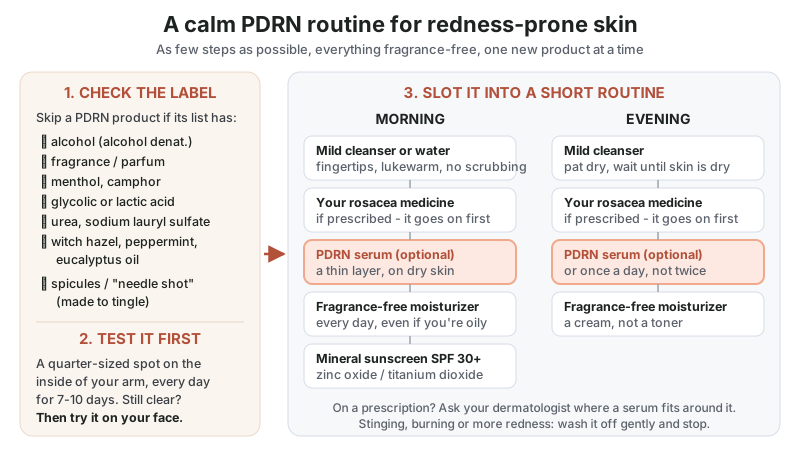
The diagram, step by step:
- Check the label. Skip alcohol (alcohol denat.), fragrance or parfum, menthol, camphor, glycolic or lactic acid, urea and sodium lauryl sulfate (the AAD’s list), plus witch hazel, peppermint and eucalyptus oil (named in the National Rosacea Society survey) and spicule “needle shot” products.
- Test it first. A quarter-sized spot on the inside of your arm, every day for 7-10 days. Still clear? Then try it on your face.
- Morning: mild cleanser or plain lukewarm water with your fingertips; your rosacea medicine if you have one; a thin layer of PDRN serum (optional); a fragrance-free moisturizer; a mineral sunscreen with SPF 30 or higher.
- Evening: mild cleanser, then wait until your skin is dry; your rosacea medicine; PDRN serum (or skip it here and use it once a day); a fragrance-free cream.
The AAD notes that moisturizer on dry skin is less likely to burn or sting, which is why every step happens on skin that’s already dry. If you have a prescription, ask your dermatologist exactly where a serum fits around it — some prescriptions come with their own instructions.
How do you patch-test a PDRN product?
Test a PDRN product on the inside of your arm for 7-10 days before it goes on your face. The AAD’s 7 rosacea skin care tips say: Apply the product to a quarter-sized patch of skin on the inside of your arm every day for 7-10 days.
If your skin is clear after that, go ahead. If you see redness, itching or swelling, wash it off gently and don’t use it again.
When should you see a dermatologist about redness?
See a dermatologist if your face flushes easily, stays red, or has bumps or visible blood vessels you can’t explain — those are signs the AAD links to rosacea, and only a doctor can diagnose it. A dermatologist can also tell you whether your redness is rosacea at all, or something else that needs different care.
The AAD puts it warmly: Your dermatologist knows how to diagnose rosacea and create a treatment plan that can bring relief.
And if you’re stuck finding gentle products, the AAD suggests asking your dermatologist to recommend some. The National Rosacea Society also runs a Seal of Acceptance program to help people find rosacea-friendly skin care and cosmetics, which is a handy shortcut when a label leaves you unsure.
One more true thing from the law books: in the US, the FDA treats products meant to change the structure or any function of the body
or to treat disease as drugs, not cosmetics (FDA: Is it a cosmetic, a drug, or both?). A PDRN serum sold as a cosmetic is there to help your skin look and feel better, which is a fine job — just not the job of a rosacea treatment.
Go slow, be kind to that lovely face of yours, and remember: the gentlest routine that keeps your skin calm is the winning routine, PDRN or not.
Sources and further reading
- American Academy of Dermatology: Rosacea overview — mainly affects the face; flushing, lasting color, acne-like breakouts, visible blood vessels; ‘At this time, there is no cure for rosacea’; dermatologist diagnosis and treatment plan
- American Academy of Dermatology: 7 rosacea skin care tips dermatologists recommend — ingredients to avoid (alcohol, camphor, fragrance, glycolic acid, lactic acid, menthol, sodium lauryl sulfate, urea); fragrance-free rather than unscented; moisturizer; SPF 30+
- American Academy of Dermatology: 7 Rosacea skin care tips — test a product on a quarter-sized patch inside your arm every day for 7-10 days
- American Academy of Dermatology: How to prevent rosacea flare-ups — fragrance-free zinc oxide / titanium dioxide sunscreen; stop astringents and toners; windburn and cold as triggers
- National Rosacea Society: Rosacea skin care and cosmetics — survey of 1,066 patients (41% aggravated by skin care products); alcohol 66%, witch hazel 30%, fragrance 30%, menthol 21%, peppermint 14%, eucalyptus oil 13%; use as few products as possible; Seal of Acceptance
- National Rosacea Society: About us — an estimated 16 million Americans have rosacea
- Shin et al., Molecular Medicine Reports (2023): Polydeoxyribonucleotide exerts opposing effects on ERK activity in human skin keratinocytes and fibroblasts — in vitro: PDRN lowered inflammatory cytokines in cultured keratinocytes
- Lee et al., Skin Research and Technology (2024): Polynucleotide with hyaluronic acid intradermal injections on facial erythema — two-patient case report of injected polynucleotides; calls for controlled trials
- FDA: Is it a cosmetic, a drug, or both? (or is it soap?) — legal definitions of cosmetics and drugs
- Anua: PDRN Hyaluronic Acid Capsule 100 Serum — maker’s product page; ingredient list also on Anua’s Ulta listing (fragrance-free; PDRN derived from salmon DNA)
- VT Cosmetics: PDRN Essence 100 — maker’s product page; ginseng-sourced PHYTO PDRN, 100,000 ppm stated, no spicules, unscented (per VT’s Ulta listing)
- VT Cosmetics: PDRN Reedle Shot 100 — CICA REEDLE enhances penetration; ‘a slight tingling sensation’ is normal; not right after procedures; Sodium DNA listed at 0.05 ppm
Questions and answers
Is PDRN good for rosacea?
PDRN can be part of a gentle routine for rosacea-prone skin, but it isn’t a rosacea treatment, and no published study has tested a PDRN serum on rosacea yet. If you try one, pick a fragrance-free, alcohol-free, spicule-free formula, test it on your arm for 7-10 days first, and keep following your dermatologist’s plan.
Can PDRN cause redness?
Any skincare product can cause redness, and with PDRN serums it’s usually something else in the formula — fragrance, drying alcohol, plant extracts or tingling spicules — rather than the PDRN itself. Test a new product on the inside of your arm for 7-10 days, and stop and wash it off if your skin gets red, itchy or swollen.
Is PDRN anti-inflammatory?
In the lab, yes: a 2023 study in Molecular Medicine Reports found PDRN lowered inflammatory signals in cultured human skin cells. That was cell-culture work, though, not a test on people, so it doesn’t prove a PDRN serum calms red skin. PDRN serums are cosmetics and aren’t sold to treat inflammation.
Can I use PDRN with my rosacea cream?
Ask your dermatologist first, because some prescriptions come with their own instructions. The AAD’s general advice is to put rosacea medicine on first, then a rosacea-friendly moisturizer, on dry skin. If your dermatologist is happy for you to add a PDRN serum, it would usually go after the medicine and before the moisturizer.
Do salmon DNA injections help with facial redness?
There’s only very early evidence: a 2024 case report described two women whose facial redness improved after polynucleotide injections given by doctors. Injections are a medical procedure for licensed professionals, separate from PDRN serums, and two patients is far too few to know how well it works. Talk to a dermatologist if you’re curious.