
How do you make a DIY printable advent calendar with boxes or envelopes (2026)?
Disclosure: this page contains Amazon affiliate links. As an Amazon Associate we earn from qualifying purchases, at no extra cost to you.
Well hello there, Countdown Captain! You’re the one who’s going to make 24 tiny surprises happen this December, and honestly, that’s a wonderful job to have. A printable advent calendar is one of those projects that looks like a lot of work on Pinterest and turns out to be paper, scissors and a free evening. You print 24 little boxes or number 24 envelopes, fill them, and line them up — and the right 65 lb cardstock for printing on Amazon makes the boxes stand up straight instead of slumping by December 3.
Short answer: To make a DIY printable advent calendar, print 24 numbered box templates on 65-80 lb cover cardstock (176-216 gsm) at 100% size, cut, score, fold and glue them, or number 24 small envelopes and clip them to a string. Fill each one, then start opening on December 1, or on November 29 for Advent 2026.
How do you make a DIY printable advent calendar?
You make a DIY printable advent calendar in five steps: pick boxes or envelopes, print 24 numbered pieces, put them together, fill them, and display them in number order. Boxes take longer to build and look more special; envelopes are faster and hang flat on a wall.
- Pick the style. Fold-up paper boxes (a 3D calendar on a shelf or tray) or flat envelopes (a garland on a string or a grid on a board).
- Print 24 pieces. Print box templates on cardstock at 100% (“actual size”), or print 24 number labels for the envelopes.
- Put them together. Cut on the solid lines, score and fold on the dashed lines, glue the tab — or stick a number on each envelope.
- Fill them. A wrapped sweet, a tiny toy, a joke, a clue or an activity card (ideas below).
- Display them. Mix the numbers up for a hunt, or keep them in order for little kids who just want to find “today”.
The idea is older than it looks. History Hit says it was in 1908 that German publisher Gerhard Lang invented the first printed and commercial Advent calendar
, inspired by his mother putting 24 biscuits on a square of cardboard, and that the little doors came later, in the 1920s. A box-and-envelope calendar at home is the same idea, with paper you choose yourself.
When does Advent start in 2026?
Advent 2026 starts on Sunday, November 29, 2026, and ends on Christmas Eve, Thursday, December 24, 2026 (timeanddate.com). That makes the church season of Advent 26 days long this year.
Most store-bought and printable advent calendars count 24 days instead: December 1 to December 24. Both are fine. If your family follows the church season, make 26 pieces and start on November 29; if you just want a Christmas countdown, make 24 and start on December 1. Undated numbers 1-24 can be reused every year, because the 24-day count never changes.
- First Sunday of Advent 2026
- Usual first door of a 24-day calendar
- Last door
- Pieces to make
- 24 for December 1-24, or 26 for the full Advent 2026 season
Should you make advent calendar boxes or envelopes?
Make boxes if you want to hold small gifts and have a few evenings; make envelopes if you want something flat, quick and cheap that holds notes, cards and flat treats. A box version uses 12-24 sheets of cardstock; an envelope version uses 24 envelopes and 2 sheets of labels.
| Question | Fold-up paper boxes | Numbered envelopes |
|---|---|---|
| What you print | 24 box templates on cardstock | 24 number labels (2 sheets of 12) |
| Paper needed | 12 sheets (1.25 in boxes) to 24 sheets (1.5-2 in boxes) | 24 envelopes + 2 label sheets |
| Holds | Small 3D things: a wrapped sweet, a tiny toy, a rolled note | Flat things: notes, activity cards, stickers, a flat chocolate |
| Building time | Longest — cut, score, fold and glue each one | Shortest — peel and stick |
| Display | A tray, a shelf or a pile under the tree | A string garland or a grid on a board |
| Reuse next year | Yes, if you open the tuck lid gently | Yes, if the flaps are tucked, not sealed |
What size advent boxes fit on one sheet of paper?
A tuck-top cube box up to about 2.1 inches (5.3 cm) on each side fits one per Letter or A4 sheet; a 1.25-inch cube fits two per sheet, and a 1-inch cube fits four. That means a 24-box calendar takes 24 sheets of cardstock at 1.5-2 inches, 12 sheets at 1.25 inches, or 6 sheets at 1 inch.
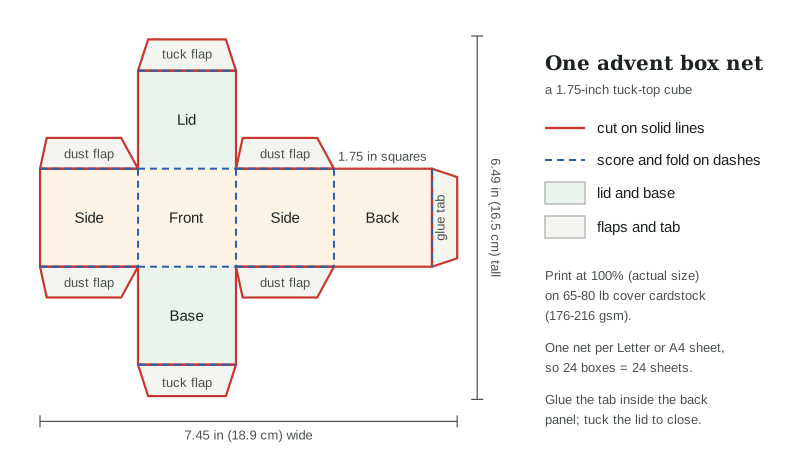
The diagram above shows one box net for a 1.75-inch cube, in plain numbers:
- Each of the four side panels, the lid and the base is a 1.75 in (4.4 cm) square.
- The glue tab is 0.45 in wide; each tuck flap is 0.62 in deep; each dust flap is 0.55 in deep.
- The whole flat net is 7.45 in wide by 6.49 in tall (18.9 by 16.5 cm), so one net fits on one Letter or A4 sheet.
- Solid lines are cut lines; dashed lines are score-and-fold lines.
We worked out the same net shape at other cube sizes. The flaps grow in proportion to the cube, and every sheet keeps a 0.25 in (6 mm) margin all round, plus a 0.15 in gap between nets.
| Cube side | Flat net size | Nets per Letter sheet | Nets per A4 sheet | Sheets for 24 boxes |
|---|---|---|---|---|
| 1 in (2.5 cm) | 4.26 x 3.71 in | 4 | 4 | 6 |
| 1.25 in (3.2 cm) | 5.32 x 4.64 in | 2 | 2 | 12 |
| 1.5 in (3.8 cm) | 6.39 x 5.56 in | 1 | 1 | 24 |
| 1.75 in (4.4 cm) | 7.45 x 6.49 in | 1 | 1 | 24 |
| 2 in (5.1 cm) | 8.51 x 7.42 in | 1 | 1 | 24 |
| 2.5 in (6.4 cm) | 10.64 x 9.27 in | 0 — too big | 0 — too big | Use legal or 11 x 17 in paper |
The biggest single cube box that fits on one Letter sheet with these margins is about 2.16 in (5.5 cm); on A4 it’s about 2.10 in (5.3 cm). Bigger than that, and the net needs larger paper or a two-piece box with a separate lid.
What paper should you print advent calendar boxes on?
Print advent calendar boxes on 65-80 lb cover cardstock, which is about 176-216 gsm. A 65 lb cover sheet like Neenah’s Astrobrights cardstock (listed as 65 lb cover, 176 gsm) folds cleanly and holds a 1.25-1.75 inch box shape; 80 lb cover (about 216 gsm, per the Paper Specs weight converter) is stiffer for 2-inch boxes.
- Ordinary copy paper is too floppy for boxes. It works for envelope inserts and note cards.
- 65 lb cover (176 gsm) is the easy middle ground for small boxes and the weight most home printers handle best.
- 80 lb cover (216 gsm) makes sturdier boxes, but check your printer’s limit first (next section).
- “110 lb” cardstock is a trap: Paper Specs lists 110 lb index at 199 gsm, while 110 lb cover works out to roughly 298 gsm — much heavier. Look for the gsm number on the pack, not just the pound number.
If you’d rather have color without printing it, white boxes printed in black ink on colored bright colored cardstock look cheerful and save a lot of ink.
Can your printer take cardstock for advent boxes?
Most home inkjet printers can print 65 lb cardstock, but each model has its own paper-weight limit and sometimes a special tray for heavy paper, so check your own printer’s spec sheet before printing 24 sheets. Never assume one printer’s limit applies to another.
Quick confession: we think the folding is the cosy part. Put on a Christmas playlist, score a stack of boxes, and watch a flat sheet of cardstock turn into a little cube — it never stops feeling like a small magic trick.
Here’s one real example of how different the trays can be. Canon’s spec sheet for the PIXMA TS6420a lists plain paper at 64-105 gsm in both the front cassette and the rear tray, and Canon’s own paper up to approximately 300 gsm in the rear tray only. On that printer, cardstock belongs in the rear tray, not the front cassette.
- Search “your printer model specifications paper weight” and look for the maker’s own page or spec sheet.
- Find the heavy-paper tray, if there is one, and the highest gsm it lists.
- Choose the paper type setting the manual suggests for card or matte paper, so the printer slows down and puts down the right amount of ink.
- Print one test sheet, measure one square with a ruler, then print the rest.
How do you cut, score and fold a paper advent box?
Cut on the solid lines, score every dashed fold line with a ruler and a blunt tool, fold along the scores, glue the side tab inside the back panel, then fold in the dust flaps and tuck the lid closed. Scoring first is what gives a cardstock box crisp, straight edges.
- Cut. Use scissors, or a craft knife and metal ruler on a cutting mat for the long straight lines.
- Score. Run a bone folder or an empty ballpoint pen along a ruler on every dashed line. You’re pressing a groove, not cutting.
- Fold. Fold every score line the same way, printed side out.
- Glue. Put glue or double-sided tape on the glue tab and press it inside the back panel. Hold it until the glue grabs.
- Close. Fold the bottom dust flaps in, then the base, and tuck its flap in. Fill the box, then close the top the same way.
Cutting machines save a lot of time on 24 boxes. In Cricut Design Space, dashed fold lines need to be set to “Score” rather than “Cut”, and the score lines have to be attached to the shape so they land on the same mat. Cricut’s help page on the Scoring Wheel tools also suggests folding into the score line and, for boxes, folding gently — only 45-50 degrees — to avoid cracking.
How do you make an advent calendar with envelopes?
To make an envelope advent calendar, number 24 small envelopes from 1 to 24, put a note, card or flat treat inside each one, tuck the flaps in, and clip them to a string with mini clothespins. It takes about an evening, and nothing has to be cut or folded.
What size envelopes work for an advent calendar?
Small coin envelopes and A2 envelopes are the two easy sizes for an envelope advent calendar. Envelopes.com’s size chart lists a #1 coin envelope at 2 1/4 x 3 1/2 inches, a #3 coin envelope at 2 1/2 x 4 1/4 inches and an A2 envelope at 4 3/8 x 5 3/4 inches.
- #1 or #3 coin envelopes hold a folded note, a small sticker sheet or a flat chocolate. They make a neat, short garland.
- A2 envelopes hold a folded 4 x 5 inch activity card or a small photo. They’re big enough to see from across the room.
How much string do 24 envelopes need?
A line of 24 #1 coin envelopes needs about 7.4 feet (2.26 m) of string, while 24 A2 envelopes hung upright need about 11.7 feet (3.56 m). Those lengths assume a 1-inch (2.5 cm) gap between envelopes and 6 inches spare at each end for tying.
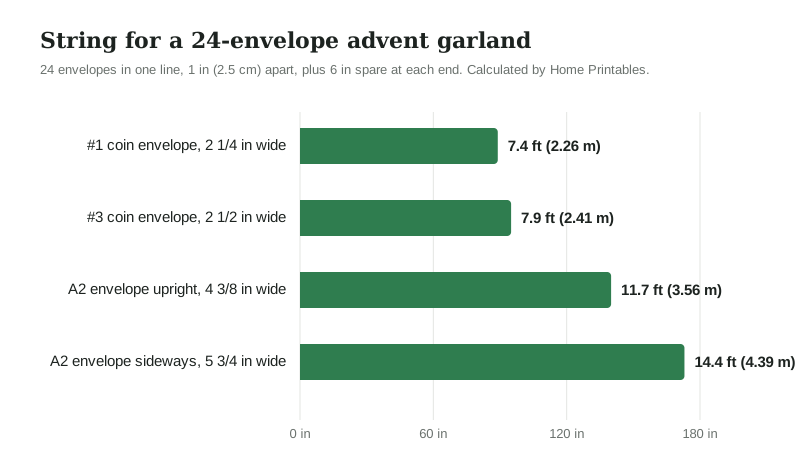
| Envelope | Width as hung | String needed |
|---|---|---|
| #1 coin envelope | 2 1/4 in | 89 in = 7.4 ft (2.26 m) |
| #3 coin envelope | 2 1/2 in | 95 in = 7.9 ft (2.41 m) |
| A2 envelope, upright | 4 3/8 in | 140 in = 11.7 ft (3.56 m) |
| A2 envelope, sideways | 5 3/4 in | 173 in = 14.4 ft (4.39 m) |
Not that much wall? Hang two rows of 12 — each row then needs a little under half the string — or pin the envelopes in a 6 x 4 grid on a corkboard.
How do you number the envelopes?
The neatest way to number advent envelopes is to print 24 round number stickers. Avery’s template 22807 is a 2-inch round print-to-the-edge label, 12 per Letter sheet, so two sheets give you numbers 1 to 24 — and a 2-inch circle fits across a 2 1/4-inch coin envelope.
Can’t find round labels? Print the numbers large on plain paper, cut them into squares and glue them on, or hand-letter them with a paint pen. Kids love doing this part.
What can you put in small advent boxes and envelopes?
Small advent boxes and envelopes fit things that are light, small and mostly flat: wrapped sweets, folded notes, activity cards, stickers, tiny toys and clues. A 1.75-inch box holds about one wrapped chocolate or a small toy; a coin envelope holds a note or a flat treat.
- Notes: a joke, a compliment, a memory from this year, or
you choose dinner tonight
. - Activity cards: bake cookies, watch a Christmas movie, make paper snowflakes, call Grandma.
- Clues: a little scavenger hunt that ends at a bigger gift on December 24.
- Flat treats: a chocolate coin, a sticker sheet, a temporary tattoo, a bookmark.
- Tiny things: a mini eraser, a hair clip, a charm — for older kids only (see the next section).
Is a DIY advent calendar safe for toddlers?
A DIY advent calendar can be safe for toddlers if every filler is too big to be a small part — or is a note, a card or an activity instead. Many things that fit in a 1.75-inch box are small enough to be a choking hazard for children under 3.
The U.S. Consumer Product Safety Commission uses a simple test. In its small parts summary, the CPSC explains:
A small part is any object that fits completely into a specially designed test cylinder 2.25 inches long by 1.25 inches wide that approximates the size of the fully expanded throat of a child under three years old.
When should you start making a DIY advent calendar?
Start making a DIY advent calendar about a week before you need it: by Sunday, November 22, 2026, for a December 1 start, or by Sunday, November 15, 2026, if you want to open the first one on November 29. That leaves time to buy cardstock, print, build and fill.
- Week 1: pick boxes or envelopes, buy paper or envelopes and labels, test-print one sheet.
- A few evenings: print and build 24 boxes (an envelope calendar fits in one evening).
- The last night: fill everything and hang or stack it, ready for the first morning.
Hide the filled calendar somewhere high until the night before. Somebody always wants to “just check” what’s in box 24.
Now go warm up that printer, Captain. Fold it, fill it, hide it somewhere high, and enjoy every single morning of the countdown.
Sources and further reading
- timeanddate.com — First Sunday of Advent — Advent 2026 starts Sunday, November 29, 2026
- U.S. Consumer Product Safety Commission — Small Parts Regulations summary (16 CFR 1501) — the 2.25 x 1.25 inch small parts test cylinder
- History Hit — The History of Advent — Gerhard Lang’s first printed advent calendar, 1908, and doors in the 1920s
- Envelopes.com — Envelopes by size — #1 coin, #3 coin and A2 envelope dimensions
- Avery — Template 22807, 2 inch round print-to-the-edge labels — 12 labels per Letter sheet
- Paper Specs — Paper weight conversion tool — cover and text pounds to gsm
- Neenah Astrobrights 65 lb cardstock listing (12x12 Cardstock Shop) — 65 lb cover = 176 gsm
- Canon PIXMA TS6420a spec sheet — paper weights by tray
- Cricut Help — Cricut Scoring Wheel Tools — folding into the score line, 45-50 degrees for boxes
Questions and answers
How do you make an advent calendar out of paper?
Print 24 numbered box templates on 65-80 lb cover cardstock at 100% size, then cut on the solid lines, score and fold on the dashed lines, and glue the side tab. Fill each box and line them up in a tray or on a shelf. Paper envelopes on a string are an easier no-fold version.
What paper weight is best for advent calendar boxes?
65-80 lb cover cardstock, which is about 176-216 gsm, works best for small fold-up boxes. 65 lb is easier on home printers; 80 lb makes stiffer boxes. Check your printer’s spec page for its paper-weight limit first.
How big should advent calendar boxes be?
1.25 to 2 inches on each side is the usual range for printable advent boxes. A 1.75-inch cube holds a wrapped chocolate or a small toy, and one tuck-top net that size fits on a Letter or A4 sheet. A 1.25-inch cube fits two per sheet.
What size envelopes for an advent calendar?
#1 coin envelopes (2 1/4 x 3 1/2 inches) make a small, neat calendar for notes and flat treats, and A2 envelopes (4 3/8 x 5 3/4 inches) fit folded activity cards. Twenty-four #1 coin envelopes need about 7.4 feet of string with 1-inch gaps.
When do you start an advent calendar in 2026?
Most advent calendars start on December 1 and end on December 24. The church season of Advent 2026 starts earlier, on Sunday, November 29, 2026, so a calendar that follows it has 26 days instead of 24.