Recipes › Gingerbread cookies
Gingerbread Cookies That Hold Their Shape (Cut-Out Recipe)
Disclosure: this recipe contains Amazon affiliate links. As an Amazon Associate we earn from qualifying purchases, at no extra cost to you.
Nothing says December like a tray of gingerbread men - as long as they still look like men when they come out of the oven. The secret is a firm dough that's chilled twice, so the edges stay sharp. A good set of gingerbread cookie cutters and a rolling pin with thickness rings (both on Amazon) make it easy to roll every cookie the same.
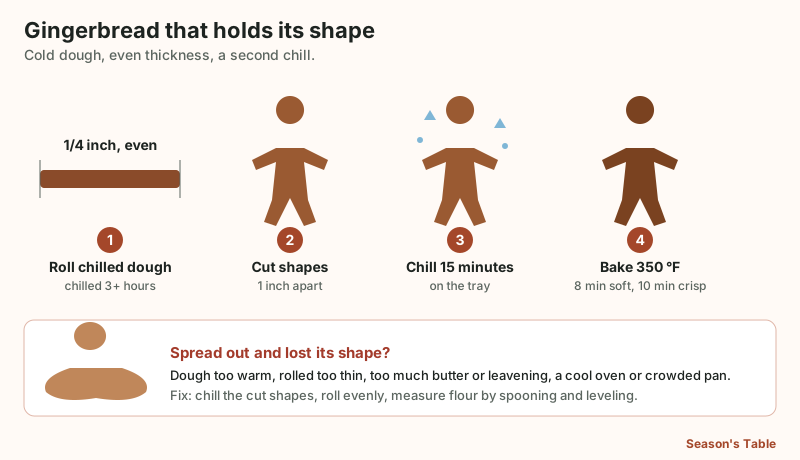
Short answer: make a molasses-spice dough with a little baking soda and not too much butter, chill it at least 3 hours, roll it 1/4 inch thick, cut shapes, chill the cut cookies again for 15 minutes, and bake at 350 °F for 8 to 10 minutes. Decorate with royal icing made from meringue powder - no raw egg whites.
Cut-Out Gingerbread Cookies
Total time includes at least 3 hours of chilling. The dough can be made up to 3 days ahead.
Ingredients
Cookies
- 3 cups (375 g) all-purpose flour, plus more for rolling
- 1 tablespoon ground ginger
- 1 1/2 teaspoons ground cinnamon
- 1/4 teaspoon ground cloves
- 1/4 teaspoon ground nutmeg
- 3/4 teaspoon baking soda
- 1/2 teaspoon salt
- 6 tablespoons (85 g) unsalted butter, softened
- 1/2 cup (100 g) packed dark brown sugar
- 1 large egg
- 1/2 cup (120 ml) unsulphured molasses
- 1 teaspoon vanilla extract
Royal icing (made with meringue powder)
- 2 cups (240 g) powdered sugar
- 1 1/2 tablespoons meringue powder
- 3 to 4 tablespoons water
Instructions
- Whisk the flour, ginger, cinnamon, cloves, nutmeg, baking soda and salt in a bowl.
- In a large bowl, beat the butter and brown sugar with a mixer for about 2 minutes, until creamy. Beat in the egg, molasses and vanilla (it may look a little curdled - that's fine).
- Add the flour mixture in two parts and mix on low just until a soft dough forms.
- Divide the dough in half, flatten each into a disc, wrap tightly and refrigerate at least 3 hours or up to 3 days.
- Heat the oven to 350 °F (175 °C). Line baking sheets with parchment.
- Roll one disc between two sheets of parchment (or on a lightly floured counter) to an even 1/4 inch thick. Cut shapes and move them to the baking sheets, about 1 inch apart. Re-roll the scraps once.
- Chill the cut cookies on the sheet for 15 minutes - this is what keeps the edges sharp.
- Bake 8 to 10 minutes: 8 for soft cookies, 10 for crisper ones. Cool 5 minutes on the sheet, then move to a rack to cool completely.
- For the icing, beat the powdered sugar and meringue powder with 3 tablespoons water until thick and glossy, adding water a little at a time until it pipes smoothly. Decorate the cooled cookies and let the icing set until hard.
Why chill the dough (twice)
The first chill, at least 3 hours, firms the butter and lets the flour soak up moisture, so the dough rolls cleanly instead of sticking. The second, short chill - after cutting - matters just as much: cold shapes set in the oven before the butter can melt and spread. Don't over-chill a big disc for days without wrapping it, though; it can dry out and crack. If it's too firm to roll, let it sit 10 minutes.
Why gingerbread spreads - and how to stop it
- Warm dough. The most common cause. Chill again if the cut shapes get soft.
- Too thin. Thin spots spread and burn. Roll evenly to 1/4 inch.
- Too much butter or leavening. Measure carefully; spoon flour into the cup and level it rather than scooping.
- A cool oven or warm pans. Use a fully heated oven and let pans cool between batches.
- Crowding. Leave about an inch between cookies.
Soft or crunchy: bake time decides
The same dough makes both. At 8 minutes the cookies are set at the edges but still soft in the middle; they firm up as they cool. At 10 minutes they're crisper - better for hanging ornaments or building a gingerbread house. Thicker cookies stay softer too.
Safe royal icing
Traditional royal icing is made with raw egg whites. Iowa State University Extension points out that eggs may carry Salmonella, and while the risk in whites is small, it can't be ruled out - so it's best to use a safer option such as meringue powder (mostly dried, pasteurized egg whites), pasteurized liquid egg whites, or lightly cooked whites. This recipe uses meringue powder. Thin it with a few drops of water for flooding, keep it thicker for piping lines.
Storing and freezing
- Baked cookies: once the icing is completely hard, store them in an airtight container at room temperature. They're typically best within about a week.
- Freeze baked, undecorated cookies in a sealed container with parchment between layers; thaw before decorating.
- Freeze the dough: wrap the discs tightly and freeze; thaw overnight in the fridge before rolling.
- Keep them soft: a slice of bread in the container helps soft cookies stay that way.
Food safety: skip the raw dough
It's tempting, but don't taste raw gingerbread dough. Michigan State University Extension, citing FDA and CDC warnings, explains that raw flour isn't treated to kill germs like E. coli, and raw eggs can carry Salmonella - baking is what makes it safe. Wash hands and surfaces after handling raw dough, especially with kids helping.
Want more for the holiday table? Try our easy apple crisp or classic pumpkin pie.
Sources and further reading
- Michigan State University Extension: raw cookie dough and raw flour can cause foodborne illness - raw flour and raw eggs; FDA/CDC
- Iowa State University Extension AnswerLine: royal icing made safe - meringue powder or pasteurized whites instead of raw
- Google search data on Christmas cookies (news coverage) - gingerbread among the most-searched cookies
Questions and answers
Why do my gingerbread cookies spread?
Usually the dough was too warm, rolled too thin, or had too much butter or leavening. Chill the cut shapes for 15 minutes before baking and roll an even 1/4 inch.
How long do gingerbread cookies last?
Stored airtight at room temperature, they're typically best within about a week. Baked, undecorated cookies also freeze well.
How do you keep gingerbread cookies soft?
Bake them on the short side (about 8 minutes at 350 °F), roll them a little thicker, and store them airtight - a slice of bread in the container helps.
Do you have to chill gingerbread dough?
Yes, for cut-outs. Chill the dough at least 3 hours so it rolls cleanly, then chill the cut shapes 15 minutes so they hold their edges in the oven.
Is it safe to eat raw gingerbread cookie dough?
No. FDA and CDC warn against eating raw dough because raw flour can carry E. coli and raw eggs can carry Salmonella. Bake it first.
How this was written: A classic molasses gingerbread cut-out cookie. Food-safety guidance on raw dough comes from Michigan State University Extension (citing FDA and CDC) and on royal icing from Iowa State University Extension. Storage times are typical home-baking practice. No nutrition numbers.