Recipes › Make-ahead stuffing
Make-Ahead Stuffing Baked in a Dish (the Safe Way to Prep It Early)
Disclosure: this recipe contains Amazon affiliate links. As an Amazon Associate we earn from qualifying purchases, at no extra cost to you.
Baking stuffing in its own dish is easier and safer than cooking it inside the turkey - USDA actually recommends it - and you get those crispy edges everyone fights over. It's also great for planning ahead, as long as you prep it the right way. You'll need a 9x13-inch baking dish and a food thermometer (both on Amazon) to check the middle.
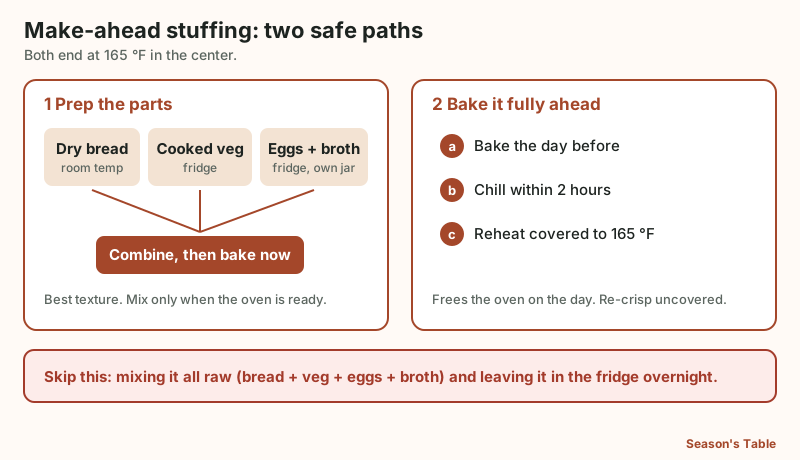
Short answer: you can make stuffing ahead in two safe ways. Either prep the parts early - dry the bread, cook the vegetables, mix the broth and eggs - and keep them separate until just before baking. Or bake it completely the day before, chill it, and reheat it to 165 °F. What you shouldn't do is mix everything raw and leave it in the fridge overnight.
Classic Sage and Onion Stuffing
Bakes in a 9x13-inch dish. Dry the bread a day or two before - it soaks up the broth without going mushy.
Ingredients
Bread
- 1 pound (450 g) sturdy white or sourdough bread, cut into 3/4-inch cubes (about 12 cups)
Vegetables
- 1/2 cup (1 stick, 113 g) unsalted butter, plus a little for the dish
- 1 large onion, chopped (about 2 cups)
- 3 ribs celery, chopped (about 1 1/2 cups)
- 2 cloves garlic, minced
- 2 tablespoons chopped fresh sage (or 2 teaspoons dried)
- 1 tablespoon fresh thyme leaves (or 1 teaspoon dried)
- 1/4 cup chopped fresh parsley
- 1 teaspoon kosher salt
- 1/2 teaspoon black pepper
To bind
- 2 1/2 to 3 cups (600-720 ml) chicken or turkey broth
- 2 large eggs
Instructions
- Dry the bread: spread the cubes on two baking sheets and bake at 300 °F (150 °C) for 25 to 30 minutes, tossing once, until dry and lightly crisp. Let cool. (Or leave them out overnight, loosely covered.)
- Melt the butter in a large skillet over medium heat. Add the onion and celery and cook, stirring, until soft, about 8 to 10 minutes. Add the garlic, sage, thyme, salt and pepper and cook 1 minute more. Stir in the parsley.
- In a bowl, whisk the eggs with 2 1/2 cups of the broth.
- When you're ready to bake, heat the oven to 350 °F (175 °C) and butter a 9x13-inch baking dish.
- In a very large bowl, toss the bread with the vegetables. Pour the egg and broth mixture over it and toss gently until the bread is evenly moist. If it still looks dry, add up to 1/2 cup more broth.
- Spread it in the dish without packing it down. Cover with foil and bake 25 minutes.
- Uncover and bake another 20 to 25 minutes, until the top is golden and crisp and the center reads 165 °F (74 °C) on a food thermometer.
- Let it sit 5 minutes, then serve.
Why it works
- Dry bread drinks up flavor. Fresh bread turns to mush; dried cubes soak up the broth and hold their shape.
- Soft vegetables, not raw. Cooking the onion and celery in butter first makes them sweet and tender.
- Eggs hold it together so it scoops instead of crumbling.
- Covered, then uncovered. The foil steams the middle; taking it off crisps the top.
Making it ahead (the safe way)
Here's the part people often get wrong. Food-safety experts say the wet ingredients can be mixed ahead and refrigerated, but you shouldn't combine the wet and dry ingredients until you're ready to cook. That's because a fridge-cold, wet, raw mix sitting overnight is a good place for bacteria to grow.
Option 1: prep the parts (best texture)
- 1 to 2 days before: dry the bread cubes and keep them in a big bag or covered bowl at room temperature.
- The day before: cook the vegetables, let them cool, and refrigerate them. Whisk the eggs and broth and refrigerate in a separate jar.
- On the day: toss everything together and bake right away.
Option 2: bake it fully ahead
- Bake it completely the day before.
- Cool it and get it into the fridge within 2 hours - in shallow containers or the baking dish, covered.
- On the day, reheat covered at 350 °F until the center reads 165 °F, then uncover for 10 minutes to re-crisp the top. Add a splash of broth if it looks dry.
Why bake it outside the turkey?
Stuffing inside a bird cooks slower than the turkey around it. By the time the stuffing in the middle reaches a safe 165 °F, the breast meat is often overcooked. That's why USDA recommends baking stuffing separately. If your family tradition is a stuffed bird, the stuffing has to reach 165 °F too - check it with a thermometer, and see our roast turkey guide for times.
Easy variations
- Sausage stuffing: brown 1 pound of bulk pork sausage until fully cooked, drain, and add it with the vegetables.
- Apple and pecan: add 1 diced apple with the vegetables and 3/4 cup toasted pecans with the bread.
- Cornbread: swap half the bread for dried cornbread cubes.
- Vegetarian: use vegetable broth.
Planning the whole oven schedule? Our make-ahead green bean casserole bakes at a similar temperature.
Leftovers
Refrigerate leftover stuffing within 2 hours, in shallow containers. USDA-based guidance says to use leftovers within 3 to 4 days; some extension charts suggest 1 to 2 days for stuffing, so sooner is better. Reheat to 165 °F.
Frequently asked questions
Can I make stuffing the day before?
Yes, two ways: prep the parts separately (dry bread, cooked vegetables, egg-and-broth mix) and combine just before baking, or bake it completely the day before and reheat it to 165 °F. Don't mix it all raw and refrigerate it overnight.
What temperature should stuffing reach?
165 °F (74 °C) in the center, checked with a food thermometer - whether it's baked in a dish or in the turkey.
What is the difference between stuffing and dressing?
Mostly where it's cooked: stuffing goes inside the bird, dressing is baked in a dish. Many people call both stuffing. This recipe is baked in a dish.
Can I freeze stuffing?
Yes. Freeze baked stuffing in airtight containers, thaw it in the fridge, and reheat it to 165 °F.
Sources and further reading
- Iowa State University Extension AnswerLine: stuffing the turkey safely - USDA: cook stuffing separately; mix wet ahead, combine with dry only when ready to cook; 165 °F
- University of Arkansas Cooperative Extension: is it safe to stuff the turkey? - wet ingredients ahead, 165 °F, refrigerate within 2 hours, 3-4 days
- University of Illinois Extension: using turkey leftovers - storage chart (stuffing 1-2 days)
- University of Illinois Extension: roast turkey (stuffed) - USDA recommends cooking stuffing outside the bird
How this was written: A classic bread stuffing (also called dressing when it's baked in a dish). Make-ahead and temperature guidance follows USDA advice as published by Iowa State University Extension and the University of Arkansas Cooperative Extension. No nutrition numbers.