Recipes › Prime rib roast
Prime Rib Roast for the Holidays (Bone-In, With Temperatures That Matter)
Disclosure: this recipe contains Amazon affiliate links. As an Amazon Associate we earn from qualifying purchases, at no extra cost to you.
A prime rib on the table makes it feel like a holiday. It looks impressive, but it's really just a big roast and a good thermometer - which is the one tool you shouldn't skip. A leave-in probe thermometer and a sturdy roasting pan (both on Amazon) are all you need.
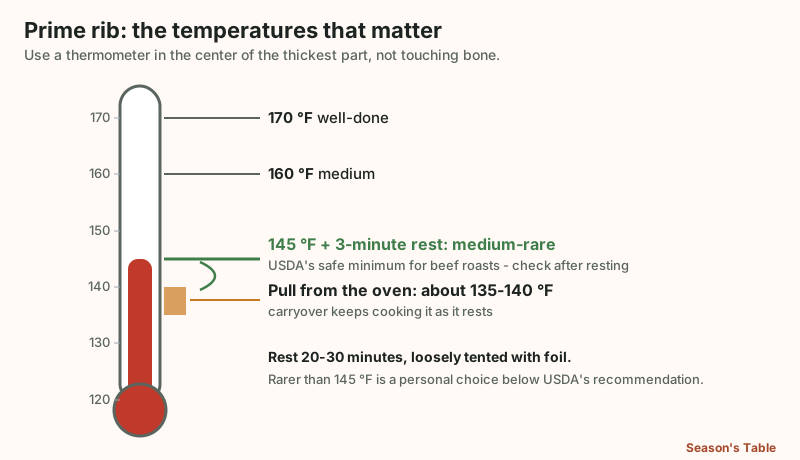
Short answer: salt a bone-in rib roast (ideally the day before), roast at 450 °F for 15 to 20 minutes, then at 325 °F until the center reads about 135 to 140 °F. Rest it 20 to 30 minutes - it keeps cooking. USDA's safe minimum for beef roasts is 145 °F with at least a 3-minute rest, which is medium-rare.
Bone-In Prime Rib Roast
For a 3-bone roast of about 6 to 7 pounds. Cook time is a guide only - start checking the temperature early. Total time includes 30 minutes of resting (and doesn't include the optional overnight salting).
Ingredients
- 1 bone-in beef rib roast (standing rib roast), 3 ribs, about 6 to 7 pounds (2.7 to 3.2 kg)
- 2 tablespoons kosher salt
- 1 tablespoon coarsely ground black pepper
- 4 cloves garlic, minced (optional)
- 1 tablespoon chopped fresh rosemary or thyme (optional)
- 2 tablespoons olive oil or softened butter
Instructions
- Optional, for the best crust and flavor: the day before, rub the roast all over with the salt, set it on a rack over a tray, and refrigerate it uncovered overnight.
- Take the roast out of the fridge about 1 hour before cooking. Heat the oven to 450 °F (230 °C).
- If you didn't salt ahead, season it all over with the salt now. Mix the pepper, garlic, herbs and oil, and rub it over the top and sides.
- Set the roast bone side down (the bones are the rack) in a roasting pan. Insert an oven-safe probe thermometer into the center of the thickest part, not touching bone.
- Roast at 450 °F for 15 to 20 minutes to brown the outside.
- Turn the oven down to 325 °F (165 °C) and keep roasting until the center reads about 135 to 140 °F. For a 6- to 7-pound roast this often takes another 1 1/2 to 2 hours, but go by the thermometer.
- Move the roast to a cutting board, tent loosely with foil, and rest 20 to 30 minutes. The temperature keeps rising as it rests - check that the center reaches at least 145 °F (USDA's safe minimum for beef roasts, with at least a 3-minute rest).
- Cut the bones away in one piece by slicing along them, then slice the roast across the grain. Serve with the pan juices.
How big a roast to buy
A common rule of thumb is about one rib for every two people. A 3-bone roast (about 6 to 7 pounds) feeds 6 to 8 with sides. Ask the butcher to cut the bones off and tie them back on if you'd like easier carving - you get the flavor of bone-in and a quick slice at the table.
Temperatures: what USDA says and what "medium-rare" means
University extension services publish USDA's guidance for whole cuts of beef like roasts and steaks:
| Doneness | Internal temperature |
|---|---|
| Medium-rare (USDA's safe minimum) | 145 °F, then rest at least 3 minutes |
| Medium | 160 °F |
| Well-done | 170 °F |
A lot of prime rib recipes go rarer than 145 °F. That's a personal choice, and it's below USDA's recommended minimum - so this recipe aims for 145 °F after resting.
Carryover cooking: a big roast keeps getting hotter after it leaves the oven, often by several degrees. That's why you pull it a little before your target. Every roast is different, so check the center after resting rather than guessing.
Why salt it the day before?
Salting ahead seasons the meat more deeply and dries the surface, so you get a better crust. Leave it uncovered on a rack in the fridge overnight. If you don't have time, salting right before roasting still works.
Carving tips
- Rest it first - cutting right away lets the juices run out onto the board.
- Cut along the bones to free them in one piece (save them - they're great reheated).
- Slice across the grain, as thick or thin as you like.
Leftovers
Refrigerate leftovers within 2 hours, in shallow containers, and eat them within 3 to 4 days. Reheat to 165 °F - or slice it thin and warm it gently in a little broth so it doesn't overcook. For a cozy follow-up meal, leftover roast works well in our beef stew (add it near the end).
Frequently asked questions
What temperature should prime rib be?
USDA's safe minimum for beef roasts is 145 °F with at least a 3-minute rest, which is medium-rare. Pull it around 135 to 140 °F and let resting carry it up, then check the center.
How long do you cook a prime rib per pound?
It varies too much with the oven and roast to trust a per-pound number. As a rough guide, a 6- to 7-pound roast often needs 15 to 20 minutes at 450 °F plus 1 1/2 to 2 hours at 325 °F - use a thermometer.
How much prime rib per person?
A common rule of thumb is one rib for every two people, so a 3-bone roast serves 6 to 8.
How long should prime rib rest?
20 to 30 minutes, loosely tented with foil. It keeps cooking as it rests and the juices settle.
Sources and further reading
- University of Illinois Extension: meat temperatures - beef roasts 145 °F + 3-minute rest; 160 medium; 170 well-done; leftovers 165 °F
- University of Minnesota Extension: safe meat handling and cooking temperatures - medium rare 145 °F, rest 3 minutes
- Mississippi State University Extension: leftover food safety - 3-4 days
How this was written: A classic standing rib roast. Safe temperatures come from USDA guidance as published by University of Illinois Extension and University of Minnesota Extension. Roasting times vary a lot with the oven and roast, so the recipe goes by thermometer. No nutrition numbers.