
Staying Warm in a Wheelchair: Thermal Layers, Leg Warmth and Easy-On Clothing
Disclosure: this page contains Amazon affiliate links. As an Amazon Associate we earn from qualifying purchases, at no extra cost to you.
Hello there, Captain of the Cozy Chariot — welcome aboard! We love this question, because a warm lap on a frosty day is one of winter’s great small joys, and it’s very doable. Cold legs in a wheelchair aren’t in your head: sitting still means your leg muscles aren’t pumping warm blood around, and a spinal cord injury can switch off the body’s own cold response below the injury. The fix is layers that stay put while you sit, starting with a smooth thermal base layer and ending with a cover that wraps your lap and feet.
Short answer: To keep your legs warm in a wheelchair, layer them: a smooth thermal base layer that won’t bunch where you sit, thermal socks and roomy boots, then a wheelchair cosy or lap blanket that tucks under your thighs and around your feet. Skip heating pads and heated cushions on skin you can’t feel well; a burn there can go unnoticed.
Why do your legs get so cold in a wheelchair?
Your legs get cold in a wheelchair because sitting still cuts the blood flow that working leg muscles normally bring, and after a spinal cord injury (SCI) the body below the injury can’t adjust its circulation to the cold at all. The legs simply drift toward the temperature of the air around them.
The Christopher & Dana Reeve Foundation’s nurse explains it plainly in its cold temperature control guide:
Adjustments in circulation and metabolism cannot be made below the level of injury.
New Mobility, the magazine of United Spinal Association, names reduced blood flow in the legs
as a main reason wheelchair users feel cold in its temperature regulation tips. And the SCI Model Systems skin-care factsheet from the MSKTC warns that after an injury you’re more susceptible to frostbite in cold weather
because of changes in circulation and lack of sensation.
It isn’t only spinal cord injury. The National Institute on Aging (NIA) says older adults’ response to cold can be dulled by chronic medical conditions and some medicines, and the CDC lists poor blood circulation as a frostbite risk. So a wheelchair user with diabetes, multiple sclerosis, a stroke or simply a lot of birthdays can feel the cold faster than the person pushing the chair.
What base layer works best when you sit all day?
The best base layer for sitting all day is a smooth thermal top and bottom with flat seams, a long back hem and nothing bulky where you sit. Warmth matters, but so does skin: wrinkles and thick seams press on the same spots for hours.
The MSKTC factsheet Preventing Pressure Sores gives the rule we’d tape to the closet door: Wear properly fitted clothing; avoid thick seams, rivets or bulky pocket and check for folds and wrinkles.
Here’s what that means for thermal underwear when you’re seated:
- Flat (flatlock) seams, especially across the seat, the back of the waistband and the backs of the knees. Check the product page for the words “flatlock” or “flat seams”.
- A long back hem on the top, so it stays tucked when you lean forward and doesn’t leave a cold strip of lower back.
- Snug but not tight. A base layer works best close to the skin, but MSKTC lists tight clothing among pressure-sore risks, so it should never leave marks.
- A soft, wide waistband with no drawcord knot or tag at the back.
- Midweight for most cold days, heavyweight for long hours sitting outside (a football game, a parade, a bus stop in January).
Merino wool or synthetic for sitting still?
Merino wool and synthetic (polyester) base layers both work for wheelchair users; pick by skin and laundry. A merino wool base layer feels warm, keeps some warmth when it gets a little damp and doesn’t hold smells, but it needs a gentle wash. A synthetic thermal dries fast and is happy in a hot wash and dryer, which matters if continence care means frequent changes. If wool itches you, go synthetic or a merino blend.
Do seated-cut pants help you stay warm?
Seated-cut pants help you stay warm because they cover your lower back while you sit, instead of riding down and letting cold air in. Gary Sheinbaum, then CEO of Tommy Hilfiger Americas, told NBC News in 2020: To allow ease of dressing for wheelchair users, we have pants that are higher in the back and lower in the front.
IZ Adaptive, a Toronto label built around the seated body, describes its Unisex Adaptive Seated Parka as cut to prevent bunching while seated. Under seated-cut adaptive pants, a thin thermal legging adds a warm layer without adding a seam.
How do you keep your legs and feet warm in a wheelchair?
The best way to keep your legs and feet warm in a wheelchair is a cover fixed to the chair (a wheelchair cosy, leg wrap or tucked lap blanket) over thermal socks and roomy boots. Fixed matters: a plain blanket slides off the first time you turn, usually without you noticing.
Timing matters too. Diana Elledge, a nurse on Craig Hospital’s Nurse Advice Line, told New Mobility:
The best way to stay warm and avoid frostbite is to put on lots of layers while your extremities are still warm.
So dress inside, in a warm room, and add the cover before the door opens, not after your feet already feel like ice.
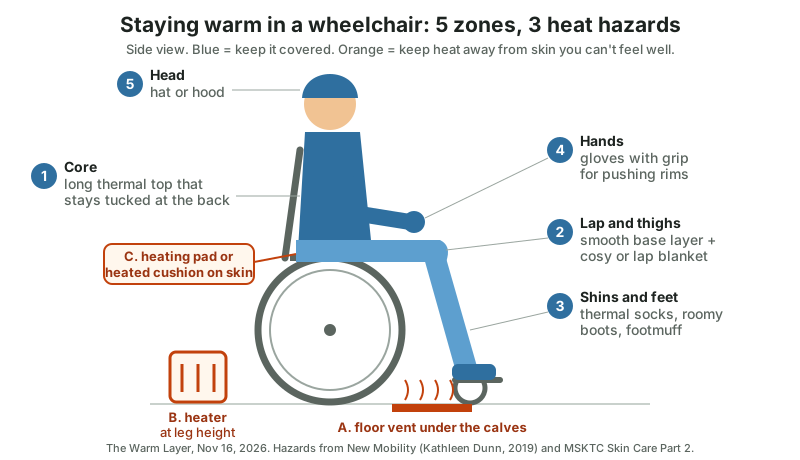
What the diagram shows, zone by zone:
- Core: a long thermal top that stays tucked at the back.
- Lap and thighs: a smooth base layer plus a cosy or lap blanket.
- Shins and feet: thermal socks, roomy boots and a footmuff.
- Hands: gloves with grip for pushing the rims.
- Head: a hat or hood.
The three heat hazards: (A) a floor heating vent under the calves, (B) a heater at leg height, and (C) a heating pad or heated cushion against the skin.
Cosy, leg wrap, lap blanket or poncho: which one fits you?
A waterproof wheelchair cosy suits wet, windy days out; a fleece leg wrap suits dry cold and indoor chills; a tucked lap blanket suits short trips; and a poncho covers arms and lap in the rain. We compared seven wheelchair covers from the two makers that publish full details on their own pages.
| Cover | Type | Size stated | How it stays on | Worth knowing |
|---|---|---|---|---|
| BundleBean Adult fleece-lined wheelchair cosy | Waterproof apron cover, fleece lined | 90 cm wide x 140 cm long | Two pairs of elastic and Velcro straps, elastic hem | Fits manual and powered wheelchairs and mobility scooters; folds down for PEG access; hand pocket |
| BundleBean Adult Wheelchair Cosy PLUS SIZE | Waterproof apron cover, fleece lined | 160 cm long x 110 cm wide | Fits without removing a harness or leaving the chair | Longer and wider for plus-size and tall users |
| BundleBean Wheelchair Fleece Leg Wrap | Fleece footmuff | 157 cm back, 102 cm front, 120 cm wide opened | Strap behind the seat, hook-and-loop front | Can be layered under the waterproof cosy |
| BundleBean Adult Wheelchair Poncho | Waterproof poncho with hood | Front 82 cm, back 61 cm, fits about 135-170 cm tall | Pull-on, poppers at chin and cuffs | Longer in front, stops at lower back; machine washable at 40 degrees |
| IZ Adaptive Outdoor Water Repellent Wheelchair Lap Blanket | Nylon shell, fleece and polyester fill | S/M and L/XL | Tucks under the thighs, Velcro with pull-tab | Wash cold, tumble dry low |
| IZ Adaptive Unisex Adaptive Parka Cape | Insulated cape | XS/S, M/L, XL/2XL | Tabbed zipper with Velcro | Extra-long front covers legs and feet |
| IZ Adaptive Unisex Adaptive Seated Parka | Insulated seated coat | XS to 3XL | Tabbed zipper with Velcro | Cut so it doesn’t bunch while seated; ribbed cuffs |
Two measuring tips before you order a fleece-lined wheelchair cosy or a wheelchair lap blanket: measure from your waist, over your knees, down to the footplate (BundleBean asks you to check leg and footplate length), and check that nothing will catch in the wheels or on a power chair’s joystick.
How do you keep feet warm on the footplate?
To keep feet warm on a wheelchair footplate, wear thermal socks inside boots with room to spare, then wrap the feet in a footmuff or the bottom of a cosy. Feet on a footplate barely move, so the boot and the cover do all the work.
- Size the boots for the socks. Thick socks in snug boots squeeze the toes, and squeezed feet get colder. Wide-width winter boots or a half size up leave room.
- No tight sock tops. If the cuff leaves a deep mark, it’s too tight for long sitting.
- Keep feet dry. Wet socks steal warmth fast; carry a spare pair.
- Check feet after a cold outing if you can’t feel them well (see the caregiver section below).
What coat works best when you’re sitting?
The best coat for a wheelchair is long in front and short in back, so it covers your lap without bunching behind you or catching in the wheels. A regular long coat does the opposite: it piles up behind your back and leaves your thighs open.
The Reeve Foundation’s cold-weather guide puts it simply: A coat should go around your whole body, not just across the front.
That’s why wheelchair ponchos and capes are cut the way they are. BundleBean’s adult poncho runs 82 cm from chin to front hem but only 61 cm from neck to back hem, and IZ Adaptive’s parka cape has an extra-long front to keep legs and feet warm. A wheelchair poncho also goes on over your head while you stay seated, with no wrestling an arm behind the chair back.
If you’d rather keep your usual jacket, pair a short, hip-length coat with a cosy or lap blanket. Together they cover the same zones as a seated parka.
What gloves work for pushing a wheelchair in the cold?
The best gloves for pushing a wheelchair in the cold are insulated gloves with a grippy palm, warm enough for the air and grippy enough for wet rims. Thick ski gloves slip, and bare hands on a cold metal rim lose heat fast.
Honest opinion: a cosy strapped to the chair is the unsung hero of winter. A plain blanket always seems to make a run for the wheels at the worst moment, and nobody needs that kind of drama on the sidewalk.
New Mobility’s Bob Vogel, a longtime wheelchair user, writes that winter gardening gloves by companies like Atlas offer the best blend of warmth
for pushing. Look for insulated Atlas-style work gloves with a coated palm, and keep a pair of mittens on your lap for waiting outside, when your hands aren’t working.
Are heating pads and heated seat cushions safe for wheelchair users?
Heating pads, heated seat cushions and electric blankets are not safe on skin you can’t feel well: every one of the five heat products’ manuals we read warns against using them on insensitive skin or with poor circulation. A burn on numb skin doesn’t hurt, so nobody stops it in time.
Kathleen Dunn, a retired clinical nurse specialist, told New Mobility: I’ve had clients that were burned when they fell asleep and had a heating pad shift to an area where they had no sensation.
The Reeve Foundation says to avoid electric blankets as they can burn your skin without your knowing
, and the MSKTC factsheet adds that after an SCI you are more susceptible to burns
.
Heated seat cushions are a popular winter buy, so read the box before one goes under someone who sits all day. The HealthMate Luxury Heated Seat Cushion’s manual says it shouldn’t be used by anyone who has sensory deficiencies in the lower half of their body
. A heated cushion is also not a pressure-relief cushion; never swap out the cushion your seating clinic fitted.
What do the makers’ own manuals say?
The makers’ own manuals agree: all five warn about reduced feeling or poor circulation and all five say not to use the product while sleeping. Three name diabetes, three say burns can happen at any setting, and one names paralysis outright.
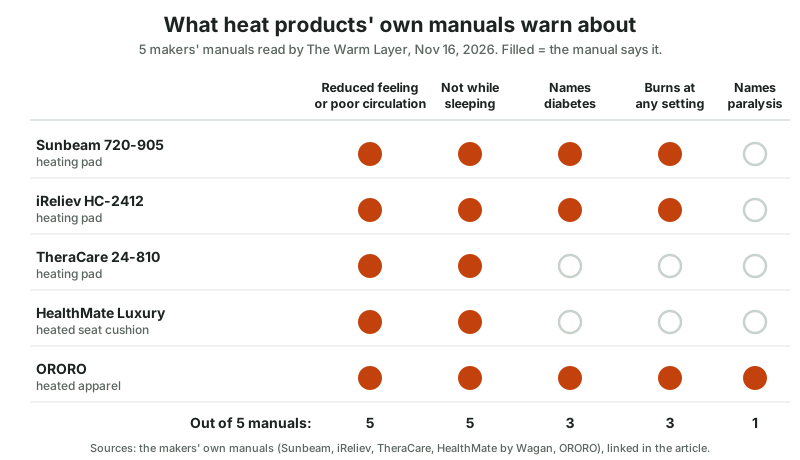
| Product | Reduced feeling or poor circulation | Not while sleeping | Names diabetes | Burns at any setting | Names paralysis | Auto-off |
|---|---|---|---|---|---|---|
| Sunbeam 720-905 heating pad | Yes | Yes | Yes | Yes | No (“an invalid”) | 2 hours |
| iReliev HC-2412 heating pad | Yes | Yes | Yes | Yes | No (“an invalid”) | 90 minutes |
| TheraCare 24-810 heating pad | Yes | Yes | Not stated | Not stated | No | About 2 hours |
| HealthMate Luxury Heated Seat Cushion | Yes | Yes | Not stated | Not stated | No | 60 minutes |
| ORORO heated apparel | Yes | Yes | Yes | Yes | Yes | Not in the warnings we read |
| Out of 5 | 5 | 5 | 3 | 3 | 1 | - |
One more number to keep in mind: the iReliev pad’s manual lists heat Adjustable up to 176°F
, and the TheraCare pad’s highest setting reaches 131 to 140°F (55 to 60°C). That’s a lot of heat for skin that can’t send a warning.
What if your doctor says heated gear is fine for you?
If you have full feeling where the heat goes and your doctor is happy with it, use heated gear exactly as its manual says: lowest comfortable setting, a base layer between the heat and your skin, and never while you might doze off. ORORO’s heated-apparel manual says NEVER wear directly against the skin
and ALWAYS wear a base layer between the product and the skin
, which is one more job for a thin thermal base layer.
Safer ways to warm up don’t involve heat on the skin at all. The Reeve Foundation suggests that if you get cold, you drink warm fluids or soup, wrap up in blankets
. Warm the room, not the skin.
How can a caregiver tell if someone is too cold?
A caregiver can tell if someone is too cold by looking and checking, not just asking, because a person with reduced feeling may not notice cold legs or feet. Take indoor breaks on long cold outings and look at the skin that can’t be felt, as New Mobility advises.
The CDC’s hypothermia page and frostbite page list the signs to watch for:
- Hypothermia (adults)
- Shivering, exhaustion or feeling very tired, confusion, fumbling hands, memory loss, slurred speech, drowsiness.
- Frostbite
- A white or grayish-yellow skin area, skin that feels unusually firm or waxy, numbness. The CDC adds:
Redness or pain in any skin area may be the first sign of frostbite.
- Most at risk of frostbite
- Nose, ears, cheeks, chin, fingers and toes.
Hypothermia means a core body temperature below 95°F (35°C), according to the National Institute on Aging’s cold weather safety page, and the NIA suggests setting your heat to at least 68°F (20°C) at home. If someone shows signs of hypothermia, call 911, move them somewhere warmer and wrap them in dry blankets. Because shivering may be missing below an SCI, a thermometer tells you more than “I’m fine”.
What should you check before heading out in the cold?
Before heading out in the cold in a wheelchair, check five things: layers on while you’re still warm, the cover fixed to the chair, dry socks in roomy boots, gloves with grip, and no heat source against numb skin. It takes about a minute at the door.
- Base layer on, top tucked, no wrinkles under the seat or behind the knees.
- Cosy, leg wrap or lap blanket strapped or tucked so it can’t slide into the wheels.
- Thermal socks, roomy boots, feet covered on the footplate.
- Gloves for pushing, mittens for waiting, a hat or hood.
- Phone charged, a spare pair of socks, a warm drink if it’s a long outing.
Want more warm ideas as we write them? Our free newsletter sends the layering tips we dig up ourselves, before the cold snaps arrive.
Now roll on out there, Captain — toasty toes, a warm lap, and not a single heating pad where it shouldn’t be. Enjoy every crisp, bright winter day.
Sources and further reading
- Christopher & Dana Reeve Foundation: Cold Temperature Control (Nurse Linda) — why the body below an injury can’t adjust, coats, electric blankets, warm fluids
- New Mobility: Wintertime SCI Skin Protection (Bob Vogel, March 1, 2019) — Kathleen Dunn on heating pads, vents, heated car seats; Diana Elledge, Craig Hospital, on layering
- New Mobility: Temperature Regulation Tips for Wheelchair Users (Bob Vogel, July 1, 2023) — reduced blood flow in the legs, gloves for pushing
- SCI Model Systems / MSKTC: Skin Care & Pressure Sores, Part 2: Preventing Pressure Sores — fitted clothing, seams and wrinkles, frostbite and burn risk
- CDC: Preventing Hypothermia — warning signs, who is at risk, loose layers
- CDC: Preventing Frostbite — signs, poor circulation as a risk
- National Institute on Aging: Cold Weather Safety for Older Adults — hypothermia below 95°F, heat at least 68°F
- NBC News Select: adaptive clothing (Veronika Bondarenko, June 9, 2020) — Tommy Hilfiger Adaptive seated pants quote
- BundleBean: wheelchair cosies, leg wraps and ponchos — sizes, fastening and care from the product pages
- IZ Adaptive: Outdoor Water Repellent Wheelchair Lap Blanket — also the Parka Cape and Seated Parka pages
- Sunbeam 720-905 heating pad manual — insensitive skin, diabetes, 2-hour auto-off
- iReliev HC-2412 Premium Heating Pad manual (PDF) — warnings, 90-minute auto-off, up to 176°F
- TheraCare 24-810 heating pad manual (PDF) — warnings, 2-hour auto-off, 131-140°F
- HealthMate (Wagan) Luxury Heated Seat Cushion 9432 manual (PDF) — sensory deficiencies warning, 60-minute auto-off
- ORORO heated apparel manual, ver. B0805 (PDF) — who shouldn’t use heated apparel, base layer rule, battery safety
Questions and answers
How do you keep your legs warm in a wheelchair?
Layer them: a smooth thermal base layer, thermal socks and roomy boots, then a wheelchair cosy, leg wrap or lap blanket fixed to the chair so it can’t slide off. Put the layers on indoors while your legs are still warm. Keep heating pads off skin you can’t feel well.
Can a paraplegic use a heating pad or electric blanket?
Not on skin without normal feeling. Heating pad manuals such as Sunbeam’s and iReliev’s say not to use them on insensitive skin, and the Reeve Foundation warns electric blankets can burn your skin without your knowing. Ask your doctor before using any heat product.
What is a wheelchair cosy?
A wheelchair cosy is a fleece-lined, usually waterproof cover that straps to the chair and wraps the user’s lap, legs and feet. BundleBean’s adult cosy, for example, measures 90 by 140 cm and fits manual and powered wheelchairs and mobility scooters without the user leaving the chair.
Why are my feet always cold in my wheelchair?
Feet on a footplate barely move, so less warm blood reaches them, and conditions like spinal cord injury, diabetes or poor circulation make that worse. Thermal socks in roomy boots and a footmuff help. If your feet are often pale, blue or numb, ask your doctor.
What should a wheelchair user wear in winter?
A smooth thermal base layer, seated-cut pants, a coat or poncho that’s long in front and short in back, a hat, gloves with grip for pushing, thermal socks and a cosy or lap blanket. Avoid thick seams and bulky back pockets where you sit.