
Doula Website Template: Birth and Postpartum Doulas (2026)
Disclosure: this page may contain affiliate links. We may earn from qualifying purchases, at no extra cost to you.
Picture an expecting parent at 2 a.m., gentle guide, typing what does a doula actually do
and finding a page that answers in plain, kind words.
A doula website template has to feel warm and explain clearly, and this guide covers the pages that do that, plus Medicaid and insurance information, consult booking and local search for birth and postpartum doulas.
A clear, friendly portrait matters more than anything else on a doula site, and a 5-in-1 photo reflector from Amazon softens light for a natural headshot outdoors.
Short answer: A doula website template should say who you support and where, explain what a doula does before, during and after birth, list services and packages, share your training and certifications, explain Medicaid and insurance options, and offer a free consult button. Keep health details out of plain contact forms.
- 28 states, Guam and Washington, D.C. have implemented Medicaid coverage for doula care, per the National Health Law Program’s latest tracker.
- Before 2020, only Oregon and Minnesota offered Medicaid doula coverage, per the same program.
- ACOG says continuous one-to-one support from a person such as a doula is associated with improved outcomes in labor.
- Reimbursement varies by state, from under $800 to more than $3,000 per pregnancy, in NHeLP’s data.
What should a doula website template include?
A doula website template should include who you support and where, a plain what does a doula do?
page, services and packages, an about page with training and certifications, Medicaid and insurance information, a free consult booking button, and the hospitals, birth centers or home births you attend. Families want warmth, clarity and fit.
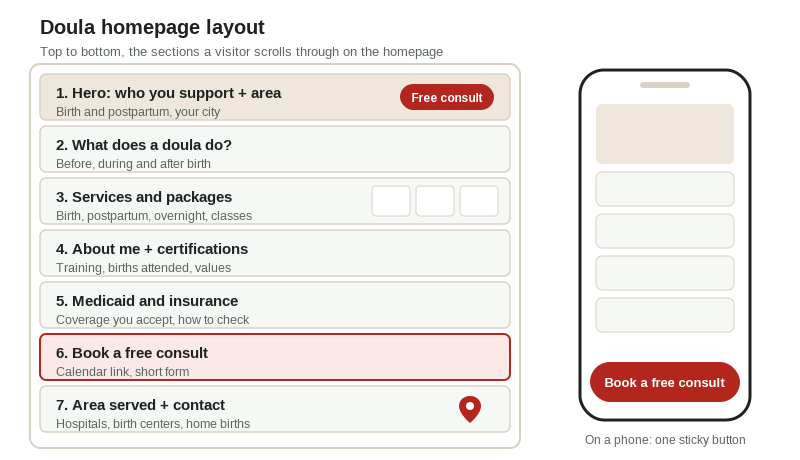
The drawing as text: (1) hero with birth or postpartum support and your city; (2) what a doula does; (3) services and packages; (4) about you and your certifications; (5) Medicaid and insurance; (6) free consult booking; (7) area served and contact.
How should a doula website explain what a doula does?
A doula website should explain that a doula gives non-medical support: emotional support, comfort measures, information and advocacy before birth, continuous support during labor, and help with feeding, rest and adjustment after birth. Say clearly that a doula does not replace the doctor or midwife.
Split it into “before birth”, “during labor” and “after birth”, each with three or four plain bullets. That structure matches how people ask and how AI assistants summarize.
What does the evidence say about doula support?
The evidence supports continuous labor support. In Committee Opinion No. 766, the American College of Obstetricians and Gynecologists wrote: Evidence suggests that, in addition to regular nursing care, continuous one-to-one emotional support provided by support personnel, such as a doula, is associated with improved outcomes for women in labor.
ACOG followed with a 2026 committee statement, Partnering With Doulas in Clinical Settings
. Linking those sources on your site shows families and clinicians that you work alongside the care team.
Does Medicaid cover doulas?
Medicaid covers doula care in a growing number of states: the National Health Law Program lists 28 states plus Guam and Washington, D.C. with coverage implemented. Rules, rates and enrollment steps differ by state, so a doula’s site should say which programs you accept.
| When | States with coverage implemented | Source |
|---|---|---|
| Before 2020 | 2 (Oregon, Minnesota) | NHeLP |
| February 2025 | 23 plus D.C. | NHeLP fact sheet |
| April 2026 | 26 plus D.C. | Axios, citing NHeLP |
| Latest tracker | 28 plus D.C. and Guam | NHeLP |
Georgetown’s Center for Children and Families compared doula reimbursement rates by state; a coverage page on your site can link your state’s program directly.
Where can you get a doula website template?
You can get a doula website template from wellness and personal-brand templates on Squarespace (a common choice for doulas, as autocomplete shows), Wix and Webflow, or from free WordPress.org themes. Choose soft colors, a large portrait area and generous text space.
This is the part that genuinely warms me: a clear page about Medicaid and insurance coverage can open doula support to families who thought it was out of reach.
How should a doula present services and packages?
A doula should present services as a few clear packages: birth support (prenatal visits, on-call period, labor support, a postpartum visit), postpartum support (daytime or overnight hours) and any classes. List what each includes in bullets so families can compare at a glance.
Mention your certification body if you have one, such as DONA International, and the number of births you have supported, if you are comfortable sharing it.
How should a doula website handle consults and private information?
A doula website should book free consults through a simple calendar link and ask only for name, contact details, due date and the kind of support wanted. Detailed health history belongs in a private conversation or a secure intake tool, not a public contact form.
How does a doula show up for “doula near me”?
A doula shows up for “doula near me” when the site names the cities, hospitals and birth centers served, the Google Business Profile matches it, and families leave reviews. Google says Relevance is how well a Business Profile matches what someone is searching for
(Google Business Profile Help).
Use the schema.org ProfessionalService type with name, areaServed and contact details, and write question headings like How much does a doula cost in our area?
answered honestly in the first sentence.
What should you remember about doula website templates?
Remember that a doula site is a first conversation: warm, clear and private. The facts worth keeping, from the sources above (November 25, 2026):
- 28 states + D.C. + Guam
- with Medicaid doula coverage implemented, NHeLP
- 2 before 2020
- Oregon and Minnesota were the only ones
- ACOG No. 766
- continuous support associated with improved outcomes
- 3 packages
- birth, postpartum, classes: simple to compare
- Private intake
- health details never in a public form
Write the explainer page, list your packages and add a consult button; the rest can grow with your practice.
Doulas who also offer counseling or wellness services may find our therapist website template guide useful for privacy-first forms.
So write the what does a doula do
page first, list your packages simply, and put a free consult button everywhere. The 2 a.m. reader will remember how calm your page felt.
Sources and further reading
- National Health Law Program: Doula Medicaid Project — 28 states, Guam and D.C. with coverage implemented; Oregon and Minnesota before 2020; reimbursement range
- NHeLP: Medicaid and Doula Care fact sheet (2025) — 23 states plus D.C. in February 2025
- Axios: More than half of states now cover doulas under Medicaid — 26 states plus D.C., April 2026
- Georgetown CCF: Doula Medicaid reimbursement by state — rates by state
- ACOG Committee Opinion No. 766: Approaches to Limit Intervention During Labor and Birth — continuous support quote
- ACOG: Partnering With Doulas in Clinical Settings (2026) — committee statement
- DONA International — doula certification body
- schema.org: ProfessionalService — structured data type
Questions and answers
What should a doula website include?
A doula website should include who you support and where, a plain explanation of what a doula does, services and packages, your training and certifications, Medicaid and insurance information, a free consult button, and the hospitals, birth centers or home births you attend.
What does a doula do during pregnancy?
During pregnancy a doula offers non-medical support: information about birth options, help preparing a birth plan, comfort techniques and emotional support. During labor they provide continuous support, and after birth they help with rest, feeding and adjustment.
Does Medicaid cover doula services?
In many states, yes. The National Health Law Program lists 28 states plus Guam and Washington, D.C. with Medicaid doula coverage implemented, with rules and rates that differ by state.
Is Squarespace good for a doula website?
Squarespace is a popular choice for doulas because its templates suit portrait-led personal brands and are easy to edit. Wix, Webflow and WordPress also work; pick the one you will keep updated.
Should a doula website list prices?
Many doulas list what each package includes and either a starting price or “contact for rates”, and mention Medicaid or insurance options. Being clear about what is included matters more than the exact figure.