Crock Pot LOW vs HIGH: What Temperature Is Each, and How Do Times Convert?
Disclosure: this page contains Amazon affiliate links. As an Amazon Associate we earn from qualifying purchases, at no extra cost to you.
Picture the crock pot knob staring back at you at 7 in the morning, my fellow dial decider, with LOW on one side, HIGH on the other, and a recipe that only gave you one time.
The honest answer lives in the clock, not the thermometer.
Two small tools make that easy to see in your own kitchen: a programmable slow cooker with a temperature probe that can switch itself to Warm, and a leave-in probe thermometer (both on Amazon) that reads the food without lifting the lid.
Short answer: LOW and HIGH end at about the same temperature, a simmer of roughly 200 to 209 °F; HIGH just gets there in about half the time. Crock-Pot says both settings stabilize near 209 °F. Hamilton Beach lists LOW at 180-200 °F and HIGH at 200-225 °F. Convert with 1 hour on HIGH = about 2 hours on LOW.
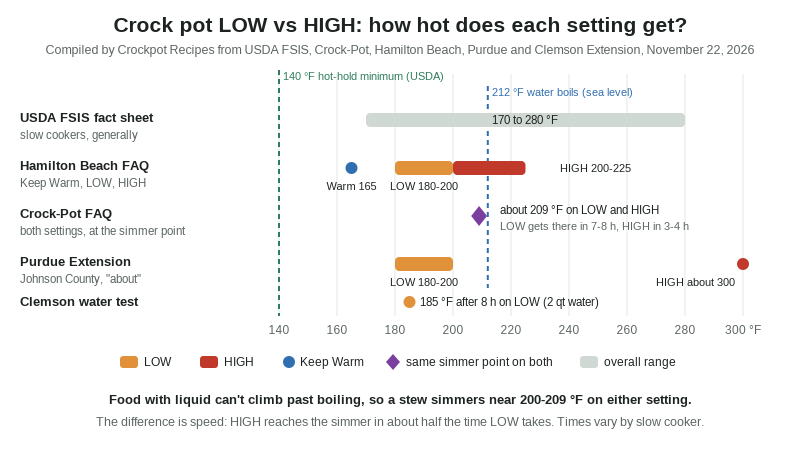
The chart’s facts, as text (each source’s own page, read November 22, 2026):
- USDA Food Safety and Inspection Service: a slow cooker cooks
generally between 170 °F and 280 °F
. - Hamilton Beach FAQ: HIGH 200-225 °F, LOW 180-200 °F, Keep Warm 165 °F.
- Crock-Pot FAQ: both HIGH and LOW reach the simmer point and stabilize at about 209 °F; LOW takes 7-8 hours to get there, HIGH 3-4 hours.
- Purdue Extension: LOW about 180-200 °F, HIGH about 300 °F.
- Clemson Extension water test: 2 quarts of water should read 185 °F after 8 hours on LOW.
- Reference lines: 140 °F, the USDA minimum for keeping cooked food hot; 212 °F, where water boils at sea level.
What temperature is LOW on a crock pot?
LOW on a crock pot brings food to about 180 to 200 °F, the range both Hamilton Beach and Purdue Extension give for the LOW setting.
Crock-Pot describes it by the finish line instead: on LOW, its slow cookers take 7 to 8 hours to reach a simmer of about 209 °F, then hold there.
The USDA’s Slow Cookers and Food Safety fact sheet doesn’t split the settings at all. It says a slow cooker cooks generally between 170 °F and 280 °F
, a range wide enough to cover every brand and both knobs.
What temperature is HIGH on a crock pot?
HIGH on a crock pot brings food to about 200 to 225 °F, according to the Hamilton Beach FAQ, and to the same 209 °F simmer as LOW, according to Crock-Pot, just sooner: 3 to 4 hours instead of 7 to 8.
Purdue Extension’s Basic Tips for Crock Pot Successes puts HIGH at about 300ºF
. That figure fits the top of the USDA’s 170-280 °F range better than it fits a pot of stew.
A stew, chili or soup with liquid in it can’t climb past the boiling point of water, 212 °F at sea level. So the food in a slow cooker on HIGH simmers near 200-212 °F; the higher numbers describe how hard the setting heats, not the food.
Why do LOW and HIGH end at about the same temperature?
LOW and HIGH end at about the same temperature because a slow cooker has no thermostat; the HIGH setting simply puts more watts into the same pot. Hamilton Beach says it plainly: Lo simply uses less watts and takes longer to get to the same cooked temperature.
Inside a typical Hamilton Beach slow cooker, two heaters wrap around the sides of the base. The company’s FAQ says one is typically used for Keep Warm, one for LOW, and both together on HIGH.
Crock-Pot’s General Information FAQ draws the practical conclusion: both settings stabilize at the same temperature, it is just a matter of how long it takes to reach the simmer point.
| Source | LOW | HIGH | Warm | How long to the simmer |
|---|---|---|---|---|
| USDA FSIS fact sheet (revised February 2012) | 170-280 °F for slow cookers in general | Hold hot food at 140 °F or above | several hours to reach a safe, bacteria-killing temperature | |
| Crock-Pot FAQ | About 209 °F once it stabilizes | About 209 °F once it stabilizes | Not given | LOW 7-8 hours, HIGH 3-4 hours |
| Hamilton Beach FAQ | 180-200 °F | 200-225 °F | 165 °F | LOW takes longer to get to the same cooked temperature |
| Purdue Extension (Johnson County) | About 180-200 °F | About 300 °F | Not given | 1 hour on HIGH = 2 to 2 1/2 hours on LOW |
| Clemson Extension, HGIC 3585 | 185 °F in 2 quarts of water after 8 hours | Not given | Hold hot food at 140 °F or above | Water test: 8 hours on LOW |
Compiled by Crockpot Recipes, November 22, 2026, from each source’s own page or fact sheet as listed in Sources. Your slow cooker may run hotter or cooler; check food with a thermometer.
What temperature is the Warm setting?
The Warm setting holds already-cooked food at about 165 °F on Hamilton Beach slow cookers, and it is not a cooking setting. The Hamilton Beach FAQ says Only cook on LOW or HIGH setting
and not to reheat food on Keep Warm.
The same FAQ says Keep Warm can be used for up to 2 hours for some foods
. For safety, the USDA’s number is the floor: hot food held for serving should stay at 140 °F or above, measured with a food thermometer.
How do you convert crock pot times between LOW and HIGH?
To convert crock pot times, double the HIGH time to get the LOW time: the Hamilton Beach 33740W manual says Generally, 1 hour on High is equal to 2 hours on Low.
Purdue Extension stretches it to 2 to 2 1/2 hours of LOW per hour of HIGH.
Crock-Pot’s own chart works differently. Its Cook Time & Quantity FAQ adds about 4 hours instead of doubling: 3 hours on HIGH is 7 on LOW, 4 is 8, and 8 hours on HIGH is 12 on LOW.
Here’s the catch: the three rules only agree in one spot. At 4 hours on HIGH, every source lands on 8 hours on LOW; for longer recipes they drift apart, by as much as 4 to 8 hours at the long end.
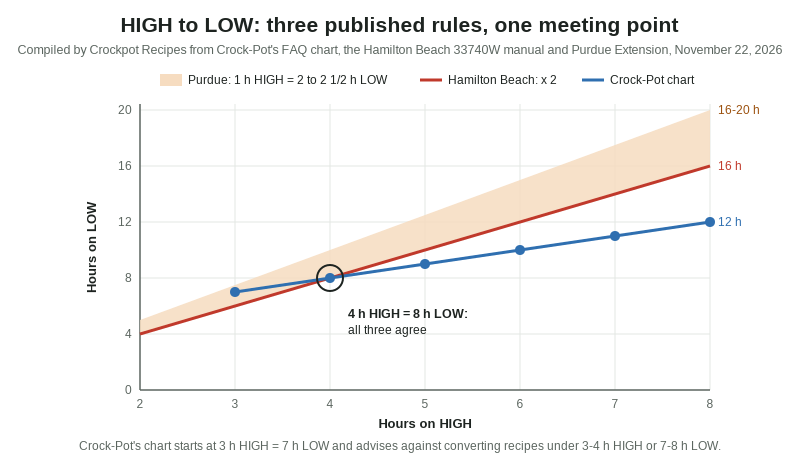
The chart’s numbers, as a table (our compilation, with our arithmetic in the last column):
| Recipe says HIGH | Crock-Pot chart (LOW) | Hamilton Beach, x 2 (LOW) | Purdue, x 2 to 2 1/2 (LOW) | Start checking on LOW at |
|---|---|---|---|---|
| 3 hours | 7 hours | 6 hours | 6 to 7 1/2 hours | 6 hours |
| 4 hours | 8 hours | 8 hours | 8 to 10 hours | 8 hours |
| 5 hours | 9 hours | 10 hours | 10 to 12 1/2 hours | 9 hours |
| 6 hours | 10 hours | 12 hours | 12 to 15 hours | 10 hours |
| 7 hours | 11 hours | 14 hours | 14 to 17 1/2 hours | 11 hours |
| 8 hours | 12 hours | 16 hours | 16 to 20 hours | 12 hours |
Compiled by Crockpot Recipes, November 22, 2026, from Crock-Pot’s Cook Time & Quantity FAQ chart, the Hamilton Beach 33740W manual and Purdue Extension’s Basic Tips for Crock Pot Successes. “Start checking” is our arithmetic: the shortest of the three, so you check doneness before anything can overcook. Done means the safe internal temperature, not the clock.
Crock-Pot adds one limit worth knowing: It is not recommended to convert recipes with cook times less than 7-8 hours on “Low” or 3-4 hours on “High.”
A 2-hour HIGH dip recipe stays a HIGH recipe.
How do you convert LOW to HIGH?
To convert LOW to HIGH, halve the LOW time: 8 hours on LOW becomes about 4 hours on HIGH, and every source agrees on that pair. Longer LOW recipes split the sources again.
- 6 hours on LOW: about 3 hours on HIGH (Hamilton Beach’s 2-to-1 rule; Crock-Pot’s chart doesn’t go below 7 hours LOW).
- 8 hours on LOW: about 4 hours on HIGH (all three).
- 10 hours on LOW: 5 hours on HIGH by Hamilton Beach’s rule, 4 to 5 by Purdue’s, 6 by Crock-Pot’s chart.
- 12 hours on LOW: 6 hours on HIGH by Hamilton Beach’s rule, about 5 to 6 by Purdue’s, 8 by Crock-Pot’s chart.
How do you convert an oven or stovetop recipe to a crock pot?
To convert an oven or stovetop recipe to a crock pot, Purdue Extension’s chart turns the original cooking time into slow-cooker hours, and the liquid gets cut by about half because almost nothing evaporates under the lid.
| Oven or stovetop time | LOW | HIGH |
|---|---|---|
| 15 to 30 minutes | 4 to 6 hours | 1 1/2 to 2 1/2 hours |
| 35 to 45 minutes | 6 to 8 hours | 3 to 4 hours |
| 50 minutes to 3 hours | 8 to 16 hours | 4 to 6 hours |
Source: Purdue Extension, Basic Tips for Crock Pot Successes (Linda Souchon, Johnson County office), conversion chart, read November 22, 2026.
Purdue’s exception to the liquid rule: rice, beans and pasta keep their full liquid, about 2 cups for every cup. Crock-Pot’s Cooking Tips FAQ gives the same advice for soups, stews and sauces from the stove: reduce the liquid or water.
Should you cook on LOW or HIGH?
Cook on LOW for all-day cooking and tough, less-tender cuts, and on HIGH when you have 3 to 5 hours. That is the USDA’s own guidance: Certainly, foods will cook faster on high than on low. However, for all-day cooking or for less-tender cuts, you may want to use the low setting.
Here’s the part we love: the two settings are basically racing to the same finish line, and HIGH just runs faster. So picking one is really about when you want dinner, not how hot you want it.
Crock-Pot adds that Most dishes can be prepared on either
setting; once food reaches the simmer, the cut and weight of the meat decide the rest. Hamilton Beach’s FAQ suggests choosing recipes that call for HIGH 4 to 5 hours or LOW 6 to 8 hours.
- A beef chuck roast or pork shoulder for the workday: LOW, the setting the USDA names for less-tender cuts and all-day cooking.
- A turkey breast: HIGH for the first hour, then LOW, as in our crock pot turkey breast for Thanksgiving (6 to 7 hours on LOW or 3 to 4 on HIGH for a 6- to 7-pound breast in a 6-quart cooker, to 165 °F).
- Potatoes for mashing: HIGH 3 to 4 hours, or LOW 6 to 7, in our no-boil slow cooker mashed potatoes.
- Chili, soup or stew: either one; pick the setting that matches when you want to eat.
Is it safe to cook on LOW all day?
Yes, it is safe to cook on LOW all day. The USDA fact sheet says to use the highest setting for the first hour if possible, then adds: However, it’s safe to cook foods on low the entire time — if you’re leaving for work, for example, and preparation time is limited.
The same fact sheet says food stays safe as long as the cooker is operating
. The part that matters is the start: thaw meat in the refrigerator first, because a slow cooker may take several hours to reach a safe, bacteria-killing temperature
. Our guide to frozen meat in a crock pot explains why.
Can you switch from HIGH to LOW partway through?
Yes, you can switch a crock pot from HIGH to LOW partway through, and the USDA recommends exactly that for the start of cooking: HIGH for the first hour, then LOW or the setting the recipe calls for.
To keep the total right, count each hour on HIGH as about 2 hours on LOW, the Hamilton Beach rule. A recipe written for 8 hours on LOW becomes 1 hour on HIGH plus about 6 hours on LOW (our arithmetic).
Switching the other way works too. Behind schedule at noon on a LOW recipe? Turning the knob to HIGH roughly halves whatever LOW time is left; check the temperature as the new finish time gets close.
What changes how long LOW and HIGH take?
Four things change how long a crock pot takes on LOW or HIGH: how full the crock is, how often the lid comes off, the size of the cooker, and the model itself. That is why every maker’s times are ranges.
- Fill level: Hamilton Beach says fill at least half and no more than three-quarters full, and to check for doneness 1 to 2 hours early when the crock is less than half full. Crock-Pot says 1/2 to 3/4; Clemson Extension says half to two-thirds.
- The lid: Clemson Extension says the temperature drops 10 to 15 °F when the lid is removed. Crock-Pot says not to remove it during the first two hours unless the recipe says so.
- Cooker size: Crock-Pot says to use the low end of a time range for a smaller-quart cooker and the high end for a larger one.
- Where the vegetables go: the USDA says vegetables cook slower than meat and poultry in a slow cooker, so they go in first, at the bottom.
How can you check what temperature your crock pot runs at?
Check what temperature your crock pot runs at with a water test: Clemson Extension’s HGIC 3585 says to fill the cooker with 2 quarts of water, heat it on LOW for 8 hours, and check with an accurate thermometer. The water should read 185 °F.
- Fill and cover: 2 quarts of water, lid on, LOW.
- Wait 8 hours without lifting the lid.
- Measure right away: Clemson notes the temperature drops 10 to 15 °F once the lid is off, so read it quickly.
- Read the result: above 185 °F, an 8-hour recipe may overcook; below it, Clemson says the cooker may not heat food high enough or fast enough. Purdue Extension’s version of the test says 180 to 200 °F, and to retire a cooker that reads under 180 °F.
Crock pot LOW vs HIGH at a glance
Every LOW and HIGH number in one list (USDA FSIS, Crock-Pot, Hamilton Beach, Purdue and Clemson Extension):
- LOW
- About 180-200 °F (Hamilton Beach, Purdue); reaches a simmer near 209 °F in 7-8 hours (Crock-Pot).
- HIGH
- About 200-225 °F (Hamilton Beach); the same simmer in 3-4 hours (Crock-Pot).
- Warm
- About 165 °F (Hamilton Beach); for holding cooked food at 140 °F or above, never for cooking or reheating.
- Convert
- 1 hour on HIGH = about 2 hours on LOW; 4 hours HIGH = 8 hours LOW by every source.
- Which one
- LOW for all-day cooking and tough cuts; HIGH for 3 to 5 hours; HIGH for the first hour if you can (USDA).
- Timing changes
- Fill 1/2 to 3/4 full; each lid lift costs heat; smaller cookers finish sooner.
- Check your cooker
- 2 quarts of water, 8 hours on LOW, should read 185 °F (Clemson).
Picture a recipe that only says 4 hours on HIGH
on a day you’ll be gone for 8. Now you know it’s a LOW day, with a thermometer check when you walk in the door.
So here’s the cheat code: double the HIGH time for LOW, start checking at the short end, keep the lid on, and let the thermometer have the final word. Then go do something more fun than watching a crock pot.
Sources and further reading
- USDA Food Safety and Inspection Service: Slow Cookers and Food Safety (fact sheet, revised February 2012, via govinfo.gov) — read in full: "generally between 170 °F and 280 °F"; "Certainly, foods will cook faster on high than on low. However, for all-day cooking or for less-tender cuts, you may want to use the low setting."; highest setting for the first hour, then low, or low the entire time (all quoted); "several hours to reach a safe, bacteria-killing temperature"; vegetables first; leftovers reheated to 165 °F elsewhere, held at 140 °F
- Crock-Pot: Cooking Tips FAQ — both "High" and "Low" reach the simmer point and stabilize at about 209 °F; fill 1/2 to 3/4 full; low-range time for smaller cookers; lid on for the first two hours; reduce liquid in stovetop recipes
- Crock-Pot: Cook Time & Quantity FAQ — simmer point 209 °F: LOW 7-8 hours, HIGH 3-4 hours to reach it; HIGH-to-LOW chart 3=7, 4=8, 5=9, 6=10, 7=11, 8=12 hours; no conversion under 7-8 h LOW or 3-4 h HIGH (quoted)
- Crock-Pot: General Information FAQ — both settings stabilize at the same temperature, "it is just a matter of how long it takes to reach the simmer point"; "Most dishes can be prepared on either" (quoted); shifts to Warm when done
- Hamilton Beach: Frequently Asked Questions (slow cookers) — High 200-225 °F, Low 180-200 °F, Keep Warm 165 °F; no thermostats; "Lo simply uses less watts and takes longer to get to the same cooked temperature" (quoted); two side heaters; only cook on LOW or HIGH; Keep Warm up to 2 hours for some foods; fill 1/2 to 3/4, less than half full = check 1-2 hours early; recipes HIGH 4-5 / LOW 6-8 hours
- Hamilton Beach 33740W slow cooker manual, page 4 (via ManualsLib) — "Generally, 1 hour on High is equal to 2 hours on Low." (quoted); food should not be cooked or reheated on Keep Warm
- Purdue Extension: Basic Tips for Crock Pot Successes (Linda Souchon, Johnson County office) — read in full: LOW about 180-200 °F, HIGH "about 300ºF" (quoted); 1 hour on High = 2 to 2 1/2 hours on Low; oven/stovetop conversion chart; reduce liquid by half except rice, beans and pasta; water test 180-200 °F after 8 hours on Low
- Clemson Cooperative Extension, Home & Garden Information Center: Slow Cooker Food Safety (HGIC 3585, E.H. Hoyle, updated February 8, 2022) — water test: 2 quarts, 8 hours on low, 185 °F; temperature drops 10-15 °F when the lid is removed; fill half to two-thirds full; hold hot food at 140 °F or above
Questions and answers
Is low on a crock pot 200 degrees?
Close to it. Hamilton Beach and Purdue Extension put the LOW setting at about 180 to 200 °F, and Crock-Pot says its slow cookers stabilize at about 209 °F on LOW once they reach the simmer point, which takes 7 to 8 hours. The exact number varies by model, so check food with a thermometer.
Is 4 hours on high the same as 8 hours on low?
Yes. 4 hours on HIGH equals about 8 hours on LOW by every rule we compared: Crock-Pot’s conversion chart, the Hamilton Beach manual’s 1-to-2 rule and Purdue Extension’s 2 to 2 1/2 times. For longer recipes the rules drift apart, so start checking doneness at the shortest time.
Does cooking on low make meat more tender than high?
Both settings end at about the same simmer, so tenderness comes from enough time at that temperature. The USDA suggests LOW for all-day cooking and less-tender cuts like chuck roast, because the long gentle heat suits them; Crock-Pot says most dishes can be made on either setting.
Can I cook on warm instead of low?
No. Warm holds already-cooked food at about 165 °F (Hamilton Beach) and is not a cooking setting; Hamilton Beach says to cook only on LOW or HIGH and never to reheat on Keep Warm. Cook on LOW or HIGH until the food reaches its safe temperature, then switch to Warm to hold it at 140 °F or above.
How long does a crock pot take to heat up on high?
About 3 to 4 hours to reach a full simmer on HIGH, compared with 7 to 8 hours on LOW, according to Crock-Pot. The USDA notes that a slow cooker may take several hours to reach a safe, bacteria-killing temperature, which is why meat goes in thawed and the USDA suggests HIGH for the first hour.