Hunting games › Trophies, rare furs and Great Ones
Trophy Scores, Rare Furs and Great Ones: The Collector's Side of Hunting Games
Disclosure: this page contains Amazon affiliate links. As an Amazon Associate we earn from qualifying purchases, at no extra cost to you.
For a lot of players, the hunt is only part of the fun - the other part is the trophy lodge. Chasing a diamond buck, a rare fur or a legendary Great One can keep you playing for hundreds of hours. Here's how that collector's side works in theHunter: Call of the Wild and Way of the Hunter (both on Amazon), and what it means for theHunter Classic.
Short answer: in Call of the Wild every harvested animal gets a trophy score and a medal - bronze, silver, gold or diamond - plus some animals have rare fur variants, and a few species have "Great Ones", which Avalanche Studios calls extremely rare. Way of the Hunter rates trophies with 1 to 5 stars and ties them to herd management: let the best animals grow old. Classic trophies disappear with the accounts on November 11, 2026.
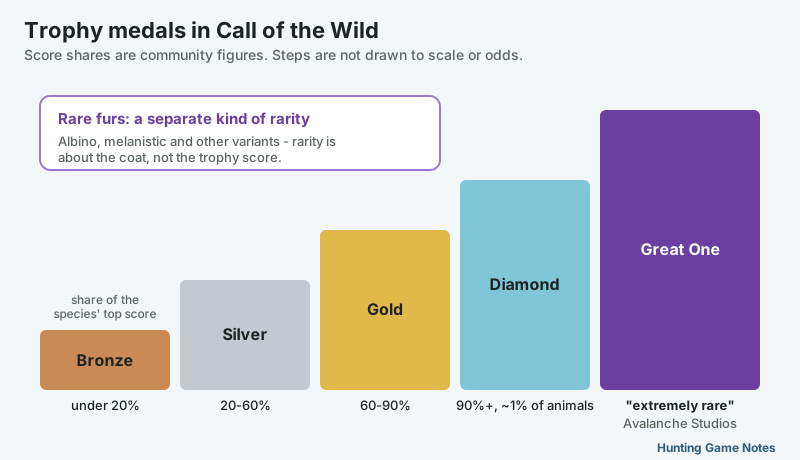
Call of the Wild: trophy scores and medals
Every animal you harvest gets a trophy score based on things like antlers, horns or size. That score earns a medal. The game shows you the result after the harvest; the exact cut-offs come from the community:
- Fan wikis describe the medal as a share of that species' top possible score - roughly bronze under 20%, silver 20 to 60%, gold 60 to 90% and diamond above 90%.
- Diamonds are rare - a fan wiki puts them at around 1% of animals.
- The developers reworked the scoring in 2020 with what Wikipedia, citing a developer post, calls the "Animal Scoring System 2.0", which went live on February 18, 2020.
Rare furs
Many species in Call of the Wild come in several fur variants, and some are much rarer than others - albino and melanistic animals are the famous ones. Community guides and wikis list the variants and how rare each is per species. They're a big reason players keep hunting the same reserve long after they've seen everything.
Great Ones
Great Ones are Call of the Wild's legendary animals. When Avalanche Studios announced the Moose Great One in a press release on November 10, 2022, it called it "one of the extremely rare Great Ones" and listed three at the time: the Moose, the Black Bear and the Whitetail Deer. Fan wikis say the first one, the Whitetail, arrived in 2020 and that more species have been added since.
Players say Great Ones score far above a normal diamond and that getting a chance at one takes a long chain of effort. The details of how they appear are a favorite topic on the forums - check a current community guide before you plan a grind.
Way of the Hunter: stars, fitness and herd management
- 1 to 5 stars. Players describe trophies rated in stars, with each species having its own score ranges per star.
- Fitness. Each animal has a fitness or condition rating that, according to players, limits how many stars it can reach.
- Herd management. The idea is to take weaker animals so the best ones get old enough to become top trophies. Players disagree on how far to push it - many advise against taking young animals, since you can't know yet how they'll turn out.
It's closer to how real wildlife managers think: in real deer, antler size depends on age, nutrition and genetics, which is why groups like the National Deer Association talk so much about letting young bucks grow.
theHunter Classic: trophies at shutdown
Classic had its own long history of trophies and competitions. But when the game shuts down on November 11, 2026, all accounts and information are deleted, according to the developers. If your trophy lodge means something to you, take screenshots before then (what's confirmed).
Real-world trophy scoring
Games borrow the idea of trophy scores from real hunting, where systems like the Boone and Crockett Club's measure antlers and horns in a standard way. Game scores aren't the same formulas, but the spirit is similar: bigger, older, more symmetrical animals score higher.
Tips for trophy hunters
- Learn the animals' routines first (need zones and routines).
- Use binoculars and your game's tools to judge an animal before you shoot.
- Make clean shots - poor hits can hurt your score in some games (shot placement).
- Be patient. Diamonds and rare furs take time, and Great Ones take a lot more.
Frequently asked questions
What is a Great One in theHunter: Call of the Wild?
A legendary, extremely rare version of certain species that scores far above a normal diamond. Avalanche Studios' 2022 announcement listed the Moose, Black Bear and Whitetail; more have been added since, according to fan wikis.
How are trophy medals decided in Call of the Wild?
By the animal's trophy score compared with the best possible for that species. Fan wikis describe roughly: bronze under 20%, silver 20-60%, gold 60-90%, diamond above 90%.
How do star ratings work in Way of the Hunter?
Players describe trophies rated 1 to 5 stars, with score ranges per species and an animal's fitness limiting how many stars it can reach.
What happens to my theHunter Classic trophies?
The developers say all accounts and information are deleted when Classic shuts down on November 11, 2026. Screenshot anything you want to keep.
Sources and further reading
- Avalanche Studios press release (Nov 10, 2022): New England Mountains and the Granite Update - Moose Great One; "extremely rare Great Ones"
- Wikipedia: theHunter (series) - Animal Scoring System 2.0, February 18, 2020
- Steam community guide: trophy ratings and fur types - community-maintained
- Way of the Hunter Steam discussion: star ratings - community view
- theHunter Classic official announcements - accounts deleted at shutdown
- Boone and Crockett Club - real-world trophy scoring
- National Deer Association - deer age, nutrition and genetics
How this was written: Based on official announcements (Avalanche Studios' press release on Great Ones, theHunter Classic's shutdown posts), the Wikipedia article on the series, and community guides and wikis. Exact percentages and thresholds come from players and are labeled that way.