Medical Chronology Software for Personal Injury: How It Works and What to Pick
Hello, and welcome to everyone who has ever highlighted page 847 at 6 p.m.
If a box of medical records is sitting on your desk and the demand is due Friday, this guide is for you.
In most small personal injury firms, a paralegal still reads every page and types each visit into a Word table or a spreadsheet.
It is careful work, it is slow work, and the one note about a prior back injury on page 847 is always the note that matters.
Short answer: Medical chronology software for personal injury reads scanned medical records with OCR and AI, sorts every visit by date and provider, removes duplicates, extracts diagnoses, treatment and bills, and links each entry to its source page. Tools include EvenUp MedChrons, Filevine MedChron and Supio. A paralegal still reviews gaps, priors and flags before the demand.
What does medical chronology software for personal injury actually do?
Medical chronology software turns a pile of records into a date-ordered table of every visit, with each line linked to the page it came from.
EvenUp’s own guide defines a medical chronology as a concise, factual report that summarizes a patient’s medical treatment history in date order.
The software does the reading, sorting and first draft of that report.
Your records do not change. Hospitals, chiropractors, imaging centers and pharmacies keep sending their own formats. What changes is that nobody types the timeline from scratch.
Most products then reuse the same chronology for the next jobs: the treatment summary, the medical specials total and the first draft of the demand letter.
How long does a medical chronology take to build by hand?
Building a medical chronology by hand usually takes a full working day or more per case, and complex files take several days.
Published estimates vary a lot, and they all come from companies that sell chronology software or services. CaseAgent reports about 8 to 10 hours and past 20 on complex files.
Healix says a 500 page set takes the average paralegal four to six hours. Read them as rough ranges, not facts about your firm.
The clearest way to see the cost is reading speed. CaseAgent puts manual review at about 50 pages an hour on clean typed records and about 20 an hour on handwritten ones. We used those two rates for the calculation below.
| Pages in the file | Typed pages at 50 an hour | Handwritten pages at 20 an hour | Reading hours | Wage cost at $30.24 an hour |
|---|---|---|---|---|
| 300 | 240 pages, 4.8 hours | 60 pages, 3.0 hours | 7.8 | $236 |
| 500 | 400 pages, 8.0 hours | 100 pages, 5.0 hours | 13.0 | $393 |
| 1,000 | 800 pages, 16.0 hours | 200 pages, 10.0 hours | 26.0 | $786 |
| 2,500 | 2,000 pages, 40.0 hours | 500 pages, 25.0 hours | 65.0 | $1,966 |
Assumptions: 80 percent typed and 20 percent handwritten pages, CaseAgent’s two reading rates, and the US median paralegal wage of $30.24 an hour from the Bureau of Labor Statistics (May 2025). That wage leaves out benefits and overhead, so the true cost to your firm is higher.
Reading is only the start. Writing the entries, checking bills against visits and formatting the table come on top, which is why one big file can quietly take a whole week.
How does AI turn a scanned records packet into a chronology?
AI chronology software follows the same six steps a careful paralegal follows, only the reading and typing happen in minutes.
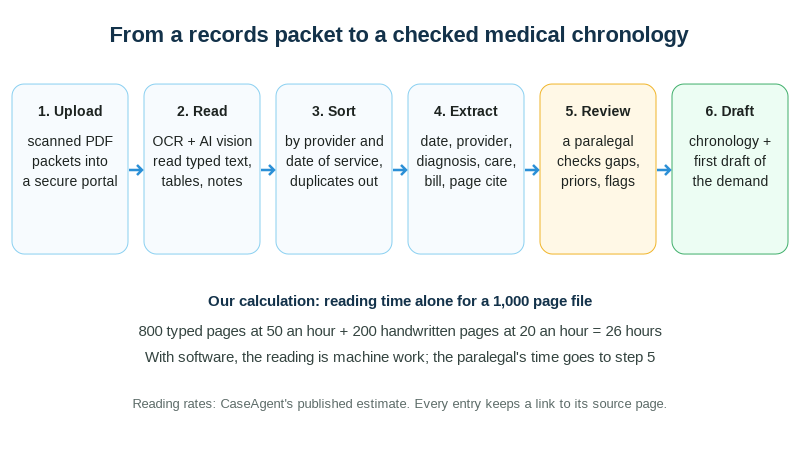
- Upload. The paralegal drops the scanned PDF packets into a secure portal or the case file. Records from new providers can be added later, and the chronology updates.
- Read. OCR and an AI vision model read typed notes, tables, forms and, less reliably, handwriting. Anthropic’s Claude PDF support, for example, turns each page into an image plus its extracted text, up to 600 pages per request.
- Sort. Pages are grouped by provider and date of service. The same ER visit sent by the hospital and by the billing company is merged into one event.
- Extract. Each visit becomes one row: date, provider, encounter type, complaints, diagnosis, treatment, bill amount and the page citation.
- Review. The software flags gaps in treatment, earlier injuries, bills without a matching record and anything it read with low confidence. A paralegal decides what each flag means.
- Draft. The checked chronology is exported to Word or PDF, saved to the case, and used to draft the treatment summary and the demand letter.
The six steps as text: 1 upload scanned PDFs, 2 read with OCR and AI vision, 3 sort by provider and date and drop duplicates, 4 extract date, provider, diagnosis, care, bill and page cite, 5 paralegal review of gaps, priors and flags, 6 chronology plus a first draft of the demand.
What should a personal injury medical chronology include?
A personal injury medical chronology should hold one row per visit, with the same columns every time, and a page citation on every row.
| Column | What goes in it | Why it matters |
|---|---|---|
| Date of service | The date on the note, not the dictation or signature date | Keeps the timeline honest when records arrive out of order |
| Provider and facility | Treating clinician, practice or hospital, specialty | Shows the path from ER to specialist to therapy |
| Encounter type | ER visit, office follow up, imaging, therapy, surgery | Lets the attorney filter the story fast |
| Complaints and findings | What the record says that day, in its own words | Ties symptoms to the incident |
| Diagnosis and codes | Diagnoses with ICD-10 codes; CPT codes from the bills | Connects the bills to the care |
| Treatment ordered | Medication, referrals, procedures, work restrictions | Supports future care and lost wages |
| Bill amount | Charge for that date from the itemized bill | Builds the medical specials total |
| Page citation | Bates number or page range | Lets anyone check the line in seconds |
CaseAgent’s guide is blunt about the last column: the citation is not optional.
Good software makes every citation a clickable link back to the page.
Which medical chronology software do personal injury firms use?
The best-known medical chronology tools for personal injury firms are EvenUp MedChrons, MedChron by Filevine and Supio, and a custom pipeline is the fourth option.
Honestly, the best thing about a source-linked chronology is the calm it brings to a hard week. Nobody has to defend a line from memory; they just click it and show the page.
| Option | How it works | Review | Public price |
|---|---|---|---|
| EvenUp MedChrons | Built from PI records, every entry cited to its source page; feeds EvenUp’s demand drafting | Two tiers: “AI + You” (your team reviews) or AI + Professional Reviewwith optional nurse review | Not listed; case-based pricing by call |
| MedChron by Filevine | Runs inside Filevine case projects; every fact links back to its source document | Your team edits events and regenerates; flags billed services with no record, CPT mismatches and 30+ day treatment gaps | Not listed on the product page |
| Supio | Pins every fact to its source; filter the timeline by events, providers and treatments | Your team reviews; Supio says it spots gaps and other case signals | Not listed; demo by request |
| Custom pipeline | Your own secure portal plus OCR and an AI model, writing into the case management system you already use | Your paralegal reviews; flags and rules are set to your firm’s habits | Depends on page volume and build |
If your firm already lives in Filevine, MedChron is the shortest path because the records are already in the case project. EvenUp makes the most sense when you also want its demand letters. Supio suits firms that want to question and filter the timeline by provider and treatment.
A custom pipeline fits firms on Clio, Litify or another system, or firms that also want immigration packets and police reports sorted the same way, and a 24/7 phone line that takes new injury leads at night.
What does medical chronology software still get wrong?
Medical chronology software is good at reading and sorting, and still needs a person for judgment, handwriting and anything that changes case value.
- Handwritten notes. Chiropractic and therapy notes are often handwritten, and that is where misreads happen. Low-confidence pages should go to a person.
- Prior injuries. The software can flag an old back complaint; only your team can decide whether it is a pre-existing condition or an unrelated visit.
- Treatment gaps. A 45 day gap may be a missing record, a holiday or a client who stopped going. Request the missing records before anyone explains it.
- Bills and liens. Charges, write-offs and lien amounts change. Check the specials total against the latest itemized bills.
- Missing providers. Software only reads what it receives. A provider who never sent records is invisible until someone notices.
ABA Formal Opinion 512 says it directly: GAI tools cannot solely substitute for a lawyer’s competent legal work.
The chronology is a draft until a person has checked it.
Is it safe to put client medical records into AI software?
Client medical records can go into AI software safely when the vendor contractually protects them, does not train on them, and your firm follows ABA guidance on consent.
The American Bar Association’s Formal Opinion 512 on generative AI (July 29, 2024) says a client’s informed consent is needed before client information goes into a self-learning tool, and that boilerplate in an engagement letter is not enough. The NCBE’s Bar Examiner summary walks through it, and your state bar may add its own rules.
Ask every vendor for its security terms in writing. Supio says it is SOC 2 Type II certified and HIPAA compliant, and Filevine says MedChron meets SOC 2 and HITECH standards.
For a custom build, the pieces can be chosen for health data. Amazon Textract is on AWS’s HIPAA eligible services list, used under a signed AWS business associate agreement, and records can stay in the firm’s own storage.
Getting the records in the first place has its own rules. Under 45 CFR 164.524, a provider must act on a patient’s access request within 30 days, with one extension of no more than 30 days, and must send the copy to a person the patient designates in writing, such as their attorney.
How do you choose medical chronology software for a small PI firm?
Choose medical chronology software by running your own messiest closed file through it and checking the result line by line.
- Does every entry link to the exact source page, and does the link open the right page?
- Did it merge duplicate records from the hospital and the billing company correctly?
- Did it catch the prior injury and the treatment gap your paralegal already knows about?
- How did it handle the handwritten therapy notes?
- Can the chronology be exported to Word or PDF and saved to your case management system?
- Is pricing per case, per page or per seat, and what does your monthly page count cost?
- Does the contract say your data is not used to train models, and where is it stored?
- Can you add late records without rebuilding the whole chronology?
A closed file is the honest test, because you already know the right answer.
What does a sensible first month look like?
A sensible first month runs the software beside your paralegals, not instead of them.
- Week 1: run two closed files through the software and compare the result with the chronologies your team built.
- Week 2: run every new records packet through it in the background while the team keeps working as usual.
- Week 3: let the software draft, and have paralegals review only the flags and a spot check of normal rows.
- Week 4: count the hours saved and the misses caught, then decide whether to keep it.
If it does not save real hours on your own files in that month, it is not worth keeping. That is the honest test, and the coffee budget will thank you either way.
Give your paralegals one file where the reading is already done, and see where they put the hours they get back.
Sources and further reading
- EvenUp: MedChrons medical chronology software
- EvenUp: What is a medical record chronology in personal injury cases
- Filevine: MedChron AI medical chronology
- Supio: medical chronologies
- Supio: security statement (SOC 2 Type II, HIPAA)
- Anthropic: Claude PDF support
- AWS: HIPAA eligible services reference
- 45 CFR 164.524: access of individuals to protected health information
- NCBE Bar Examiner: ABA Formal Opinion 512 on generative AI tools
- BLS: paralegals and legal assistants, median pay
- CaseAgent: reading rates and chronology time (vendor estimate)
- Healix: time for a 500 page record set (vendor estimate)
Questions and answers
Can I use AI to build a medical chronology for a personal injury case?
Yes. AI software can read scanned medical records, sort every visit by date and provider, extract diagnoses, treatment and bills, and link each entry to its source page. A paralegal or attorney still has to review gaps, prior injuries and low-confidence pages before the chronology is used in a demand.
How much does medical chronology software cost?
EvenUp, Filevine and Supio do not list chronology prices on their product pages; EvenUp describes case-based pricing and the others take demo or sales calls. Ask for the price per case and per page, and compare it with your own paralegal hours on a typical file.
How accurate is AI medical chronology software?
It depends on the scan quality, the share of handwritten notes and how varied your providers are. Test it on a closed file your team already knows, check every source link, and keep low-confidence pages for human review instead of trusting a headline accuracy number.
Can medical chronology software find gaps in treatment?
Yes. Filevine says MedChron flags stretches of 30 or more days with no treatment records, and Supio says it spots gaps and other case signals. The software only finds the gap; your team decides whether it is a missing record or a real pause in care.
Does medical chronology software replace a nurse consultant?
Not fully. The software reads and organizes records quickly, but clinical judgment about causation or prior conditions still needs a qualified person. EvenUp offers optional nurse review in its professional review tier for that reason.