Is PDRN Safe During Pregnancy and Breastfeeding?
Disclosure: this page contains Amazon affiliate links. As an Amazon Associate we earn from qualifying purchases, at no extra cost to you. PDRN topical products are cosmetics, not medical treatments, and nothing here is medical advice.
Hello, bump-and-baby label sleuth, if you’re holding a PDRN serum and wondering whether it’s still OK now that you’re pregnant or nursing, this one’s for you.
Topical PDRN isn’t on any pregnancy avoid list we found, but nobody has studied it in pregnancy or breastfeeding, so the honest answer is probably low risk, but not proven safe.
The bigger worry is usually the other ingredients in the same bottle, like retinol.
If you want to browse while you read, here are retinol-free PDRN serums on Amazon, and please check every label against the list below before you buy.
Short answer: Not proven either way: no study has tested PDRN in pregnancy or breastfeeding. Topical PDRN isn’t on the AAD’s list of pregnancy ingredients to avoid, but PDRN and “salmon DNA” injections are a no. Some PDRN products also contain retinol or retinal, which you should skip. Show any product’s ingredient list to your doctor before you use it.
- Pregnancy studies on PDRN: none. A 2026 review in the Journal of Cutaneous and Aesthetic Surgery says PN/PDRN use in pregnancy and lactation
is not recommended due to a lack of studies
. - Injections: the same review lists pregnancy and lactation as contraindications for polynucleotide and PDRN injections.
- Size: PDRN molecules weigh about 50-1,500 kilodaltons, 100 to 3,000 times the 500 Dalton line that skin-absorption research uses (our calculation).
- The real label risk: the American Academy of Dermatology (AAD) says to avoid retinoids during pregnancy, and 2 of the 5 popular PDRN products we checked (40%) name a retinoid.
- Breastfeeding: keep skincare off the nipple and areola and wash it off the chest before a feed (MotherToBaby’s advice for topical acne products).
Is PDRN safe to use while you’re pregnant?
PDRN hasn’t been studied in pregnancy, so no one can honestly call it “pregnancy-safe.” What we can say is that topical PDRN isn’t on the AAD’s list of ingredients to avoid during pregnancy, that very little of a big molecule like PDRN is likely to get through skin, and that injected PDRN is a different story and should wait.
The AAD starts from a reassuring place: You can safely use a lot of skin care products during pregnancy.
But it also says some ingredients can pose a risk to your baby
, and its advice is to tell your obstetrician and dermatologist about all the medications and prescription skin care you use
. A PDRN serum fits that rule like any other new product: it goes on the list you show your doctor.
What does the research say about PDRN in pregnancy?
There is no published research on PDRN in pregnancy or breastfeeding, for skincare or for injections. A 2026 narrative review of polynucleotides (PN) and PDRN in dermatology, by G. Arora in the Journal of Cutaneous and Aesthetic Surgery, puts it plainly:
The use of PN/PDRN in pregnancy and lactation is not recommended due to a lack of studies.
That sentence is about missing evidence, not about harm someone found. Nobody has shown PDRN hurts a pregnancy, and nobody has shown it doesn’t. Most of the PDRN research in that review is about injections and lab work; the review notes that topicals may have limited penetration and, hence, are less efficacious than injections
.
Does PDRN even get through the skin?
Probably very little, because PDRN is a huge molecule. The 2026 review gives PDRN a molecular weight of typically between 50 and 1500 kilo Daltons (kDa)
, and a classic paper in Experimental Dermatology (Bos and Meinardi, 2000) argued that a compound needs to be under 500 Daltons to get through healthy skin. Here’s how the sizes compare:
| Molecule | Size | Compared with the 500 Da line |
|---|---|---|
| Retinol (vitamin A in skincare) | 286.5 Da | Under the line (57% of it) |
| Tretinoin (prescription retinoid) | 300.4 Da | Under the line (60% of it) |
| PDRN, smallest pieces | 50 kDa = 50,000 Da | 100 times bigger |
| PDRN, largest pieces | 1,500 kDa = 1,500,000 Da | 3,000 times bigger |
So a little of a retinoid can get into skin (one reason retinoids carry pregnancy warnings), while PDRN is 100 to 3,000 times past the line. That’s encouraging, but it isn’t proof of safety. The 500 Dalton rule is about healthy, intact skin; broken or irritated skin, microneedling and “needle shot” products are designed to let more through. VT Cosmetics, for example, says the spicules in its PDRN Reedle Shot 100 work by enhancing the penetration of beauty ingredients into the skin
. While you’re pregnant, we’d keep things simple and skip penetration tricks altogether.
Are PDRN or “salmon DNA” injections safe during pregnancy?
No, wait until after pregnancy and breastfeeding. The 2026 Journal of Cutaneous and Aesthetic Surgery review lists Pregnancy and lactation
among the contraindications for polynucleotide and PDRN injections, next to things like active infection at the injection site and autoimmune conditions.
Injected PDRN, the Rejuran-style “skin booster” treatments you see on social media, is a medical procedure that puts the ingredient under the skin, past the barrier that keeps most of a serum out. That makes it a completely different question from a serum on the surface. A licensed injector should ask whether you’re pregnant or breastfeeding before any treatment; if they don’t, tell them anyway.
Which ingredients in a PDRN product should you avoid while pregnant?
Avoid any PDRN product that contains a retinoid (retinol, retinal, retinyl esters, tretinoin, adapalene, tazarotene) or hydroquinone, and ask your dermatologist about anything on the AAD’s “use sparingly” list. These rules come from the ingredients themselves, so they apply whether or not the product has PDRN in it.
The AAD’s pregnancy skin care page explains why the label matters:
Some prescription and over-the-counter skin care ingredients can put your baby at risk of birth defects.
The AAD’s avoid list includes retinoids, hydroquinone (an ingredient that lightens skin tone
), and the medicines finasteride, spironolactone, tetracycline, doxycycline, minocycline and 5-fluorouracil. The AAD’s tip for checking is simple: look at the ingredients portion of the product’s label
.
Why are retinol and other retinoids off the table?
Retinoids taken by mouth are known to cause birth defects, so doctors advise avoiding the skin versions too, even though much less gets absorbed. MotherToBaby, a service of the Organization of Teratology Information Specialists, says in its topical acne treatments fact sheet that it is generally recommended to avoid topical retinoid medications such as tretinoin and adapalene during pregnancy, because retinoids taken by mouth cause birth defects. Its tretinoin fact sheet adds that only a small amount is likely absorbed through the skin, yet the safest approach may be to avoid use of tretinoin during pregnancy
. Retinol and retinal in cosmetics are cousins of tretinoin, so they go in the same “after the baby” box.
What does “use sparingly” mean for pregnancy skincare?
A “use sparingly” ingredient is one the AAD says is fine in limited amounts but not well enough studied to use freely. In the AAD’s words, Some ingredients are safe to use on a limited basis while you’re pregnant.
Its list includes salicylic acid (high doses), benzoyl peroxide, parabens, phthalates, phenol, triclosan and essential oils, and the AAD says to discuss them with your dermatologist and limit how often you use them. MotherToBaby notes that, under guidance from the American College of Obstetricians and Gynecologists (ACOG), over-the-counter benzoyl peroxide, azelaic acid, salicylic acid or glycolic acid may be used during pregnancy if needed.
Which popular PDRN products contain retinol or retinal?
Of the five popular PDRN products we checked, two name a retinoid: Medicube’s PDRN Pink Peptide Eye Cream lists retinol as a key ingredient, and mixsoon’s PDRN Collagen Retinal 6 Capsule Serum is built around retinal. The other three list no retinoid and no hydroquinone. Here’s the full check, so you can see how we got there.
I’ll admit it: there’s something oddly satisfying about catching a sneaky retinol hiding in an eye cream’s ingredient list, like finding the one sock that ran off in the dryer.
| Product | PDRN source (per the maker) | Retinoid named? | AAD avoid list | Worth asking your doctor about |
|---|---|---|---|---|
| Anua PDRN Hyaluronic Acid Capsule 100 Serum | Salmon DNA | No | None found | Nothing flagged; plant extracts (neem, turmeric, holy basil) |
| VT Cosmetics PDRN Essence 100 | Ginseng (“PHYTO PDRN”) | No | None found | Nothing flagged |
| COSRX The 5 PDRN Collagen Intense Vitalizing Serum | Salmon plus four plant and probiotic sources | No | None found | Alpha-arbutin (a brightener) |
| Medicube PDRN Pink Peptide Eye Cream | Salmon DNA | Yes: retinol | Retinoid | Skip while pregnant |
| mixsoon PDRN Collagen Retinal 6 Capsule Serum | Plant-based | Yes: retinal (Retinal 6% Capsule Complex) | Retinoid | Skip while pregnant |
What the table shows, in words:
- Anua PDRN Hyaluronic Acid Capsule 100 Serum (Anua): a fragrance-free hyaluronic acid serum with salmon-derived Sodium DNA and niacinamide; no retinoid, no hydroquinone. Look for the Anua PDRN Hyaluronic Acid Capsule 100 Serum on Amazon.
- VT Cosmetics PDRN Essence 100 (VT Cosmetics): an essence with ginseng-sourced PDRN, ceramides, panthenol and squalane; no retinoid, no hydroquinone. Look for the VT PDRN Essence 100 on Amazon.
- COSRX The 5 PDRN Collagen Intense Vitalizing Serum (COSRX’s launch announcement): no retinoid, but it lists alpha-arbutin, a brightening ingredient made of hydroquinone bonded to a sugar. Alpha-arbutin isn’t on the AAD’s list; hydroquinone is, so it’s one to show your doctor.
- Medicube PDRN Pink Peptide Eye Cream (Medicube): Medicube names its key ingredients as Salmon DNA PDRN, retinol, peptide and niacinamide, so it’s a retinoid product. Save it for after pregnancy, and ask your doctor before using it while breastfeeding.
- mixsoon PDRN Collagen Retinal 6 Capsule Serum (mixsoon): plant-based PDRN, but the whole product is built around a
Retinal 6% Capsule Complex
, and retinal is a retinoid. Skip it while pregnant.
Our count: 2 of 5 (40%) of these PDRN products name a retinoid, and both say so in the product name or key-ingredient list. One more label lesson: the ingredient list on mixsoon’s US product page didn’t show “retinal” when we checked, while a retailer listing of the same serum did. Lists change between batches and shops, so always read the box in your hand, and treat a product with “retinol” or “retinal” in its name as a retinoid product whatever a web page says. We have not tested these products on anyone; this is a check of what the makers and retailers print.
Is PDRN safe while breastfeeding?
PDRN hasn’t been studied in breastfeeding either, but very little of a skincare product applied to your face is likely to reach breast milk, so the bigger question is where the product goes and what else is in it. Keep it off your chest, and still clear retinoid products with your doctor.
MotherToBaby’s acne treatment fact sheet notes that The skin acts as a barrier, so only a small amount of a topical acne treatment is usually absorbed into the bloodstream
, and that more may get through on broken or irritated skin, with frequent use or over a large area. Its breastfeeding advice for those products is practical:
Do not apply topical acne treatments directly to the nipple or areola, where your baby can ingest the medication.
If a product is applied to the breast or chest area, wash it off before breastfeeding.
- Wash your hands after you apply the product.
Those rules were written for acne products, but they make sense for any serum or cream while you’re nursing. For retinoid products, MotherToBaby says tretinoin use during breastfeeding has not been studied
, though the amount in breast milk would probably be small. The AAD says your obstetrician and dermatologist can update your skin care plan during pregnancy and breastfeeding, if necessary
, so bring the Medicube or mixsoon type of product to them before it goes back on your shelf.
How do you check a PDRN product with your doctor?
Run the product through five quick questions (injection? retinoid? “use sparingly” ingredient? fish allergy?) and bring anything that passes to your obstetrician, midwife or dermatologist with its full ingredient list. Then patch-test it and add it on its own.
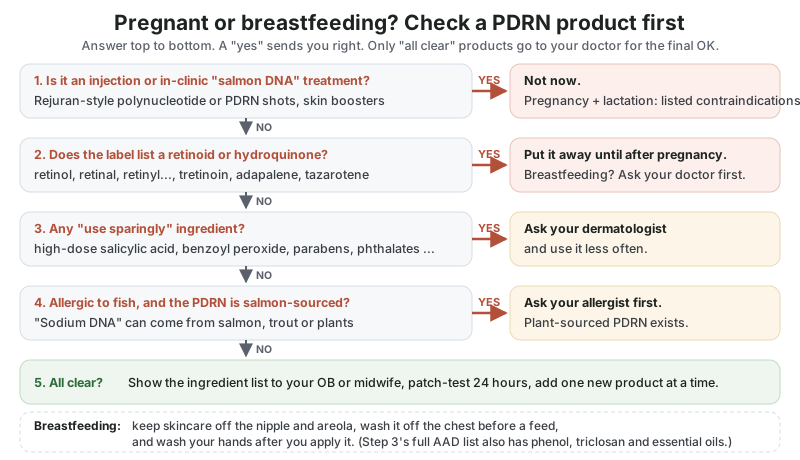
The diagram, step by step:
- Is it an injection or in-clinic “salmon DNA” treatment? If yes: not now. Pregnancy and lactation are listed contraindications (J Cutan Aesthet Surg, 2026).
- Does the label list a retinoid or hydroquinone? Retinol, retinal, retinyl esters, tretinoin, adapalene, tazarotene, hydroquinone. If yes: put it away until after pregnancy (AAD); if you’re breastfeeding, ask your doctor first.
- Any “use sparingly” ingredient? High-dose salicylic acid, benzoyl peroxide, parabens, phthalates, phenol, triclosan, essential oils. If yes: ask your dermatologist and use it less often (AAD).
- Allergic to fish, and the PDRN is salmon-sourced? “Sodium DNA” can come from salmon, trout or plants. If yes: ask your allergist first; plant-sourced PDRN exists.
- All clear? Show the ingredient list to your OB or midwife, patch-test for 24 hours, and add one new product at a time.
- Breastfeeding: keep skincare off the nipple and areola, wash it off the chest before a feed, and wash your hands after applying it (MotherToBaby).
How do you patch-test a PDRN product while pregnant?
Patch-test any new PDRN product on a small spot before it goes on your face, and don’t start it on a day your skin already feels irritated. If you also deal with redness, our guide to PDRN for rosacea and redness-prone skin walks through the AAD’s longer 7-10 day arm test.
What if you’re allergic to fish?
Talk to your allergist before using a salmon-sourced PDRN product, because PDRN is DNA traditionally taken from salmon or trout. The 2026 review says that, for PDRN treatments, A patch test is warranted in patients who give a history of hypersensitivity to fish.
If fish is a problem for you, plant-sourced PDRN exists: VT Cosmetics says its PDRN Essence 100 uses ginseng-sourced PDRN, and mixsoon says its serum uses plant-based PDRN (though that one also has retinal, so not during pregnancy).
Does “pregnancy-safe” on the box mean anything?
A “pregnancy-safe” badge on a cosmetic is the brand’s own claim, not an approval from a regulator. The FDA says that Under the law, cosmetic products and ingredients do not need FDA premarket approval, with the exception of color additives.
Companies have a legal responsibility to ensure the safety of their products
(FDA: how cosmetics are regulated), but no one checks a pregnancy badge before it’s printed. Read the ingredient list anyway.
What does a simple skincare routine look like while pregnant or breastfeeding?
A gentle cleanser, a fragrance-free moisturizer and a mineral sunscreen cover most of what pregnant and breastfeeding skin needs, and a retinoid-free PDRN serum can be an optional extra once your doctor has OK’d it. Fewer products means fewer labels to check.
For sun protection, the AAD recommends applying a broad-spectrum, water-resistant sunscreen with an SPF of at least 30 or higher
, and adds: Choose a physical sunscreen that contains zinc oxide, titanium dioxide, or both during pregnancy to avoid skin irritation.
If you’re shopping, look at zinc oxide mineral sunscreens with SPF 30+. In winter, a richer fragrance-free ceramide moisturizer helps with the dry, tight feeling cold air brings.
One more true thing from the law books: the FDA treats products meant to change the structure or any function of the body
or to treat disease as drugs, not cosmetics (FDA: Is it a cosmetic, a drug, or both?). A PDRN serum sold as a cosmetic is there to help your skin look and feel better. That’s a lovely job, and it’s also why it can wait a few months if you or your doctor would rather keep things simple.
Be gentle with yourself, keep the routine short and sweet for now, and let your doctor have the final word. Your glow will still be here when you’re ready for more.
Sources and further reading
- American Academy of Dermatology: Dermatologist-approved pregnancy skin care — updated 6/26/25; avoid list (retinoids, hydroquinone, finasteride, spironolactone, tetracycline / doxycycline / minocycline, 5-fluorouracil); use-sparingly list (high-dose salicylic acid, benzoyl peroxide, parabens, phthalates, phenol, triclosan, essential oils); SPF 30+ physical sunscreen; tell your obstetrician and dermatologist
- MotherToBaby: Topical Acne Treatments fact sheet — February 1, 2026; avoid topical retinoids in pregnancy; ACOG: benzoyl peroxide, azelaic, salicylic or glycolic acid may be used; skin-barrier absorption; breastfeeding nipple/areola and wash-off advice
- MotherToBaby: Topical Tretinoin fact sheet — July 1, 2024; small amount absorbed; ‘the safest approach may be to avoid use of tretinoin during pregnancy’; breastfeeding not studied
- Arora G. Polynucleotides and polydeoxyribonucleotides in dermatology — a narrative review. J Cutan Aesthet Surg 2026;19:17-28 — PN/PDRN not recommended in pregnancy and lactation due to a lack of studies; contraindications table; molecular weight 50-1500 kDa; topicals’ limited penetration; patch test with fish hypersensitivity
- Bos JD, Meinardi MM. The 500 Dalton rule for the skin penetration of chemical compounds and drugs. Exp Dermatol 2000;9:165-169 — compounds need to be under 500 Daltons to pass healthy skin
- PubChem: Retinol — molecular weight 286.5 g/mol
- PubChem: Tretinoin — molecular weight 300.4 g/mol
- FDA: FDA authority over cosmetics — how cosmetics are not FDA-approved, but are FDA-regulated — no premarket approval except color additives; companies responsible for product safety
- FDA: Is it a cosmetic, a drug, or both? (or is it soap?) — legal definitions of cosmetics and drugs
- Anua: PDRN Hyaluronic Acid Capsule 100 Serum — maker’s page; salmon-derived Sodium DNA; ingredient list also on Ulta (fragrance-free)
- VT Cosmetics: PDRN Essence 100 — maker’s page; ginseng-sourced PHYTO PDRN; full ingredient list on Ulta / Soko Glam
- VT Cosmetics: PDRN Reedle Shot 100 — spicules for ‘enhancing the penetration of beauty ingredients into the skin’
- COSRX: 5 PDRN Vital Care collection launch — maker’s announcement; full ingredient list of The 5 PDRN Collagen Intense Vitalizing Serum from Jolse / YesStyle listings (Sodium DNA, alpha-arbutin, no retinoid)
- Medicube: PDRN Pink Peptide Eye Cream — maker’s page; key ingredients Salmon DNA PDRN, retinol, peptide, niacinamide
- mixsoon: PDRN Collagen Retinal 6 Capsule Serum — maker’s page; ‘Retinal 6% Capsule Complex’, plant-based PDRN (Sodium DNA); retinal also in YesStyle’s ingredient listing
Questions and answers
Is PDRN safe during pregnancy?
No one knows for sure, because PDRN has never been studied in pregnancy. Topical PDRN isn’t on the American Academy of Dermatology’s list of ingredients to avoid, and it’s a very large molecule that likely barely gets through skin, but a 2026 review says PDRN isn’t recommended in pregnancy because of the lack of studies. Show any PDRN product’s ingredient list to your doctor first.
Can I use PDRN serum while breastfeeding?
PDRN hasn’t been studied in breastfeeding, but very little of a face serum is likely to reach breast milk. Check the product has no retinoid, ask your doctor, keep it off the nipple and areola, and wash it off your chest before a feed, as MotherToBaby advises for topical acne products.
Can I get Rejuran or salmon DNA injections while pregnant?
No. A 2026 review in the Journal of Cutaneous and Aesthetic Surgery lists pregnancy and lactation as contraindications for polynucleotide and PDRN injections. Injections are a medical procedure, so wait until you’ve finished pregnancy and breastfeeding, and tell any injector if you’re pregnant or nursing.
Can I use PDRN instead of retinol while pregnant?
PDRN isn’t a retinoid, so it doesn’t carry the retinoid warning, but it hasn’t been studied in pregnancy either, and some PDRN products contain retinol or retinal. Check the whole ingredient list, skip anything with retinol, retinal or retinyl esters, and ask your obstetrician which steps fit your pregnancy.
Is salmon DNA skincare safe if I’m allergic to fish?
Ask your allergist first. PDRN is traditionally made from salmon or trout DNA, and a 2026 review advises a patch test for PDRN treatments in people with a history of fish hypersensitivity. Plant-sourced PDRN exists, such as VT Cosmetics’ ginseng-sourced PDRN Essence 100.