
When are the Jewish holidays in 2027 (Rosh Hashanah, Yom Kippur, Hanukkah, Passover)?
Disclosure: this page contains Amazon affiliate links. As an Amazon Associate we earn from qualifying purchases, at no extra cost to you.
Every year the Jewish holidays seem to wander across the calendar, Keeper of the Holiday Dates, and every year somebody’s printed copy has one of them a day off.
I spent Sunday, November 29, 2026 reading Hebcal’s own date feed for 2027 and Wikipedia’s rules for the Hebrew calendar, instead of the blogs that quote each other, and I compared the Diaspora list with the Israel list line by line.
You probably won’t find this on Reddit, but the Jewish Encyclopedia’s Calendar article says later Jewish writers credit Hillel II with fixing the calendar in 359 CE, and its rules still decide where each holiday lands on a 2027 wall calendar with Jewish holidays on Amazon.
Three dates stood out. Rosh Hashanah 5788 begins at sundown on Friday, October 1, 2027. Hanukkah begins at sundown on Friday, December 24, and runs to nightfall on January 1, 2028. And every holiday from Purim to Hanukkah lands exactly 20 days later on the calendar than it did in 2026.
Short answer: In 2027, Passover begins at sundown on Wednesday, April 21, Rosh Hashanah on Friday, October 1, Yom Kippur on Sunday, October 10, and Hanukkah on Friday, December 24. Every Jewish holiday starts at sundown the evening before its first full day, so mark the evening as well as the day on your calendar.
When are the Jewish holidays in 2027?
The major Jewish holidays in 2027 run from Purim at sundown on Monday, March 22 to Hanukkah, which begins at sundown on Friday, December 24. The table gives each one’s exact start and end, using Hebcal’s Diaspora dates.
| Holiday | Starts at sundown | Ends at nightfall | Days covered |
|---|---|---|---|
| Purim | 1 full day | ||
| Passover (Pesach) | 8 days | ||
| Shavuot | 2 days | ||
| Tish’a B’Av | 1 full day | ||
| Rosh Hashanah (Jewish new year 5788) | 2 days | ||
| Yom Kippur | 1 full day | ||
| Sukkot | 7 days | ||
| Shemini Atzeret and Simchat Torah | 2 days | ||
| Hanukkah | 8 nights and days |
In one line: eight holiday blocks fit on a 2027 calendar, and only Hanukkah spills into the next year. Hebcal’s page shows its 2027 start and end as Fri, 24 Dec 2027 sunset — Sat, 1 Jan 2028 nightfall
.
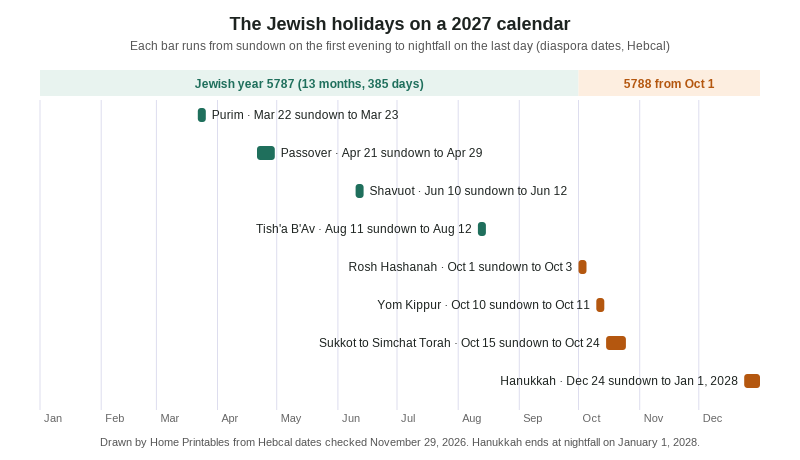
Why does a Jewish holiday start the evening before?
A Jewish holiday starts the evening before because a day in the Hebrew calendar runs from sunset to the next sunset. Wikipedia’s article on the Hebrew calendar says that a day in the rabbinic Hebrew calendar runs from sunset
to the next sunset.
So Rosh Hashanah, which most calendars print on Saturday, October 2, 2027, begins at sundown on Friday, October 1, and the Friday-evening box is the part people miss.
Hebcal’s holiday data feed shows this directly: each holiday has an Erev entry, Hebrew for evening, on the day before. For 2027 it lists Erev Rosh Hashana on October 1, Erev Yom Kippur on October 10 and Erev Pesach on April 21.
How do you mark a Jewish holiday on a printed calendar?
Mark a Jewish holiday on a printed calendar with a bar that starts in the bottom half of the evening box and runs through the last day. That way the calendar shows both the sundown start and the daytime holiday.
- Find the Erev day. It is the evening box: for Yom Kippur 2027, Sunday, October 10.
- Colour the lower half of that box. A highlighter stripe along the bottom edge says the holiday begins that evening.
- Colour the full boxes through the last day. For Passover that is Thursday, April 22 to Thursday, April 29.
- Stop at nightfall. Colour only the top half of the final box, or leave a small dot, if you like the calendar to be exact.
One-page year calendars have day boxes only about 0.34 in wide, so use a dot and a colour, as our 2027 calendar printing guide suggests.
When are Rosh Hashanah and Yom Kippur in 2027?
Rosh Hashanah 2027 begins at sundown on Friday, October 1 and ends at nightfall on Sunday, October 3, and Yom Kippur begins at sundown on Sunday, October 10 and ends at nightfall on Monday, October 11.
It is the start of the Jewish year 5788. The days from January to the evening of October 1 still belong to the year 5787, so a 2027 calendar carries two Jewish year numbers.
Yom Kippur’s first full day, Monday, October 11, comes nine days after Rosh Hashanah’s first full day, Saturday, October 2.
Can Rosh Hashanah or Passover fall on any day of the week?
No. The Hebrew calendar’s rules keep Rosh Hashanah off Sunday, Wednesday and Friday, and Passover off Monday, Wednesday and Friday. Wikipedia gives the reason for the first rule: so that Yom Kippur does not fall on a Friday or Sunday.
We checked every date in the table against those three rules, and 2027 passes all of them:
| Holiday, first full day | Date in 2027 | Weekday | Weekdays the rules forbid | Result |
|---|---|---|---|---|
| Rosh Hashanah | Saturday | Sunday, Wednesday, Friday | Allowed | |
| Yom Kippur | Monday | Friday, Sunday | Allowed | |
| Passover | Thursday | Monday, Wednesday, Friday | Allowed |
If a 2027 calendar ever shows Rosh Hashanah on a Friday or Passover starting on a Wednesday, the date is wrong, and you can spot it without any special knowledge.
When does Hanukkah start in 2027, December 24 or 25?
Hanukkah 2027 begins at sundown on Friday, December 24, so the first candle is lit on the evening of December 24 and the first full day is Saturday, December 25. It ends at nightfall on Saturday, January 1, 2028.
This is where sources can disagree on a printed calendar: Hebcal’s data feed dates the first candle December 24, the evening, while a calendar that marks only the daytime puts the first day on December 25. Both are right, because one counts the evening and the other the daytime.
It also means Hanukkah overlaps the US holidays already on a 2027 calendar. December 24 is the observed Christmas day off and December 25 is Christmas itself, and the last Hanukkah candle evening, December 31, is the observed New Year’s Day holiday for 2028 per the U.S. Office of Personnel Management.
A printed 2027 calendar can therefore only show eight evenings of Hanukkah up to the 31st, and the last nightfall belongs to a 2028 calendar.
When is Passover 2027, and why is it later than in 2026?
Passover 2027 begins at sundown on Wednesday, April 21 and ends at nightfall on Thursday, April 29, because the Jewish year 5787 has 13 months and 385 days, which pushes every holiday 20 days later than in 2026.
Here’s the part I like best: the whole thing runs on evenings. Rosh Hashanah begins on a Friday night in 2027, and once you start looking for the evening box, every date on the page makes more sense.
The Jewish Encyclopedia’s Calendar article explains the leap month: it says that every two or three years an extra month was added. Wikipedia names the leap years of the 19-year cycle as years 3, 6, 8, 11, 14, 17 and 19.
The year 5787 is year 11 of its cycle (5787 minus 5776, which is 19 times 304), so it is a leap year with an extra month.
Hebcal’s dates agree: Rosh Hashanah 2026 to Rosh Hashanah 2027 is exactly 385 days. Our table shows the shift:
| Holiday, first full day | 2026 | 2027 | Shift |
|---|---|---|---|
| Purim | March 3 | March 23 | 20 days later |
| Passover | April 2 | April 22 | 20 days later |
| Shavuot | May 22 | June 11 | 20 days later |
| Tish’a B’Av | July 23 | August 12 | 20 days later |
| Rosh Hashanah | September 12 | October 2 | 20 days later |
| Yom Kippur | September 21 | October 11 | 20 days later |
| Sukkot | September 26 | October 16 | 20 days later |
| Hanukkah (first candle evening) | December 4 | December 24 | 20 days later |
The reason is plain arithmetic: 385 days minus the 365 days of 2027 leaves 20. That shortcut works for 2026 to 2027 only. In 2028 the dates jump back, so Hebcal has Passover 2028 beginning at sundown on Monday, April 10, which is 11 days earlier on the calendar than April 21, 2027.
Do the Jewish holiday dates change in Israel?
Yes. In 2027, five days count as a holiday in the Diaspora but not in Israel, because Israel keeps one day where the Diaspora keeps two on several festivals. Hebcal’s feed has a separate Israel setting, and we compared both lists.
| Date in 2027 | Diaspora | Israel |
|---|---|---|
| Passover, second day | Intermediate day (Chol Hamoed) | |
| Passover, eighth day | No holiday: Passover ended April 28 | |
| Shavuot, second day | No holiday: Shavuot is one day, June 11 | |
| Sukkot, second day | Intermediate day (Chol Hamoed) | |
| Simchat Torah | No holiday: combined with Shemini Atzeret on October 23 |
If your family or school follows the Israeli custom, print the Israel version of these five days. Rosh Hashanah, Yom Kippur, Purim and Hanukkah fall on the same dates in both lists.
How do you print a 2027 calendar with Jewish holidays?
Print a 2027 calendar with Jewish holidays by taking a blank monthly calendar PDF in Letter or A4, marking the eight holiday blocks above by hand or in a calendar app, and printing at Actual size on 24-32 lb paper.
- Start with the right file. Our 2027 calendar printing guide covers page size, Fit versus Actual size and the months that need six rows.
- Pick the paper. A sturdy page holds highlighter and pen; see the paper weights and printer settings that make printables look professional.
- Mark the evenings. Use the half-box trick above, with a set of fine-tip highlighters in one colour for holidays.
- Add the year change. Write 5788 beside October 1, so the new Jewish year is visible at a glance.
Putting up a Hanukkah display on the same wall? Our DIY advent calendar boxes guide uses the same cardstock and fold lines for a countdown of any kind.
Put the data together and one shortcut follows: each 2027 holiday is the 2026 date plus 20 days, because 5787 is a 385-day year, but only until the end of this year.
And since every holiday starts the evening before, the most common mistake is one box too late, which in 2027 puts Hanukkah’s first candle on Friday, December 24, the same evening as Christmas Eve.
The Jewish Encyclopedia article adds that the 19-year Jewish cycle runs 2 hours, 8 minutes and 15.3 seconds longer than the Gregorian one, a reminder that these two calendars never quite line up and every printed calendar is a fresh set of dates.
How we researched this
- On November 29, 2026 we read Hebcal’s Jewish holiday pages for 2026-2027 and 2027-2028 and pulled its holiday data feed for 2026 and 2027, once for the Diaspora and once for Israel, then compared the two 2027 lists line by line to find the five days that differ.
- We read Wikipedia’s Hebrew calendar article for the day starting at sunset, the weekday rules and the 19-year leap cycle, and the Jewish Encyclopedia’s Calendar article for Hillel II (359 CE), the extra month every two or three years and the 19-year cycle’s 2 hours, 8 minutes and 15.3 seconds.
- We checked the observed federal holidays against the U.S. Office of Personnel Management’s page.
- Our own work: the weekday of each date, the 385-day arithmetic and the 20-day and 11-day shifts, the half-box marking method and the timeline diagram.
- What we did not do: we did not print or test any calendar, we did not check local candle-lighting times, and we did not compare other websites’ date lists. We are not a religious authority.
Go on, Keeper of the Holiday Dates, mark the evenings, add 5788 beside October 1, and enjoy a calendar where every holiday is on the right box.
Sources and further reading
- Hebcal — Jewish holidays 2026-2027 — sunset to nightfall ranges; Purim, Pesach and Shavuot 2027 dates
- Hebcal — Jewish holidays 2027-2028 — Rosh Hashana, Yom Kippur, Sukkot, Hanukkah 2027 and the 2028 Purim and Pesach dates
- Hebcal — Jewish Calendar REST API — the holiday data feed, with separate Diaspora and Israel settings
- Wikipedia — Hebrew calendar — day starts at sunset; weekday rules; 19-year cycle leap years 3, 6, 8, 11, 14, 17, 19; 353-355 and 383-385 day years
- Jewish Encyclopedia — Calendar (1901-1906) — Hillel II and 359 CE; an extra month every two or three years; the 19-year cycle’s 2 h 8 min 15.3 s
- U.S. Office of Personnel Management — Federal Holidays — observed federal holidays, including Friday, December 31, 2027
Questions and answers
When is Rosh Hashanah in 2027?
Rosh Hashanah 2027 begins at sundown on Friday, October 1 and ends at nightfall on Sunday, October 3, per Hebcal. It starts the Jewish year 5788, and most calendars print its first full day as Saturday, October 2.
When does Hanukkah start in 2027?
Hanukkah 2027 begins at sundown on Friday, December 24, so the first candle is lit that evening and the first full day is Saturday, December 25. It ends at nightfall on Saturday, January 1, 2028, so a 2027 calendar shows only the first eight evenings, through December 31.
When is Passover in 2027?
Passover 2027 begins at sundown on Wednesday, April 21 and ends at nightfall on Thursday, April 29 in the Diaspora. In Israel it ends a day earlier, on April 28.
Why do Jewish holidays start at sundown?
A day in the Hebrew calendar runs from sunset to the next sunset, so each holiday begins the evening before its first full day. That is why Hebcal lists Erev entries, Hebrew for evening, such as Erev Yom Kippur on Sunday, October 10, 2027.
Why are the Jewish holidays 20 days later in 2027 than in 2026?
The Jewish year 5787 is a leap year with 13 months and 385 days, which is 20 more than the 365 days of 2027. Every holiday from Purim to Hanukkah therefore lands 20 days later than in 2026, and in 2028 the dates move about 11 days earlier again.