Dressing for Raynaud’s: Base Layers, Gloves and Socks That Keep Fingers and Toes Warm
Disclosure: this page contains Amazon affiliate links. As an Amazon Associate we earn from qualifying purchases, at no extra cost to you.
Hello, Keeper of the Ten Toasty Fingers!
Let’s dress you for Raynaud’s from the inside out, so your fingers and toes have the warmest possible winter.
Dressing for Raynaud’s starts at your chest, not at your fingertips, because the NIAMS says keeping your whole body warm matters as much as warming your hands and feet.
So the plan is a warm merino base layer under loose layers and a hat, then mittens over thin liners and warm socks in roomy boots.
Short answer: To keep fingers and toes warm with Raynaud’s, warm your whole body first: a thermal base layer under loose layers and a hat, then mittens (warmer than gloves) over thin liner gloves, and thick socks with no tight cuffs inside roomy boots. Dress before you go out, and ask your doctor before using heated gloves or socks.
A few facts to set the scene, each from the source named:
- What Raynaud’s is
- A condition that
causes the blood vessels in the extremities to narrow, restricting blood flow
(NIAMS). - How common it is
As much as 5-10 percent of the population
, about 90 percent of them primary Raynaud’s (Raynaud’s Association).- How long an attack lasts
A typical episode, or attack, lasts 20 minutes
(Cleveland Clinic); the NHS says from a few minutes to a few hours.- The main trigger
Exposure to cold temperatures is the most common trigger
(NIAMS). Stress, smoking and vaping can set off attacks too.- What you see
- Fingers or toes turn white, then blue, then red as blood flow comes back (NHS).
Why does a warm core help cold fingers and toes?
A warm core helps cold fingers and toes because a chilled body keeps warm blood close to the heart and organs and lets the hands and feet cool first, and Raynaud’s makes the small blood vessels in the fingers and toes over-react to that cold. Warm the chest, belly and head, and there’s less reason for the body to hold back.
The National Institute of Arthritis and Musculoskeletal and Skin Diseases (NIAMS), part of the NIH, says it plainly on its Raynaud’s self-care page:
Keeping your hands and feet, as well as your entire body, warm is important.
The same NIAMS page explains that warm hands and feet often aren’t enough: you need to keep your “core body”, meaning the chest, abdomen and head, warm too. That’s why a thermal base layer and a hat belong in a Raynaud’s outfit as much as mittens do.
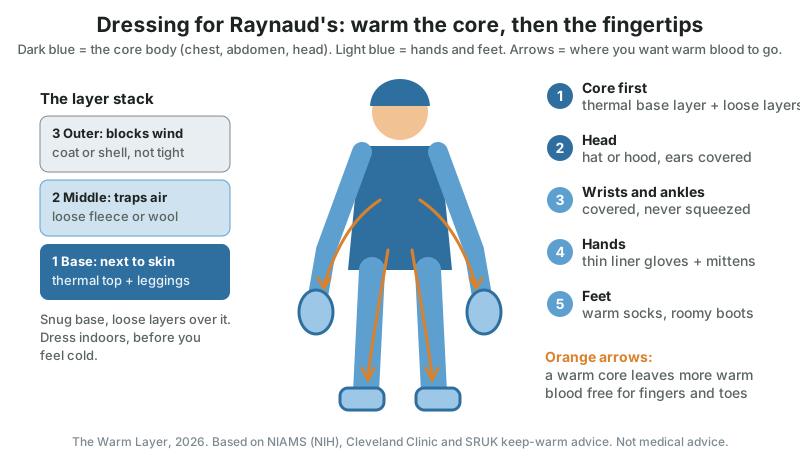
What the diagram shows, zone by zone:
- Core first: a thermal base layer with loose layers over it.
- Head: a hat or hood, with the ears covered if your ears are affected.
- Wrists and ankles: covered, but never squeezed by tight cuffs.
- Hands: thin liner gloves inside mittens.
- Feet: warm socks in roomy boots.
The layer stack: (1) a base layer next to the skin, a thermal top and leggings; (2) a middle layer that traps air, a loose fleece or wool sweater; (3) an outer layer that blocks wind, a coat or shell that isn’t tight.
What base layers work best for Raynaud’s?
The best base layers for Raynaud’s are long-sleeved thermal tops and leggings that cover the wrists and ankles, worn under loose layers you can add or remove. Scleroderma & Raynaud’s UK (SRUK), the UK charity for the condition, says on its managing your Raynaud’s symptoms page: Consider wearing thermal under layers
.
SRUK also says to Wear lots of thin layers and loose clothing.
Thin layers trap warm air between them, and you can peel one off before you overheat and sweat, which matters because damp skin cools fast. Here’s what to look for in a thermal underwear set:
- Long sleeves that reach the hand. Thumbholes or a long cuff keep the wrist covered when you reach forward, so no cold strip opens between sleeve and mitten.
- Leggings that reach the ankle bone and tuck into socks, so the ankle stays covered.
- A long hem on the top, so the lower back stays covered when you bend.
- Midweight for everyday cold; heavyweight for long, still hours outside (a bus stop, the bleachers, a dog walk at dawn).
- A warm vest over the top when you’re indoors. A fleece vest adds core warmth without bulky sleeves.
Is merino wool or synthetic better for Raynaud’s?
Merino wool and synthetic base layers both work for Raynaud’s; choose by how your skin feels and how much you move. A merino base layer feels warm against the skin, keeps some warmth when a little damp and doesn’t hold smells between wears, but it needs a gentle wash. A synthetic (polyester) base layer dries quickly and handles a hot wash and the dryer. If wool feels itchy, pick synthetic or a merino blend; if you sweat on a brisk walk and then stand still, merino’s damp-warmth is the bigger help.
How tight should a base layer be with Raynaud’s?
A base layer for Raynaud’s should sit close to the skin without squeezing anywhere, especially at the wrists, ankles and waist. A snug base layer moves moisture away and holds warm air; a tight one presses on the skin. The health guides lean the same way: Cleveland Clinic and SRUK both say loose clothing
for the layers on top. If a cuff leaves a deep mark on your wrist or ankle, it’s too tight for you.
Are mittens or gloves better for Raynaud’s?
Mittens are better than gloves for Raynaud’s because your fingers share one warm pocket instead of sitting alone in separate cold tubes. Cleveland Clinic’s Raynaud’s page says: Don’t forget mittens (warmer than gloves) and a hat.
The Raynaud’s Association agrees: Mittens are even better protection.
What makes a warm pair of mittens good for cold fingers:
- Room inside. Your fingers should be able to wiggle. A snug mitten squeezes out the warm air.
- A long cuff that goes over the sleeve of your coat, so snow and wind can’t get to the wrist.
- Insulation plus a windproof shell for real cold; a knit mitten alone lets the wind straight through.
- A wrist leash or clip, so you can pull a mitten off to use your phone without dropping it in the slush.
Do glove liners help under mittens?
Glove liners help under mittens because when you pull a mitten off to unlock a door or pay at a register, your fingers stay covered instead of meeting the cold air bare. A thin merino glove liner or silk glove liner adds a little warmth inside the mitten too.
SRUK also suggests fingerless gloves
with mitten tops, often sold as flip-top or convertible mittens: the mitten hood folds back for fiddly jobs and flips over the fingers again when you’re done.
What should you wear on your hands indoors?
Indoors, wear gloves or mitts whenever you handle cold things, and keep a sweater nearby for air conditioning and chilly rooms. The American College of Rheumatology (ACR) patient page says: Wear oven mitts or gloves when taking food out of the freezer or refrigerator.
- The freezer aisle: the Raynaud’s Association suggests gloves in the refrigerated section of a supermarket.
- Cold drinks: Cleveland Clinic suggests a beverage holder; an insulated tumbler with a handle keeps your fingers off the cold side.
- Air conditioning: the NIAMS says to bring a sweater or jacket to air-conditioned places, and the ACR says not to keep the AC too low in summer.
What socks are best for Raynaud’s?
The best socks for Raynaud’s are thick, warm wool or thermal socks with a soft top that doesn’t dig in, worn with room to spare in your shoes. SRUK says Choose warm socks indoors (don’t go barefoot)
, and the ACR lists socks, boots, mittens or gloves
as the clothing to wear in fall and winter.
- Wool or a thermal synthetic, not cotton. Cotton holds sweat, and damp socks steal warmth. Merino wool thermal socks stay warmer when a little damp.
- A non-binding top. If the sock cuff leaves a deep ring around your leg, it’s too tight. Compression socks aren’t a warmth tool; ask your doctor before wearing them with Raynaud’s.
- Warm socks at home too. Cold floors count. Socks plus slippers beat bare feet on tile.
Some sock makers publish a warmth number. Heat Holders, a thermal sock brand, says on its Raynaud’s warmth guide that its ORIGINAL socks are 2.3 TOG
and about seven times warmer than cotton, and that they’re tested and endorsed by the Raynaud’s Association. Those are the maker’s own figures, not our test. TOG (thermal overall grade) is a measure of how well a fabric holds heat. If you want to try them, here are Heat Holders thermal socks on Amazon.
How do you keep toes warm in boots?
To keep toes warm in boots, leave room: thick socks in tight boots press the toes and leave less warm air around them. Buy winter boots a half size up or in a wide width so your warmest socks fit, add a warm insole, and carry a spare pair of socks in case your feet get damp.
SRUK suggests hand and feet warmers such as thermal insoles. A thermal insole adds a layer between your sole and the cold ground, which is where standing feet lose the most warmth.
What do six Raynaud’s health guides actually tell you to wear?
Six Raynaud’s health guides all mention warm feet and avoiding cold air or sudden temperature changes; most say to wear gloves for cold things, dress in layers, wear a hat and wear mittens. Only one, the NIAMS, mentions heated gloves. We read each organisation’s own self-care page on November 19, 2026 and counted.
We’ll admit it: lining up six health guides side by side and counting dots made us ridiculously happy. And when all six of them bring up your feet, that’s a clear sign to go dig out the good socks.
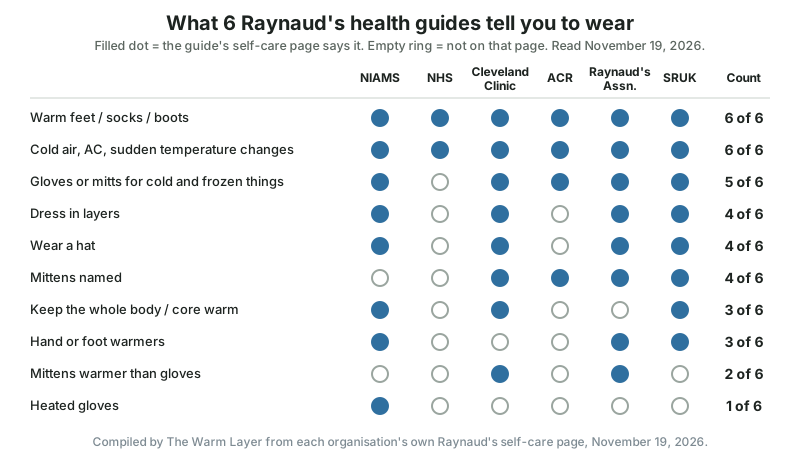
| Tip | NIAMS | NHS | Cleveland Clinic | ACR | Raynaud’s Association | SRUK | Count |
|---|---|---|---|---|---|---|---|
| Warm feet, socks or boots | Yes | Yes | Yes | Yes | Yes | Yes | 6 of 6 |
| Cold air, AC or sudden temperature changes | Yes | Yes | Yes | Yes | Yes | Yes | 6 of 6 |
| Gloves or mitts for cold and frozen things | Yes | No | Yes | Yes | Yes | Yes | 5 of 6 |
| Dress in layers | Yes | No | Yes | No | Yes | Yes | 4 of 6 |
| Wear a hat | Yes | No | Yes | No | Yes | Yes | 4 of 6 |
| Mittens named | No | No | Yes | Yes | Yes | Yes | 4 of 6 |
| Keep the whole body or core warm | Yes | No | Yes | No | No | Yes | 3 of 6 |
| Hand or foot warmers | Yes | No | No | No | Yes | Yes | 3 of 6 |
| Mittens warmer than gloves | No | No | Yes | No | Yes | No | 2 of 6 |
| Heated gloves | Yes | No | No | No | No | No | 1 of 6 |
The pattern is clear: warm feet and steady temperatures come up everywhere, layers and a hat come up in most guides, and heated gear comes up in only one. “No” doesn’t mean a guide disagrees, only that this tip isn’t on that page. The NHS page, for example, keeps it short: wear warm clothes during cold weather, especially on your hands and feet
.
Are heated gloves, heated socks and hand warmers OK with Raynaud’s?
Heated gloves, heated socks and hand warmers can help some people with Raynaud’s, but ask your doctor first, because fingers that go numb in an attack can’t feel when something is too hot. The NIAMS suggests you consider heated gloves or hand warmers
, and the Raynaud’s Association suggests carrying hand and foot warmers.
The makers’ own instructions are where the cautions are. The HotHands FAQ says its air-activated warmers produce heat anywhere from 100°F to 180°F
for 1 to 20+ hours, and explains it doesn’t want them on bare skin because some people may have reduced sensation to heat
. ORORO’s heated-apparel manual lists heat-sensitivity medical issues such as poor blood circulation among its warnings and says to ALWAYS wear a base layer between the product and the skin
. We read five heat products’ manuals for our guide to staying warm in a wheelchair, and all five warned about reduced feeling or poor circulation.
If your doctor is happy with them, air-activated hand warmers work best inside a mitten, not clutched in a bare hand, and toe warmers go on the outside of the sock, as their package instructions say.
How do you warm up during a Raynaud’s attack?
To warm up during a Raynaud’s attack, get somewhere warm and warm the fingers or toes gently: the NIAMS suggests warm (not hot) water, tucking your hands under your armpits, or whirling your arms in a windmill motion. Gentle matters. SRUK’s Raynaud’s page says: Do not put cold hands or feet onto heat sources such as radiators.
- Run warm, not hot, water over the fingers or toes.
- Tuck your hands into your armpits, under your base layer.
- Swing your arms in big windmill circles.
- Head indoors and add a layer to your core, not only your hands.
When should you see a doctor about Raynaud’s?
See a doctor about Raynaud’s if your symptoms are very bad or getting worse, affect only one side of your body, come with joint pain, skin rashes or muscle weakness, or start for the first time after age 30, says the NHS. Cleveland Clinic adds sores or ulcers on your fingers or toes.
Raynaud’s comes in two forms. The NIAMS explains: The primary form has no known cause, but the secondary form is related to another health issue
, such as lupus or scleroderma, and secondary Raynaud’s tends to be more serious. The NIAMS also notes that some medicines can bring on attacks, so talk to your doctor about the ones you take.
What should you put on before you head out?
Before you head out with Raynaud’s, dress fully indoors while you’re still warm: base layer, warm middle layer, coat, hat, liners and mittens, warm socks in roomy boots. Putting it all on after your fingers go white is too late, so build the outfit in a warm room.
- Thermal base layer top and leggings, cuffs covering wrists and ankles.
- A loose fleece or wool layer and a wind-blocking coat.
- A hat or hood that covers your ears.
- Liner gloves on, mittens over them, clipped to your sleeves.
- Warm wool socks with soft tops, in boots with room to wiggle your toes.
- In your pocket: a spare pair of socks and, if your doctor is fine with it, a pair of hand warmers.
Want more warm ideas as we write them? Our free newsletter sends the layering tips we dig up ourselves, before the cold snaps arrive.
Now off you go, Keeper of the Ten Toasty Fingers: core warm, mittens on, toes wiggling happily in roomy boots. Here’s to a winter of pink fingertips and cozy walks.
Sources and further reading
- NIAMS (NIH): Raynaud’s Phenomenon (reviewed July 2024) — definition, primary vs secondary, cold as the most common trigger
- NIAMS (NIH): Raynaud’s Phenomenon: Diagnosis, Treatment, and Steps to Take — keep the core body warm, layers, hat, heated gloves or hand warmers, warming up during an attack, medicines
- NHS: Raynaud’s (reviewed July 20, 2023) — colour changes, attack length, warm clothes for hands and feet, when to see a GP
- Cleveland Clinic: Raynaud’s Syndrome (reviewed June 26, 2026) — mittens warmer than gloves, loose layers, 20-minute typical attack, sores or ulcers
- American College of Rheumatology: Raynaud’s Phenomenon (Kiren Sahni, MD, updated February 2025) — socks, boots, mittens or gloves; freezer and air conditioning
- Raynaud’s Association: What else can I do to avoid a Raynaud’s attack? — layers, hat, mittens even better than gloves, hand and foot warmers
- Raynaud’s Association: How common is Raynaud’s? — 5-10 percent of the population, about 90 percent primary
- Scleroderma & Raynaud’s UK: Managing your Raynaud’s symptoms (reviewed January 2026) — thermal under layers, thin loose layers, warm socks indoors, mittens and flip-top gloves, thermal insoles
- Scleroderma & Raynaud’s UK: Raynaud’s — don’t put cold hands or feet on radiators; warm rather than hot water
- HotHands (Kobayashi Consumer Products): FAQ — 100-180°F for 1 to 20+ hours; why warmers don’t go on bare skin
- Heat Holders: The Raynaud’s Warmth Guide — the maker’s 2.3 TOG and warmer-than-cotton figures
- ORORO heated apparel manual, ver. B0805 (PDF) — poor circulation warning, base layer between heat and skin, battery safety
Questions and answers
Are mittens or gloves better for Raynaud’s?
Mittens. Cleveland Clinic calls mittens warmer than gloves, and the Raynaud’s Association says mittens are even better protection, because your fingers share one warm space. Wear thin liner gloves inside so your fingers stay covered when you take a mitten off.
What kind of socks are best for Raynaud’s?
Thick wool or thermal socks with a soft, non-binding top, worn in shoes or boots with room for your toes. Avoid cotton, which holds sweat, and wear warm socks indoors too; Scleroderma & Raynaud’s UK says not to go barefoot.
Do heated gloves help with Raynaud’s?
The NIAMS suggests considering heated gloves or hand warmers, and many people with Raynaud’s use them. Ask your doctor first, keep a liner between the heat and your skin, start on low, and follow the maker’s battery instructions, because numb fingers can’t feel when something is too hot.
Is merino wool good for Raynaud’s?
Merino wool is a good choice for Raynaud’s base layers, socks and glove liners because it feels warm and stays warm when a little damp. If wool itches you, a synthetic thermal or a merino blend works too; the key is layering and covering the core, not one fabric.
How do you warm up your hands quickly with Raynaud’s?
Get somewhere warm, then run warm (not hot) water over your hands, tuck them under your armpits, or swing your arms in windmill circles, as the NIAMS suggests. Don’t put cold hands on a radiator or heater. If your fingers stay white or blue, call your doctor.