
Real Estate Website Template: What Agents Need Beyond Listings (2026)
Disclosure: this page may contain affiliate links. We may earn from qualifying purchases, at no extra cost to you.
Picture a buyer scrolling listings at 11 pm, deal maker, and landing on your neighborhood page that answers what the school run and the Saturday market are really like.
A real estate website template does more than show houses, and this guide covers the pages that make an agent’s site worth bookmarking, how listings get onto it and how to set it up for search.
Clear listing and neighborhood photos matter, and a phone gimbal from Amazon makes smooth walk-through videos without a film crew.
Short answer: A real estate website template should combine live listings through an IDX feed with pages only you can write: neighborhood guides, buyer and seller guides, a home-value form, real reviews and your license and brokerage details. Use RealEstateAgent schema and keep your words within fair housing rules.
- 1,453,690 NAR members were reported on May 31, 2025, the last public count, so a template alone will not make an agent stand out.
- Median first-time buyer age: 40, a record, in NAR’s 2025 Profile of Home Buyers and Sellers.
- 21% of buyers were first-time buyers in that 2025 profile, the lowest share since NAR began tracking in 1981.
- 88% of buyers bought through an agent, per the same profile.
What should a real estate website template include?
A real estate website template should include a home search with live listings, featured listings, neighborhood guides, separate buyer and seller sections, a home-value request form, client reviews, and contact details with your license number and brokerage. Listings bring visitors; the local pages make them choose you.
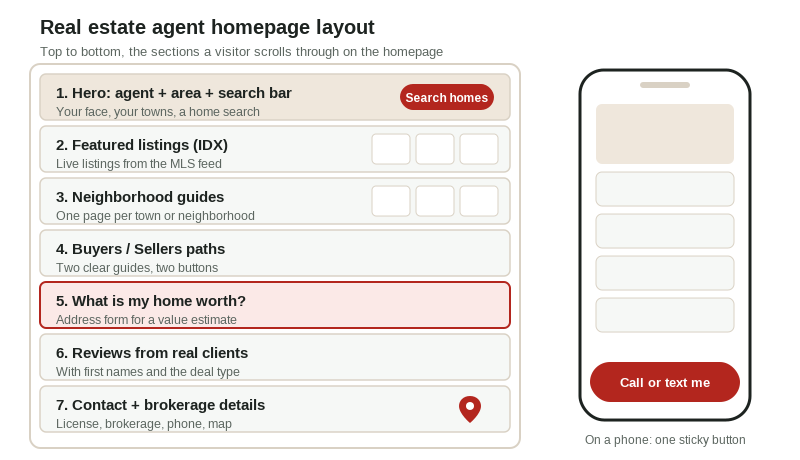
The drawing as text: (1) hero with the agent, the towns served and a search bar; (2) featured listings from the IDX feed; (3) neighborhood guides; (4) buyer and seller paths; (5) a What is my home worth?
form; (6) reviews from real clients; (7) contact, license and brokerage details with a map.
How do listings get onto a real estate website?
Listings get onto a real estate website through IDX, short for Internet Data Exchange, which lets an agent display listings from their local MLS under the MLS’s rules. Agents usually connect an IDX provider’s plugin or embed to the template, so listings update on their own.
Ask your MLS which IDX vendors it approves before you buy a template, then check the template’s demo with that vendor’s widgets. A template that looks good only with its own demo listings may break with a real feed.
Why do neighborhood pages matter on a real estate website?
Neighborhood pages matter because every agent in a market shows the same MLS listings, but nobody else has your descriptions of streets, parks, commutes and local spots. Unique local pages are what search engines and AI assistants can quote when someone asks what an area is like.
Give each neighborhood page the same short sections: where it is, what homes are like, getting around, parks and everyday places, and who tends to love it. Keep it factual and positive about places, never about people.
What do the latest numbers say about home buyers and agents?
The latest numbers say buyers are older and more of them use an agent. The National Association of Realtors’ 2025 Profile of Home Buyers and Sellers found the median first-time buyer age rose to 40 and their share fell to 21%.
| Measure | Value | Source |
|---|---|---|
| Median first-time buyer age | 40 | NAR 2025 Profile |
| Median repeat buyer age | 62 | NAR 2025 Profile |
| First-time buyers’ share | 21% | NAR 2025 Profile |
| Buyers who used an agent | 88% | NAR 2025 Profile |
| NAR members (May 31, 2025) | 1,453,690 | NAR via Florida Realtors |
With well over a million members in one association, a real estate template is a starting point; the local knowledge on it is the difference (Florida Realtors on NAR membership).
Where can you get a real estate website template?
You can get a real estate website template from the free WordPress.org theme directory, paid themes on ThemeForest, builders such as Squarespace and Webflow, or from your brokerage, which may provide an approved agent site.
- WordPress is the most common home for IDX plugins and lets you add many neighborhood pages.
- Brokerage sites come with compliant listings and branding, but you may not own the content if you change brokerages.
- Builders are easy to edit; check that your IDX vendor supports them.
- Free HTML templates suit a developer, but listings still need an approved IDX feed.
How should a real estate website collect leads?
A real estate website should collect leads with a short, honest form: What is my home worth?
asks for the address and an email, and a showing request asks for the listing, a time and a phone number. Say what happens next, such as I’ll email a price range within one business day.
Here is the bit I find genuinely exciting: the listings are the same on every agent’s site, but your neighborhood pages exist nowhere else on the internet.
Avoid forcing a signup just to see listings. People leave when a wall appears before any value, and search engines cannot read content behind a forced login.
What fair housing rules apply to a real estate website?
The federal Fair Housing Act applies to real estate advertising, including websites: descriptions must not show a preference based on race, color, religion, sex, disability, familial status or national origin. The US Department of Housing and Urban Development explains the rules.
How does a real estate website rank locally?
A real estate website ranks locally when the agent’s name, brokerage, address and phone match the Google Business Profile, the site has strong neighborhood pages, and the homepage uses RealEstateAgent structured data. Google weighs relevance, distance and prominence, and says Prominence means how well-known a business is
(Google Business Profile Help).
Mark up the homepage with the schema.org RealEstateAgent type, including name, telephone, address and areaServed. Keep listing photos compressed so pages meet the 2.5-second main-content target in Core Web Vitals.
What should you remember about real estate website templates?
Remember that listings are shared by every agent, while your neighborhood knowledge is yours alone. The numbers and parts worth keeping, from the sources above (November 25, 2026):
- 40
- median first-time buyer age, NAR 2025 Profile
- 88%
- of buyers used an agent, NAR 2025 Profile
- 1,453,690
- NAR members, May 31, 2025
- IDX
- the approved way to show MLS listings on your site
- RealEstateAgent
- the schema.org type for the homepage
Connect the listings, then spend your time on neighborhood pages, honest forms and fair, factual descriptions.
Agents often work with inspectors and notaries; see our guides to a home inspector website template and a notary website template.
So connect your listing feed, then write one honest neighborhood page this week. That page is the one people will remember you for.
Sources and further reading
- NAR: First-time home buyer share falls to historic low of 21%, median age rises to 40 — 2025 Profile of Home Buyers and Sellers
- NAR: 2025 Profile of Home Buyers and Sellers, highlights — repeat buyer age 62; 88% used an agent
- Florida Realtors: NAR membership remains above forecast — 1,453,690 members on May 31, 2025
- schema.org: RealEstateAgent — structured data type
- HUD: Fair Housing and Equal Opportunity — Fair Housing Act protected classes
- Google Business Profile Help: local ranking — prominence quote
- web.dev: Web Vitals — LCP 2.5 s
Questions and answers
What should a real estate agent website include?
A real estate agent website should include a home search with IDX listings, featured listings, neighborhood guides, buyer and seller guides, a home-value form, real client reviews, and contact details with the agent’s license and brokerage.
Are there free real estate website templates for WordPress?
Yes. The WordPress.org directory has free themes that work for real estate, and many IDX providers offer WordPress plugins. Listings still require an IDX feed approved by your MLS, which is usually a paid service.
What is IDX on a real estate website?
IDX, or Internet Data Exchange, lets an agent show listings from their local MLS on their own website under the MLS’s display rules. An IDX provider supplies the search and listing pages that plug into the template.
How do I make a real estate website?
Choose a platform your IDX vendor supports, pick a real estate template, connect the listing feed, then write neighborhood pages, buyer and seller guides and a home-value form. Match your details to your Google Business Profile.
Do fair housing rules apply to real estate websites?
Yes. The Fair Housing Act covers real estate advertising, including websites and listing descriptions. Describe homes and places, not the kind of people who should live there; HUD’s fair housing pages explain the rules.