
Vacation Rental Website Template: Direct Bookings for Hosts (2026)
Disclosure: this page may contain affiliate links. We may earn from qualifying purchases, at no extra cost to you.
Picture a guest who stayed last summer and wants to book again, cozy host, typing your property name and landing on your own site with the calendar right there.
A vacation rental website template turns that guest into a direct booking, and this guide covers the booking engine, property pages, full-price display, local guide and structured data that make a host’s own site work.
Bright, wide interior photos sell a stay, and a wide-angle phone lens from Amazon fits a whole living room into one honest shot.
Short answer: A vacation rental website template should open with the view and a Check Dates button, then show live availability with a booking engine, the home room by room, house rules and policies, a local guide, real guest reviews and the location. Show the total price, fees included, before checkout.
- 1.76 million available US short-term rental listings in June 2025, a record, per AirDNA.
- 56.9% average US short-term rental occupancy in 2025, per AirDNA.
- 1.77 million available listings projected for 2026 in AirDNA’s outlook, as reported by Stayfi.
- The FTC’s fee rule requires the total price, including mandatory fees, in short-term lodging offers.
What should a vacation rental website template include?
A vacation rental website template should include a hero with the property and a date search, live availability with a secure booking engine, a room-by-room description with amenities, house rules and cancellation policy, a local guide, dated guest reviews and directions. Guests booking direct want the same confidence a big platform gives them.
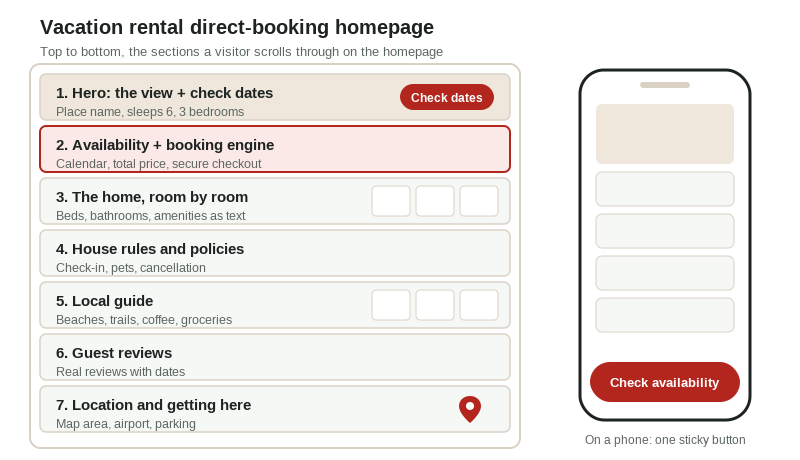
The drawing as text: (1) hero with the view, sleeping capacity and Check Dates; (2) availability calendar and booking engine; (3) the home room by room; (4) house rules and policies; (5) local guide; (6) guest reviews with dates; (7) location, airport and parking.
What booking engine should a vacation rental website use?
A vacation rental website should use a booking engine connected to a channel manager, so one calendar updates your own site and the listing platforms together. Property-management systems such as Lodgify, OwnerRez, Hostaway and Guesty offer booking engines and calendar sync.
Synced calendars prevent double bookings, the one mistake that hurts a direct-booking site most.
How big is the short-term rental market?
The US short-term rental market reached a record 1.76 million available listings in June 2025, according to AirDNA, with average occupancy of 56.9% for the year. With that much supply, a host’s own site helps repeat guests and referrals find them directly.
| Measure | Value | Source |
|---|---|---|
| Available listings, June 2025 (record) | 1.76 million (+6.1% year over year) | AirDNA |
| Average available listings, 2025 | 1.69 million | AirDNA via Stayfi |
| Projected available listings, 2026 | 1.77 million | AirDNA via Stayfi |
| Average occupancy, 2025 | 56.9% | AirDNA |
| Rentals listed at some point in 2023 | 2.4 million | CRS, AirDNA data |
“Available listings” is a monthly measure, while the 2.4 million figure counts every rental listed at any point in 2023, so the two are not directly comparable (Stayfi).
Where can you get a vacation rental website template?
You can get a vacation rental website template from your property-management system (many include one), from travel and rental themes on ThemeForest, from builders such as Squarespace and Wix, or from free WordPress.org themes with a booking plugin.
The deciding factor is the booking engine. Pick the system first, then a template it supports, so availability and payments work on day one.
How should a vacation rental website show prices and fees?
A vacation rental website should show the total price, including mandatory fees such as cleaning fees, before the guest enters payment details. The FTC’s Rule on Unfair or Deceptive Fees covers short-term lodging and requires the total price to be shown up front, more prominently than other pricing.
Here is the bit I find genuinely exciting: your local guide page, the one with your favorite coffee spot and the hidden trail, is something no listing platform can copy.
Why should a vacation rental website have a local guide?
A vacation rental website should have a local guide because it helps guests choose your place and enjoy the stay, and it is content only you can write. List nearby beaches, trails, coffee shops, grocery stores and rainy-day ideas, with distances and your honest notes.
Searches like vacation rental welcome guide template
show hosts want this. A public local guide plus a private arrival guide (codes, Wi-Fi) covers both.
What structured data should a vacation rental website use?
A vacation rental website can describe each property with the schema.org VacationRental type, but Google’s rich vacation rental results are limited. Google’s VacationRental documentation says: This feature is limited to sites that meet certain eligibility criteria.
So use the markup for clarity, but count on what every site controls: plain-text descriptions, question headings (Is the house pet friendly?
) and a Google Business Profile where your property qualifies.
What should you remember about vacation rental website templates?
Remember that a direct-booking site wins on trust: synced availability, the full price up front and details only you know. The numbers and rules worth keeping, from the sources above (November 25, 2026):
- 1.76 million
- available US listings, June 2025 record, AirDNA
- 56.9%
- average 2025 occupancy
- Total price first
- the FTC fee rule for short-term lodging
- Synced calendar
- one booking engine for every channel
- VacationRental
- schema.org type; Google’s rich results need eligibility
Choose the booking engine, write the room-by-room page and local guide, and show the full price; that is a direct-booking site.
Hosts who also sell homes or work with agents may like our real estate website template guide.
So connect the booking engine, write the room-by-room page and your local guide, and show the full price before checkout. Returning guests will book straight with you.
Sources and further reading
- AirDNA: US Review, June 2025 — 1.76 million available listings, +6.1% year over year
- Stayfi: Vacation rental statistics (AirDNA outlook) — 1.69 million in 2025, 1.77 million projected 2026
- AirDNA: US short-term rental market data — 56.9% occupancy in 2025
- Google Search Central: VacationRental structured data — eligibility quote
- schema.org: VacationRental — structured data type
- FTC: Rule on Unfair or Deceptive Fees — total price for short-term lodging
Questions and answers
What should a vacation rental website include?
It should include the property with a date search, live availability with a secure booking engine, a room-by-room description and amenities, house rules and cancellation policy, a local guide, dated guest reviews and directions, with the total price shown before payment.
How do I make a vacation rental website for direct bookings?
Pick a property-management system with a booking engine and channel manager, use its website template or a supported theme, add property pages, policies and a local guide, and sync calendars with your listing platforms to avoid double bookings.
Are there free vacation rental website templates?
Yes. Free WordPress.org themes with a booking plugin work, and some property-management systems include a website template with their plans. The booking engine matters more than the template.
Do vacation rental websites have to show cleaning fees?
Under the FTC’s Rule on Unfair or Deceptive Fees, short-term lodging offers must show the total price including mandatory fees such as cleaning fees, more prominently than other pricing, before payment.
Can I use VacationRental schema on my rental website?
You can add schema.org VacationRental markup to describe properties, but Google’s rich vacation rental results are limited to sites that meet eligibility criteria and work through its Hotel Center program.