
AI for Seniors in 2026: Who Uses It, What For, and What Worries Them
Disclosure: this page contains Amazon affiliate links. As an Amazon Associate we earn from qualifying purchases, at no extra cost to you.
Oh, I love this one — pull up a chair, kitchen-table tech helper, the numbers on older adults and AI are better than the headlines suggest! Here’s a question that comes up at a lot of family dinners this year: is Grandma using ChatGPT now, or is that just us? The numbers say more older adults use AI chatbots than ever, but still far fewer than younger people, and they have clear ideas about what they want from it. If you’d like a gentle paper guide to sit next to the screen, there are beginner-friendly AI books for older adults on Amazon.
Short answer: About 23% of Americans 65 and older used AI chatbots in early 2026, up from 12% in 2024, compared with 49% of all U.S. adults, according to Pew Research Center. Adults 50+ most want AI for practical jobs like translation and home monitoring, and their top worries are AI outpacing ethics and losing human contact.
The five numbers that sum up older adults and AI right now:
- 23% of U.S. adults 65+ ever use AI chatbots, and 7% use them every day (Pew Research Center, survey February 2026).
- 55% of adults 50+ have used some AI they talk or type to, such as a voice assistant or a chatbot (University of Michigan National Poll on Healthy Aging, February 2025).
- 74% of adults 50+ are interested in AI for translation, the top use in AARP’s January 2026 survey.
- 73% of adults 50+ think AI is advancing faster than ethics rules can keep up (AARP, January 2026).
- $352 million in AI-related fraud losses were reported to the FBI by people 60 and older in 2025 (FBI IC3, 2025 Internet Crime Report).
How many seniors use AI chatbots in 2026?
Just under a quarter of Americans 65 and older — 23% — say they ever use AI chatbots, according to Pew Research Center’s Americans and AI 2026
report, published June 17, 2026. That compares with 49% of all U.S. adults and 66% of adults ages 18 to 29.
Pew surveyed 5,119 U.S. adults from February 17 to 23, 2026, on its American Trends Panel. Daily use of AI chatbots is much rarer among older adults: 7% of people 65+ use a chatbot every day, against 24% of all adults. Here are the numbers by age, from Pew’s chapter on how AI use differs by age:
| Age group | Ever use AI chatbots | Use AI chatbots daily |
|---|---|---|
| 18-29 | 66% | 31% |
| 30-49 | 61% | 34% |
| 50-64 | 42% | 19% |
| 65 and older | 23% | 7% |
| All U.S. adults | 49% | 24% |
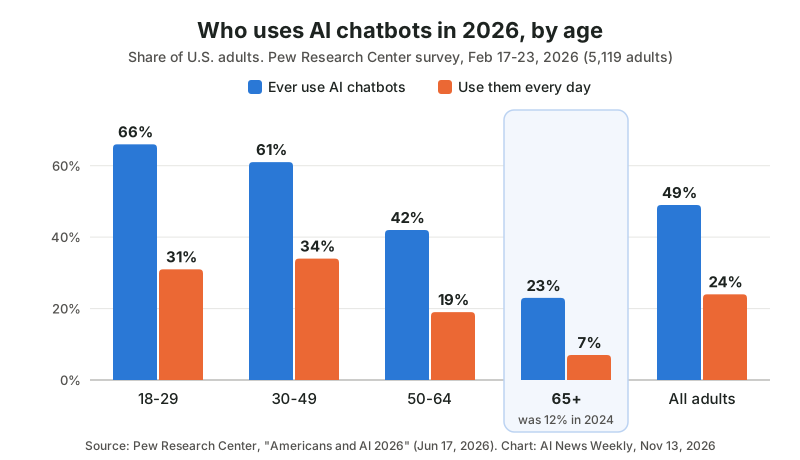
The chart as text: ever use / daily use — ages 18-29: 66% / 31%; 30-49: 61% / 34%; 50-64: 42% / 19%; 65+: 23% / 7% (12% ever used in 2024); all adults: 49% / 24%.
How much did AI use by older adults grow from 2024 to 2026?
AI chatbot use among Americans 65+ nearly doubled in two years, from 12% in 2024 to 23% in 2026, per Pew Research Center. Our own arithmetic from Pew’s figures shows the older group grew faster in relative terms but still fell further behind in raw percentage points:
- Adults 65+, 2024 to 2026
- 12% to 23%: up 11 points, about 1.9 times as many
- All U.S. adults, 2024 to 2026
- 33% to 49%: up 16 points, about 1.5 times as many
- Gap between all adults and 65+
- 21 points in 2024, 26 points in 2026
- Older users who use a chatbot daily
- 7% of 23%: roughly 3 in 10 older chatbot users use one every day
Calculated by AI News Weekly from Pew Research Center’s 2026 report, November 13, 2026. So the honest headline is both: more older adults are trying AI chatbots than ever, and the age gap in AI chatbot use is still wide.
Which AI chatbots do Americans use most?
ChatGPT is by far the most used AI chatbot in the U.S.: 44% of all adults say they use it, followed by Google’s Gemini at 24% and Microsoft’s Copilot at 17%, per Pew’s Americans and AI 2026
. Among adults 65+, 19% use ChatGPT.
- ChatGPT (OpenAI): 44% of U.S. adults
- Gemini (Google): 24%
- Copilot (Microsoft): 17%
- Meta AI: 14%; Grok (xAI): 8%
- Claude (Anthropic): 6%
Pew’s report gives the brand breakdown for all adults, not by age, except for ChatGPT. Pew also found that 57% of adults under 50 use ChatGPT, compared with 28% of those 50 and older.
Do older adults use AI by talking to it instead of typing?
Yes — for many older adults, AI arrived through the voice assistant on the kitchen counter or the phone, not a chatbot. The University of Michigan’s National Poll on Healthy Aging found that 55% of adults 50 and older had used some AI technology they speak or type to, such as Amazon’s Alexa or ChatGPT.
The poll surveyed 2,883 adults aged 50 and older in February 2025; its authors, led by Erica Solway, published the key findings in the journal Innovation in Aging in December 2025. The same paper reports that 14% of adults 50+ had used AI to get health information and 35% were interested in using AI in their day-to-day life. AARP’s January 2026 “AI Trends” datastory goes further: eight in ten adults 50+ report having used some form of AI.
That makes the voice assistant a friendly on-ramp. Asking Apple’s Siri or Amazon’s Alexa a question out loud is the same idea as typing to a chatbot: you ask in plain words and the AI assistant answers. If reading small text is the hard part, a smart speaker with a screen lets a person both hear and see the answer.
What do older adults want AI to help with?
Older adults want AI for practical, everyday jobs: in AARP Research’s January 2026 survey, 74% of adults 50+ were interested in AI for translation services and 71% in home monitoring systems. The survey asked about “jobs” for AI, and the jobs that mattered most were health and everyday help, not novelty.
AARP Research’s report, Older Adults Want AI to Show Up in Practical Ways
by Brittne Kakulla (published January 13, 2026), surveyed 1,661 adults, 1,148 of them over 50, in January 2025. Its findings for adults 50+:
- Interest in AI for translation services: 74%.
- Interest in AI home monitoring systems: 71%.
- Interest in AI driving assistance or self-driving: 36%; pet care: 34%.
- The three top “jobs” for AI: managing one’s health support network, filtering news, and simplifying health information.
- Seven of the top 20 jobs relate to health, wellness guidance or medication tracking.
- 42% of adults 50+ call themselves AI beginners, and 28% intermediate.
The report’s own summary line puts it well: In short, the application of AI — or, “job,” as the survey frames it — matters.
In other words, older adults aren’t asking “what is AI?” so much as can it read this letter for me?
Which everyday AI uses does this series cover?
This article opens AI News Weekly’s AI for Seniors series, ten stories that each take one everyday job older adults told AARP and the University of Michigan they care about, and show what the main AI assistants can and can’t do for it. The ten parts, in order:
- Who uses AI, what for, and what worries older adults (this page).
- AI scams aimed at older adults, and how to fight back.
- Asking AI health questions safely.
- Medication reminders and health organizers.
- Explaining bills, Medicare and government letters.
- Tech support for phones and computers.
- Writing a life story and letters to family.
- Translation for families who speak different languages.
- News summaries without the overload.
- Trip planning for older travelers.
Each part lands here over the coming days, and this list becomes links as they go live.
What worries older adults about AI?
Older adults’ biggest worries about AI are trust and the human touch: 73% of adults 50+ think AI is advancing faster than ethical policies can keep pace, and 68% worry it could reduce meaningful human interaction, according to AARP’s January 2026 “AI Trends” datastory. Yet 51% of the same group believe AI’s benefits outweigh its risks.
Can I say my favorite number in this whole story? Ninety-two percent. Nearly everyone over 50 wants to know whether an answer came from a person or a machine — and honestly, that’s the smartest instinct any AI user can have, at any age.
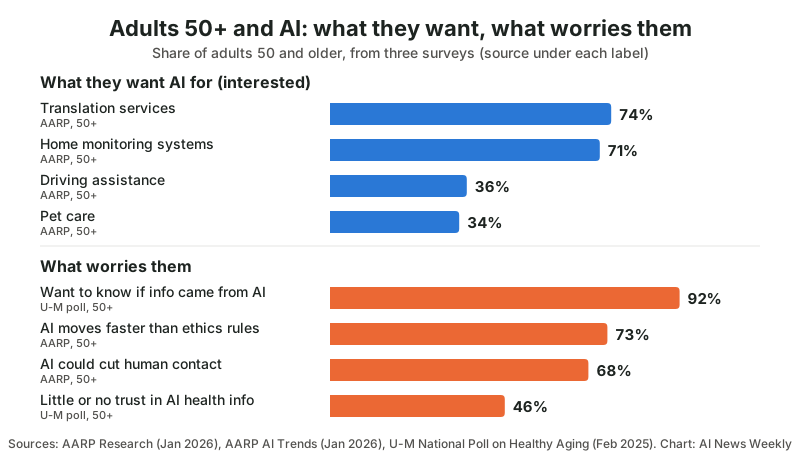
The chart as text — interested in AI for: translation services 74%, home monitoring systems 71%, driving assistance 36%, pet care 34% (AARP Research, adults 50+). Worries: want to know whether information came from AI 92% (University of Michigan poll), AI advancing faster than ethics rules 73% (AARP), AI could reduce human contact 68% (AARP), little or no trust in AI health information 46% (University of Michigan poll).
The University of Michigan poll adds two clear wishes: 92% of adults 50+ want to know whether information comes from a person or from AI, and 81% want to learn more about AI’s risks. Pew Research Center found that Americans 65+ are the most unsure age group about AI’s effect over the next 20 years. Pew’s own sentence:
Americans ages 65 and older are most likely to say they’re unsure about both AI’s personal and societal impact.
Among Americans 65+, 35% expect AI’s impact on society over the next 20 years to be negative, 15% positive, and 21% aren’t sure, per Pew. Those are reasonable feelings, and the next section shows why caution about one thing in particular — scams — is well founded.
Are scammers using AI against older adults?
Yes. The FBI’s 2025 Internet Crime Report is the first to include a section on artificial intelligence, and it counts $352,496,231 in AI-related losses reported by people 60 and older in 2025 — about 39% of the $893 million in AI-related losses from all ages (our share, from the FBI’s two figures).
The FBI Internet Crime Complaint Center (IC3) report for 2025 lists, for people 60 and older: 201,266 complaints (up 37% from 2024), $7.748 billion in losses (up 59%), an average loss of $38,500, and 12,444 people who lost more than $100,000. Across all ages, IC3 received 22,364 complaints with AI-related information. The report explains why AI makes scams harder to spot:
AI-enabled synthetic content is becoming increasingly difficult to detect and easier to make, which allows criminal actors to potentially conduct successful fraud schemes against individuals, businesses, and financial institutions.
The same report notes that grandparent or “distress” scams now use voice cloning to mimic the sound of a loved one in trouble, with over $5 million in reported losses to those scams in 2025.
What is a safe first way for a senior to try AI?
The safest first step is to use an AI assistant for a low-stakes job you can check yourself, like explaining a word, planning a recipe or drafting a birthday message, and never to share passwords, account numbers or health records with it. Start with the assistant already on your phone or computer, so there’s nothing new to install.
- On an iPhone: Siri is already there — hold the side button or say
Siri
and ask in plain words. - On an Android phone: Google’s Gemini app or the Google assistant.
- On a Windows computer: the Microsoft Copilot app, or copilot.microsoft.com in the browser.
- In any web browser: ChatGPT, Gemini, Copilot or Claude, each from the maker’s own website (check the maker’s page for plans and terms).
Three first questions that are safe and genuinely useful (our own examples — type them or say them):
Explain what "two-factor authentication" means, in three
short sentences, as if to someone who has never heard of it.

I have chicken, rice, carrots and an onion. Suggest one easy
dinner for two, with large clear steps.

Help me write a warm, short birthday message for my
granddaughter who just turned 16 and loves soccer.
Then read the answer the way you’d read advice from a stranger: is it clear, is it right, would you double-check it? That habit — checking what the AI assistant says — is the most important skill for any AI user at any age. A large-print keyboard can make typing to an AI chatbot easier on the eyes.
For step-by-step guides to one assistant in particular, our sister site How To With Claude AI is publishing a matching series for older adults, with screens and prompts for Claude.
How can adult children help a parent start using AI?
Adult children help most by sitting beside an older parent for one real task, not by explaining AI in general. Pick one job from AARP’s list — say, translating a letter or simplifying a health leaflet — and do it together once, then let the parent do it alone while you watch.
- Choose one AI assistant and stick with it for the first month.
- Agree on the family safe word in the same sitting (the FBI’s advice above).
- Write three “never share” items on a card next to the computer: passwords, bank and card numbers, Social Security or Medicare numbers.
- Show how to ask the AI assistant
How sure are you?
andWhere can I check this?
In AARP’s survey, 42% of adults 50+ call themselves AI beginners, so a patient half hour of side-by-side help goes a long way.
What are the key numbers on seniors and AI in 2026?
The key numbers on older adults and AI in 2026, gathered in one place from four primary sources:
| Finding | Number | Who was asked | Source |
|---|---|---|---|
| Ever use AI chatbots | 23% (12% in 2024) | U.S. adults 65+, Feb 2026 | Pew Research Center |
| Use AI chatbots daily | 7% | U.S. adults 65+, Feb 2026 | Pew Research Center |
| Ever used AI they talk or type to | 55% | U.S. adults 50+, Feb 2025 | University of Michigan poll |
| Interested in AI for translation | 74% | U.S. adults 50+ | AARP Research |
| Call themselves AI beginners | 42% | U.S. adults 50+ | AARP Research |
| AI advancing faster than ethics | 73% | U.S. adults 50+ | AARP AI Trends |
| Want to know if info came from AI | 92% | U.S. adults 50+, Feb 2025 | University of Michigan poll |
| AI-related fraud losses, age 60+ | $352.5 million | Complaints filed in 2025 | FBI IC3 |
Different surveys asked different age groups (50+, 60+ or 65+) in different months, so compare the numbers within a row, not across rows.
The short version for families: older adults are trying AI in growing numbers, they want it for real jobs like translation and health paperwork, and they’re right to ask where answers come from. The rest of this series takes those jobs one at a time.
So here’s my little nudge: pick one small, checkable job, try it with the AI assistant already on your phone, and set the family safe word while you’re at it. Ten minutes, two good habits, and you’re ahead of most of the internet.
Sources and further reading
- How opinions and use of AI differ by age (Pew Research Center) — June 17, 2026; 65+ chatbot use 23% (12% in 2024), daily 7%; age table; 65+ views of AI impact; read Nov 13, 2026
- Americans and AI 2026: Chatbots, Smart Devices and Views on Impact (Pew Research Center) — survey of 5,119 adults, Feb 17-23, 2026; chatbot brands; ChatGPT by age; read Nov 13, 2026
- Older Adults Want AI to Show Up in Practical Ways (AARP Research, Brittne Kakulla) — January 13, 2026; translation 74%, home monitoring 71%, 42% beginners, top jobs; read Nov 13, 2026
- AI Trends: How Older Adults Use and View Technology (AARP datastory) — January 2026; 73% ethics, 68% human contact, 51% benefits outweigh risks; read Nov 13, 2026
- Artificial Intelligence Use and Views: Key Findings From the National Poll on Healthy Aging (Innovation in Aging) — Solway et al., December 2025; 2,883 adults 50+, February 2025; 55%, 92%, 81%, 46%, 35%, 14%; read Nov 13, 2026
- How Older Adults Use and Think About AI (University of Michigan National Poll on Healthy Aging) — the poll’s own report page
- 2025 Internet Crime Report (FBI Internet Crime Complaint Center) — 60+: 201,266 complaints, $7.748 billion; AI-related: 22,364 complaints, $893,346,472; AI-related 60+: $352,496,231; read Nov 13, 2026
- Criminals Use Generative Artificial Intelligence to Facilitate Financial Fraud (FBI IC3 PSA) — December 3, 2024; secret family word, hang up and call back
- ChatGPT (OpenAI)
- Gemini (Google)
- Microsoft Copilot
- Claude (Anthropic)
- Siri (Apple)
Questions and answers
What percentage of seniors use AI?
About 23% of Americans 65 and older used AI chatbots in early 2026, according to Pew Research Center, up from 12% in 2024. Counting voice assistants like Alexa too, the University of Michigan National Poll on Healthy Aging found 55% of adults 50+ had used AI they speak or type to.
Do seniors use ChatGPT?
Some do: 19% of U.S. adults 65 and older say they use ChatGPT, per Pew Research Center’s 2026 report, compared with 44% of all adults. Pew also found 28% of adults 50 and older use ChatGPT, against 57% of those under 50.
What do older adults use AI for?
Older adults are most interested in practical AI jobs. In AARP Research’s January 2026 survey, 74% of adults 50+ were interested in AI for translation and 71% in home monitoring, and the top jobs were managing a health support network, filtering news and simplifying health information.
Why are older adults worried about AI?
Older adults worry most about ethics, human contact and trust: 73% of adults 50+ think AI is moving faster than ethics rules and 68% fear less human interaction (AARP, January 2026). 46% have little or no trust in AI health information (University of Michigan poll).
What is the best AI assistant for seniors?
The best AI assistant for a senior is usually the one already on their phone or computer, such as Siri on an iPhone, Gemini on Android or Copilot on Windows, because there is nothing new to set up. Start with low-stakes questions, never share passwords or account numbers, and agree on a family safe word against voice-clone scams.