
4 in 10 Older AI Users Ask It Health Questions: How to Do It Safely
Disclosure: this page contains Amazon affiliate links. As an Amazon Associate we earn from qualifying purchases, at no extra cost to you.
Well hello, appointment-prep champion — grab your reading glasses and a cup of tea, because it turns out loads of us are already asking AI about our aches, pills and lab results, and I’m so glad you want to do it the smart way! Four in ten adults over 50 who use AI have already asked it a health question, according to AARP’s June 2026 survey — and in 2026 the biggest AI makers opened separate health spaces that can read your medical records. One low-tech helper still wins for keeping it all straight: large-print health and appointment notebooks on Amazon hold your questions, medicines and the doctor’s answers in one place you control.
Short answer: Yes, older adults can ask AI health questions safely if they keep it to understanding and preparation: 41% of AI users over 50 already do, per AARP. Use AI to explain words, tests and leaflets and to list questions for your doctor; call 911 for emergencies, and remove your name and ID numbers before pasting anything.
The five numbers that sum up older adults and AI health questions in 2026:
- 41% of adults 50+ who use AI have asked an AI tool a health-related question, and 62% say they’re likely to in the next 12 months (AARP Research, June 11, 2026).
- 11% of those AI users have shared personal health documents such as test results or insurance statements with an AI tool — so roughly 3.7 people ask for every one who shares (our arithmetic).
- 69% of adults 50+, users and nonusers alike, are not comfortable sharing personal health information with a health-specific AI tool (AARP).
- 52% of the emergency cases in a Nature Medicine stress test were under-triaged by ChatGPT Health — sent to a 24-48 hour check instead of the emergency department (February 23, 2026).
- 3 of the biggest AI makers opened dedicated health spaces in early 2026: OpenAI’s ChatGPT Health (January 7), Anthropic’s Claude health-record connectors (January 11) and Microsoft’s Copilot Health (March 12).
How many older adults ask AI health questions?
About four in ten older adults who use AI have asked it a health question: 41% of AI users aged 50 and older in AARP’s survey, with 62% expecting to do so in the next year. Counting everyone over 50, users or not, AARP’s companion survey found that about one in four (23%) used a generative AI tool in connection with their own health care in the past 12 months.
The AARP survey, Adults Age 50-Plus and AI-Powered Health Tools
by Brittne Kakulla of AARP Research, interviewed 1,031 adults 50+ between February 12 and 16, 2026, online and by phone, in NORC at the University of Chicago’s Foresight 50+ panel. It was published June 11, 2026, as part of AARP’s AI and Health series.
How do the 2025 and 2026 surveys on AI health questions compare?
Four recent surveys measured health questions to AI, each asking a slightly different question of a different group. Side by side, they show older adults trying AI for health more often, while still using it less than younger adults:
| Survey (when asked) | Who was asked | Finding |
|---|---|---|
| University of Michigan National Poll on Healthy Aging (February 2025) | Adults 50+ | 14% had used AI to get health information |
| AARP AI-Powered Health Tools Survey (February 12-16, 2026) | Adults 50+ who use AI | 41% asked an AI tool a health question; 62% likely to in the next 12 months |
| AARP AI and Health Care Providers Survey (published June 11, 2026) | Adults 50+ | 23% used a generative AI tool in connection with their own health care in the past 12 months |
| KFF Tracking Poll (February 24 — March 2, 2026) | Adults 18+ | 29% used AI for physical health information in the past year; 32% for physical or mental health |
| KFF Tracking Poll, by age | Adults 50+ and 18-29 | AI for mental health: 8% of adults 50+, 28% of adults 18-29 |
Because the questions and the groups differ, compare within a row rather than drawing a trend line across rows. What every row agrees on: asking AI about health has moved from rare to ordinary in about a year.
What do older adults use AI for in their health care?
Older adults mostly use AI to look up a diagnosis or a medicine their doctor mentioned. In AARP’s providers survey, published June 11, 2026, adults 50+ who used AI to navigate their health care named these top uses:
- Looking up information about a diagnosis or condition their provider mentioned: 64%
- Researching a medication that was mentioned or prescribed: 62%
- Deciding whether a symptom was serious enough to contact their provider: 45%
- Understanding or interpreting what a provider told them during a visit: 41%
- Preparing questions before an appointment: 21%
- Tracking or managing their treatment or medication: 10%
Two of those numbers stand out. Deciding whether a symptom is serious (45%) is the job the 2026 research says an AI chatbot handles worst, and preparing questions for an appointment (21%) is one of the jobs the AI makers themselves say it handles best. Both come up again below.
Why don’t older adults trust AI with their health records?
Older adults hold back mainly because they trust their doctor more: 69% of adults 50+ aren’t comfortable sharing personal health information with a health-specific AI tool, and the top reason, given by 63% of those not completely comfortable, is that they’d rather have a doctor explain their health. AARP’s Brittne Kakulla put the finding in the survey’s title: older adults Trust the Doctor in the Room, Not the AI Health Tool
.
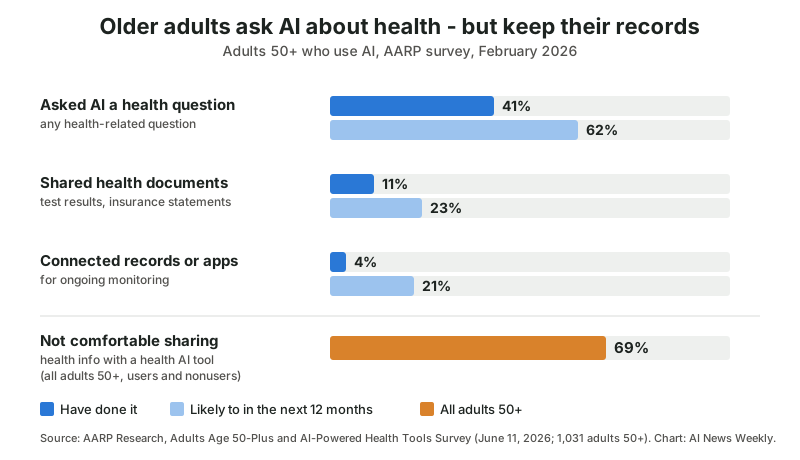
The chart as text — adults 50+ who use AI: asked an AI tool a health question 41% (likely in the next 12 months 62%); shared personal health documents 11% (likely 23%); connected medical records or wellness apps 4% (likely 21%). All adults 50+: not comfortable sharing personal health information with a health-specific AI tool 69%.
The other reasons AARP recorded among adults 50+ who weren’t completely comfortable sharing:
- Information could be shared or sold without consent: 61%
- Unsure how the AI system would use the information: 58%
- Privacy and security concerns about health data: 58%
- Lack of regulation or oversight of AI companies: 57%
- Unclear who is accountable if the AI gives incorrect or harmful guidance: 57%
The caution shows up in other polls too. The University of Michigan’s National Poll on Healthy Aging found that 46% of adults 50+ had little or no trust in AI-generated health information, as its authors reported in Innovation in Aging, and the KFF Tracking Poll found that 77% of all adults are very or somewhat concerned about the privacy of medical information given to AI tools.
What changed in AI health tools in 2026?
In early 2026, three of the biggest AI makers opened separate health spaces that can connect to your medical records and fitness apps: OpenAI’s ChatGPT Health on January 7, Anthropic’s health-record connectors for Claude on January 11, and Microsoft’s Copilot Health on March 12. Each one is opt-in, and each maker says the health data isn’t used to train its AI models.
| Health space | Maker and date | What it can connect to | Training on your health data | Who could use it at launch |
|---|---|---|---|---|
| ChatGPT Health | OpenAI, January 7, 2026 | Medical records through b.well; Apple Health, MyFitnessPal, Weight Watchers and Function lab data (CNBC) | Not used to train OpenAI’s foundation models (CNBC) | A small group of early users first, expanding in the following weeks (CNBC) |
| Claude health connectors | Anthropic, January 11, 2026 | Lab results and health records through HealthEx and Function (beta); Apple Health and Android Health Connect (beta) | We do not use users’ health data to train models | U.S. subscribers on the Claude Pro and Max plans, opt-in |
| Copilot Health | Microsoft, March 12, 2026 | Records from over 50,000 U.S. hospitals and provider organizations through HealthEx; over 50 wearables including Apple Health, Oura and Fitbit; Function lab results | Not used for model training | A careful, phased rollout |
CNBC’s Ashley Capoot reported on January 7, 2026 that ChatGPT Health keeps health chats in their own space and quoted OpenAI that it is not intended for diagnosis and treatment
; OpenAI’s own announcement page refused our fetch, so we cite the report. Anthropic’s announcement says a connected Claude can summarize medical history, explain test results in plain language and prepare questions for appointments, and is designed to direct users to healthcare professionals for personalized guidance.
Microsoft says its consumer products already answer over 50 million health questions a day, and that it designed Copilot Health in collaboration with organizations including AARP. Microsoft’s announcement sums up the makers’ shared pitch:
Copilot Health doesn’t replace your doctor. It makes every minute you have with them count more.
Google’s Gemini, Meta AI, Amazon’s Alexa+ and Apple’s Siri answer health questions as general assistants; the safety rules further down this page apply to them just the same.
Is your health information private when you ask an AI chatbot?
Health information typed into an AI chatbot is only as private as that company’s own settings and promises: AARP warns that most AI-powered tools are not required to meet the same privacy and data protection standards as health care platforms. The dedicated health spaces add protections — separate storage, opt-in connections, no model training, and the option to disconnect at any time, per Anthropic and Microsoft — but they are company policies you agree to, not your doctor’s office.
- Unsure who will see their data
- 57% of adults 50+ are unsure who will have access to personal health information once it’s entered into a generative AI tool (AARP)
- The “HIPAA compliant” mix-up
- 34% of adults 50+ believe that if an AI tool says it’s “HIPAA compliant”, anything they enter is safeguarded by confidentiality rules — AARP calls that assumption incorrect
Only I can see it
- 6% believe they’re the only ones with access to what they share or upload — also incorrect, per AARP
- Uploads are already common
- 41% of adults who used AI for health in the past year say they’ve uploaded personal medical information such as test results or doctor’s notes — 13% of all adults (KFF)
Can AI tell you if a symptom is an emergency?
No — an AI chatbot is the wrong tool for deciding whether something is an emergency. In a stress test published in Nature Medicine on February 23, 2026, ChatGPT Health under-triaged 52% of the true emergencies it was given, telling people with conditions such as diabetic ketoacidosis or impending respiratory failure to get checked in 24 to 48 hours instead of going to the emergency department.
The study, ChatGPT Health performance in a structured test of triage recommendations
by Ashwin Ramaswamy and colleagues, ran 60 doctor-written patient scenarios across 21 areas of medicine under 16 different conditions — 960 responses in all. ChatGPT Health got some classic emergencies right, such as stroke and anaphylaxis, but missed others. The finding families should know: When family or friends minimized symptoms
, the paper’s abstract reports, recommendations shifted significantly in borderline cases, mostly toward less urgent care.
That matters because 45% of older adults who use AI for their health care already use it to decide whether a symptom is serious enough to call their provider (AARP). The KFF poll adds that 58% of adults who used AI for physical health advice followed up with a doctor afterward — so about four in ten did not (our arithmetic).
How do you ask an AI assistant a health question safely?
To ask an AI assistant a health question safely, sort the question first: emergencies go to 911, decisions about your care go to your doctor or pharmacist, and only questions about understanding and preparing go to the AI. Then strip out personal details, describe symptoms plainly, ask for sources and take the answer to a person.
Here’s the bit that makes me grin: the best use of an AI assistant before a doctor’s visit isn’t getting an answer at all — it’s showing up with better questions. A tidy list of five questions is a little superpower, and nobody has to know a chatbot helped you write it.
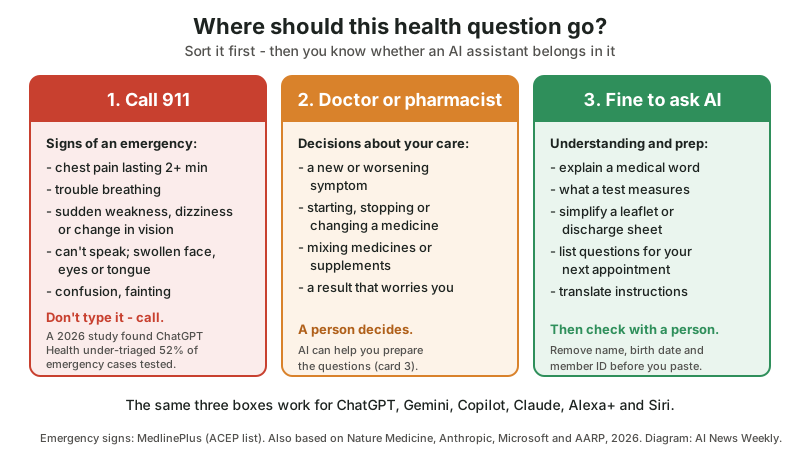
The diagram as text — 1. Call 911 for signs of an emergency: chest pain lasting two minutes or more, trouble breathing, sudden weakness, dizziness or change in vision, being unable to speak or a swollen face, eyes or tongue, confusion or fainting. 2. Doctor or pharmacist for decisions about your care: a new or worsening symptom, starting, stopping or changing a medicine, mixing medicines or supplements, a result that worries you. 3. Fine to ask AI for understanding and preparation: explaining a medical word, what a test measures, simplifying a leaflet or discharge sheet, listing questions for your next appointment, translating instructions — then check with a person.
Seven habits that work with ChatGPT, Gemini, Copilot, Claude, Alexa+ or Siri:
- Sort first. Use the three boxes above before you type anything.
- Remove what identifies you. Name, birth date, Medicare or insurance member ID, Social Security number, address.
- Describe symptoms exactly as they are. Don’t play them down; the Nature Medicine study found that minimizing language pushed answers toward less urgent care.
- Ask for sources. Ask the AI assistant to name where its information comes from, such as MedlinePlus, a medical society or a major clinic, and open the source yourself.
- Ask what it doesn’t know. A good follow-up:
What would my doctor need to know that you can’t see?
- Write the answer down and bring it to your appointment, rather than acting on it alone.
- Check medicines with a pharmacist. Questions about mixing medicines, doses or supplements belong to the person who can see your full medication list.
What personal details should you never paste into an AI chatbot?
Never paste details that identify you or open your accounts into an AI chatbot: your full name, birth date, Social Security number, Medicare or insurance member ID, address, phone number, or any password or patient-portal login. If you want a document explained, copy only the lines you need — the test names, your numbers and the reference ranges — instead of uploading the whole page with your details on it.
Can AI explain your lab results?
Yes, an AI assistant can explain in plain words what a lab test measures and what a number outside the printed reference range usually means — 19% of adults used AI that way in the past year, per KFF, and Anthropic says a connected Claude can explain test results in plain language
. What an AI model can’t do is weigh your result against your history, your medicines and your last tests; that’s your doctor’s job. Our own example prompt:
I'm in my 70s and got blood test results back. Please explain
in plain words, without guessing at a diagnosis:
1. what each test below measures,
2. what it usually means when a number is outside the
   reference range printed next to it,
3. three questions I should ask my doctor about these results.
I removed my name and ID numbers.
[paste only the test names, my numbers and the reference ranges]
What should you ask AI before a doctor’s appointment?
The best thing to ask AI before a doctor’s appointment is help writing your questions: describe what you want to discuss, without personal details, and ask for a short, clear list to bring along. Only 21% of older adults who use AI for their health care use it this way (AARP), yet it’s the use Anthropic and Microsoft both put first.
Our own example prompt for any AI assistant:
I have a doctor's appointment next week about [the topic, e.g.
my knee pain that started a month ago]. Please help me write
5 short, clear questions to ask, in plain words, and remind me
what details my doctor will probably want from me (when it
started, what makes it better or worse, medicines I take).
Don't diagnose me - just help me prepare.
Five questions worth bringing to almost any appointment, whether or not an AI helped you write them:
- What do you think is causing this, and what else could it be?
- What is this test or medicine for, and what side effects should I watch for?
- Does it interact with anything else I take? (Bring your full medicine list.)
- What happens if I wait or do nothing?
- When should I call you, and when should I go to the emergency room?
For a step-by-step version with one assistant, our sister site How To With Claude AI is publishing a matching seniors series with screens and prompts for Claude.
What are the key numbers on older adults and AI health questions?
The key numbers on older adults, AI health questions and AI health tools, gathered from AARP, KFF, the University of Michigan, Nature Medicine and the AI makers:
| Finding | Number | Source |
|---|---|---|
| AI users 50+ who asked AI a health question | 41% (62% likely in the next 12 months) | AARP |
| Adults 50+ who used generative AI for their own health care, past 12 months | 23% | AARP |
| AI users 50+ who shared health documents with AI | 11% (about 1 for every 3.7 who asked) | AARP (our arithmetic) |
| Adults 50+ not comfortable sharing health information with a health AI tool | 69% | AARP |
| Adults 50+ with little or no trust in AI health information | 46% | University of Michigan |
| Adults (18+) who used AI for physical health information, past year | 29% | KFF |
| Emergencies under-triaged by ChatGPT Health in a stress test | 52% | Nature Medicine |
| Health questions answered by Microsoft’s consumer products | over 50 million a day | Microsoft AI |
| AI health spaces launched January-March 2026 | 3 (ChatGPT Health, Claude health connectors, Copilot Health) | OpenAI via CNBC, Anthropic, Microsoft |
The surveys asked different questions of different groups, so compare numbers within a row, not across sources.
The short version for families: AI assistants are good at turning medical words into plain ones and at helping you walk into an appointment prepared. They are not a doctor, not a pharmacist and not 911 — and the more an older adult treats them as a study partner rather than a decision-maker, the more useful they get.
So here’s my gentle nudge for this week: before your next appointment, ask any AI assistant to help you write three questions, cross out your name and numbers before you paste anything, and keep 911 for the scary stuff. Small habits, big peace of mind — and you’ll walk in as the best-prepared patient in the waiting room.
Sources and further reading
- Adults Age 50-Plus and AI-Powered Health Tools Survey: Older Adults Trust the Doctor in the Room, Not the AI Health Tool (AARP Research, Brittne Kakulla) — June 11, 2026; 1,031 adults 50+, Feb 12-16, 2026, NORC Foresight 50+; 41% asked, 62% likely, 11%/23% documents, 4%/21% connected, 69% not comfortable, reasons 63/61/58/58/57/57%, 57% unsure, 34% HIPAA belief, 6%; read Nov 13, 2026
- Adults Age 50-Plus AI and Health Care Providers Survey (AARP Research, Brittne Kakulla) — June 11, 2026; 23% used generative AI for their own health care; top uses 64/62/45/41/21/10%; read Nov 13, 2026
- KFF Tracking Poll on Health Information and Trust: Use of AI for Health Information and Advice (KFF) — March 25, 2026; 1,343 adults, Feb 24 — Mar 2, 2026; 32%/29%/16%, 19% lab results, 58% followed up, 77% privacy concern, 41% uploaded; read Nov 13, 2026
- Artificial Intelligence Use and Views: Key Findings From the National Poll on Healthy Aging (Innovation in Aging) — December 2025; 2,883 adults 50+, February 2025; 14% health information, 46% little or no trust
- ChatGPT Health performance in a structured test of triage recommendations (Nature Medicine, Ramaswamy et al.) — published online February 23, 2026; 60 vignettes, 21 domains, 960 responses; 52% of emergencies under-triaged; family minimizing symptoms shifted recommendations; read Nov 13, 2026
- Advancing Claude in healthcare and the life sciences (Anthropic) — January 11, 2026; HealthEx and Function connectors, Apple Health and Android Health Connect in beta, US Pro and Max, opt-in, no training on health data; read Nov 13, 2026
- Introducing Copilot Health (Microsoft AI) — March 12, 2026; 50,000+ US hospitals via HealthEx, 50+ wearables, Function labs, not used for model training, 230+ physicians, AARP collaboration, 50 million health questions a day; read Nov 13, 2026
- OpenAI launches ChatGPT Health to connect user medical records, wellness apps (CNBC, Ashley Capoot) — January 7, 2026; b.well, connected apps, not used to train foundation models, not intended for diagnosis and treatment; read Nov 13, 2026
- Introducing ChatGPT Health (OpenAI) — the maker’s own page; it refused our fetch on Nov 13, 2026, so its details here come from CNBC and Nature Medicine
- Recognizing medical emergencies (MedlinePlus, U.S. National Library of Medicine) — American College of Emergency Physicians warning signs; read Nov 13, 2026
- ChatGPT (OpenAI)
- Gemini (Google)
- Microsoft Copilot
- Claude (Anthropic)
Questions and answers
Is it safe to ask ChatGPT medical questions?
It’s safe to ask ChatGPT or any AI assistant to explain medical words, tests and leaflets or to help you prepare questions for your doctor, as long as you remove personal details first. It isn’t safe to rely on it for emergencies or treatment decisions: a February 2026 Nature Medicine study found ChatGPT Health under-triaged 52% of the emergencies it was tested on.
Can AI explain my lab results?
Yes, an AI assistant can explain what each lab test measures and what a number outside the reference range usually means, in plain words. Paste only the test names, your numbers and the reference ranges, not your name or ID numbers, and ask your doctor what the results mean for you, since the AI can’t see your history or medicines.
Is my health information private if I share it with an AI chatbot?
Only as private as the company’s own settings and policies: AARP warns that most AI tools aren’t required to meet the privacy standards of health care platforms, and that a “HIPAA compliant” label doesn’t mean everything you enter is protected. The 2026 health spaces from OpenAI, Anthropic and Microsoft are opt-in and say health data isn’t used to train their models.
How many seniors use AI for health information?
In AARP’s February 2026 survey, 41% of adults 50+ who use AI had asked an AI tool a health question, and 62% expected to in the next year. Across all adults 50+, AARP’s companion survey found 23% used generative AI in connection with their own health care in the past 12 months.
Can AI tell me if I should go to the emergency room?
Don’t rely on AI for that decision. In a Nature Medicine stress test published February 23, 2026, ChatGPT Health sent 52% of true emergencies to a 24-48 hour check instead of the emergency department. For warning signs such as chest pain, trouble breathing, sudden weakness or trouble speaking, call 911.