
AI Scams Aimed at Older Adults Hit $352 Million: How to Use AI to Fight Back
Disclosure: this page contains Amazon affiliate links. As an Amazon Associate we earn from qualifying purchases, at no extra cost to you.
Hello there, family fraud-buster — roll up your sleeves, because this is the story where we take the scammers’ shiny new toy and turn it right back around on them! A phone rings, and it’s a grandchild’s voice — crying, in trouble, begging for help and for secrecy. In 2026 that voice can be built by a computer from a short audio clip, and the FBI now counts what these AI scams cost older Americans. If the phone in question is a landline, landline call blockers on Amazon can screen out many unknown callers before anyone picks up.
Short answer: People 60 and older reported $352.5 million in AI-related fraud losses to the FBI in 2025 — about 39% of all AI-related losses, from just 14% of the AI-related complaints. The strongest defenses are a family code word, hanging up and calling back on a number you know, your phone’s built-in scam filters, and reporting fast.
The five numbers that sum up AI scams and older adults right now:
- $352,496,231 in AI-related fraud losses were reported to the FBI by people 60+ in 2025 (FBI IC3, 2025 Internet Crime Report).
- 3,143 of the FBI’s 22,364 AI-related complaints came from people 60+, about 14% (our arithmetic).
- $112,153 was the average loss per AI-related complaint from someone 60+, about 2.8 times the all-ages AI average of $39,946 (our arithmetic from the FBI’s totals).
- Over $3 billion in fraud losses were reported to the Federal Trade Commission by people 60+ in 2025, up from about $600 million in 2020 (FTC, October 19, 2026).
- Over $5 million was lost to voice-cloning “distress” scams, including grandparent scams, in 2025 (FBI IC3, all ages).
How much did older adults lose to AI scams in 2025?
People 60 and older reported $352,496,231 in AI-related fraud losses to the FBI in 2025, out of $893,346,472 in AI-related losses from all ages. That makes older adults about 39% of the money lost to AI-related fraud, even though they filed only about 14% of the AI-related complaints.
The figures come from the FBI Internet Crime Complaint Center’s 2025 Internet Crime Report, the first IC3 annual report to track an “AI Related” descriptor. The FBI gives the totals; we did the division to show how unevenly the losses fall:
| Measure | People 60+ | All ages | 60+ share |
|---|---|---|---|
| AI-related complaints | 3,143 | 22,364 | 14% |
| AI-related losses | $352,496,231 | $893,346,472 | 39% |
| Average loss per AI-related complaint | $112,153 | $39,946 | 2.8 times |
| Average loss per complaint, any crime type, 60+ | $38,500 | - | - |
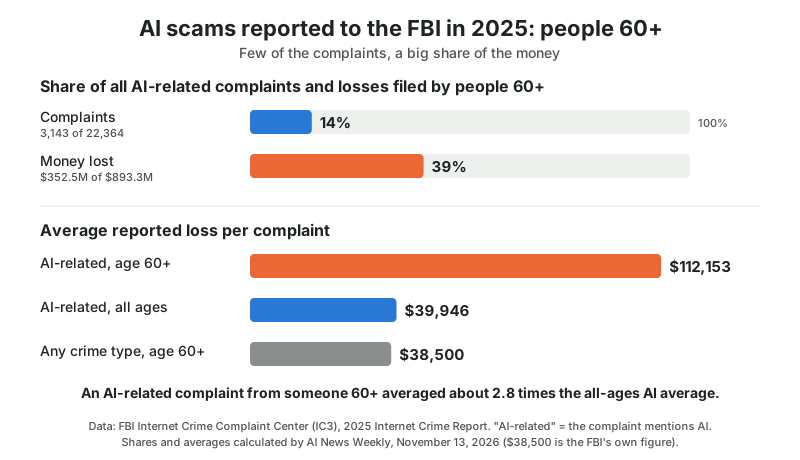
The chart as text — share of AI-related complaints and losses from people 60+: complaints 14% (3,143 of 22,364), money lost 39% ($352.5 million of $893.3 million). Average reported loss per complaint: AI-related, age 60+, $112,153; AI-related, all ages, $39,946; any crime type, age 60+, $38,500 (the FBI’s own figure).
So an AI-related scam that reaches an older adult tends to be a big one: the average AI-related complaint from someone 60+ was nearly three times the size of the average complaint of any kind from the same age group.
Are the FBI’s AI scam numbers too low?
The FBI’s AI scam numbers are very likely an undercount, because IC3 marks a complaint “AI Related” only when the information reported contains a reference to artificial intelligence — and many victims never learn that AI was involved. The FBI’s report says as much about investment fraud, where AI-linked losses topped $632 million but all investment losses exceeded $8 billion:
…demonstrating that many victims do not realize the extent AI may be involved in scams.
Underreporting in general is large too. The Federal Trade Commission estimates that the true cost of fraud to older adults in 2025 was between $13.3 billion and $119.5 billion, depending on the method, far above the roughly $3 billion that people 60+ reported to it directly.
What kinds of AI scams target older adults?
The FBI’s 2025 report and its warnings describe five main ways criminals use AI in fraud: cloned voices of family members in “distress” calls, fake investment pitches with AI-made videos of celebrities and executives, AI-written romance and confidence chats, official-sounding business emails, and altered “proof-of-life” photos in fake kidnappings. Older adults are hit hardest by the investment, impersonation and family-emergency versions.
Here is what the FBI’s 2025 report counted for AI-related complaints of each type, across all ages (the report does not split these by age):
| Crime type | AI-related complaints | AI-related losses |
|---|---|---|
| Investment | 4,356 | $632,041,188 |
| Business email compromise | 135 | $30,256,592 |
| Tech or customer support | 574 | $19,457,078 |
| Confidence or romance | 626 | $19,041,653 |
| Personal data breach | 1,204 | $18,767,964 |
| Employment | 691 | $12,550,185 |
| Government impersonation | 260 | $7,061,628 |
- Fake investment clubs: the FBI says investment scammers use AI-generated videos and voices of celebrities, CEOs or other trusted figures, and AI to run thousands of chats that each look personal.
- Grandparent or “distress” calls: voice cloning mimics a loved one in trouble; victims reported over $5 million in losses to distress scams in 2025, and the FBI says the scam is spreading to other family members and close friends.
- Virtual kidnapping: in a December 5, 2025 public service announcement, the FBI warned that criminals alter photos from social media and send them as “proof of life”, sometimes with timed messages so there’s no time to look closely.
- Romance and friendship: AI chat generators write the scripts that make a fake profile sound real.
How does a voice-clone grandparent scam work?
A voice-clone grandparent scam copies a family member’s voice from a short recording — often a video posted online — and uses it in a panicked call asking for money and for secrecy. The FTC’s consumer alert of March 20, 2023, by Alvaro Puig, explains how little the scammer needs: All he needs is a short audio clip of your family member’s voice.
- The scammer finds a short clip of the grandchild’s voice, for example in a video posted online.
- Voice-cloning software turns the clip into a voice that can say anything.
- The call comes with an emergency — an accident, an arrest, a hospital — and a plea not to tell the parents.
- The payment is one that is hard to reverse: gift cards, cryptocurrency, a wire transfer or cash for a courier.
The FTC’s advice is short and works against any cloned voice: Don’t trust the voice. Call the person who supposedly contacted you and verify the story.
What does the FTC’s newest report say about older adults and fraud?
The FTC’s report to Congress, Protecting Older Consumers 2025-2026
, published October 19, 2026, found that people 60 and older reported over $3 billion in fraud losses in 2025, about five times the roughly $600 million they reported in 2020. Very large losses drove most of the increase.
- Reports from people 60+
- 469,597 reports, about 33% of reports that gave an age; about 123,000 reported losing money
- Six-figure losses
- 6% of older adults’ loss reports were over $100,000, but they made up 70% of the money lost
- Median loss, ages 60+
- about $900; for people 80 and over, $2,000 (up 21% from 2024)
- Phone versus social media
- median loss $3,000 when the scam started with a phone call, $599 when it started on social media
- How family scams get paid
- gift cards were the payment method older adults reported most often on family- and friend-impersonation scams
- Investment scams
- older adults’ reported losses jumped 42% in 2025, to over $1 billion
The FTC also found that people 80 and over lost far more to scams that began with a phone call than to any other contact method — the very channel a cloned voice uses. One bright spot: about 74% of older adults’ fraud reports showed no money lost, which suggests many people spot the scam in time and report it anyway.
Can AI help you spot a scam?
Yes — AI now works on the defending side too: Android phones and iPhones have built-in features that screen unknown callers and flag scam texts, and any AI assistant such as ChatGPT, Gemini, Copilot or Claude can give you a second opinion on a suspicious message. Neither replaces a call back on a number you trust.
Which phones have AI scam filters built in?
Google and Apple both build scam screening into their phones, and the features are free parts of the operating system. Here is what the makers themselves say, from their own announcements:
| Feature | Phone | What it does | On by default? |
|---|---|---|---|
| Scam Detection in Google Messages | Android | On-device AI warns about likely scam texts from people not in your contacts; started in English in the U.S., U.K. and Canada | Yes |
| Scam Detection in Phone by Google | Pixel phones | Warns during a call when the caller sounds like a scam (for example, asking for gift cards); no call audio is stored or sent to Google | No — turn it on |
| Enhanced protection in Google Messages | Android | Uses Google’s cloud Gemini models through Private AI Compute to catch sophisticated conversational scams | No — opt in |
| Call Screening | iPhone (iOS 26) | Asks an unknown caller for a name and reason before the phone rings | Check the iPhone’s Phone settings |
| Screen unknown senders in Messages | iPhone (iOS 26) | Puts texts from unknown senders in a separate folder, silenced until you accept them | Opt in, in Messages |
Google said on November 2, 2026 that Scam Detection in Phone by Google and Google Messages already flags more than 5 million suspected scam calls and texts every month; the original March 4, 2025 post explains how each part works. Apple introduced Call Screening and message screening in its iOS 26 announcement; Apple’s iPhone User Guide has the setup steps under Screen and filter calls
and Screen and filter texts
. Availability depends on the phone model, the country and the language, so check the maker’s page for yours.
How do you ask an AI assistant whether a message is a scam?
To check a suspicious text or email with an AI assistant, copy the words into ChatGPT, Gemini, Copilot or Claude, take out your name, account numbers and any codes first, and ask what the message wants you to do and what the warning signs are. Never click the message’s links or call its numbers to “check”. Our own example prompt:
I got the message below and I'm not sure it's real. Please don't
open any links in it. In plain words, tell me:
1. what it is asking me to do,
2. any signs that it could be a scam,
3. how I can check it myself using the company's official website
   or a phone number I already have.
Here is the message (I removed my name and account numbers):
[paste the message here]
Treat the AI assistant’s answer as a second opinion, not a verdict: an AI model can miss a well-made scam or flag a real message. The checking still happens outside the message — on the company’s own website, or a call to a number printed on your card or statement. For a step-by-step version with one assistant, our sister site How To With Claude AI is publishing a matching seniors series.
How do you set up a family code word against AI voice scams?
A family code word is a word or phrase that only your family knows, agreed in person, that anyone calling with an emergency must say before money moves. The FBI recommends it in its December 3, 2024 announcement on generative AI fraud and again in its December 5, 2025 warning about virtual kidnappings.
Can I tell you my favorite thing about the code word? It’s gloriously low-tech. Scammers pay for clever voice-cloning software, and all of it falls flat the moment Grandma says, Lovely to hear from you, dear — what’s our word?
I adore that.
- Choose something odd and unguessable: not a pet’s name, birthday or street that appears on social media.
- Agree it in person or on a call you placed yourself, never by text or email.
- Tell everyone who might call: grandchildren, adult children, and the person who manages a parent’s money.
- Rehearse the script:
I want to help — what’s our word?
A real grandchild laughs and says it; a scammer stalls or gets angry. - Change the word if anyone ever says it in a text, an email or a public post.
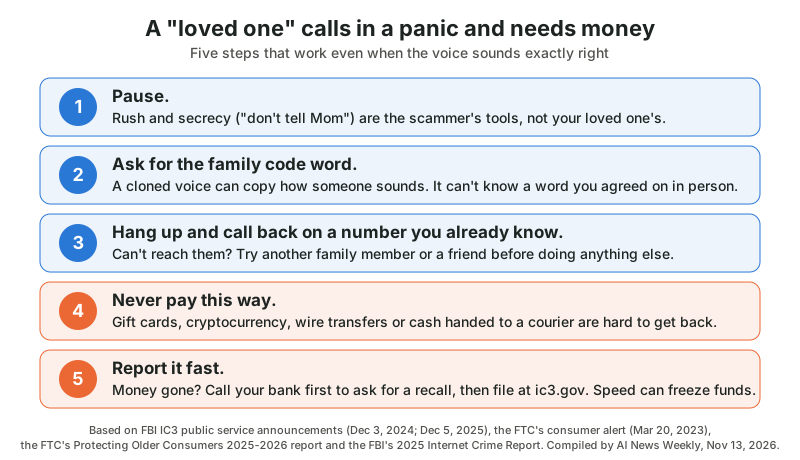
The checklist as text: 1. Pause — rush and secrecy are the scammer’s tools. 2. Ask for the family code word. 3. Hang up and call back on a number you already know; if you can’t reach them, try another family member or a friend. 4. Never pay by gift card, cryptocurrency, wire transfer or cash handed to a courier. 5. Report it fast — if money left, call your bank first to ask for a recall, then file at ic3.gov.
The FBI’s December 2025 announcement adds one rule worth taping by the phone: Always attempt to contact your loved one before considering paying any ransom demand.
Its December 2024 announcement also suggests keeping social media accounts private and limiting public videos of your voice, which gives cloning software less to work with.
Where do you report an AI scam against an older adult?
Report an AI scam against someone 60 or older to the FBI at ic3.gov and to the FTC at ReportFraud.ftc.gov, and call the National Elder Fraud Hotline at 833-372-8311 (833-FRAUD-11) for one-on-one help. If money has already been sent, call the bank or payment company first.
- National Elder Fraud Hotline (U.S. Department of Justice)
- 833-372-8311, Monday to Friday, 10 a.m. to 6 p.m. Eastern; for fraud against anyone 60 or older; a case manager stays your point of contact (Office for Victims of Crime)
- FBI Internet Crime Complaint Center
- ic3.gov — file regardless of the amount lost, with the full transaction details
- Federal Trade Commission
- ReportFraud.ftc.gov — the reports feed the FTC’s Consumer Sentinel data used in its yearly report
- AARP Fraud Watch Network Helpline
- 877-908-3360, Monday to Friday, 8 a.m. to 8 p.m. Eastern; help deciding whether something is a scam and support afterward (AARP)
The Office for Victims of Crime warns that scammers impersonate the hotline itself: never give a Social Security number or money to someone who calls you claiming to be from it.
AI-voiced robocalls are also illegal on their own. The Federal Communications Commission ruled on February 8, 2024 that AI-generated voices count as “artificial” voices under the Telephone Consumer Protection Act, which lets state attorneys general go after the callers. The FCC’s then-chairwoman said:
Bad actors are using AI-generated voices in unsolicited robocalls to extort vulnerable family members, imitate celebrities, and misinform voters.
What should you do right after sending money to a scammer?
Right after sending money to a scammer, call the bank or payment company and ask for a recall of the transfer, then file at ic3.gov with every transaction detail — speed matters. The FBI’s report puts it plainly: If you discover a fraudulent transfer, time is of the essence.
The FBI’s Recovery Asset Team works with banks through what it calls the Financial Fraud Kill Chain. In 2025 it handled 642 incidents with victims 60 and older, who reported $65,367,648 in losses, and helped freeze $32,865,655 of it — about half (our arithmetic). Most of those older-adult cases were tech support and account takeover scams.
What are the key numbers on AI scams and older adults?
The key numbers on AI scams and fraud against older adults, gathered from the FBI, the FTC and the FCC:
| Finding | Number | Source |
|---|---|---|
| AI-related fraud losses, people 60+, 2025 | $352.5 million (39% of all AI-related losses) | FBI IC3 |
| AI-related complaints, people 60+, 2025 | 3,143 (14% of 22,364) | FBI IC3 |
| Average AI-related loss, people 60+ | $112,153 per complaint | FBI IC3 (our arithmetic) |
| Voice-clone distress scams, all ages | over $5 million lost | FBI IC3 |
| Fraud losses reported by people 60+, 2025 | over $3 billion (about $600 million in 2020) | FTC |
| Share of older adults’ losses from $100,000+ cases | 70%, from 6% of loss reports | FTC |
| Median loss, people 80+ | $2,000 | FTC |
| Funds frozen for victims 60+ | $32.9 million of $65.4 million (about 50%) | FBI IC3 (our arithmetic) |
| AI voices in robocalls | illegal under the TCPA since February 8, 2024 | FCC |
The FBI and the FTC count different complaints in different ways (the FTC excludes IC3’s data from its age figures), so compare numbers within a row, not across sources.
The short version for families: AI makes a scam sound more real, but it doesn’t change what a scam needs from you — speed, secrecy and a payment that can’t be reversed. Slow down, ask for the word, call back, and report.
So here’s your homework, and it’s the fun kind: pick a delightfully silly code word at the next family dinner, switch on your phone’s scam filter tonight, and save your bank’s real number in your contacts. Three small moves, and even the cleverest voice clone hits a brick wall.
Sources and further reading
- 2025 Internet Crime Report (FBI Internet Crime Complaint Center) — AI section: 22,364 complaints, $893,346,472; AI losses by crime type; 60+: 3,143 AI-related complaints, $352,496,231; $38,500 average loss; distress scams over $5 million; Financial Fraud Kill Chain 60+: 642 incidents, $65,367,648 lost, $32,865,655 frozen; read Nov 13, 2026
- Criminals Use Generative Artificial Intelligence to Facilitate Financial Fraud (FBI IC3 PSA) — December 3, 2024; secret family word, hang up and call back, limit public voice and image content; read Nov 13, 2026
- Criminals Using Altered Proof-of-Life Media to Extort Victims in Virtual Kidnapping for Ransom Scams (FBI IC3 PSA) — December 5, 2025; code word, contact your loved one before paying; read Nov 13, 2026
- Protecting Older Consumers 2025-2026 (Federal Trade Commission report to Congress) — October 19, 2026; 60+ losses over $3 billion, 70% from $100,000+ reports, medians, phone vs social media, gift cards on family impersonation; read Nov 13, 2026
- FTC Issues Annual Report to Congress on Agency’s Actions to Protect Older Adults (FTC press release) — October 19, 2026
- Scammers use AI to enhance their family emergency schemes (FTC consumer alert, Alvaro Puig) — March 20, 2023; short audio clip, call the person back; read Nov 13, 2026
- FCC Makes AI-Generated Voices in Robocalls Illegal (FCC news release) — February 8, 2024; Declaratory Ruling under the TCPA; Chairwoman Rosenworcel quote; read Nov 13, 2026
- National Elder Fraud Hotline (Office for Victims of Crime, U.S. Department of Justice) — 833-FRAUD-11 / 833-372-8311, Monday-Friday 10 a.m.-6 p.m. ET; read Nov 13, 2026
- AARP Fraud Watch Network Helpline — 877-908-3360, Monday-Friday 8 a.m.-8 p.m. ET; read Nov 13, 2026
- ReportFraud.ftc.gov (Federal Trade Commission)
- New AI-Powered Scam Detection Features to Help Protect You on Android (Google) — March 4, 2025; Google Messages on by default for non-contacts, Phone by Google off by default, on-device; read Nov 13, 2026
- The latest AI news we announced in October 2026 (Google) — November 2, 2026; over 5 million suspected scam calls and texts flagged a month; Enhanced protection in Google Messages; read Nov 13, 2026
- Apple elevates the iPhone experience with iOS 26 (Apple Newsroom) — June 9, 2025; Call Screening, screening unknown senders in Messages; read Nov 13, 2026
- ChatGPT (OpenAI)
- Gemini (Google)
- Microsoft Copilot
- Claude (Anthropic)
Questions and answers
How much money do seniors lose to AI scams?
People 60 and older reported $352,496,231 in AI-related fraud losses to the FBI in 2025, about 39% of the $893 million lost to AI-related fraud by all ages, according to the FBI’s 2025 Internet Crime Report. The real figure is likely higher, because many victims never learn that AI was involved.
Can scammers clone your voice?
Yes, scammers can clone a voice from a short recording, such as a video posted online. The FTC warns that a scammer needs only a short audio clip of a family member’s voice, which is why a family code word and a call back on a known number matter more than how the voice sounds.
What is the AI grandparent scam?
The AI grandparent scam is a phone call that uses a cloned voice of a grandchild who claims to be in trouble — an accident, an arrest or a hospital — and asks for money and secrecy. The FBI counted over $5 million in losses to these voice-cloning “distress” scams in 2025. Hang up and call the grandchild back on a number you already have.
How can you tell if a call is an AI voice clone?
You often can’t tell an AI voice clone by ear, so don’t rely on the voice. Ask for your family code word, hang up and call back on a number you already know, and treat any demand for gift cards, cryptocurrency, wire transfers or cash couriers as a scam. The FBI also suggests listening for odd tone and word choice.
Where do I report an AI scam against an elderly person?
Report it to the FBI at ic3.gov and to the FTC at ReportFraud.ftc.gov, and call the Department of Justice’s National Elder Fraud Hotline at 833-372-8311 (Monday to Friday, 10 a.m. to 6 p.m. Eastern) for help. If money was sent, call the bank or payment company first and ask for a recall.