Auto Shop Phone Answering and Scheduling: Never Miss a Booking Call
Hello, and here’s to a shop phone that never rings out again.
If your shop phone rings out while your advisor is writing an estimate, this guide is for you.
Most of those calls are simple: a driver who wants an oil change on Thursday, or an owner asking if the car is ready.
Your shop management system already holds the answer to both, so the question is who picks up when nobody at the counter can.
Short answer: Auto shop phone answering and scheduling means an assistant, human or AI, picks up the calls your counter misses, books appointments straight onto the live shop calendar in Tekmetric, Shopmonkey or Mitchell 1, answers status and hours questions from the shop’s own data, and sends everything else to a callback list with a short summary for the advisor.
What is phone answering and scheduling for an auto shop?
It is a backup that answers when the front counter can’t, and books the car into a real open slot instead of taking a message.
- Trigger: the shop number rings about four times with no answer, or rings after closing time, and call forwarding sends it on.
- Reads: the caller’s number, the matching customer and vehicle, the open slots on the shop calendar and the repair order status.
- Writes: an appointment on the calendar, or a callback item with a summary of what the caller needs.
- Tells: the caller, with a confirmation text, and the advisor, through the callback list.
The counter still answers first. The assistant only takes the calls that would otherwise reach voicemail, and it never decides anything about a repair.
How many calls does an auto repair shop miss?
Tekmetric says the average shop misses 160 calls a month
, and that 90% of those happen during business hours, when advisors are already stretched thin (Tekmetric announcement, November 3, 2026).
Older research points the same way. The Marchex Institute studied more than 8.7 million calls to eleven US auto service brands and found shops dropped the ball on nearly 30% of calls from people asking for service.
The same Marchex report found that 68% of callers who don’t reach a business on the first try don’t call back (Auto Service World, November 26, 2019).
The trade press describes why. In a Ratchet+Wrench column from August 3, 2026, columnist Greg Bunch put it in one line: The phone can ring more than the counter can handle.
| Missed calls a month | Of those, booking calls (50%) | Callers who don’t call back (68%) | Repair orders at risk at $400 each |
|---|---|---|---|
| 40 | 20 | 13.6 | $5,440 |
| 80 | 40 | 27.2 | $10,880 |
| 160 (Tekmetric’s average) | 80 | 54.4 | $21,760 |
Assumptions: half of missed calls are people trying to book (our round number), 68% of them don’t call back (Marchex, 2019), and $400 is a round placeholder for a first repair order, not a survey figure. Count one week of your own missed calls from the phone log and swap in your average repair order.
The table only counts the first visit. A new customer who books once and is treated well tends to come back, which is why a missed booking call costs more than one ticket.
Which shop calls can a machine answer, and which need a person?
Booking, status, hours and directions can be automated; anything about price, approval or an upset customer goes to a person.
| Caller wants | Assistant can | Hand to a person when |
|---|---|---|
| An appointment (oil change, brakes, check engine light) | Offer real open slots and book one on the shop calendar | The caller describes a tow, a no-start or a fleet job |
Is my car ready? | Read the repair order status and the promised time | The car is late or the status is unclear |
| Hours, address, loaner or shuttle | Answer from the list the shop wrote | The question isn’t on the list |
How much for a brake job? | Give a posted price only for a fixed menu service, if the shop allows it | Always for repairs that need an inspection |
| Approve extra work | Send the existing approval link by text | The customer has questions about the work |
| A complaint or a comeback | Take the details and promise a callback time | Every time |
| Sales calls and spam | Screen them out | Never |
A good rule of thumb: if the answer already sits in the shop system or on the shop’s written answer list, the assistant can say it. If it needs judgment, a person says it.
How does an answering assistant book onto the shop calendar?
It recognizes the caller, asks three or four short questions, checks live availability and writes the appointment into the shop management system.
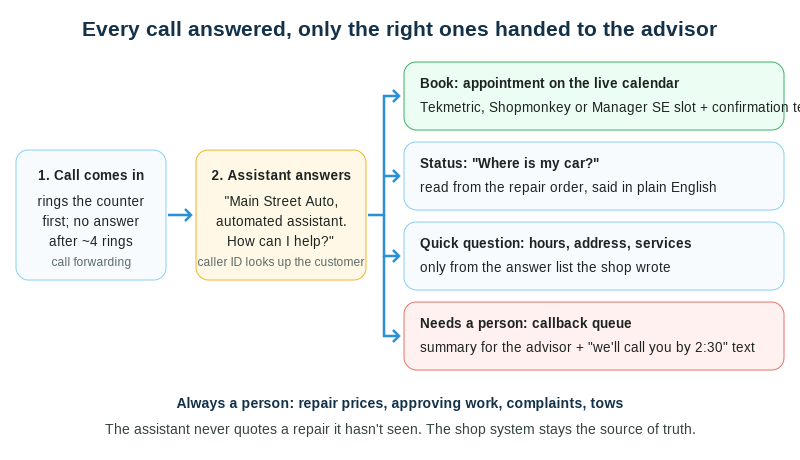
The diagram, as text:
- Call comes in: it rings the counter first, then forwards after about four rings.
- Assistant answers: with the shop name, says it is automated, and looks up the caller ID.
- Book: a slot on the live Tekmetric, Shopmonkey or Manager SE calendar, then a confirmation text.
- Status: read from the repair order and said in plain English.
- Quick question: answered only from the shop’s written list.
- Needs a person: a callback item with a summary, and a text with the callback time.
- Forward. The shop’s phone provider sends unanswered and after-hours calls to the assistant. The shop keeps its main number.
- Recognize. The caller’s number is matched to a customer and vehicle in the shop system, so a regular hears
Hi Dana, is this about the Civic?
- Ask. What the car needs, which day suits, and whether the customer will wait or drop off.
- Check. Open slots are read from the shop calendar, which already blocks times by service type and technician capacity.
- Write. The appointment is created through the shop system’s own booking or API, so it appears on the advisor’s screen like any other.
- Confirm. The customer gets a text with the date, time and shop address, and the call summary is saved on the customer record.
The calendar stays the single source of truth. If the assistant writes to a separate calendar that someone copies over later, double bookings follow within a week.
What do Tekmetric, Shopmonkey and Mitchell 1 offer for phone answering and scheduling?
All three book appointments online; Tekmetric is the one that now also answers the phone itself.
| Software | Answers calls? | Books appointments | Worth knowing |
|---|---|---|---|
| Tekmetric Receptionist | Yes, the calls the team can’t reach | Onto the live Tekmetric schedule; routine questions from shop-written answers; spam deflected | Rolling out first to shops on RingCentral through Tekmetric Phones with Online Booking; 30-day free trial; general availability planned for Q1 2027 |
| Tekmetric Online Booking | No | 24/7 online, straight to the shop calendar, with a Google Business Profile button | Availability by service type, blocked times and a minimum notice buffer |
| Shopmonkey Appointment Scheduler | No | Chosen canned services online, through a website button, a public link or Book Online with Google | Slot length, minimum notice and how far ahead customers can book are set by the shop; a public API exists for custom tools |
| Mitchell 1 SocialCRM Book It Now | No | Real-time slots from the shop’s Google Business Profile, synced with Manager SE | Texts customers who start a booking and don’t finish; Diagnostics First lets them describe the problem instead of picking a service |
Tekmetric’s announcement says calls the Receptionist can’t finish, including a request for a person or a vehicle update, go to a callback queue with a summary and suggested next steps
. That callback list is the part worth copying, whatever software you run.
Mitchell 1 shops on the older SocialCRM request flow review each online request and accept or decline it inside Manager SE, as Mitchell 1 explains in its Online Appointments post. More on that system in our Mitchell 1 CRM text guide.
Should an auto shop use an answering service, an AI receptionist or online booking?
Turn on online booking first, then cover the phone with whichever backup can write to your calendar.
A caller who hears a friendly answer and gets a real time slot feels looked after, even when the whole team is busy. And the advisor gets to keep their attention on the person standing at the counter.
- Online booking only: no new cost on many plans, and it catches people who prefer to tap a button. It does nothing for the caller who dials.
- Human answering service such as Ruby or Smith.ai: a warm voice, good with upset callers. Check whether the agents can see your shop calendar, or they will only take messages.
- Built-in AI receptionist such as Tekmetric Receptionist: books onto the same schedule the advisor uses, with nothing to sync. It depends on your phone system and the rollout.
- Custom assistant connected through the shop system’s API: fits two locations, an unusual phone setup or your own answer list, and needs someone to maintain it.
Whichever you choose, ask one question in the demo: Show me the appointment you just booked, on my calendar.
A message pad with a nicer voice doesn’t solve the problem.
What should the shop’s phone assistant say to callers?
A short honest greeting, three booking questions and a clear promise about what happens next.
- Greeting:
Thanks for calling Main Street Auto. You’ve reached our automated assistant while the team is with customers. How can I help?
- Vehicle:
Which car is this for?
Regulars hear their car named from the customer record. - Need:
What’s going on with it?
The caller’s words go into the appointment note as said. - Time:
Would you like to wait or drop it off? I have Thursday at 8 or 10:30.
- Close:
You’re booked for Thursday at 8. I’ll text you the details. Anything else for the team?
The caller’s own description matters to the technician later. Grinding from the front when I brake
is more useful than a menu choice called brakes
.
When the assistant can’t help, it says so plainly: I’ll have Sam call you back by 2:30.
Then that promise goes on the callback list with the time attached.
What rules apply to automated phone answering at an auto shop?
Get consent before recording where the law requires it, be honest that the caller is talking to an automated assistant, and register any number that sends texts.
- Recording: many AI phone tools record or transcribe calls. California’s Penal Code section 632 requires the consent of all parties to record a confidential conversation, and other states have their own rules, so the greeting should say the call may be recorded.
- Outbound calls: the FCC ruled on February 8, 2024 that AI-generated voices count as artificial voices under the TCPA. Answering a customer who called you is different from an AI calling out, so keep reminder calls inside the consent rules.
- Confirmation texts: texts sent from a 10DLC number by an application must be registered for A2P 10DLC, as Twilio’s documentation explains. Ask on the call whether the customer wants a text, and honor STOP.
- Honesty: say the assistant is automated in the first sentence. Callers forgive a machine; they don’t forgive being fooled by one.
What goes wrong with automated phone answering at a shop?
Most failures come from a stale calendar, a missing answer list or a callback list nobody owns, and each has a simple guard.
- Booked into a full day. Guard: block lunch, training and the bays already promised before the assistant goes live.
- A guessed price. Guard: the assistant only quotes the fixed menu prices you typed in, and says
the advisor will give you an exact quote after we look at it
for everything else. - A callback that never happens. Guard: one named person owns the list, and any item older than an hour pings them.
- A regular who wants a human. Guard:
say ‘person’ at any time
transfers to the counter, or takes a callback when nobody is free. - The rings run too long or too short. Guard: about four rings lets the counter answer first without leaving the caller waiting.
Status calls are often the biggest share of the ringing. Sending automated repair status texts cuts them before they start, so the assistant has fewer calls to answer in the first place.
How do you start phone answering and scheduling without upsetting regular customers?
Start after hours, then add lunch and overflow, and read every summary along the way.
- Days 1 to 3: export the call log and count missed calls by hour; that is your baseline.
- Days 4 and 5: write the answer list (hours, address, shuttle, menu prices) and block the calendar times that are not bookable.
- Week 1 weekend: forward after-hours calls only, and read every summary Monday morning.
- Week 2: add lunch-hour and overflow forwarding during the day; the advisor works the callback list twice a day.
- End of week 2: compare missed calls and new bookings with the baseline, and fix any answer the assistant got wrong.
If something sounds off, the call summaries will tell you. They show exactly where a caller got confused, and one line on the answer list usually fixes it.
The goal is simple. Every caller gets an answer, and your advisor gets to finish the estimate in front of them.
Pull last month’s missed calls this week, and you’ll know exactly which hours need cover first.
Sources and further reading
- Tekmetric via Business Wire: New Tekmetric tools help shops fix more vehicles, finish inspections faster and answer more calls (November 3, 2026)
- Tekmetric: automotive appointment scheduling software
- Shopmonkey Help: CRM Essentials, Appointment Scheduler
- Shopmonkey Developer: public API
- Mitchell 1: Book It Now, smarter scheduling and appointment recovery (May 7, 2026)
- Mitchell 1: Online Appointments in SocialCRM and Manager SE
- Auto Service World: Phone fails lead to missed automotive service revenue (Marchex Auto Services Industry Report 2019)
- Ratchet+Wrench: Bunch, Your shop is trying to tell you something (August 3, 2026)
- Ruby: virtual receptionist service
- Smith.ai: receptionist and answering service
- California Penal Code section 632
- FCC: Declaratory Ruling on AI-generated voices under the TCPA (February 8, 2024)
- Twilio: A2P 10DLC registration
Questions and answers
Can I use AI to answer my auto shop’s phone and schedule appointments?
Yes. An AI receptionist can answer calls your counter misses, book onto the live calendar in Tekmetric, Shopmonkey or Mitchell 1, and answer hours or status questions from the shop’s data. Repair prices, approvals and complaints should still go to a service advisor through a callback list with a summary.
Does Tekmetric have an AI receptionist?
Yes. Tekmetric announced Tekmetric Receptionist on November 3, 2026. It answers calls the team can’t reach, books onto the live Tekmetric schedule and sends other calls to a callback queue. It is rolling out first to shops on RingCentral through Tekmetric Phones, with general availability planned for Q1 2027.
Should an automated phone assistant quote repair prices?
Only fixed menu prices the shop has written down, such as a standard oil change. Any repair that needs an inspection should get a callback from the service advisor, because a guessed price on the phone becomes an argument at the counter.
Do I have to tell callers they are talking to an AI or being recorded?
Say it anyway, in the first sentence. Recording rules differ by state; California Penal Code section 632 requires every party’s consent to record a confidential call. The FCC treats AI voices as artificial voices for outbound calls under the TCPA. Check your setup with your phone provider or an attorney.
How many phone calls does an auto repair shop miss?
Tekmetric says the average shop misses 160 calls a month, 90% of them during business hours. A 2019 Marchex study of 8.7 million auto service calls found shops dropped nearly 30% of service calls, and 68% of callers who didn’t get through didn’t call back.