
Collision Center Insurance Supplement Follow-Up That Runs Itself
Hello, and here’s to every estimator with a torn-down car on the lift and a supplement still waiting.
If a torn-down car is sitting on your lift while a supplement waits for an adjuster’s answer, this guide is for you.
Most collision centers don’t lose supplement days to hard negotiation.
They lose them to silence, because nobody had time to send the second email or make the third call.
Short answer: Collision center insurance supplement follow-up means chasing the insurer from the moment a supplement is sent until it is approved. An automated tracker logs each supplement from CCC ONE or Mitchell, starts a clock with any state deadline, emails and calls the adjuster on schedule, escalates on day 3, and texts the owner.
What is insurance supplement follow-up at a collision center?
Supplement follow-up is every contact a collision center makes with an insurer between sending a supplement and getting it approved.
A supplement is the added repair cost found after the first estimate, usually during teardown: a cracked bracket behind the bumper, a sensor that needs calibration, a procedure the photo estimate missed. Repairs and parts orders often stop until the insurer agrees.
- Who does it: the estimator, the production manager or a dedicated supplement writer.
- What it involves: emails, portal checks, voicemails and calls to the adjuster or the desk reviewer.
- What it costs: estimator hours, a car that can’t move, and a customer whose rental days keep counting.
- Why it slips: follow-ups live in someone’s memory or on a sticky note, not on a schedule.
Supplements aren’t rare. In Vermont’s 2025 study of auto insurance practices, the Department of Financial Regulation reported that the average response among responding auto body shops was that supplements are required 95% of the time
(Vermont DFR, Act 32 report).
How long do insurers take to answer a supplement?
Several days on average, with wide gaps between insurers and between network and non-network shops.
- 7.32 days
- The average delay to repairs caused by supplements, as reported by Vermont shops in the DFR study dated December 31, 2025. The report adds that shops said the delay was typically under two weeks.
- 4.2 days
- The average insurer response time to a first supplement across 100 jobs tracked by LaMettry’s Collision in Minnesota, about three-quarters of them non-DRP, as reported by Autobody News. DRP jobs got answers in under a day.
- 51.5%
- The share of ADAS calibrations that appeared on a supplement rather than the first estimate in Q3 2025, according to CCC’s Crash Course Q4 2025.
CCC itself ties shop productivity to this exact step. Its Q4 2025 Crash Course says Given the increased propensity for repairs to include supplements, productivity improvements will likely rely upon improved communication and process efficiency between shops and insurance carriers.
Here’s the catch: the insurer’s side of that communication is out of your hands. Your side, the speed and regularity of your follow-ups, is the part a tracker can fix.
Is there a legal deadline for an insurer to respond to a supplement?
In some states, yes; Massachusetts and Washington, for example, write supplement deadlines into their regulations.
| State | Rule | What the insurer must do | Deadline |
|---|---|---|---|
| Massachusetts | 212 CMR 2.04(1)(h) | Assign an appraiser who personally inspects the vehicle after a supplement request | 3 business days from receipt of the request |
| Massachusetts | 212 CMR 2.04(1)(i), expedited process | Send its decision on a supplement when insurer, shop and claimant all agreed to skip the inspection | 2 business days, or back to the 3-day inspection |
| Washington | WAC 284-30-390, effective October 18, 2026 | Respond in writing to the claimant and the repair facility with the amounts covered | 5 business days from receipt of supplemental estimates and final invoice |
Washington’s rule also says that when an insurer rejects damage on a supplement, it must cite the policy language, explain its position, or both. Massachusetts regulators reminded appraisers of their timeframes in Advisory Ruling 2025-1, which Repairer Driven News covered on April 30, 2025.
A tracker that knows your state’s clock can show it on every open supplement. Day 4 of 5
on the screen is a calmer opening line for a phone call than it’s been a while
.
How much does chasing supplements cost a collision center each month?
Roughly 10 to 32 hours of estimator time a month for a shop closing 30 to 100 repairable jobs, before counting the days cars sit still.
| Repairable jobs a month | Supplements (95%) | Follow-up by hand (hours) | With a tracker (hours) | Hours back | Value at $25 an hour | Car-days waiting at 7.32 days each |
|---|---|---|---|---|---|---|
| 30 | 29 | 12.1 | 2.4 | 9.7 | $242 | 212 |
| 60 | 57 | 23.8 | 4.8 | 19.0 | $475 | 417 |
| 100 | 95 | 39.6 | 7.9 | 31.7 | $792 | 695 |
Assumptions: 95% of repairable jobs need a supplement (the Vermont DFR shop average), 25 minutes of follow-up per supplement by hand (four emails, calls or portal checks at 5 minutes each, plus 5 minutes updating the file and the owner), and 5 minutes per supplement with a tracker for reviewing its escalations.
The $25 an hour is a rough loaded cost for estimator time. These are our round numbers, not a survey; time your own follow-ups for one week and swap them in.
The last column is the bigger number. If faster follow-up cut just one day off each wait, a 60-job shop would free about 57 car-days a month on its lifts and in its lot.
How does an automated supplement follow-up tracker work?
A tracker reads each sent supplement from the estimating system, starts a clock, follows up with the adjuster on a schedule, and writes every answer back to the file.
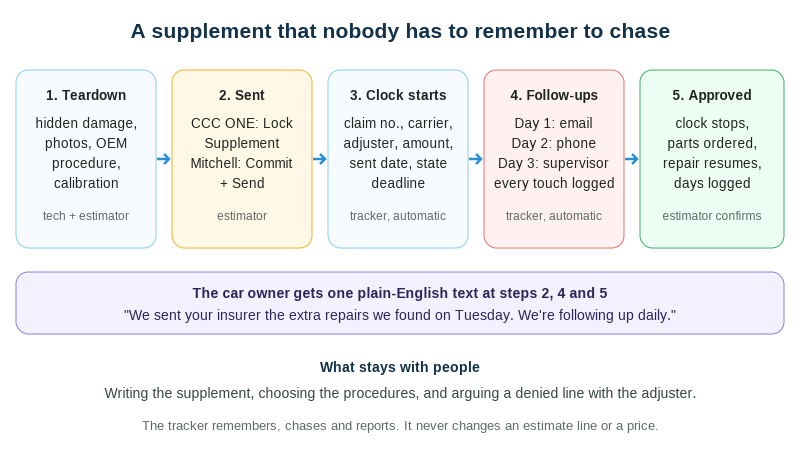
The diagram, as text:
- Teardown: the tech and estimator find hidden damage, take photos and pull the OEM procedure.
- Sent: the estimator locks the supplement in CCC ONE, or commits and sends it in Mitchell.
- Clock starts: the tracker logs claim number, carrier, adjuster, amount, sent date and any state deadline.
- Follow-ups: day 1 email, day 2 phone call, day 3 supervisor, each one logged.
- Approved: the clock stops, parts are ordered and the days waited are recorded.
- Car owner: a plain-English text at the sent, follow-up and approved steps.
- Read. The tracker watches the estimating system for a newly sent supplement and copies the claim number, insurer, adjuster contact, supplement number and amount.
- Clock. It counts business days from the sent date and shows any deadline your state sets.
- Chase. It sends the scheduled follow-ups and records each reply, voicemail or bounce.
- Escalate. When a step passes with no answer, it emails the adjuster’s supervisor or the carrier’s supplement inbox, and pings your estimator.
- Close. When the insurer’s approval or change request arrives, it stops the clock and tells production the parts can be ordered.
The tracker never edits an estimate line, accepts a reduction or promises a customer a date. Those stay with your estimator.
Can a tracker read supplements from CCC ONE or Mitchell?
Yes, both CCC ONE and Mitchell record when a supplement is sent and when the insurer answers, so a tracker reads status rather than retyping it.
Waiting on an adjuster is part of collision work, but forgetting to follow up doesn’t have to be. A schedule that remembers for you is a kind thing to give a busy estimator.
| System | How a supplement is sent | How the insurer’s answer shows up | Route for an outside tracker |
|---|---|---|---|
| CCC ONE | Create Supplement, add changes and images, then Lock Supplement, which sends the workfile back to the insurer | Insurer change requests appear in a bar on the workfile; Accept Changes and Lock answers them | CCC Secure Share, switched on per app under Configure |
| Mitchell Connect with Mitchell Cloud Estimating | Set the supplement to Committed, add the completed estimate, then Send to the insurer | Insurer notes appear in the job’s Journals tab; a lock may need the insurer to release it | Ask Mitchell which integrations your account allows |
CCC describes Secure Share as the way repairers may choose to activate or de-activate sharing with those apps at any time
, and its data uses the CIECA BMS standard. That on-off switch matters: the shop, not the app maker, decides what leaves the workfile.
Where no data route fits yet, the tracker can start from a simple form. The estimator pastes the claim number and amount when the supplement goes out, and everything after that runs on its own.
How often should a collision center follow up with an adjuster on a supplement?
Once a business day, changing the channel each time, and moving up a level after the third day without an answer.
| Business day | Channel | What it says | Who sees the result |
|---|---|---|---|
| Day 0 | Supplement sent from CCC ONE or Mitchell | Photos, OEM procedure pages and the supplement total | Tracker logs it |
| Day 1 | Email to the adjuster | Supplement 1 on claim 123-456 was sent yesterday: $1,840. Car is torn down on a lift. Anything missing? | Reply saved to the file |
| Day 2 | Phone call | One question: when will supplement 1 be reviewed? Offers a transfer to the estimator | Answer or voicemail logged |
| Day 3 | Email to the supervisor or the carrier’s supplement inbox | The dates of every earlier contact, plus the state deadline if one applies | Estimator gets an alert |
| Day 4 and on | Estimator decides | Personal call, reinspection request or a note to the customer about their own claim contact | Shop manager sees the open list |
Every message names the claim number, the supplement number and the amount in its first line. Desk reviewers juggle many files, and a follow-up they can find in ten seconds gets answered sooner.
Can an automated voice call follow up with an insurance adjuster?
Yes, technically, but an AI or recorded voice falls under federal calling rules, so settle consent and disclosure before the first call.
The FCC issued a Declaratory Ruling on February 8, 2024 that recognizes calls made with AI-generated voices are “artificial” under the Telephone Consumer Protection Act (TCPA)
. The TCPA puts consent rules on artificial-voice calls, especially to cell phones.
- Call the number the insurer gave for the claim, ideally a desk or claims line, not a personal cell.
- Say what it is in the first sentence:
This is an automated assistant calling for Main Street Collision about claim 123-456.
- Ask one question, and offer to connect a person from the shop.
- Log the answer on the supplement file, word for word.
Calling platforms such as Twilio Voice provide the phone side; the rules about who may be called are yours to follow. Many shops start with email and portal follow-ups, and add calls once their attorney or carrier partners have agreed on the approach.
What should the car owner hear while a supplement waits?
A short, plain-English text when the supplement goes out, when the follow-ups continue, and when it is approved.
- Sent:
We found extra damage behind your bumper and sent the repair to your insurer Tuesday. We’ll follow up daily.
- Still waiting:
Your insurer hasn’t answered yet. We called today. Your claim number is 123-456 if you’d like to ask them too.
- Approved:
Your insurer approved the added repairs. Parts are ordered; new estimate for completion: Friday.
Owners who know the shop is chasing don’t feel abandoned, and they stop calling for status. The texts follow the same consent and STOP rules described in our guide to automated repair status texts.
On CCC ONE, the built-in Update Plus already texts status changes, so the tracker only adds the supplement step. Mitchell 1 shops on the mechanical side can see what their CRM already sends in our Mitchell 1 CRM text guide.
What gets an insurance supplement approved on the first look?
A supplement with photos, the OEM procedure and a clear reason for each line leaves the reviewer fewer questions to send back.
In Autobody News reporting on supplement problems, Aaron Schulenburg of the Society of Collision Repair Specialists said shops lacking adequate photos and OEM procedures need to supply them. Every missing photo is one more round of emails.
- Before and after teardown photos, each labeled with the estimate line it supports.
- The OEM repair procedure page for every operation not on the first estimate.
- Scan and calibration lines tied to the procedure that requires them.
- A one-sentence reason per added line, written for a desk reviewer who has never seen the car.
- The supplement number, claim number and total in the first line of the message.
An AI model can help here too. It can turn the tech’s notes into the one-sentence reasons and flag a line with no photo before the supplement is locked, while the estimator signs off.
How do you start tracking supplements this week?
List every open supplement today, then let the tracker take over the follow-ups for new ones.
- Day 1: write down every open supplement with claim number, insurer, adjuster, amount and sent date.
- Day 2: sort the list by days waiting and send one follow-up on each, logged.
- Day 3: switch on the automatic day 1 email for every new supplement.
- Day 4: add the day 3 escalation and the owner texts.
- End of week: compare average days waiting by insurer, and keep that list.
After a month, the list tells you which carriers answer in two days and which take eight. That is useful before your next DRP conversation, and it shows how long a car will likely sit before you quote a completion date.
The aim isn’t to argue more with adjusters. It is never forgetting a follow-up, so your estimator can spend the day writing the next good supplement.
List your open supplements today, and let the follow-ups for tomorrow’s run themselves.
Sources and further reading
- Vermont Department of Financial Regulation: Act No. 32 (2023) study of automobile insurance business practices (December 31, 2025)
- 212 CMR 2.00: Massachusetts Auto Damage Appraisers Licensing Board regulation
- Repairer Driven News: Massachusetts licensing board ruling on appraisal timeframes (April 30, 2025)
- Washington WAC 284-30-390: acts or practices for automobile claims (effective October 18, 2026)
- CCC Intelligent Solutions: Crash Course Q4 2025
- CCC ONE Help: Working with supplement assignments
- CCC Secure Share for repairers
- CCC ONE Help: Update Plus overview
- Mitchell Connect Help: Add a supplement
- Autobody News: Everyone in the collision repair process plays a part in solving problems with supplements
- Autobody News: Vermont report puts labor rates, supplements and DRPs under regulators’ microscope
- FCC: Declaratory Ruling on AI-generated voices under the TCPA (February 8, 2024)
- Twilio Voice documentation
- Society of Collision Repair Specialists
Questions and answers
Can I use AI to follow up on insurance supplements at my collision center?
Yes. A tracker can read sent supplements from CCC ONE or Mitchell, email and call the adjuster on a schedule, escalate after day 3, and text the car owner. AI also helps write each line’s reason. Your estimator still writes the supplement, handles any denied line and approves the wording.
How long does an insurance company have to approve a supplement?
It depends on the state. In Massachusetts, 212 CMR 2.04 gives an insurer 3 business days to inspect after a supplement request. In Washington, WAC 284-30-390 requires a written answer within 5 business days since October 18, 2026. Many states set no supplement deadline.
How often should a body shop follow up with an adjuster on a supplement?
About once a business day: an email on day 1, a phone call on day 2 and an escalation to the supervisor or the carrier’s supplement inbox on day 3. Each message should name the claim number, the supplement number and the amount.
Is it legal to use an AI voice to call insurance adjusters?
The FCC ruled on February 8, 2024 that AI-generated voices count as artificial voices under the TCPA, which carries consent rules, especially for cell phones. Call the claims line the insurer gave you, say it is automated, and check your approach with an attorney.
How much time does supplement follow-up take?
By our estimate, about 25 minutes per supplement by hand, or roughly 24 hours a month for a shop closing 60 repairable jobs with 95% supplemented. A tracker can cut that to about 5 minutes per supplement for reviewing its escalations.