How to Automate Unscheduled Treatment Plan Follow-Up (Kindly)
Hello, and a warm welcome to every treatment coordinator with a list of let me think about it
plans that never seems to shrink.
Picture the patient who nodded at the crown, said let me check my schedule,
and walked out without a date.
That patient was not saying no. Most of the time they were waiting for someone to ask again, and nobody had a free minute.
This guide shows how to automate unscheduled treatment plan follow-up so every plan gets asked about again, on time, in a kind voice.
Short answer: To automate unscheduled treatment plan follow-up, pull every presented but unscheduled plan from Dentrix, Open Dental or Eaglesoft nightly, send each patient short texts around days 2, 14, 60 and 120 with a booking link, have a person call larger plans near day 30, let an SMS assistant book replies, and route cost questions to your coordinator.
- What gets followed up
- Treatment that was diagnosed and presented, has a fee, and has no appointment on the schedule
- Where the list lives
- Dentrix Treatment Manager, Open Dental Treatment Finder, Eaglesoft Patient Management with the Unscheduled treatment plan filter
- First touch
- About 2 days after the presentation, the start of the 2 day, 2 week, 2 month rhythm Bryant Consultants describes
- Why patients wait
- Cost first: 17% of US working-age adults did not get needed dental care because of cost in 2022 (ADA Health Policy Institute)
- What a US text costs
- $0.04 per outgoing message on Open Dental Integrated Texting; incoming replies are free (Open Dental fee page, November 2026)
What is unscheduled treatment plan follow-up?
Unscheduled treatment plan follow-up is the job of contacting patients whose recommended treatment was presented but never booked, until each plan is scheduled, declined or closed.
The list is different from your recall list. Recall reminds a patient that a cleaning is due. An unscheduled treatment plan is a specific piece of care the dentist already diagnosed: a crown, a filling, scaling and root planing, an implant consult.
It is also different from the broken appointment list. Open Dental’s manual keeps the two apart: the Unscheduled List holds missed and cancelled visits, while the Treatment Finder and the Planned Appointment Tracker hold planned work that never got a date.
Automating it means the practice software list is read every night, each patient gets the next message in a set sequence, and the sequence stops the moment the plan is booked.
Why do dental treatment plans go unscheduled?
Dental treatment plans usually go unscheduled because of cost, timing or nerves, and then simply because nobody asks a second time.
Cost is the largest of the three. The ADA Health Policy Institute reports that 17% of working-age adults in the US did not get needed dental care because of cost in 2022, and that cost barriers for dental care run higher than for other kinds of health care.
Then the follow-up itself slips. A ringing phone and a patient at the window always win over a cold call about a crown from three weeks ago.
Certified Dentrix Trainer Dayna Johnson put the fix plainly in Dentrix Magazine: You cannot expect them to pick up the phone and call you.
Here’s the catch: a plan that waits does not stay the same. A small cavity can become a larger one, so a kind, timely second ask is part of good care as much as good business.
How much staff time does manual unscheduled treatment follow-up take?
Following up on unscheduled treatment by phone takes about seven times more staff time than an automated text sequence with a person on the larger plans, in our example with stated assumptions.
| New unscheduled plans a month | Staff hours, all by phone | Staff cost by phone at $22/hour | Staff hours, automated | Staff cost, automated | Text cost (4 each at $0.04) |
|---|---|---|---|---|---|
| 50 | 16.7 | $367 | 2.3 | $51 | $8 |
| 100 | 33.3 | $733 | 4.7 | $103 | $16 |
| 200 | 66.7 | $1,467 | 9.3 | $205 | $32 |
Assumptions for the phone column: five call attempts per plan at 4 minutes each for dialing, a voicemail and the note, so 20 minutes a plan, and $22 an hour as a rough loaded front desk cost.
Assumptions for the automated column: 3 plans in 10 are over your call threshold and get one 4-minute call, and 4 patients in 10 reply, each reply taking 4 minutes of a person’s time. That is 2.8 minutes a plan.
The text cost uses Open Dental’s published $0.04 per outgoing US text. A message with a long link can run past 160 characters and count twice, so check your own lengths. Swap in your own numbers; the gap stays wide.
Where is the unscheduled treatment list in Dentrix, Open Dental and Eaglesoft?
Each of the three big practice management systems already builds the unscheduled treatment list; automation reads that list instead of a printed report.
| Software | Tool | How to open it | Worth knowing |
|---|---|---|---|
| Dentrix | Treatment Manager | Appointment Book, Options menu, Treatment Manager (per Dentrix Magazine) | A sortable working list you follow up from without printing; the older Unscheduled Treatment Plans list sits under Office Manager, Reports, Lists |
| Open Dental | Treatment Finder report | Standard Reports, Lists, Treatment Finder | By default lists patients with treatment planned procedures, no scheduled appointment and calendar-year insurance; a checkbox adds patients with no insurance |
| Open Dental | Planned Appointment Tracker | Appointment Lists, Planned Tracker | Lists planned appointments that were created but not scheduled |
| Eaglesoft | Patient Management, Treatment Plans filter | Patient Management, Show Filters, Treatment Plans, Unscheduled, Apply Filters (per Patterson Support) | Patterson also points to the Proposed Treatment report, filtered by date, provider and location |
Whichever system you run, the automation needs the same four facts per plan: who the patient is, when the plan was presented, its total fee, and whether any appointment now holds it.
How do you automate unscheduled treatment plan follow-up, step by step?
Automated unscheduled treatment plan follow-up runs in six steps, and each step reads from or writes back into the practice software.
- Pull the list every night. A small service reads plans that were presented, carry a fee and have no appointment, through the practice software’s API or a scheduled report export.
- Check what changed. Plans booked since yesterday leave the sequence. New plans join it at day 0, with the presentation date and total fee.
- Pick the next touch. Each plan gets the message its age calls for: day 2, 14, 60 or 120 by text, or a call task for your coordinator at day 30 if the plan is over your set amount.
- Send. Texts go out from the office number through a messaging service under a signed business associate agreement, during office hours, so someone can answer.
- Read the replies. An SMS assistant books scheduling replies into open slots and sends everything else to the treatment coordinator with the thread attached.
- Write back. Every touch is logged as a contact note, a booking lands on the schedule, and a STOP sets the patient’s no-text flag in the practice software.
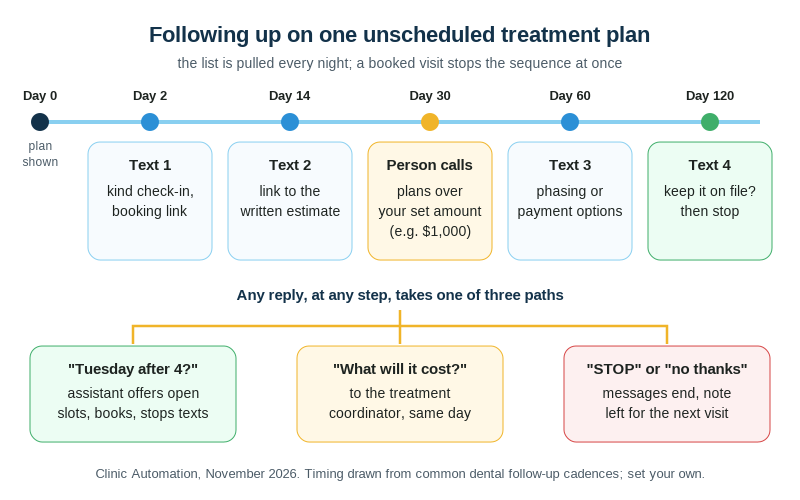
In words, the timeline shows: plan shown on day 0, text 1 on day 2, and text 2 with the estimate on day 14.
Then a personal call on day 30 for plans over a set amount such as $1,000, text 3 with phasing or payment options on day 60, and text 4 on day 120 asking whether to keep the plan on file.
Below it, three reply paths: “Tuesday after 4?” gets open slots and a booking, What will it cost?
goes to the coordinator the same day, and “STOP” or “no thanks” ends the messages and leaves a note for the next visit.
When should each unscheduled treatment follow-up go out?
The first unscheduled treatment follow-up should go out within a few days of the presentation, with later touches spaced out over about four months.
Dental consultants publish similar rhythms. Bryant Consultants describes a 2 day, 2 week, 2 month follow-up run from a weekly report, SPS Dental Academy goes lighter: a first call two to three weeks after the presentation, a second at sixty days, and a warning that More follow-up than this isn’t more effective.
The sequence below sits between the two. Texts are lighter than calls, so they carry the early and late touches, and a person makes the one call that matters most.
| Day | Channel | Purpose | Stops early if |
|---|---|---|---|
| 2 | Text | Kind check-in and a booking link | Booked, STOP, or “no thanks” |
| 14 | Text | Link to the written estimate in the patient portal | Same |
| 30 | Call by a person | Plans over your set amount: talk through cost, timing and nerves | Same |
| 60 | Text | Phasing the work or payment options | Same |
| 120 | Text | Ask whether to keep the plan on file, then close the sequence | Always the last touch |
That is four texts in four months, far below the FCC’s limit for automated health care texts of 1 a day and 3 a week per patient. After day 120, the plan stays in the chart and the dentist brings it up again at the next recall visit.
What should an unscheduled treatment follow-up text say?
An unscheduled treatment follow-up text should name the practice and the dentist, say that recommended care is still open, give one easy way to book or ask, and show how to opt out.
Most of those patients never decided against the care. They were simply waiting for a second, kinder ask that never came.
Keep the tooth, the procedure and the fee out of the text itself. A text can be read on a lock screen by anyone nearby, so the details belong behind a secure portal link or a phone call.
| Day | Text | Characters |
|---|---|---|
| 2 | Hi [FirstName], it’s [Practice]. Dr. [Name] wanted to check in about your care plan. Book here: [Link] or reply with a good day. Reply STOP to opt out. | 151 |
| 14 | Hi [FirstName], [Practice] here. Your written estimate is ready to view: [Link]. Questions? Just reply and [Coordinator] will help. Reply STOP to opt out. | 154 |
| 60 | Hi [FirstName], it’s [Practice]. We can split your care into steps or set up payments. Reply 1 to talk it over, 2 to book. Reply STOP to opt out. | 145 |
| 120 | Hi [FirstName], [Practice] here. Should we keep your care plan on file for your next visit? Reply YES, or BOOK to pick a time. Reply STOP to opt out. | 149 |
Check the length after names and links are filled in. Open Dental’s texting counts every extra 160-character segment as another message.
The day 120 text earns its place. A clear “yes, keep it” or “no thanks” closes the loop, so the list holds only plans someone is still deciding on.
How is treatment plan follow-up different for a cash-pay or out-of-network clinic?
For a cash-pay or out-of-network clinic, treatment plan follow-up should lead with the cost picture, because the patient usually pays the full fee and waits for any reimbursement.
An in-network patient hears your plan covers most of it.
An out-of-network patient hears the full fee and has to guess what their plan will send back, so let me check my insurance
is often the real reason a plan stalls.
That is why the day 14 touch carries the written estimate. If the estimate comes from an automated insurance verification lookup, the patient sees an out-of-network reimbursement estimate before they ever have to call.
The day 60 touch offers the two levers consultants mention most: phasing the work into steps, and outside financing or an in-office membership plan. Your coordinator explains the options on the phone; the text only opens the door.
Many patients of out-of-network offices still carry a calendar-year plan whose annual maximum does not roll over, so a plan presented in the fall can sometimes be split across December and January. Open Dental’s Treatment Finder can filter by benefits remaining for exactly that list.
What can an AI text or voice agent do in treatment plan follow-up?
An AI text or voice agent can send the sequence, answer scheduling replies with real open slots and sort every other reply, while cost, clinical and anxious conversations stay with a person.
Patients rarely reply “1.” They write is the 14th still open?
, can my son come in the same day?
or “does it hurt?”. A plain texting tool drops all of those in one inbox; an assistant books the first, offers family slots for the second and hands the third to your team.
A voice agent can also make or answer the calls, but the rules are stricter. In Declaratory Ruling FCC 24-17, released February 8, 2024, the FCC confirmed that AI-generated voices count as “artificial” voices under the Telephone Consumer Protection Act.
In practice that means outbound AI voice calls need the patient’s prior express consent. Many offices keep the day 30 call human for that reason, and because a warm voice moves a $3,000 decision better than any script.
Two guards keep any agent safe. Messages with patient details go only through services under a signed business associate agreement; Twilio, for example, signs one for qualifying accounts. And the agent never gives clinical advice: “does it hurt?” always goes to the dentist’s team.
The same assistant can answer incoming scheduling texts all day, including reactivation replies from long-overdue patients, so one tool works both lists.
What HIPAA and FCC rules apply to treatment plan follow-up messages?
Treatment plan follow-up messages sit under HIPAA for privacy and under the FCC’s Telephone Consumer Protection Act rules for automated texts and calls.
On the HIPAA side, a reminder about the patient’s own recommended care is generally a treatment communication, not marketing. The definition of marketing at 45 CFR 164.501 excludes communications For treatment of an individual by a health care provider
, as long as no third party pays the practice to send them.
On the FCC side, the health care exemption at 47 CFR 64.1200(a)(9)(iv) lists purposes such as appointment reminders and wellness checkups, caps texts at 160 characters, 1 a day and 3 a week, and requires an opt-out honored immediately.
Treatment plan follow-up is not named on that list word for word. The simplest path is a plain line on your intake form where patients agree to texts about appointments and their care, and a sequence that stays inside the same limits anyway.
- Send only to the cell number the patient gave the office, with the practice’s name.
- No discounts, specials or advertising inside a follow-up text.
- No tooth, procedure or fee in the text itself; put details behind a secure link.
- STOP and plain-word opt-outs (
please stop texting me
) end all messages at once. - AI voice calls only with the patient’s prior express consent.
What should you check before automating unscheduled treatment follow-up?
Check these nine things before the first automated follow-up goes out, because a wrong list or a missing agreement is much harder to fix after a few hundred messages.
- The report includes patients with no insurance (the Open Dental Treatment Finder checkbox, or the matching filter in your system).
- Plans with a $0 fee, completed work and plans already on the schedule are left out.
- Patients flagged “do not text” or “do not contact” are excluded.
- The intake form asks for consent to texts about appointments and care.
- The texting vendor has signed a business associate agreement with the practice.
- The office number is registered for business texting (A2P 10DLC) through the vendor.
- No text holds a tooth, a procedure name, a fee or a discount.
- Your call threshold (for example $1,000) and who makes the day 30 calls are written down.
- One named person owns the reply list and clears it every working day.
How do you start automating unscheduled treatment follow-up in the first month?
Start with plans presented in the last 30 days, because recent plans are the freshest in the patient’s mind, and widen the window only when replies are handled smoothly.
- Week 1: pull the list, clean it with the checklist above, set your call threshold, and send day 2 texts only for new plans.
- Week 2: add the day 14 estimate text and read every reply the same day.
- Week 3: start the day 30 call list for larger plans, and move plans 30 to 90 days old into the sequence at their matching step.
- Week 4: count plans booked, plans closed with a clear “no,” replies per day and staff minutes spent, then decide what to adjust.
Once the month runs calmly, let the nightly pull do the remembering. Your coordinator’s day changes from dialing a cold list to answering patients who already raised a hand.
And the patient who said let me think about it
hears from you at the right time, kindly, with one easy way to say yes.
Start with last week’s plans, answer every reply the same day, and let the nightly list do the remembering for you.
Sources and further reading
- Open Dental manual: Treatment Finder report
- Open Dental manual: Planned Appointment Tracker
- Open Dental: published fees (Integrated Texting)
- Dentrix Magazine: Mining for Gold, three reports for unscheduled treatment (Dayna Johnson, 2017, updated 2021)
- Patterson Support: Eaglesoft, tracking outstanding treatment
- ADA Health Policy Institute: Improving Dental Care Access for Vulnerable Populations
- 45 CFR 164.501: HIPAA definitions, including marketing and its treatment exception
- 47 CFR 64.1200: FCC rules for automated calls and texts, health care messages
- Wiley: FCC Declaratory Ruling 24-17, AI-generated voices under the TCPA (February 2024)
- Twilio: HIPAA and the Business Associate Addendum
- Bryant Consultants: Why following up on unscheduled treatment is non-negotiable
- SPS Dental Academy: How to follow up on unscheduled treatment without sounding pushy
Questions and answers
Can I use AI to automate follow-up on unscheduled treatment plans?
Yes. AI can read the unscheduled plan list from Dentrix, Open Dental or Eaglesoft every night, send a set text sequence, book scheduling replies into open slots and sort the rest. Keep cost, clinical and anxious conversations with your coordinator, and use only services under a signed business associate agreement.
How soon should you follow up after a dental treatment plan is presented?
Within a few days to a few weeks. Bryant Consultants describes a 2 day, 2 week, 2 month rhythm, while SPS Dental Academy makes its first call two to three weeks after the presentation. A short text with a booking link is the lightest early touch.
How many times should a dental office follow up on unscheduled treatment?
Four or five touches over about four months is a common, gentle range: texts around days 2, 14, 60 and 120, plus a personal call near day 30 for larger plans. Stop at once when the patient books, says no or replies STOP.
Is it HIPAA compliant to text patients about unscheduled treatment?
A reminder about a patient’s own recommended care is generally a treatment communication under HIPAA, not marketing. Send it through a vendor under a business associate agreement, keep the tooth, procedure and fee out of the text, and put details behind a secure link. Ask your counsel about your own messages.
Which report shows unscheduled treatment in Dentrix and Open Dental?
In Dentrix, the Treatment Manager (Appointment Book, Options, Treatment Manager) or the Unscheduled Treatment Plans list. In Open Dental, the Treatment Finder report under Standard Reports, Lists, plus the Planned Appointment Tracker. Eaglesoft uses Patient Management with the Unscheduled treatment plan filter.