Front Desk Phone Overflow for a Dental Office: Catch the Third Call
Hello, and a warm welcome to every front desk where the phone rings the moment a patient steps up to the window.
If the phone always rings the moment a patient steps up to the window, this guide is for you.
Most dental front desks have two people and three jobs at once: checking patients in, checking them out and answering every call.
When all three happen together, the call loses, and the caller who hears four rings and voicemail often tries the next office on the list.
Short answer: To handle front desk phone overflow in a dental office, set a rollover rule in your phone system so a call that hits busy lines, rings unanswered or arrives at lunch moves to a backup. That backup can be a second ring group, a missed-call text, a live answering service or an AI receptionist that books the visit.
What is front desk phone overflow in a dental office?
Front desk phone overflow is every call that arrives while the people who answer the phone are already busy.
In a dental office that usually means the third caller: one coordinator is on the line with an insurance company, the other is taking a payment, and the next ring has nowhere to go.
- Busy overflow: every line or person is already on a call.
- No-answer overflow: the phone rings, but the person beside it is helping a patient at the window.
- Queue overflow: callers wait on hold until they give up.
- Closed-hours overflow: lunch, early mornings, evenings and weekends.
Each kind needs its own rule in the phone system. A good overflow setup treats them separately instead of sending all four to one voicemail box.
When do dental office phones overflow?
Dental office phones overflow in predictable windows, so the backup can be planned instead of hoped for.
- Opening hour: patients who thought about the toothache overnight call at 8 a.m., while the first patients are checking in.
- Lunch: the desk is short-staffed or closed, but patients on their own lunch break call then.
- Check-out rush: several patients finish at once and need payment, a next visit and a treatment plan talk.
- After hours: evening and weekend calls, when nobody is there at all.
The after-hours share is bigger than it looks. Peerlogic, a vendor that sells dental call handling, writes that roughly 30% of dental calls arrive outside normal call center hours. That is a vendor’s number, so check it against your own phone report.
How many calls does a busy dental front desk really miss?
A busy dental front desk misses a third or more of its calls in most vendor studies, though every figure comes from companies that sell the fix.
| Figure | Who published it | What it is based on |
|---|---|---|
| 38% of inbound calls went unanswered | Peerlogic, May 2026 | 4,280 calls across 26 practices, February 2026 |
| 68 of every 100 new patient calls answered; 42% of those booked | Peerlogic, March 2025 | Sample size not stated |
| 30% fewer missed patient calls after switching phones | Henry Schein One, Ascend Phones page | One customer, Beam Dental |
| Two-thirds of callers set a two-minute hold limit; 13% will not hold at all | Weave, citing SharpenCX | Consumer survey, all industries |
Weave’s own guide puts the patience problem plainly: The majority (two-thirds to be exact) say that their maximum threshold is two minutes.
A caller on hold through a long check-out has usually hung up by the time anyone picks up.
Here is a simple way to see your own overflow. It assumes one person answers phones, each scheduling call takes 4 minutes, and calls arrive evenly through the busiest hour.
| Calls in the busiest hour | Share of that hour the phone person is free | Calls they can take (4 min each) | Calls that overflow | Overflow calls a month (21 workdays) |
|---|---|---|---|---|
| 12 | 100% | 15 | 0 | 0 |
| 12 | 50% | 7 | 5 | 105 |
| 12 | 25% | 3 | 9 | 189 |
| 20 | 50% | 7 | 13 | 273 |
Real calls bunch together, so the true overflow is usually higher than this even split shows. Swap in your own numbers from your phone system’s call report; the pattern stays the same.
Which dental calls can an overflow backup handle without your team?
An overflow backup can finish routine scheduling calls on its own and should pass anything clinical or financial to a person.
| Call type | Overflow backup can finish it? | What happens |
|---|---|---|
| Book, move or cancel a routine visit | Yes, if it can see open slots | Books into the schedule and texts a confirmation |
| New patient wants a first visit | Yes, with your rules for visit types | Books or captures the request, sends intake forms and a card photo link |
Hours, address, parking, are you open Saturday? | Yes | Answers from a fact sheet you approve |
Do you take my insurance? | Partly | Gives your approved in-network or out-of-network answer, asks for a card photo |
| Balance, statement or payment plan question | No | Takes a message with a summary for billing |
| Pain, swelling, bleeding, a broken tooth | No | Transfers to a live person or the on-call line at once |
The emergency row is the one to set up first. Every overflow script, human or AI, should know your exact words for this needs the doctor
and where to send that call.
What are the options for dental office phone overflow?
A dental office has six practical ways to cover overflow calls, and most offices end up combining two or three.
| Option | What it does | Best for | The catch |
|---|---|---|---|
| Second ring group | Rolls the call to the back office, a treatment coordinator or a manager’s phone | Short peaks during the day | Pulls those people away from their own work |
| Voicemail | Records a message for a callback | Closed hours, as a last step | Many callers hang up instead of leaving one |
| Missed-call text | Texts the caller from your office number right away | Every office, as a safety net | Someone still has to answer the replies |
| Live answering service | A trained agent answers, takes messages, sometimes books | Offices that want a human voice every time | Per-minute or per-call bills rise in busy months |
| AI receptionist | Answers, recognizes the caller, books into the schedule, texts a confirmation | High call volume, after hours, lunch | Needs your rules, a BAA and a clean hand-off to staff |
| Online self-booking | Patients book themselves, such as with Open Dental’s Web Sched | Patients who would rather not call at all | Does not help the patient who is already dialing |
Practice owners argue about this mix in public too. In a February 2025 r/Dentistry thread summarized by HelpSquad, one owner losing a front desk person asked about virtual answering; some replies said a real person matters at that size, and another pointed to online self-booking instead.
Both camps have a point. The setup that works for most offices keeps the team answering first and lets a backup catch only what would have rung out.
How does an automated overflow agent handle a dental call step by step?
An automated overflow agent takes a call only after your phone system’s rollover rule hands it over, then follows five steps.
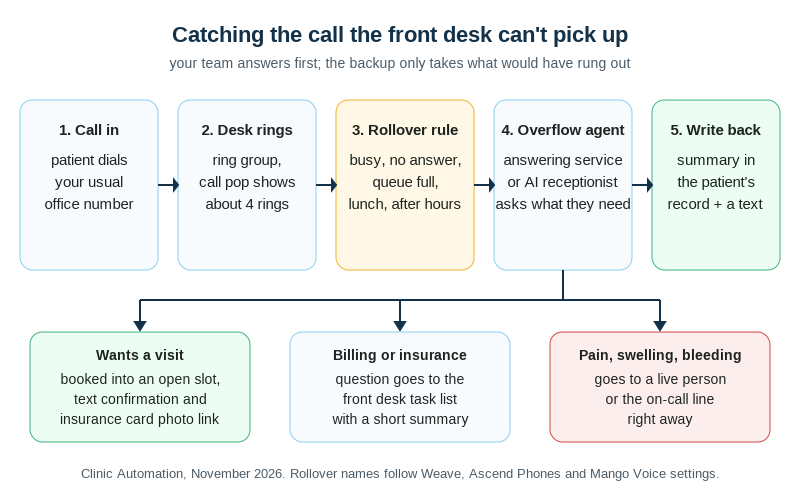
- Ring the desk first. The call rings your front desk ring group for about four rings, with call pop showing who is calling.
- Roll over. If every line is busy, nobody answers, the queue is full, or it is lunch or after hours, the phone system forwards the call to the backup number.
- Answer and recognize. The answering service or AI receptionist greets the caller in your office’s name and matches the phone number to the patient record.
- Finish or hand off. A booking request goes into an open slot; a billing question becomes a task; pain or swelling goes to a live person.
- Write back. A short summary lands in the patient’s record, and the patient gets a text confirmation and, if needed, a link to send an insurance card photo.
Step 4 is where the software you already own matters. Open Dental’s API, for example, has Appointments GET Slots and Appointments POST calls, which let an outside agent see open times and book one.
The same card photo can feed the next job. An AI vision step reads the payer and member ID from the photo and starts the eligibility check described in our guide to automated dental insurance verification software.
How do you set up overflow rollover in Weave, Ascend Phones or Mango Voice?
You set up overflow rollover in the phone system’s routing screen, by adding a busy path, a no-answer path and a schedule for lunch and closed hours.
Your team still answers first. The backup only catches the calls that would have rung out while someone was being cared for at the desk.
Weave’s call queue guide recommends call groups so several team members can pick up, and a cap on how many callers may wait.
To avoid unreasonably long hold times, you can limit the number of callers waiting in your call queue at any given time.
Weave, Call Queue Management: 15 Ways to Better Manage Calls
Weave’s guide then says to choose where overflow goes once that cap is reached. Weave’s Missed Call Text sends a text to every missed caller, with separate messages for open and closed hours.
Weave also sells an AI Receptionist that answers calls and texts and books appointments. It grew out of Weave’s TrueLark acquisition, completed May 19, 2025, and Weave’s plans page listed it as early access on November 27, 2026.
Henry Schein One’s Ascend Phones works natively with Ascend by Dentrix. It shows patient details when the phone rings, routes calls across locations or departments and documents calls in the patient record.
In Mango Voice’s Switchboard, the Transfer and Rollover module rings an extension or ring group for a set timeout, then takes the No Answer path. An unavailable extension sends the call straight to the Busy path.
| Phone system | First ring | Overflow trigger | Built-in backup |
|---|---|---|---|
| Weave | Call groups | Queue cap, schedules, call forwarding | Missed Call Text; AI Receptionist (early access) |
| Ascend Phones | Routing by location or department | Routing rules | Call documentation in the patient record |
| Mango Voice | Ring group in Switchboard | No Answer and Busy paths, Queue module | Voicemail, queue, or an outside number |
Why does phone overflow matter more for an out-of-network or cash-pay dental office?
Phone overflow matters more for an out-of-network or cash-pay dental office because its callers ask harder questions, and a voicemail answers none of them.
The most common one is do you take my insurance?
An in-network office can say yes. An out-of-network office needs to explain that the patient pays at the visit and the plan reimburses them, which takes a calm minute the desk does not have during check-out.
A good overflow script gives your approved answer in plain words, then asks the caller to text a photo of the insurance card. Your team calls back with a real reimbursement estimate instead of a guess.
Cash-pay offices also tend to see fewer patients a day, so each missed new patient call is a bigger share of the week. That makes a backup that books on the first call worth more per call than it is at a busy in-network office.
Patients who stop calling back often end up on the overdue list later. Our guide to dental patient reactivation text software covers how to bring them back.
What HIPAA and texting rules apply to dental overflow answering?
Any answering service or AI receptionist that hears patient details on your behalf handles protected health information, so it needs a signed business associate agreement before it takes a call.
- Business associate agreement: HHS publishes sample business associate agreement provisions. Ask every overflow vendor to sign one.
- The telephone and text layer: Twilio signs a Business Associate Addendum for customers on its Security or Enterprise Edition, and only for its HIPAA-eligible products.
- Voicemail and messages: HHS says providers may leave appointment messages on an answering machine, keeping the detail to what is needed.
- Texts: automated texts fall under the FCC rule at 47 CFR 64.1200, and business texting in the US runs on A2P 10DLC registration. Keep the text about scheduling and honor STOP at once.
What does dental phone overflow coverage cost?
Dental phone overflow coverage runs from almost nothing for a missed-call text to a few thousand dollars a month for another full-time person, based on published prices and vendor benchmarks.
- Weave base plan
- Starting at $199 a month, with Missed Call Text and Call Pop included (Weave plans page, November 27, 2026)
- Weave AI Receptionist
- Listed as early access with no published price (same page)
- AI overflow tools sold flat
- One founder’s overflow-only tool at $99 a month, without a practice software connection (an August 2026 r/Dentists post, as summarized by HelpSquad)
- Dedicated outside staff
- $8 to $13 an hour, HelpSquad’s own published rate for full-time staffing
- Another in-house receptionist
- About $20 an hour, roughly $3,200 a month, as HelpSquad’s benchmark
Compare those with your own count from the calculation above. If 105 overflow calls a month include even a handful of new patients, a backup in the low hundreds of dollars is usually the cheaper answer than another hire.
What should you ask before choosing a dental overflow answering service?
Ask eight questions, and get the answers in writing before any call is forwarded.
- Does it answer only overflow, or does it take every call?
- Can it see open slots and book into our exact version of Dentrix, Ascend, Open Dental or Eaglesoft?
- What does it do with pain, swelling or bleeding, and how fast does that reach a person?
- Does it give our approved out-of-network answer and ask for an insurance card photo?
- Where does the call summary land: the patient record, a task list or only an email?
- Does the caller ID show our office number on the text it sends?
- Will it sign a business associate agreement, and where are recordings kept?
- How is it billed: per minute, per call, or flat, and what happens in a busy month?
How do you start overflow call answering without upsetting patients?
Start with lunch and after hours, where nobody answers today, so any call the backup takes is a call you were already losing.
- Day 1: pull last month’s call report and count missed calls by hour of the day.
- Day 2: write the fact sheet (hours, address, visit types, your out-of-network answer) and the emergency rule.
- Days 3 and 4: send lunch and after-hours calls to the backup, and read every summary the next morning.
- Days 5 to 7: add the no-answer path for business hours, set at about four rings, and test it with a real call.
- End of week one: compare missed calls, bookings from overflow and the time your team spent fixing summaries.
If the backup books real visits and your team spends minutes, not hours, on its notes, keep it and widen it to the morning rush.
And the patient who calls during a busy check-out gets a friendly answer and a booked visit, instead of four rings and a beep.
Start with lunch and after hours, read every summary the next morning, and widen it only when it earns your trust.
Sources and further reading
- Weave: Call Queue Management, 15 Ways to Better Manage Calls
- Weave: Missed Call Text
- Weave: Plans (base plan price, AI Receptionist early access)
- Weave investor relations: Weave Completes TrueLark Acquisition (May 19, 2025)
- ADA News: ADA Member Advantage endorses Weave (March 12, 2026)
- Henry Schein One: Ascend Phones
- Mango Voice support: Using the Mango Voice Switchboard
- Mango Voice support: Call Queue FAQs and Settings
- Open Dental API: Appointments (GET Slots, POST)
- Open Dental manual: Web Sched New Patient
- Peerlogic: Fix Missed Scheduling Opportunities in Dental Call Centers (vendor figures, May 2026)
- Peerlogic: Turning Missed Dental Phone Calls Into Profit (vendor figures, March 2025)
- HelpSquad: Dental Answering Service Costs, Features, and How to Choose (vendor, with r/Dentistry summary)
- HHS HIPAA FAQ 198: May providers leave messages for patients?
- HHS: Sample business associate agreement provisions
- Twilio: HIPAA and the Business Associate Addendum
- Twilio docs: A2P 10DLC registration
- 47 CFR 64.1200: FCC rules for automated calls and texts
Questions and answers
Can I use AI to handle front desk phone overflow for my dental office?
Yes. An AI receptionist can answer the calls your front desk can’t reach, recognize the caller, book routine visits into open slots and text a confirmation. Keep your team answering first, send pain or swelling to a live person, and use only a service that signs a business associate agreement.
How many rings before a dental office call should roll over?
About four rings, roughly 20 to 25 seconds on a standard US ring, is a common starting point. It gives your front desk a fair chance to answer first while the caller is still patient. Test it with real calls and adjust it after a week of call reports.
Is an answering service or an AI receptionist better for a dental office?
It depends on call volume and budget. A live answering service gives a human voice every time but often bills per minute or per call. An AI receptionist can book directly into the schedule at a flat monthly price. Many offices use one for overflow and a missed-call text as the safety net.
Do dental overflow answering services need a business associate agreement?
Yes. Callers share names, birthdays and symptoms, which is protected health information. Any outside answering service or AI vendor handling those calls for your practice should sign a business associate agreement under HIPAA before calls are forwarded.
What is a missed-call text for a dental office?
It is an automatic text sent from your office number to anyone whose call went unanswered, inviting them to reply by text. Weave’s Missed Call Text, for example, lets you set separate messages for open and closed hours. Someone still needs to answer the replies.