Guides › Crossbow in a ground blind
Shooting a Crossbow From a Ground Blind: Window Height, Limb Clearance and Sitting Posture
Disclosure: this guide contains Amazon affiliate links. As an Amazon Associate we earn from qualifying purchases, at no extra cost to you.
A ground blind and a crossbow go together really well - no drawing motion to spook a deer, and you can sit for hours. But there's one mistake that catches a lot of hunters: the deer looks perfect in the scope, you squeeze the trigger, and the bolt smacks the window frame. A good hunting ground blind and a set of shooting sticks (both on Amazon) help, but the real fix is understanding why it happens.
Short answer: your scope sits above the bolt, so you can see the deer over the window's bottom edge while the bolt's path is lower and hits it. Keep the bolt clearly above the sill, make sure the limbs have room on both sides, use a chair at the right height and a steady rest, and test it all from the actual blind before the season - with the crossbow uncocked.
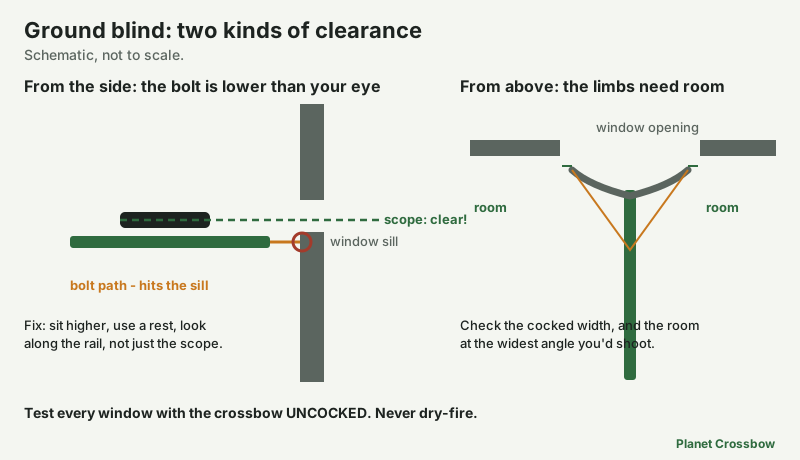
Why the bolt hits the window
On a crossbow, the scope is mounted above the rail. So the line you see along and the line the bolt travels aren't the same - the bolt starts out noticeably lower than your eye. Close to the crossbow, that gap matters most.
Picture yourself sitting low with the crossbow just poking toward the window. Through the scope you can see the deer over the bottom edge. But the bolt is below your line of sight, and it's right at the edge of the fabric. That's how bolts end up in the window frame.
The same thing can happen when you tilt the crossbow to follow a deer that's uphill or off to the side. Grand View Outdoors calls out exactly this: a tilt to find the deer in the scope can send the bolt into the blind instead of through the opening.
Limb clearance
A cocked crossbow is wide. If a limb or cam touches the window edge, a chair or a blind pole when you shoot, the shot can go wild - and it's hard on the crossbow. Deer & Deer Hunting's advice is simple: make sure the limbs won't contact anything before you need the shot.
- Know your width. Your manual lists the crossbow's width; check whether it's the cocked width (the one that matters here).
- Measure the window. You want clear room on both sides of the limbs, not just enough to squeeze through.
- Watch your angles. A shot to the side of the window needs more room than a straight-out shot.
Narrow crossbows are a real advantage in blinds - it's one of the reasons we suggest measuring your blind before you buy (see how to choose a crossbow).
Chair height and posture
Most window problems are really chair problems. A low, saggy camp chair puts your eye at the bottom of the window, so the bolt's path ends up even lower. Deer & Deer Hunting points out that sagging chairs leave many hunters too low to line up a shot, which makes them squirm at the worst moment.
- Use a firm chair with adjustable legs so you sit level on uneven ground.
- Sit so your scope looks through the middle of the window, not the bottom edge.
- Sit back a bit from the window. Keeping the crossbow inside the blind hides your movement, and the dark interior hides you.
Use a steady rest
Shooting sticks, a bipod or a monopod keep the crossbow steady and at the same height every time. Set them so the bolt sits clearly above the sill when you're on target. A rest also means you can hold on a deer for a while without your arms shaking.
Test it before the season
This is the step that saves a hunt. Set up the blind, chair and rest exactly how you'll hunt, then:
- With the crossbow uncocked, settle in and aim through each window at the spots where deer will be.
- Look along the rail, not just through the scope - is the bolt's path clearly above the sill?
- Check that the limbs have room at the widest angle you'd shoot.
- Then, outside the blind and safely, practice real shots from the same chair height at a target (see sighting in at 20, 30 and 40 yards).
A few more blind tips
- Open only the windows you need, and keep the ones behind you closed so you're not outlined.
- Cock before you get settled - outside, in a safe direction, or right as you sit down - so you aren't making noise later. And unload before you walk out (see how long a crossbow can stay cocked).
- Mark distances with a rangefinder at the start of the sit.
- Wear dark clothing inside the blind so you blend into the shadows.
Frequently asked questions
Why did my crossbow bolt hit the blind window?
Because the scope sits above the bolt. You can see the deer over the window's bottom edge while the bolt's path is lower and catches the frame. Sit higher, keep the bolt well above the sill, and check along the rail before you shoot.
How wide should a ground blind window be for a crossbow?
Wide enough for your crossbow's cocked width plus room on both sides at the angles you'll shoot. Measure your crossbow (check the manual for cocked width) and the window, and test it uncocked in the blind.
Can I shoot through blind mesh with a crossbow?
Some blinds sell shoot-through mesh, but bolts and broadheads can be deflected. Check the blind maker's guidance; many hunters prefer an open window for crossbow shots.
What chair is best for a ground blind?
A firm chair with adjustable legs so you sit level and high enough that your scope looks through the middle of the window.
Sources and further reading
- Grand View Outdoors: tips for crossbow hunting from ground blinds - bolt clearance when tilting, rests, chairs
- Deer & Deer Hunting: don't make these mistakes shooting from a ground blind - limb clearance, chair height, practice from the blind
- TenPoint: how to safely handle and shoot a crossbow - safety basics, never dry-fire
- National Bowhunter Education Foundation (NBEF) - bowhunter education
How this guide was written: Based on how a crossbow's scope sits above the bolt, manufacturer safety guidance, and ground-blind advice published by Grand View Outdoors and Deer & Deer Hunting. Window and limb sizes vary by blind and crossbow - measure yours.