Guides › How to sight in a crossbow scope
How to Sight In a Crossbow Scope (20, 30 and 40 Yards)
Disclosure: this guide contains Amazon affiliate links. As an Amazon Associate we earn from qualifying purchases, at no extra cost to you.
A crossbow scope is only as accurate as its zero. Sighting in takes an afternoon, a safe range, a crossbow-rated target (see options on Amazon) and a handful of bolts, and you should repeat it whenever you change bolts or broadheads, after a hard knock, and before every season.
Short answer: from a steady rest, zero the top aiming point at 20 yards with three-bolt groups, then shoot 30 and 40 yards with the lower points without touching the turrets (on a speed-dial scope, adjust the speed ring), re-check 20, and finally confirm your broadheads hit with your field points.
Safety first
- Use a backstop and a target rated for crossbow speeds - field points can pass straight through targets made for vertical bows.
- Keep fingers and thumbs below the flight rail and clear of the string path at all times.
- Never dry-fire. Cock only when you are ready to shoot, with the safety on until you are on target.
What you need
- A crossbow-rated target (crossbow targets on Amazon) and a measured range - 20, 30 and 40 yards marked accurately (a rangefinder or tape).
- A steady rest: shooting sticks, a bench rest or a padded bag. You are testing the scope, not your offhand shooting.
- At least three bolts of the exact type, length and weight you will hunt with, with field points of the same weight as your broadheads.
- Your scope's manual and the small tool for the turrets, if it uses one.
How the reticle works
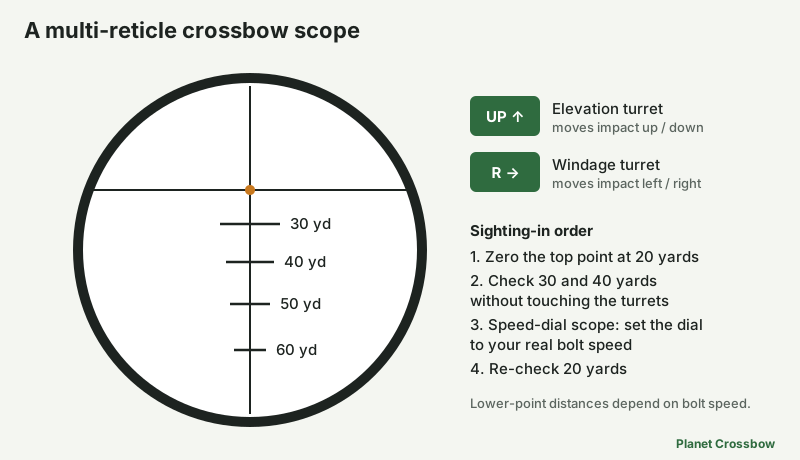
Most crossbow scopes have several aiming points. You zero the top one at 20 yards; the lower ones are spaced for 30, 40 and beyond at a particular speed. If your crossbow shoots faster or slower than the scope assumes, the lower points will hit high or low - that is what the 30- and 40-yard checks reveal. Speed-dial scopes let you turn a ring to match your actual speed instead.
Step by step
- Start close. If the scope has never been zeroed, shoot one bolt from 10 yards to make sure you are on paper.
- Shoot a group at 20 yards. From your rest, aim the top aiming point at the bullseye and shoot three bolts. Ignore a single flier; you are adjusting to the center of the group.
- Adjust elevation and windage. Most crossbow scope turrets are marked with the direction the point of impact moves (for example "UP" and "R"). If your group is low and left, turn elevation toward UP and windage toward R. Check the manual for how far each click moves impact at 20 yards.
- Repeat until three-bolt groups center on the bullseye at 20 yards.
- Move to 30 yards and shoot with the second aiming point. Don't touch the turrets. Note where the group lands.
- Move to 40 yards with the third aiming point. On a speed-dial scope, adjust the speed ring (not the elevation turret) until the 30- and 40-yard groups hit where you aim - follow your scope's instructions, since some tell you to set the dial at the longer distance.
- Go back to 20 yards and confirm the zero didn't move.
Check your broadheads
Broadheads can fly differently from field points, especially fixed-blade heads on a fast crossbow. Once the scope is zeroed with field points, shoot each broadhead you intend to hunt with into a dedicated broadhead target at 20 and 30 yards. If they group with the field points, you are done. If not, check that the broadheads spin true, that bolts are straight and nocks seated, and consider mechanical heads designed for crossbows (see bolts and broadheads). Mark the bolts you used and keep a separate practice set.
Keeping your zero
- Recheck after travel, a drop, string or cable changes, or a scope remount.
- Use the same bolts, nocks and point weights every time.
- Cock carefully and consistently - an off-center string moves impact left or right. A cocking device helps (see cocking options).
- Keep the rail and string maintained (crossbow maintenance).
Finally, practice at the distances and angles you will hunt. Shots from a tree stand or kneeling in a blind feel different from the bench, and knowing your effective range is part of ethical hunting.
Frequently asked questions
What distance should I sight in my crossbow?
Most multi-reticle crossbow scopes are designed to be zeroed with the top aiming point at 20 yards, then checked at 30 and 40. Some scopes use a different distance, so follow your scope's manual.
Which way do I turn the scope to move my shots?
Turn the turrets in the direction you want the point of impact to move - most crossbow scope turrets are marked UP and R (right). If your group is low, turn elevation toward UP.
Do I need to shoot broadheads after sighting in?
Yes - check that your broadheads hit with your field points before hunting, using a broadhead target. If they don't, fix the bolt or broadhead issue rather than hunting with a different zero.
Sources and further reading
- TenPoint arrow and broadhead FAQs - manufacturer answer on checking broadheads after sighting in
- TenPoint: compensating for shot angle - aiming from tree stands
- National Bowhunter Education Foundation (NBEF) - bowhunter education and shot placement
How this guide was written: Based on crossbow and scope manufacturers' published sighting-in procedures. Always follow the manual for your specific scope - some are designed to be zeroed at a different distance.