Guides › How to choose a crossbow
How to Choose a Crossbow: A Complete Buying Guide
Disclosure: this guide contains Amazon affiliate links. As an Amazon Associate we earn from qualifying purchases, at no extra cost to you.
A crossbow is a long-term tool: a well-chosen one will shoot accurately for many seasons, and a poorly chosen one will be too heavy to carry, too hard to cock, or too wide for your blind. This guide walks through the decisions in the order that matters, so you can compare any crossbow - in a store or while browsing hunting crossbows on Amazon - on the things that actually change how it hunts.
Short answer: pick a crossbow you can legally hunt with, carry comfortably and cock consistently (with a rope or crank if needed), with a clean trigger and anti-dry-fire protection. Advertised top speed matters far less than fit, a good trigger and practice.
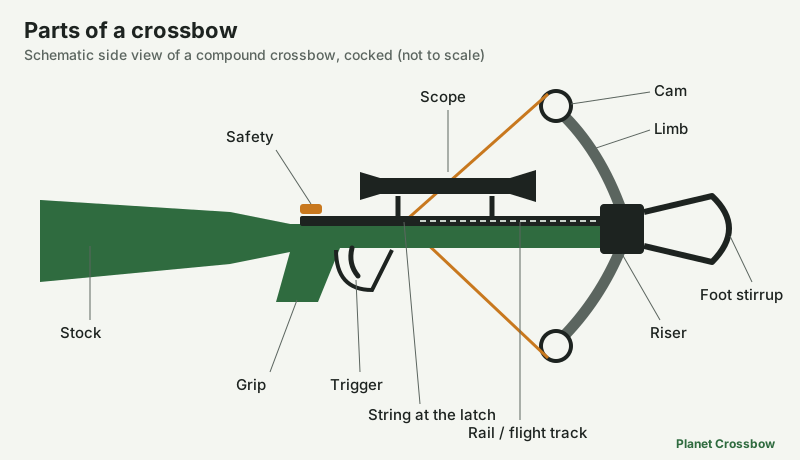
1. Start with how you will hunt
Before comparing numbers, write down three things: where you will shoot from (ground blind, tree stand, still-hunting on foot), the largest animal you plan to hunt, and the longest shot you would ethically take. A crossbow for a 20-yard shot at deer from a cramped blind should be short and narrow; one carried up a mountain should be light. Most regret comes from buying for the spec sheet instead of the situation.
2. Limb design: recurve, compound or reverse-draw
- Recurve crossbows use simple limbs with no cams. They are mechanically simple, often quieter and easier to restring, but they are usually longer and wider for a given energy and need a higher draw weight to reach compound speeds.
- Compound crossbows use cams and cables. The cams store more energy in a narrower package, so most hunting crossbows sold today are compounds. They have more parts to maintain and usually need a bow press for string changes.
- Reverse-draw (reverse-limb) crossbows mount the limbs so the string starts further forward and travels a longer power stroke. A longer power stroke can produce more energy at a lower draw weight and moves weight back toward your shoulder, which many shooters find steadier. They tend to cost more.
3. Draw weight, speed and kinetic energy
Advertised speed (feet per second, fps) gets the headlines, but it is measured with the lightest bolt the maker allows. What kills cleanly is the energy and momentum of your hunting bolt. Draw weight alone is also a poor guide: a short power stroke at a high draw weight can deliver less energy than a longer stroke at a lower one. Our draw weight, FPS and kinetic energy guide shows the formulas and how to estimate the energy of any setup.
Practical points:
- Check your state or province's minimum draw weight and any other crossbow rules for the season you plan to hunt - they vary and they change.
- For deer-sized game, almost every current hunting crossbow sold by a reputable maker delivers more than enough energy at normal crossbow ranges. Accuracy and shot placement matter far more than an extra 30 fps.
- Faster is louder and harder on strings, cables and your shoulder when cocking. Don't pay for speed you will not use.
4. Weight, width and length
These three numbers decide how the crossbow feels on day three of a hunt:
| Spec | Why it matters |
|---|---|
| Weight (with scope) | You carry it and hold it on target. Heavier is steadier at the bench but tiring in the field. Compare weights with the scope and quiver attached, as you will actually hunt. |
| Width (axle-to-axle, cocked) | Narrow crossbows are easier to maneuver in blinds and stands. Measure your blind window if you hunt from one. |
| Length | Shorter is handier in brush and vehicles. Very short designs can be front-heavy or have a heavier trigger pull. |
| Length of pull / stock fit | An adjustable stock helps you get the same eye position behind the scope every shot - a big part of accuracy. |
5. Cocking: be honest about your strength
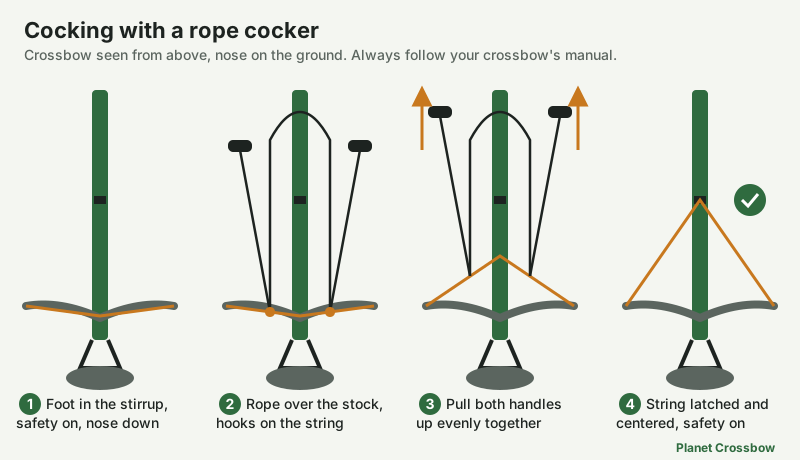
Cocking a hunting crossbow by hand takes real strength, and doing it inconsistently can make the string sit off-center and push shots sideways. Options:
- Rope cocker - a rope with handles and hooks that roughly halves the effort. Inexpensive and reliable. Browse rope cocking devices on Amazon.
- Crank cocker - a winch that lets almost anyone cock even very heavy crossbows, slowly and quietly. Many crossbows have a built-in or dedicated crank; aftermarket ones must match your model.
- De-cocking - many crossbows can only be "unloaded" by shooting a bolt into a target (or a discharge bolt into the ground). Some cranks and designs allow safe de-cocking without shooting. Read the manual for your exact model - it matters for how you end each hunt.
6. Trigger, safety and dry-fire protection
A good trigger breaks cleanly without creep at a moderate weight, which helps accuracy more than speed does. Look for an automatic safety that engages when you cock, and anti-dry-fire mechanisms that block the trigger unless a bolt is properly seated. Dry-firing (releasing the string without a bolt) can destroy limbs and strings and injure the shooter; most warranties exclude it.
7. Scopes
Most crossbows are sold with a multi-reticle scope calibrated for a typical speed: the top line for 20 yards and lower lines for 30, 40 and beyond. Some scopes have a speed dial that adjusts the reticle spacing to your crossbow's actual speed. Whatever you choose, it has to be sighted in with your hunting bolts - see how to sight in a crossbow scope. A scope matched to the crossbow by the manufacturer is usually the simplest choice for a first crossbow.
8. Packages and what is (or isn't) included
Most crossbows are sold as packages. Before comparing prices, list what each one includes - scope, bolts (how many, what weight), quiver, cocking device, sling, case - and what you would still need to buy. A cheaper package that needs a new scope and a crank is not cheaper.
Things you will need regardless: extra bolts of the type your manufacturer specifies (see crossbow bolts and broadheads), a target rated for crossbow speeds (crossbow targets on Amazon), rail lube and string wax (maintenance guide), and broadheads for hunting.
9. Budget tiers - what changes as you spend more
- Entry level: usually heavier, wider and louder, with simpler triggers and basic scopes. Many still shoot accurately enough for ethical hunting at normal ranges when set up well.
- Mid-range: typically lighter and narrower, better triggers, better scopes, often a crank or improved cocking system.
- Premium: the most compact designs, refined triggers, built-in de-cocking cranks, tighter tolerances and longer warranties.
Spend first on fit (weight, width, cocking you can manage) and a crisp trigger; spend last on top speed.
10. Checklist before you buy
- Legal for your hunt? (Check your wildlife agency's current regulations.)
- Weight and width suit where you hunt?
- Can you cock it safely and consistently - and de-cock it the way you want to?
- Trigger and safety design, including anti-dry-fire?
- What does the package include, and what will you still need?
- Warranty length and what it excludes?
- Does the manufacturer specify bolt length, weight and nock type - and can you get those bolts?
When you have a short list, compare current listings and owner questions side by side - for example hunting crossbow packages on Amazon - and check each model's manual for the specifications above.
Frequently asked questions
What is a good first crossbow?
One you can cock safely and consistently, that is legal for your hunt, light and narrow enough for where you hunt, and sold as a complete package from a reputable maker with a clear warranty. A mid-weight compound crossbow with a matched scope and a rope or crank cocker suits most beginners.
How many fps do I need for deer?
Most current hunting crossbows have more than enough speed and energy for deer at normal crossbow ranges. Kinetic energy with your actual bolt matters more than the advertised fps - see our kinetic energy guide.
Should I buy a crossbow with a crank?
If cocking by hand or rope is difficult for you, yes - a crank lets almost anyone cock consistently, and some crank systems also allow safe de-cocking without shooting. Check that the crank fits your exact model.
Sources and further reading
- List of U.S. state fish and wildlife agencies - find your state's current crossbow rules
- Hunter-ed.com official hunter education courses - state-approved hunter safety courses
- National Bowhunter Education Foundation (NBEF) - bowhunter education
- TenPoint ACUslide cocking and de-cocking system - an example of a built-in crank de-cocking design
How this guide was written: Based on manufacturer owner's manuals, published archery engineering references and state hunter-education material. We have not hands-on tested specific models for this guide, so it explains how to judge any crossbow rather than ranking products.