Hunting games › Callers and decoys
Callers and Decoys in Hunting Games: What Works and Why
Disclosure: this page contains Amazon affiliate links. As an Amazon Associate we earn from qualifying purchases, at no extra cost to you.
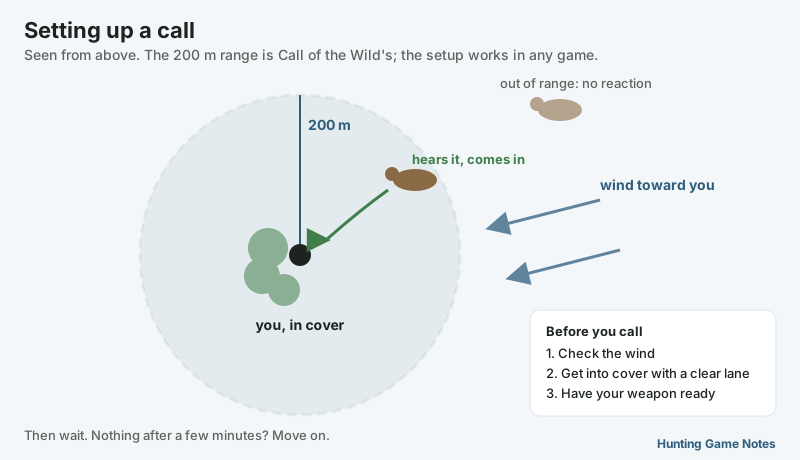
A caller flips the usual hunt around: instead of walking to the animal, you make it come to you. Done well, it's one of the most satisfying moments in a hunting game. Done badly, you just tell every deer in the valley where you are. Here's how callers and decoys work in theHunter: Call of the Wild and Way of the Hunter (both on Amazon), and how to set up a call that works.
Short answer: in Call of the Wild, callers have an effective range of 200 meters, and you can also place a remote electronic caller on the ground. In Way of the Hunter, each caller matches an animal, and you have to time your call on a meter and wait between calls. In both, call from cover with the wind in your favor and a clear view of where the animal will come from.
How callers work in Call of the Wild
A 2023 developer diary on the game's official site gives the firmest facts:
- Range: the existing callers and the Quist Red Pro Electronic Caller all have "an effective range of 200m".
- Electronic caller: it's "a remotely controlled speaker". You place it on the ground the same way as decoys or stands, then pick and play calls with a remote.
- Species: it can attract "any species in the game that can be lured by other callers".
- Multiplayer limit: it can't be placed within 200 m of another player's caller.
What players report about calling
The rest comes from players on the game's Steam forums, and they don't all agree:
- Species callers: players report that dedicated callers for red deer and roe deer work better on those species than the general bleat and grunt callers.
- Success rate: one player puts it at about 60% at best; others say callers are very effective, at least on lower-level animals.
- Big bucks: some players say large trophy bucks don't respond very often, while does and smaller bucks usually come in first.
- Spooking: many players say the call itself doesn't spook animals - being heard, seen or smelled does. But one nervous animal can set off the whole group (see herd behaviour).
- Pacing: common advice is a couple of calls, a wait of a minute or two, then more calls.
How callers work in Way of the Hunter
According to a Gamesfuze how-to guide, Way of the Hunter makes calling more of a skill:
- Match the animal. You use a caller specific to the animal you're after.
- Time it on the meter. An on-screen indicator shows the animal type, its odds of responding and an action bar. Hit the action button when the arrow is in the center of the white area.
- Wait between calls. Each caller has a waiting period, because calling too often sounds wrong to the animal, and it may detect you and flee.
- Unlock better calls. Callers have up to three levels. The guide says level 2 comes from the "Within Call" perk (sell 10 called animals) and level 3 from "Pied Piper" (sell 30).
That guide is a few years old, so check the numbers against your version.
Decoys in hunting games
The Call of the Wild diary confirms decoys are placed on the ground like stands. How much they help is less clear. Players on the Steam forums are mixed: some find goose and duck decoys more useful than turkey decoys, and some skip decoys altogether and scout the water first. Treat them as a nice extra for birds rather than a sure thing.
Setting up a call
- Check the wind first. An animal walking to your call will still smell you if the wind is wrong (see wind, scent and sound).
- Get into cover with a clear lane on the side the animal should come from.
- Have your rifle or bow ready before you call. Less movement when the animal arrives means fewer spooked animals.
- Call near animals you know are there. Use tracks, sound or need zones to find them first.
- Be patient, then move on. If nothing shows after a few minutes, try somewhere else.
A good gaming headset helps here, because you'll often hear an animal coming before you see it.
How real hunters use calls and decoys
The games are borrowing from the real thing. Hunter-education material says calling is "an effective technique for most animals", using territorial sounds like a deer's rattle, an elk's bugle or a turkey's gobble, and distress sounds for coyotes, bobcats and foxes. Decoys are "life-like models of game", typically used for ducks, geese and wild turkey, and they work best alongside calling. Rules on calls and decoys vary, so real hunters check with their state wildlife agency.
Sources and further reading
- theHunter: Call of the Wild developer diary: the Quist Red Pro Electronic Caller - official; 200 m range, placement, species
- Call of the Wild Steam discussion: using the bleat caller effectively - community view, 2019
- Call of the Wild Steam discussion on callers - community view
- Gamesfuze: Way of the Hunter - how to use and unlock level calls - guide; meter, timing, caller levels
- Hunter-ed.com: game calling, scents and decoys - real-world calling and decoys
Questions and answers
What is the range of callers in theHunter: Call of the Wild?
The game's official developer diary says callers have an effective range of 200 meters. That includes the Quist Red Pro Electronic Caller.
Do callers actually work in theHunter: Call of the Wild?
Yes, but not every time. Players disagree on how often: one estimates about 60% at best, and others call them very effective on lower-level animals. Some report that big trophy bucks respond less often.
Do callers scare animals in Call of the Wild?
Many players say the call itself doesn't spook animals; being heard, seen or smelled does. The developers haven't published a rule on this, so treat it as player experience.
How do you use callers in Way of the Hunter?
Equip the caller that matches the animal and press the action button when the arrow is in the center of the white area on the meter. Then wait before calling again, because calling too often can make the animal suspicious.
Are decoys worth using in hunting games?
They can help with birds, but player opinion is mixed. Some find goose and duck decoys more useful than turkey decoys, and some skip decoys and scout first instead.
How this was written: Based on an official Call of the Wild developer diary, a Way of the Hunter how-to guide, community findings from the game's Steam forums and hunter-education material. We didn't find official caller details for Way of the Hunter 2 or theHunter Classic, so we don't make claims about them.