Hunting games › Herd behaviour and hunting pressure
Herd Behaviour and Hunting Pressure: Why Animals Leave Your Spot
Disclosure: this page contains Amazon affiliate links. As an Amazon Associate we earn from qualifying purchases, at no extra cost to you.
Every hunting-game player has seen it: a spot that was full of animals goes dead after a few good days. Sometimes it's one spooked doe taking the whole herd with her, sometimes it's the game quietly tracking how hard you've hunted an area. Here's how that works in theHunter: Call of the Wild and Way of the Hunter (both on Amazon) - and how close it is to real deer.
Short answer: two things empty a spot. First, herd alarm - one animal that sees, hears or smells you warns the rest, and they all run. Second, in Call of the Wild, hunting pressure: players report that after several kills in one area a purple circle appears on the map and the need zones there fade for a while. Spread your hunting out, stay quiet, and pick off herds carefully.
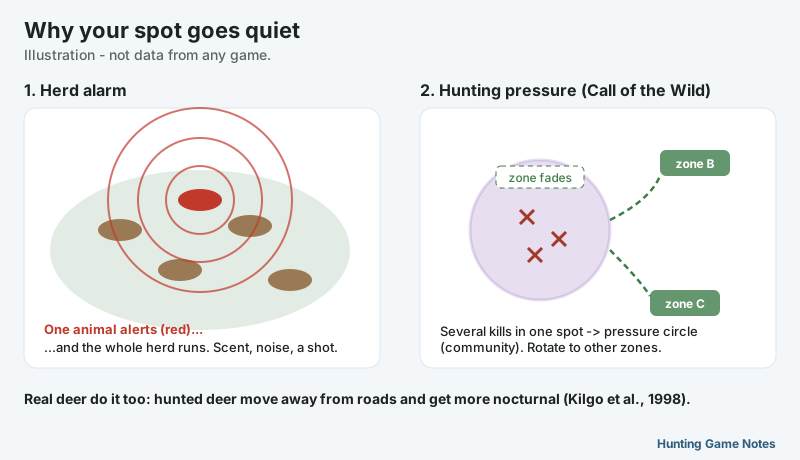
Herd alarm: one animal warns the rest
In both games, animals in a group don't react alone. If one notices you - your scent, a noise, movement - it alerts, and the rest of the herd follows. That's why a big group is both a gift and a trap: more animals, but more eyes, ears and noses watching for you.
- Way of the Hunter's store page promises "true to live animal group behavior" and animals that react "when sensing the player's presence".
- Way of the Hunter 2's official site says animals "behave and react naturally to their surroundings", and that "firing a suppressed shot greatly reduces animal alertness".
- In Call of the Wild, players report that any shot - hit or miss - can send a herd running, and that running or driving nearby spooks animals too (see wind, scent and sound).
Call of the Wild's hunting pressure
This is a system players talk about a lot. Here's the community's understanding - the developers haven't published exact numbers:
- Kills build pressure. Several kills in one area (players often say around three or four) bring up a purple circle on your map.
- Need zones fade. Under heavy pressure, the need zones in that area can disappear for a while (see need zones and routines).
- It counts all species. Players report pressure builds from kills of any animal, not just the one you're after.
- Stands may help. Some players say shooting from a stand adds less pressure.
- It wears off. Pressure eases with time and hunting elsewhere.
Players don't all agree on the details - one longtime player found its main visible effect was need zones disappearing - so treat specific numbers as estimates.
How to hunt herds without clearing them
- Approach downwind and slow. The whole herd has to miss you, not just your target.
- Pick the right animal before you shoot, so you only need one shot.
- Wait after the shot. Animals that bolt may settle and drift back, or come to a call.
- Rotate spots. Don't hammer one need zone every session; move between several.
- Use the quiet options your game gives you - stands, cover, and in Way of the Hunter 2, suppressed shots.
Signs a spot is pressured
- Animals arrive later or not at all during their usual windows.
- They're jumpier - alerting at longer range and bolting sooner.
- In Call of the Wild, the map shows the purple pressure circle and need-zone markers vanish.
- You keep finding old tracks and sign but no fresh ones.
When you see those, it's time to hunt somewhere else for a while and come back later.
What real deer do under pressure
The games aren't making this up. A study of radio-collared white-tailed deer in Florida, published in Conservation Biology (Kilgo, Labisky and Fritzen, 1998), found that deer "responded to hunter disturbance by moving away from roads and increasing nocturnal activity" during hunting season. Other studies have found similar shifts, though how strongly deer react depends on how much pressure there is, the habitat and the herd.
So when a game makes animals abandon a spot you've hunted hard, it's a simplified version of something real hunters see every season: pressure changes where and when deer move.
Frequently asked questions
What is the purple circle in theHunter: Call of the Wild?
Players identify it as hunting pressure - it shows up after several kills in one area, and the need zones there can fade for a while.
How do I reduce hunting pressure in Call of the Wild?
Spread your kills across different areas and give a pressured spot time. Players also report that shooting from stands adds less pressure.
Why did the whole herd run when I shot one animal?
Herd animals alert each other. A shot, a noise or one animal catching your scent can send the whole group running, in both Call of the Wild and Way of the Hunter.
Do real deer really change their behavior when hunted?
Yes. A Florida study of white-tailed deer found they moved away from roads and became more active at night during hunting season.
Sources and further reading
- Way of the Hunter on Steam - "true to live animal group behavior"
- Way of the Hunter 2 official site - natural reactions; suppressed shots reduce alertness
- Call of the Wild Steam discussion on hunting pressure - community findings
- Kilgo, Labisky & Fritzen (1998), Conservation Biology - via USDA Forest Service - white-tailed deer response to hunting
How this was written: Based on the games' official pages (Way of the Hunter store page and Way of the Hunter 2 site), community findings from the games' Steam forums, and a peer-reviewed study of white-tailed deer published by the USDA Forest Service. Community claims are labeled.