Insurance Agency Renewal Automation Software: What Each Tool Covers
Good morning to everyone with a renewal spreadsheet open in one tab and a carrier PDF in the other.
If your renewal list is a spreadsheet someone exported from the AMS last Monday, this guide is for you.
Every commercial account renewing in the next four months needs an owner, fresh exposure data from the client, a renewal offer from the carrier and a careful read of what changed.
In a quiet month that works, but in January or July the careful read is the first thing that gets squeezed, and that is exactly where a lowered limit slips through.
Short answer: Insurance agency renewal automation software pulls expirations from your AMS, creates a task and owner for each account, sends clients a pre-filled renewal questionnaire, reads the carrier’s renewal offer with AI vision, compares it with the expiring policy, flags lowered limits, new exclusions and premium jumps for a licensed broker, and logs the result in the AMS.
- Starts
- 120 days before expiration, from the AMS renewal list
- Reads
- The renewal offer, the expiring policy, the client’s updated questionnaire
- Flags
- Lower limits, higher deductibles, removed endorsements, new exclusions, premium changes
- Writes
- Tasks, notes and approved policy data back to Applied Epic, AMS360, HawkSoft or EZLynx
- Decides
- A licensed broker or account manager, on every red and amber flag
- Model cost
- About $0.69 to $0.99 to read one 50-page renewal against its expiring policy (our calculation below)
What is insurance agency renewal automation software?
Insurance agency renewal automation software is any tool that moves a policy from “expiring soon” to “renewed and explained” with fewer manual steps.
It covers four jobs: tracking which policies expire and who owns each one, collecting updated information from the client, comparing the carrier’s renewal terms with the expiring policy, and telling the client what changed. Most agencies already automate the first job inside their AMS.
The other three jobs are where the hours go. A renewal risk-flagging workflow adds the missing reading step, so the account manager starts from a short list of changes instead of two long PDFs.
Why do commercial renewals slip through the cracks?
Commercial renewals slip because the tracking lives in one place, the documents in another, and the reading depends on whoever has a free afternoon.
A familiar pattern: the expiration report is exported to Excel, color-coded by hand and shared by email. A week later the AMS and the spreadsheet disagree, a filter hides three rows, and the 90-day touch becomes a 30-day phone call.
The cost of a missed change can be real. Utica National’s E&O claims examples describe a surplus lines renewal where the property damage limit dropped from $2 million to $1 million and no specific notice was given that the property damage limits had been lowered.
Utica’s lesson: Carefully review all proposals submitted on renewal by a surplus lines carrier.
One signal that should not be ignored by agencies is if the renewal premium is the same or lower than the prior year.
That quote is the heart of the problem. A renewal at a friendly premium looks safe on a spreadsheet, and only a careful read of the forms shows the new exclusion that paid for the discount.
What renewal automation do AMS360, HawkSoft, Applied Epic, EZLynx and AgencyZoom already include?
Each major agency system already automates part of the renewal: mostly the list, the tasks and the client questionnaire, less often the reading of commercial forms.
| Tool | What the maker describes | Lines it is built for |
|---|---|---|
| AMS360 Renewal List Tool (Vertafore) | Renewal lists built from expiration criteria, sent to a responsible employee who assigns the policies; an Expiration/Renewal Report that exports to CSV | Commercial and personal |
| HawkSoft renewals | Default Tasks and Download Task Rules that create renewal tasks when a carrier download arrives; Uprate Alerts when a renewal premium rises by a set amount | Commercial and personal, where carriers send downloads |
| Applied Epic Collaboration Portal (formerly Indio) | Last year’s answers returned for the client to confirm; AI reads dec pages or last year’s application to fill the ACORD application; a signed application updates the Epic policy | Commercial applications and renewals |
| EZLynx Retention Center | Automated Renewal Quoting remarkets at-risk renewals to alternate carriers and shows the rates beside the renewing policy | Personal lines |
| AgencyZoom (Vertafore) | A CRM that sits on top of the AMS; “Renewal automation” is listed on four of its five plans | Sales and retention follow-up |
Applied’s Collaboration Portal page puts its renewal idea plainly: Last year’s answers come back for the client to confirm, so a renewal takes minutes instead of an evening.
Applied also says the portal draws on more than 14,000 ACORD forms, carrier supplementals and agency questionnaires.
EZLynx says Automated Renewal Quoting can remove up to 15 minutes of manual work per at-risk renewal. That is the maker’s own figure, and it applies to personal lines.
What do these renewal tools still leave to your team?
Most renewal tools still leave the commercial renewal offer itself for a person to read against the expiring policy.
The list, the task and the premium are numbers an AMS already holds. A changed additional insured endorsement, a new designated work exclusion or a per-location aggregate that disappeared lives on page 31 of a PDF. Those are the changes that matter most on a contractor or a property account.
That is the job our renewal setup is built around. A small service on your own server picks up each renewal offer from the carrier email, a portal download or Ivans Download, reads it beside the expiring policy with AI vision, and writes the differences into the AMS as a task with page numbers.
The engine is the same one described in our guide to an automated insurance policy comparison tool, run on a schedule instead of on request.
How much time do manual renewals cost an insurance agency?
Manual commercial renewals cost roughly 100 minutes each by our working estimate, which adds up to dozens of staff hours a month on a mid-sized book.
| Commercial renewals a year | Renewals a month | Minutes per renewal | Hours a month | Cost a month at $35 an hour |
|---|---|---|---|---|
| 200 | 16.7 | 100 | 27.8 | $972 |
| 400 | 33.3 | 100 | 55.6 | $1,944 |
| 800 | 66.7 | 100 | 111.1 | $3,889 |
| 1,200 | 100.0 | 100 | 166.7 | $5,833 |
Assumptions: 10 minutes to pull the list and prepare the file, 15 minutes chasing the client for updated exposures, 60 minutes reading a 50-page renewal against the expiring policy (30 minutes each), and 15 minutes updating the AMS and writing the client note.
The $35 an hour is a rough loaded cost for an experienced account manager. These are our working assumptions, not a survey. Time five of your own renewals and replace them.
How does an automated insurance renewal workflow run, step by step?
An automated renewal workflow runs five stations on a fixed calendar: list, ask, read, flag and decide.
A renewal that arrives with its changes already listed is a quieter kind of morning. Your account managers still make the call; they just stop spending the afternoon finding out what the call is about.
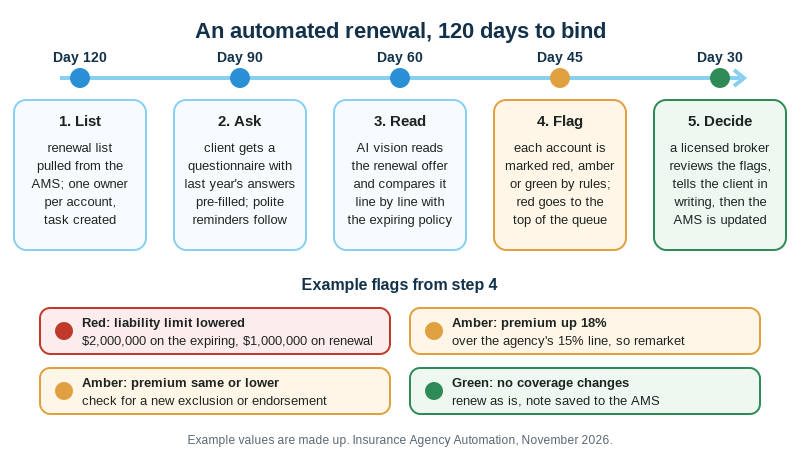
The diagram in text, station by station:
- Day 120, list: the renewal list is pulled from the AMS, one owner per account, a task created
- Day 90, ask: the client gets a questionnaire pre-filled with last year’s answers, with polite reminders
- Day 60, read: AI vision reads the renewal offer and compares it line by line with the expiring policy
- Day 45, flag: rules mark each account red, amber or green, and red goes to the top of the queue
- Day 30, decide: a licensed broker reviews the flags, tells the client in writing, and the AMS is updated
The four example flags in the diagram, all made-up values: a liability limit lowered from $2,000,000 to $1,000,000 (red), a premium up 18% against a 15% agency line (amber), a premium the same or lower than last year (amber, check for a new exclusion), and a renewal with no coverage changes (green).
- List. Each night the service reads the AMS renewal list, for example an AMS360 Expiration/Renewal Report exported to CSV or an Epic or HawkSoft API call, and opens a task for any account newly inside 120 days.
- Ask. The client receives a short questionnaire with last year’s payroll, sales, vehicles and locations already filled in. Returned answers are read like any scanned ACORD form and checked against the AMS.
- Read. When the renewal offer arrives, the service sends it and the expiring policy to a vision-capable model. Anthropic’s PDF support for Claude reads every page as an image plus its text, so schedules and scanned forms are covered.
- Flag. Plain rules compare the two field lists and set a color. Nothing here is a judgment call; it is arithmetic and form numbers.
- Decide. The account manager opens each red or amber line beside its source page, writes the client note, and approves the changes that sync into the AMS.
Here’s the catch: a renewal offer that has not arrived by day 45 is a flag of its own. The service should raise it, because a missing offer is often the first sign of a non-renewal.
Which renewal risk flags should the software raise?
Renewal software should flag every change that reduces protection or surprises the client, not only premium increases.
| Flag | Rule | Color |
|---|---|---|
| Limit lowered | Any occurrence, aggregate or per-location limit lower than the expiring policy | Red |
| Endorsement removed | An additional insured, waiver of subrogation or primary and noncontributory form on the expiring policy but not the renewal | Red |
| New exclusion | An exclusion endorsement that the expiring policy did not carry | Red |
| Edition change | The same form number with a newer edition date | Amber |
| Deductible raised | A higher deductible or self-insured retention on any line | Amber |
| Premium jump | Premium up more than the agency’s own line, for example 15% | Amber |
| Premium same or lower | A flat or cheaper renewal, checked for a narrowing change | Amber |
| Surplus lines carrier | Any surplus lines renewal, read in full | Amber |
| Missing offer | No renewal offer on file 45 days before expiration | Red |
| No changes | Every field matches the expiring policy | Green |
HawkSoft’s Uprate Alerts already cover the premium jump on renewals that arrive by carrier download. The coverage flags above need the documents themselves, which is why the reading step matters.
What does insurance agency renewal automation software cost?
Renewal software ranges from features already included in your AMS to about $99 to $349 a month for a CRM such as AgencyZoom, and the AI reading adds well under a dollar per renewal.
AgencyZoom’s pricing page lists Single Location ($99 a month), Multiple Location ($129), Essential ($149), Growth ($199) and Pro ($349), with “Renewal automation” on every plan except Essential. AMS360, HawkSoft and Applied Epic renewal features come with those systems; their makers do not publish list prices.
For the reading step, Anthropic’s documentation says each PDF page uses 1,500 to 3,000 text tokens plus at most 1,568 image tokens, and Anthropic’s pricing page lists Claude Sonnet 5.5 at $2 per million input tokens and $10 per million output tokens.
| Commercial renewals a year | Pages read per renewal | Cost per renewal | Cost a year |
|---|---|---|---|
| 200 | 100 | $0.69 to $0.99 | $138 to $198 |
| 400 | 100 | $0.69 to $0.99 | $276 to $396 |
| 800 | 100 | $0.69 to $0.99 | $552 to $792 |
| 1,200 | 100 | $0.69 to $0.99 | $828 to $1,188 |
Assumptions: a 50-page renewal plus a 50-page expiring policy, 3,068 to 4,568 tokens per page, and about 8,000 output tokens of structured fields per renewal. Anthropic’s Batch API halves these prices, which suits renewals because none of them need an answer within the hour. Hosting, setup and review time come on top.
How do you choose renewal automation software for your agency?
Choose renewal automation software by what it reads and where it writes, not by how many reminder emails it can send.
Six questions to put to any vendor, or to your own AMS rep:
- Does it read the renewal offer and the expiring policy, or only the dates and premium already in the AMS?
- Does every flagged difference keep the page number it came from?
- Can it write tasks, notes and attachments back into Applied Epic, AMS360, HawkSoft or EZLynx through an API or approved integration?
- Does it handle commercial lines and surplus lines carriers, or personal lines only?
- Where are client documents stored and processed, and are they used to train anyone’s model?
- Can you run it in shadow mode for one renewal cycle before it touches a client?
Many agencies end up with two layers: the AMS or a CRM for the list and the tasks, and a reading layer for the documents. That split keeps your existing system as the record and adds only the missing step.
What must a licensed person still do at renewal?
A licensed person still decides what each renewal change means for the client and tells the client in a way that is documented.
The software can show that a waiver of subrogation became scheduled instead of blanket. It cannot know that the client signed a new lease last month that requires a blanket waiver. Only a conversation catches that.
IA Magazine’s February 2025 piece on hail damage exclusions makes the documentation point: an agent who discussed an exclusion but did not write it down still faced a claim. Its advice on a short written acknowledgment: This takes very little time to document and provides good evidence for those forgetful customers.
Keep three renewal jobs with your team:
- Reviewing every red and amber flag beside its source page
- Calling or writing the client about each reduction in coverage, and saving that note in the AMS
- Deciding whether to renew as is, remarket, or ask the carrier to restore the coverage
How do you start automating insurance renewals without disrupting the book?
Start with one renewal month in shadow mode, so the software flags while your team keeps renewing as usual.
- Pick the commercial accounts renewing in one calendar month, ideally 20 to 40 of them.
- Export their expiring policies and renewal offers, and let the service read and flag every pair.
- Have your account managers do their normal review, then compare their notes with the flags.
- Count the changes the flags caught that people missed, and the false alarms.
- Tune the premium line and the rules, then switch on the 120-day list and client questionnaires for the next month.
If insurance agency renewal automation software does not catch real changes or save real hours on your own renewals within one cycle, it is not worth keeping. If it does, every later month starts from a short list instead of a long spreadsheet.
Give it one renewal month beside your team, and see which flags it raises that the spreadsheet never did.
Sources and further reading
- Vertafore: AMS360 help, Renewal List Tool
- Vertafore: AMS360 help, Expiration/Renewal Report
- HawkSoft: Assigning Renewals, Reporting and Tasks
- HawkSoft: Automated Uprate Alerts
- Applied Systems: Applied Epic Collaboration Portal (formerly Indio)
- EZLynx: Automated Renewal Quoting in Retention Center (June 18, 2024)
- AgencyZoom: pricing and plans
- Ivans: Ivans Download for agents
- Anthropic: PDF support (pages as images plus text, tokens per page)
- Anthropic: API pricing (Claude Sonnet 5.5, Batch API)
- IA Magazine: Avoid E&O Claims from Cosmetic Hail Damage Exclusions (Janice Blanton, 2025)
- Utica National: E&O claims examples (failure to renew or service policies)
Questions and answers
Can I use AI to automate renewals in my insurance agency?
Yes. AI vision can read a carrier’s renewal offer beside the expiring policy, list every changed limit, deductible, form and endorsement with its page number, and raise a red, amber or green flag. The AMS keeps the list and the tasks. A licensed broker should still review each flag and tell the client about any reduction in coverage.
Does my AMS already automate renewals?
Partly. AMS360 has a Renewal List Tool, HawkSoft creates renewal tasks from carrier downloads and sends Uprate Alerts, and Applied Epic’s Collaboration Portal returns last year’s answers for clients to confirm. Comparing the commercial renewal policy against the expiring one is usually still done by a person.
How far ahead should renewal automation start?
Many agencies start 120 days before expiration for commercial accounts: the list and owner at 120 days, the client questionnaire at 90, the renewal offer read at 60 and flags by 45. Smaller personal lines policies can run on a shorter calendar.
How much does insurance renewal automation software cost?
AgencyZoom lists plans from $99 to $349 a month, with renewal automation on four of five plans. AMS renewal features come with the AMS. By our calculation, reading a 50-page renewal against its expiring policy with Claude Sonnet 5.5 costs about $0.69 to $0.99 in model fees.
Does renewal automation work for surplus lines policies?
Yes, and it matters most there. Utica National’s E&O examples warn agents to carefully review surplus lines renewal proposals, because a lowered limit can arrive without a separate notice. A renewal workflow can flag every surplus lines renewal for a full read.