How to Summarize Deposition Transcripts Automatically (With Page and Line Cites)
Hello, and welcome to everyone who has read page 143, line 9 for the third time tonight.
Every deposition summary I looked at while researching this one ends the same way: a paralegal, a transcript, and an evening.
I spent November 28, 2026 reading the makers’ own pages for CaseMark and Filevine, the text of Federal Rule 30, and the paralegal guides that give real hours per page.
Three facts stood out. A 200-page transcript takes a paralegal roughly 8 to 10 hours. CaseMark says it turns the same pages into a summary in under two minutes. And Rule 30(e) gives the witness 30 days to change the answers.
Short answer: Yes, you can summarize deposition transcripts automatically. Upload the transcript to a secure tool, such as CaseMark or a custom pipeline. It reads every page and line number and writes a summary where each point carries its page:line cite. A paralegal then clicks each cite to confirm it before the attorney relies on it.
What does it mean to summarize a deposition transcript automatically?
Summarizing a deposition transcript automatically means software reads the whole transcript and writes the summary, and every statement points back to the page and line where the witness said it.
The cites are what make it usable. A summary without them is a story you cannot check. With them, the paralegal’s job changes from writing to verifying.
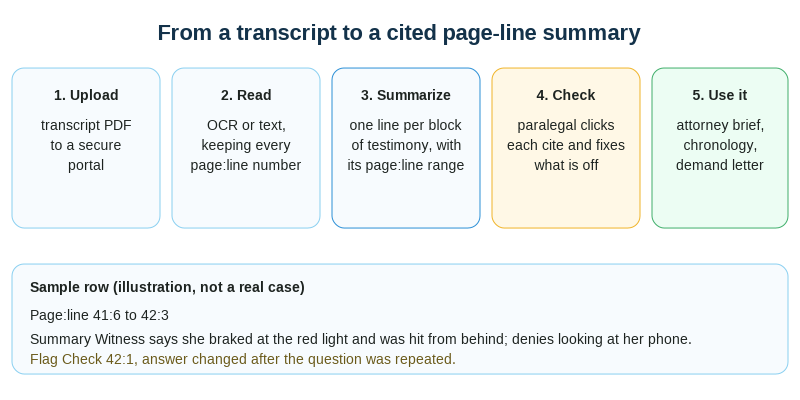
The five steps as text: 1 upload the transcript to a secure portal, 2 read it keeping every page:line number, 3 summarize each block of testimony with its range, 4 a paralegal checks every cite, 5 use the summary in the attorney brief, chronology and demand letter.
The sample row: 41:6 to 42:3, the witness says she braked at the red light and was hit from behind, and denies looking at her phone, with a flag to check 42:1 because the answer changed when the question was repeated. It is an illustration, not a real case.
How long does it take to summarize a deposition by hand?
An experienced litigation paralegal summarizes about 20 to 25 transcript pages an hour, so a 200-page deposition takes 8 to 10 hours.
That pace comes from Paralegal Bootcamp’s guide to deposition summary methods, which says it depends on the case, the witness and the paralegal’s experience. It is a trade guide’s estimate, not a measured benchmark.
| Transcript length | Hours at 25 pages an hour | Hours at 20 pages an hour | Wage cost at 20 pages an hour |
|---|---|---|---|
| 100 pages | 4.0 | 5.0 | $151 |
| 200 pages | 8.0 | 10.0 | $302 |
| 300 pages | 12.0 | 15.0 | $454 |
| 500 pages | 20.0 | 25.0 | $756 |
Assumptions: the US median paralegal wage of $30.24 an hour from the Bureau of Labor Statistics, without benefits or overhead, and the two paces above.
The length of one witness is also capped. Under Federal Rule 30(d)(1), a deposition is limited to 1 day of 7 hours
unless the parties or the court say otherwise. A case with six witnesses can still put 1,000 pages on one desk.
What format should a deposition summary use?
A deposition summary uses one of three formats: page-line, page, or issue, and the page-line format is the most common and the slowest to write.
| Format | What it lists | Best for |
|---|---|---|
| Page-line | Each block of testimony with its page and line range | Precise cross-referencing; the most common method, and the most time-consuming |
| Page | The basics of testimony by page range | A quick map; the guide says it takes the least time |
| Issue | Testimony grouped by the key issues, not page order | Fact-specific cases, with the witnesses compared side by side |
Software removes the time penalty. CaseMark’s own page lists four outputs: Page Line, Deposition Analysis Summary, Deposition Index and Narrative.
Length is where the guides disagree. Paralegal Bootcamp suggests about one summary page for every five transcript pages, while other trade guides say one for every ten or more. Ask your attorney which one they want before you ask software for it.
How does AI summarize a deposition transcript?
AI summarizes a deposition by reading the transcript’s text with its page and line numbers, grouping the testimony into blocks, and writing one cited line per block.
- Upload. The paralegal drops the transcript into a secure portal. A text or ASCII file from the court reporter reads cleanly; a scanned PDF goes through OCR first.
- Read. The tool keeps the page and line numbers attached to every answer, plus the exhibits that were marked.
- Summarize. The model writes the chosen format. Anthropic’s Citations feature, for example, returns the passage behind each sentence, and page ranges for PDFs.
- Check. The tool flags contradictions, objections and answers that changed. The paralegal opens each cite.
- Export. The checked summary goes to Word or PDF, or into the case file.
CaseMark’s page promises every finding linked to the page it came from
. That link is the feature to demand from any vendor.
Which tools summarize deposition transcripts?
CaseMark and Filevine’s deposition software both summarize transcripts with links back to the testimony, and a custom pipeline is the third route when you want your own format.
| Option | What it produces | Public price |
|---|---|---|
| CaseMark | Page Line, Analysis, Index and Narrative summaries, every finding linked to its page | $25 per summary, no subscription |
| Filevine deposition software | Post-deposition summaries, same-day rough transcript, hyperlinks to the original transcript | Not published on the page |
| Custom pipeline | Your own secure portal, OCR and AI model, your firm’s summary format, written into your case system | Depends on transcript volume and build |
CaseMark says a 200-page transcript becomes an analysis summary in under two minutes.
That is the vendor’s claim, so time it on your own transcript.
Filevine’s page says post-deposition summaries are completed the same day
and that flagged points carry direct hyperlinks to the original transcript. It does not name page-line layouts, so ask for a sample.
A custom pipeline fits a firm that already scans records and wants one portal for transcripts, the document index and the intake packet, instead of three logins.
What happens if the witness changes the transcript after you summarize it?
If the witness asks for review, they get 30 days to make changes, so a summary written before then may need a second pass.
The calmest part of a cited summary is the click. Nobody argues about what the witness said; they open the page and read the line.
Federal Rule 30(e) says that on request the deponent must be allowed 30 days after being notified by the officer that the transcript or recording is available
and, for changes in form or substance, to sign a statement listing the changes and the reasons. State rules differ, so check yours.
None of the vendor pages we read say how their tools handle an errata sheet. Our advice is to treat the first summary as a working draft, date it, and upload the errata sheet as its own document so a person compares the changed answers.
What does an automatic deposition summary still get wrong?
An automatic deposition summary is fast at reading and still needs a person to confirm cites, tone and the answers that quietly change the case.
- Wrong cites. A cite off by a few lines can send the attorney to the wrong answer. Click every one you plan to quote.
- Evasive answers. “I don’t recall” and a long non-answer can both be summarized as a clean fact. Keep the question next to the answer.
- Objections and instructions not to answer. These shape what testimony is usable and must stay visible.
- Exhibits. The summary should name each exhibit as marked, with its number.
- Tone. Hesitation and sarcasm do not show on the page. The attorney who sat in the room adds that.
ABA Formal Opinion 512 says it directly: GAI tools cannot solely substitute for a lawyer’s competent legal work.
A summary is a draft until a person has checked it.
Is it safe to upload a deposition transcript to an AI tool?
Uploading a transcript to an AI tool can be safe when the vendor protects the data by contract, does not train on it, and your firm follows ABA guidance on client information.
Opinion 512 (July 29, 2024) says informed client consent is needed before client information goes into a self-learning tool. The NCBE’s Bar Examiner summary walks through it. Also check for a protective order in the case, since many forbid sharing designated testimony with outside services.
Where does the deposition summary go next?
A checked deposition summary feeds the case chronology and the demand letter, so the testimony is typed once and reused.
The cited admissions land in the timeline next to the medical chronology, and the strongest testimony supports the liability section of the demand. A paralegal uploads the transcript; your server organizes the timeline and drafts the structured summary.
Many firms pair this with a 24/7 phone intake line, so new leads reach the same portal the same night.
How do you choose a deposition summary tool?
Choose a deposition summary tool by running one closed deposition your team already summarized and comparing the two line by line.
- Does every point carry a correct page:line cite?
- Does it produce the format your attorney asks for?
- Does it flag objections, changed answers and exhibits?
- Can you add the errata sheet later?
- Does the contract say transcripts are not used to train models?
- What does your monthly volume cost per summary?
Run it beside your team for a month. Week one, two closed transcripts. Week two, every new one in the background. Week three, review cites only. Week four, count the hours. If the saved hours are real, the evening goes back to your paralegal.
How we researched this
- Read on November 28, 2026: CaseMark’s deposition summaries page and page-line workflow post, Filevine’s deposition software page, FRCP Rule 30 on Cornell LII, Paralegal Bootcamp’s summary methods guide, the BLS paralegal page and the NCBE summary of ABA Opinion 512.
- Compared: formats, speed claims, public prices, source links and errata handling.
- Where sources disagree: summary length per transcript page, and CaseMark’s price, which a third-party page also lists.
- We did not install or test any tool, and we found no reliable Reddit thread to cite, so no practitioner quotes are claimed.
Let the first draft write itself, keep the checking with your paralegal, and see what the evening becomes.
Sources and further reading
- CaseMark: deposition summaries
- CaseMark: AI-assisted page-line deposition summaries
- Filevine: deposition software
- Federal Rule of Civil Procedure 30: depositions by oral examination
- Paralegal Bootcamp: 3 methods for preparing a deposition summary
- Anthropic: Citations
- NCBE Bar Examiner: ABA Formal Opinion 512
- BLS: paralegals and legal assistants, median pay
Questions and answers
Can I use AI to summarize deposition transcripts automatically?
Yes. AI can read a transcript with its page and line numbers and write a page-line, narrative or issue summary where each point links back to the testimony. A paralegal should still click every cite before an attorney relies on it, and treat the output as a draft.
How long does it take to summarize a deposition transcript?
By hand, an experienced paralegal summarizes about 20 to 25 transcript pages an hour, so 200 pages take 8 to 10 hours. CaseMark says its tool summarizes a 200-page transcript in under two minutes, before human review of the cites.
What is a page-line deposition summary?
A page-line summary lists each block of testimony with the page and line range where it appears, so a lawyer can find and cite it fast. Paralegal Bootcamp calls it the most common method and the most time-consuming to write by hand.
How much does automatic deposition summary software cost?
CaseMark lists $25 per summary with no subscription. Filevine does not publish a price on its deposition software page. A custom pipeline depends on transcript volume. Compare any price with the wage cost of the hours in our table.
What if the witness changes the transcript after the summary?
Under Federal Rule 30(e), a witness who asks for review has 30 days after notice to sign a statement of changes and reasons. Date your first summary, add the errata sheet as its own document, and have a person compare the changed answers.