
How to Speed Up Manufacturing Quote Turnaround From Days to Hours
Hello, and welcome to everyone whose quotes are ready in an hour but reach the buyer in a week.
Picture a Thursday morning when a buyer asks about the quote they sent on Monday, and the honest answer is that it’s still waiting for the anodizer to call back.
Your estimator only needed about an hour for the actual pricing.
The other four days were spent in queues, and that is the part you can take out.
Short answer: To speed up manufacturing quote turnaround, attack the waiting, not the pricing. Log every RFQ the minute it arrives, price material and outside processing from standing lists instead of waiting for vendors, let AI vision read the prints and draft the quote sheet, review drafts in fixed daily blocks, and set an approval threshold so most quotes skip the owner’s desk.
- Share of a slow quote that is actual work
- About 6%: 2.25 hours of work in 40.25 business hours (our worked example below)
- The same RFQ with drafts and price lists
- About 3.7 business hours, so the quote goes out the same day
- Win rate on new business, quotes back within a day
- 51%, against 41% for slower shops (Modern Machine Shop, 2026 Top Shops benchmark)
- Buyers who expect a quote within 24 hours
- 67% (Paperless Parts, 2020 Part Buyer Survey)
- AI cost to read one four-page RFQ
- About 7 cents on Claude Sonnet 5.5 at list prices (our calculation below)
Why does quote turnaround take days in a machine shop?
Quote turnaround takes days in a machine shop because the RFQ waits in line far longer than anyone works on it.
It waits in the inbox until someone logs it. It waits behind other RFQs on the estimator’s desk. Then it waits for a material price, a heat treat or anodize price, and finally for the owner to look it over.
Shop owners on Practical Machinist describe the same pattern. In a thread from a buyer whose RFQs were going unanswered, one reply said most shops they deal with take four or five days to a full week to turn a quote around.
In another thread on expediting quotes, a poster said they send RFQs to material and finishing vendors first, then plan the job, and start calling when vendor prices haven’t come back. Some of their customers want quotes within 72 hours.
TBM Consulting Group found the worst case in one aerospace shop. Every part needing heat treat or a special finish waited on vendor callbacks, and that chain could run up to fourteen days before the customer heard back.
Where do the hours of a slow quote actually go?
In our worked example, a three-part RFQ with anodize spends about 38 of its 40.25 business hours waiting and only 2.25 hours being worked on.
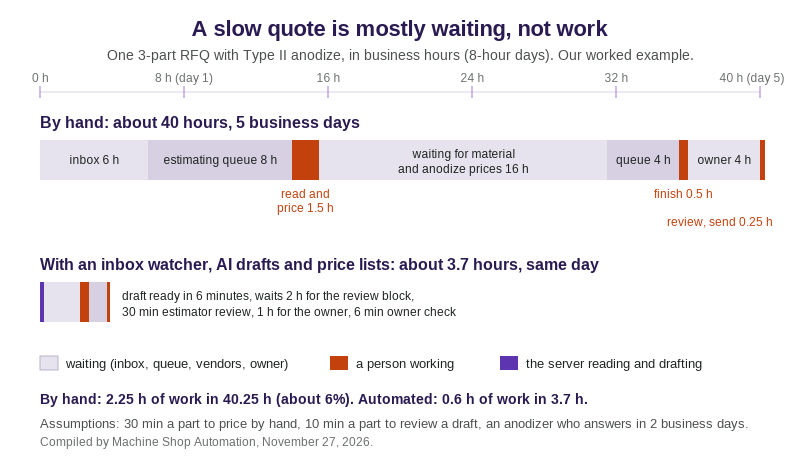
What the timeline shows, in text:
- By hand: inbox 6 h, estimating queue 8 h, reading and pricing 1.5 h, waiting for material and anodize prices 16 h, back in the queue 4 h, finishing the quote 0.5 h, waiting for the owner 4 h, owner review and send 0.25 h.
- Total by hand: 40.25 business hours, about five business days, with 2.25 hours of work.
- Automated: draft ready in 6 minutes, 2 h waiting for the estimator’s review block, 30 minutes of review, 1 h waiting for the owner, 6 minutes of owner review.
- Total automated: about 3.7 business hours, the same day, with 0.6 hours of a person’s work.
| Step | By hand, waiting | By hand, working | Automated, waiting | Automated, working |
|---|---|---|---|---|
| Inbox until the RFQ is logged | 6 h | 0 | 0 | 0.1 h, the server |
| Estimating queue | 8 h | 0 | 2 h, until the review block | 0 |
| Read prints and price machine time | 0 | 1.5 h | 0 | 0.5 h, reviewing the draft |
| Material and anodize prices | 16 h | 0 | 0, from price lists | 0 |
| Back in the queue, then finish the quote | 4 h | 0.5 h | 0 | Part of the review |
| Owner approval and send | 4 h | 0.25 h | 1 h | 0.1 h |
| Total | 38 h | 2.25 h | 3 h | 0.7 h |
Assumptions: 8-hour business days; 30 minutes a part to read and price by hand; 10 minutes a part to review a draft; an anodizer who replies in 2 business days; material and finishing on standing price lists in the automated case. Swap in your own numbers.
Here’s the catch: making the estimator twice as fast at pricing would save 45 minutes. Removing the waits saves about 36 hours.
How fast do buyers expect a manufacturing quote?
Most buyers expect a manufacturing quote within 24 hours, and shops that meet that win noticeably more new work.
Paperless Parts’ 2020 Part Buyer Survey found that 67% of buyers expect a quote in less than 24 hours, up from 53% in 2019. That is a quoting-software maker’s survey, so read it as a direction, not a law.
The shop-side data points the same way. Modern Machine Shop’s 2026 Top Shops benchmark reports that shops returning quotes within a day win 51% of new business, against 41% for shops that take longer.
Owners are realistic about the limits. In a Practical Machinist thread on quote turnaround, a reply called a 24-hour quote on a regular 6061 part expected and easy, while an exotic alloy at volume took a couple of days, and a job needing new equipment could take weeks.
So the goal is not every quote in an hour. The goal is that routine parts go out the same day, and complex ones get an answer and a firm due date the same day.
How do you measure quote turnaround time?
You measure quote turnaround time with two timestamps per RFQ: when the request arrived and when the quote was sent, counted in business hours.
Most shops guess this number, and the guess is usually kinder than the log. An inbox watcher records the arrival time automatically; your quoting tool or ERP records the send.
Track these five numbers each week:
- Median turnaround: received to sent, in business hours.
- Share sent within 24 hours: the number buyers actually feel.
- Touch time: minutes someone actually worked on the quote.
- Biggest wait: inbox, queue, vendor, clarification or approval, tagged on each late RFQ.
- Win rate by speed: quotes sent within a day against slower ones.
The biggest-wait tag is the useful one. After two weeks, it tells you which of the fixes below to do first.
What speeds up quote turnaround without new software?
Six process changes speed up quote turnaround without new software, because each one removes a wait rather than a minute of pricing.
| Change | Wait it removes | Effort to set up |
|---|---|---|
| One estimating address, such as quotes@, checked on a schedule | RFQs sitting unseen in personal inboxes | An hour |
| Same-hour acknowledgment with a promised quote date | The buyer chasing you while you work | A saved reply |
| Standing price lists from your finishers and heat treaters | Vendor callbacks on routine outside work | A few phone calls |
| Vendor RFQs sent on day 0, before you plan the job | Vendor callbacks on unusual work | A habit |
| Look up past quotes for the same or similar part first | Re-pricing a job you already priced | A searchable quote log |
| An approval threshold, such as quotes under a set dollar total going out on the estimator’s signature | Quotes waiting on the owner’s desk | One decision |
The past-quote lookup pays off fast. Paperless Parts’ case study on Aurora Machine credits its Matching Parts search with saving 5 hours a week on parts and up to a full day a week on assemblies.
The approval threshold is the cheapest fix of all. If the owner signs every quote, every quote waits for the owner’s busiest day.
How do you quote outside processing without waiting for vendors?
You quote routine outside processing from a standing price list your vendors agree to, with a buffer, and only send a vendor RFQ for unusual work.
Shaving minutes off the pricing rarely moves the needle. Taking the waiting out of the line around it usually does, and your estimator gets to finish a quote in one sitting instead of four.
TBM Consulting’s aerospace shop asked how much its outside-service costs really changed between quotes. The answer: Not much, it turns out, typically within about a twelve-month window.
Once it built cost baselines with a buffer, most of its quotes went out the same day.
Practical Machinist posters say the same from experience. One said years with the same vendors let them estimate outside processing within a few percent of cost; another said a reliable number appears after asking the same vendor four or five times.
A standing list for anodize, plating, heat treat or passivation needs four columns:
- The process and spec, such as Type II anodize, clear.
- The lot charge and the price per part or per pound.
- Freight both ways and the vendor’s usual turn time in days.
- The date the price was confirmed, so stale rows are easy to spot.
For a process that isn’t on the list, send the vendor RFQ in the first hour, not after planning. If the quote must go out first, mark that one line as an estimate to be confirmed.
How does automation cut quote turnaround to hours?
Automation cuts quote turnaround to hours by reading each RFQ the moment it arrives and putting a priced draft on the estimator’s screen before the RFQ would normally have been opened.
This is the setup we describe on this site, running on your own web server:
- Watch: Gmail API push notifications or Microsoft Graph change notifications tell the server a new RFQ has landed in quotes@.
- Log: the RFQ gets a number, the received time and the requested due date, which starts the turnaround clock.
- Read: AI vision reads each print as an image plus its text, using Claude’s PDF support, and pulls out material, tolerances, finishes, quantities and revisions.
- Price: your own rates, the material list and the outside-processing list fill a draft quote sheet.
- Flag: anything outside your rules goes to the top: a tolerance tighter than your flag line, a finish not on the list, a missing revision, an ITAR marking.
- Review: the estimator checks the flags, adjusts price and lead time, and signs.
- Send: the quote and reply go out, and the sent time closes the turnaround clock.
Steps 1 to 5 take minutes. The full walk-through of the reading and pricing is in our guide to automated CNC quoting software, and the logging and chasing are covered in machine shop RFQ automation.
Reading the print is the hard part. Our guide on how to extract dimensions from engineering drawings PDF files explains why scanned prints need extra care.
Which quoting software helps speed up turnaround?
Quoting platforms, ERP estimating modules and a custom inbox reader can all speed up turnaround, and they attack different waits.
| Option | What is said about speed | Wait it mainly removes |
|---|---|---|
| Paperless Parts | Modern Machine Shop reports rules that add an operation or start an RFQ to an outside supplier when a print calls out brazing or honing, plus integrated material prices; the maker cites a 75%+ average turnaround reduction across its case studies | Vendor callbacks, re-pricing repeat parts |
| JobBOSS² with ECI Ally | ECI says Ally, the AI built into JobBOSS², can turn an emailed RFQ into a quote and a customer reply | Inbox and data entry |
| ProShop ERP | Template-driven quotes pre-loaded with your shop’s actual labor, material, and vendor costs | Looking up rates and vendor costs |
| Custom inbox reader | Watches your own inbox, drafts with your own rate and price lists, writes into the quote sheet or ERP you already use | Inbox, queue and vendor waits, measured end to end |
Paperless Parts co-founder Jason Ray told Modern Machine Shop the material pricing feature came from experience: We built this feature in response to the metal pricing fluctuations we saw during COVID.
The turnaround and win-rate figures on vendor pages are customer-reported case-study numbers. None of these makers shows a public price on the pages we read, so ask each to run a week of your own RFQs.
What does it cost to run AI over every RFQ?
Reading one four-page RFQ with AI vision costs a few cents in model fees, about 7 cents on Claude Sonnet 5.5 at Anthropic’s list prices in our calculation.
Anthropic’s PDF documentation says each page typically uses 1,500 to 3,000 text tokens, and each page image at most 1,568 tokens. We used the top of both ranges, so about 4,568 tokens a page.
| Model | Price per million tokens, in / out | Per RFQ | 20 RFQs a week, per month | 40 RFQs a week, per month |
|---|---|---|---|---|
| Claude Sonnet 5.5 | $2 / $10 | about $0.07 | about $6.20 | about $12.39 |
| Claude Opus 5.5 | $4 / $20 | about $0.14 | about $12.39 | about $24.78 |
That covers only the model fees on Anthropic’s pricing page. Setup, the server and the estimator’s review time are separate, and a 20-page drawing package costs proportionally more.
For scale, the by-hand example above uses 2.25 hours of paid time on a single RFQ. The model fee is not the number that decides this.
What should stay with a person when quotes go out faster?
A person should still own the price, the lead time and every flagged callout, because a fast wrong quote costs more than a slow right one.
An underpriced quote that wins is a job you lose money on for months. Speed only helps if the draft prices the way your best estimator would.
- The price and margin: drafts suggest, the estimator decides.
- The lead time: only a person knows what the floor looks like next month.
- Every flag: new materials, tight tolerances, unknown finishes, revision mismatches.
- Stale price lists: any vendor row older than your set limit gets re-confirmed.
- Controlled prints: ITAR, EAR or CUI markings route the RFQ to an approved system before any cloud step; the State Department’s DDTC administers ITAR.
How do you start cutting quote turnaround this month?
Start by measuring for one week, fix the biggest wait in the second week, and let automated drafts run in the background in the third.
- Week 1: one estimating address, received and sent times on every RFQ, a biggest-wait tag on each late one.
- Week 2: standing price lists from your two most-used finishers, an approval threshold, two daily review blocks.
- Week 3: drafts produced for every RFQ in the background while your estimator quotes the usual way.
- End of week 3: compare median turnaround, the share sent within 24 hours, and how close the drafts came to the real prices.
Most shops find their first big gain in week 2, before any software. That is a fine result, and it shows exactly which wait the automation should take next.
If the drafts in week 3 land close to your estimator’s prices, let them carry the next week, with every quote still signed by a person.
Put two timestamps on every RFQ this week, and let the biggest wait tell you where to start.
Sources and further reading
- TBM Consulting Group: streamline aerospace machine shop quoting for faster wins (September 4, 2026)
- Modern Machine Shop: Quoting in the Age of AI, Tariffs and Market Shifts (June 16, 2025)
- Modern Machine Shop: 2026 Top Shops roster and benchmark findings
- Paperless Parts: facts and customer-reported proof points
- Paperless Parts blog: responding too slowly (2020 Part Buyer Survey)
- Paperless Parts case study: Aurora Machine and Matching Parts
- ECI: JobBOSS² with ECI Ally
- ProShop ERP: estimating and quoting
- Anthropic: Claude PDF support (tokens per page)
- Anthropic: Claude API pricing
- Gmail API: push notifications
- Microsoft Graph: change notifications overview
- U.S. State Department: Directorate of Defense Trade Controls (ITAR)
- Practical Machinist forum: methods to expedite quoting (owner discussion)
- Practical Machinist forum: shops not responding or turning down my RFQ (discussion)
- Practical Machinist forum: average quote turnaround time for custom tooling (discussion)
Questions and answers
Can I use AI to speed up my manufacturing quote turnaround?
Yes. An AI service on your server can log each RFQ the moment it arrives, read the prints for material, tolerances, finishes and quantities, and draft a priced quote sheet from your own rates and price lists within minutes. Most of the time saved is waiting, not pricing. Keep an estimator’s sign-off on every price and lead time.
What is a good quote turnaround time for a machine shop?
Same day or within 24 hours for routine parts. Paperless Parts’ 2020 Part Buyer Survey found 67% of buyers expect a quote in under 24 hours. Complex alloys, large packages or new equipment can fairly take longer, but the buyer should get a firm quote date the same day.
Why do outside processing quotes slow down machining quotes?
Because each heat treat, plating or anodize price usually waits on a vendor callback. TBM Consulting described an aerospace shop where that chain ran up to fourteen days. Standing price lists with a buffer, re-confirmed on a schedule, let routine outside work be priced at once.
How do I measure quote turnaround time?
Record when each RFQ arrived and when the quote was sent, and count business hours between them. Track the weekly median, the share sent within 24 hours, the touch time and the biggest wait on each late quote. An inbox watcher can record the arrival time automatically.
Do faster quotes really win more jobs?
The available data says yes. Modern Machine Shop’s 2026 Top Shops benchmark reports a 51% new-business win rate for shops that quote within a day, against 41% for slower shops. Paperless Parts reports a 30% average win-rate improvement among its customers, a customer-reported figure.