
PDRN for Sensitive and Reactive Skin: How to Try It Safely
Disclosure: this page contains Amazon affiliate links. As an Amazon Associate we earn from qualifying purchases, at no extra cost to you. PDRN topical products are cosmetics, not medical treatments, and nothing here is medical advice.
Hello, gentle-routine guardian, if your face stings at the mere sight of a new bottle and you still can’t stop wondering about PDRN, this one’s for you.
Picture a new PDRN serum on your shelf and skin that stings at the first wrong ingredient.
PDRN itself is usually gentle and hydrating, so it can suit sensitive skin.
Your skin reacts to the whole formula, though, so the label matters more than the PDRN.
If you’d like to browse while you read, here are fragrance-free PDRN serums on Amazon.
Short answer: Often, yes, but test before you trust it. PDRN rarely seems to be the problem; fragrance, tingling spicules and long plant-extract lists in the same bottle are more likely culprits. Pick a short, fragrance-free formula, test it on your arm for 7-10 days, then use it every other night for two weeks before going daily.
- How common sensitive skin is: 71% of people in a 2020 meta-analysis of 26 studies (51,783 people) said their skin was sensitive to some degree, and 40% said very or moderately sensitive.
- The PDRN research: in a 2025 study, 10 adults used a 1% PDRN cream on detergent-irritated arm skin. Water loss settled 21% in 2 weeks, against 14% with a plain cream, and no irritation was reported.
- How little PDRN some bottles hold: two makers’ ingredient lists print 0.05 and 5 parts per million (ppm) of Sodium DNA, the label name for PDRN. That’s 0.000005% and 0.0005% of the product.
- Our label check: 1 of 5 popular PDRN products names “Fragrance”, 1 uses tingling spicules and propolis, and the lists run from 19 to 53 ingredients.
- The safe pace: the American Academy of Dermatology (AAD) arm test takes 7-10 days, so a slow start reaches daily face use around day 25.
Is PDRN good for sensitive skin?
PDRN is generally a calm, hydrating ingredient, and early research suggests it may help irritated skin settle. Whether a PDRN serum suits your sensitive skin depends on everything else in the bottle and on how slowly you introduce it.
PDRN (polydeoxyribonucleotide) is a mix of DNA fragments, traditionally from salmon or trout and now also from plants like ginseng, peony and oat. On an ingredient list it usually appears as “Sodium DNA”.
It isn’t an acid, an exfoliant or a retinoid, the ingredient families most often blamed for stinging. That’s the good news. The catch is that a PDRN serum is never just PDRN.
What counts as sensitive skin?
Sensitive skin means skin that stings, burns, itches or tingles from things that shouldn’t bother it, often with no visible rash. Dermatologists treat it as a recognized syndrome, not just a marketing label.
In 2017 a special interest group of the International Forum for the Study of Itch agreed on this definition, published in Acta Dermato-Venereologica:
Sensitive skin is a syndrome defined by the occurrence of unpleasant sensations (stinging, burning, pain, pruritus, and tingling sensations) in response to stimuli that normally should not provoke such sensations.
The same paper adds that The skin can appear normal looking or be accompanied by erythema
(redness), that it can affect any part of the body, especially the face
, and that cosmetics are among the chemical triggers.
You’re far from alone. A 2020 meta-analysis in the Journal of the European Academy of Dermatology and Venereology pooled 26 studies from 18 countries. It found 71% of people report sensitive skin to some degree, and 40% very or moderately sensitive skin.
For the face alone, the figures were 64% and 34%. The authors note that questionnaire surveys may overestimate it, but the takeaway stands: sensitive skin is common, and products should be chosen with it in mind.
Does PDRN help the skin barrier?
One small 2025 study found that a topical PDRN cream helped irritated skin get back to normal water loss a little faster than a plain cream. It’s a promising hint, not proof that any serum on the shelf will do the same.
In the study, published in the International Journal of Molecular Sciences (Bak and colleagues), researchers first irritated a patch of upper-arm skin on 10 adults with a 1% solution of sodium lauryl sulfate, a detergent, for 24 hours.
A cream with 1% peony-derived PDRN went on one spot and the same cream without PDRN on another, twice a day for 2 weeks. The researchers measured transepidermal water loss, the water escaping through the skin, which goes up when the barrier is disturbed.
| Cream | Drop after 1 week | Drop after 2 weeks |
|---|---|---|
| Plain cream (no PDRN) | 8.40% | 13.98% |
| Cream with 1% peony PDRN | 13.43% | 21.01% |
Both spots recovered, as irritated skin usually does, and the PDRN spot recovered faster (p = 0.026 at 2 weeks). The paper also states: No instances of skin irritation or adverse reactions were reported.
Keep three limits in mind. Only 10 people took part, the skin was on the arm rather than the face, and the paper declares that all six authors are employed by one company, NewLife BST. Most other PDRN barrier research involves injections, which are a separate medical procedure.
Why would a PDRN serum make sensitive skin sting?
When a PDRN serum stings, the cause is usually another ingredient in the formula: fragrance, needle-like spicules, or one of many plant extracts. PDRN is often a tiny fraction of the bottle, so the rest of the formula is what your skin mostly meets.
How much PDRN is actually in a PDRN serum?
Very little, in the two products whose makers print an amount. Soko Glam’s ingredient list for VT Cosmetics’ PDRN Reedle Shot 100 shows “Sodium DNA(0.05ppm)”, and Purito Seoul’s Oat PDRN Gentle Refining Toner shows Sodium DNA (5 ppm)
.
Here’s what those numbers mean, in our own calculation:
- 0.05 ppm is 0.000005% of the product. In a 50 ml bottle (assuming it weighs about as much as water, 50 g), that’s roughly 2.5 micrograms of Sodium DNA.
- 5 ppm is 0.0005% of the product, 100 times more than 0.05 ppm. In the toner’s 200 ml bottle, that’s roughly 1 milligram.
Most brands don’t publish a PDRN amount at all, and we never guess one. Here’s the catch for sensitive skin: when PDRN is a trace ingredient, more than 99.99% of what touches your face is everything else.
Why does fragrance-free matter so much?
Fragrance is one of the most common causes of allergic skin reactions, and on a US label it can hide dozens of chemicals behind one word. The AAD’s contact dermatitis page names fragrance and nickel
as allergens found in hundreds of products and everyday items
.
The FDA explains that fragrance and flavor ingredients can be listed simply as “Fragrance” or “Flavor.”
It adds that Some components of fragrance formulas may have a potential to cause allergic reactions or sensitivities for some people.
Watch the wording, too. The AAD’s dry skin tips say Dermatologists recommend using products labeled “fragrance-free.”
An “unscented” product, the AAD explains, can contain chemicals that neutralize or hide the odors of other ingredients
, and those chemicals can irritate dry, sensitive skin
. So “unscented” on the front is your cue to read the list on the back.
Are “needle shot” PDRN serums OK for sensitive skin?
We’d leave spicule serums until last, if at all, because they’re designed to tingle, and tingling is one of the very sensations that define sensitive skin. That makes it hard to tell “working as designed” from my skin is reacting
.
VT Cosmetics says its PDRN Reedle Shot 100 may give a slight tingling sensation, which is completely normal
. To be fair, VT says the line is designed even for sensitive skin
and names its Mild Reedle Shot 50 as a starting strength.
The directions on Soko Glam’s listing are cautious too: Begin 2-3 times per week and increase as tolerated.
If you do try one, follow that pace and never add it in the same weeks as another new product.
Can plant extracts and propolis cause reactions?
Yes, any botanical can, and a long list of extracts gives your skin more chances to meet one it dislikes. Propolis, the resin bees make from plants, is a well-known example; VT’s Reedle Shot 100 lists Propolis Extract.
A 2025 study in Contact Dermatitis (Antelmi and colleagues) notes that Contact dermatitis is commonly reported following exposure to cosmetics containing propolis
. In Genoa, Italy, 16 of 257 dermatitis patients (6.2%) reacted to propolis on patch testing.
That doesn’t make extracts bad. Many people love them. It just means a sensitive-skin first try goes better with a shorter list, and if you already know a plant or bee product bothers you, search the ingredient list for it before you buy.
Which popular PDRN products look gentlest on paper?
Of the five popular PDRN products we checked, VT Cosmetics’ PDRN Essence 100 and Purito Seoul’s Oat PDRN Gentle Refining Toner look gentlest on paper: no fragrance, no spicules and just one named extract each. Medicube’s PDRN Pink Peptide Serum is the one that lists “Fragrance”.
Confession: I get a tiny nerdy thrill from ingredient lists that print an actual number next to the PDRN, because it makes the whole bottle feel a little less mysterious.
| Product | PDRN source (per the maker) | Ingredients listed | Fragrance listed? | Spicules? | Extracts | Worth knowing |
|---|---|---|---|---|---|---|
| Purito Seoul Oat PDRN Gentle Refining Toner | Oat | 19 | No | No | 1 (oat; the base is 80% oat seed water) | Sodium DNA 5 ppm; panthenol, beta-glucan, dipotassium glycyrrhizate |
| VT Cosmetics PDRN Essence 100 | Ginseng | 31 | No | No | 1 (ginseng) | Five ceramides, panthenol, allantoin; VT calls it “unscented” |
| Anua PDRN Hyaluronic Acid Capsule 100 Serum | Salmon | 34 | No | No | 8 | Neem, turmeric, holy basil, eggplant and others |
| Medicube PDRN Pink Peptide Serum | Salmon (a Rose PDRN version also exists) | 40 | Yes: “Fragrance” | No | 7 | Also milt and salmon egg extract; page says Tested to be Low-Irritating |
| VT Cosmetics PDRN Reedle Shot 100 | Ginseng | 53 | No | Yes | 4, including propolis | Sodium DNA 0.05 ppm; tingling “completely normal” per VT |
What the table shows, product by product:
- Purito Seoul Oat PDRN Gentle Refining Toner (Soko Glam listing): the shortest list here at 19 ingredients, built on oat. It’s a toner rather than a serum, which makes it an easy, low-drama first PDRN step. Look for the Purito Seoul Oat PDRN toner on Amazon.
- VT Cosmetics PDRN Essence 100 (VT Cosmetics): ginseng-sourced PDRN with five ceramides and panthenol, and no fragrance on Soko Glam’s full list. Look for the VT PDRN Essence 100 on Amazon.
- Anua PDRN Hyaluronic Acid Capsule 100 Serum (Anua): no fragrance, but eight extracts. Fine for many people; test it with extra care if botanicals have bothered you before.
- Medicube PDRN Pink Peptide Serum (Medicube): both ingredient lists on Medicube’s page, for the salmon and Rose PDRN versions, name “Fragrance”.
- VT Cosmetics PDRN Reedle Shot 100 (Soko Glam listing): the longest list at 53 ingredients, plus spicules and propolis. It’s the one we’d save for last on reactive skin.
One label lesson from Medicube’s page: its “formulated without” list includes “Fragrances”, yet the ingredient lists on the very same page include “Fragrance”. We can’t tell which is current, so read the box in your hand.
Our tally: 1 of 5 (20%) names fragrance, 1 of 5 uses spicules, and the ingredient lists run from 19 to 53 items. We have not tested these products on anyone; this is a check of what makers and retailers print.
Do “hypoallergenic” or “dermatologist-tested” labels mean a product is gentle?
Not by themselves. The FDA says There are no Federal standards or definitions that govern the use of the term “hypoallergenic.”
It adds: The term means whatever a particular company wants it to mean.
“Dermatologist-tested” and “low-irritating” are the brand’s own claims too, about the brand’s own tests. They’re nice to see, but the ingredient list and your own arm test tell you more about your skin.
How do you introduce PDRN to sensitive skin?
Introduce a PDRN product slowly: read the label, test it on your arm for 7-10 days, use it every other night on your face for two weeks, then go daily if your skin stays calm. Add nothing else new in that time, so you’ll know exactly what caused any reaction.
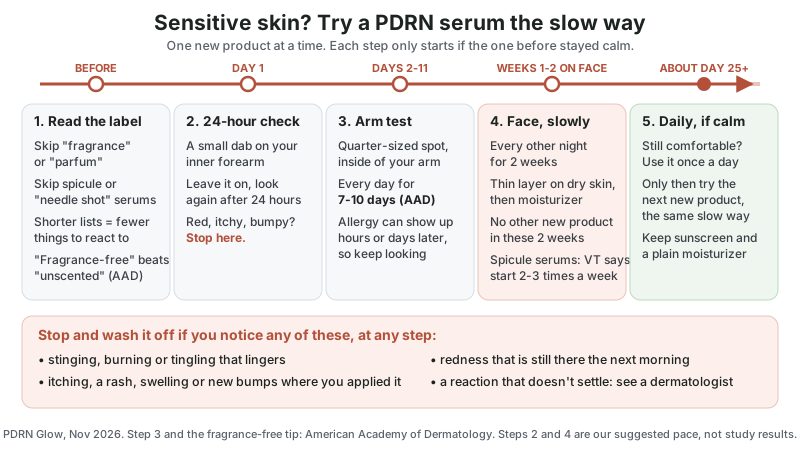
The diagram, step by step:
- Before you start: read the label. Skip “fragrance” or “parfum” and spicule or “needle shot” products, and prefer a shorter list. “Fragrance-free” beats “unscented” (AAD).
- Day 1: a 24-hour check. Put a small dab on your inner forearm and look again after 24 hours. Red, itchy or bumpy? Stop there.
- Days 2-11: the arm test. The AAD’s 7 skin care tips for rosacea-prone skin describe a quarter-sized patch on the inside of your arm, every day for 7-10 days. Keep looking, because allergic rashes can appear later.
- Weeks 1-2 on the face: every other night. A thin layer on dry skin, then your usual moisturizer, and no other new product. Spicule serums: VT’s own directions say start 2-3 times a week.
- About day 25 onward: daily, if calm. Use it once a day. Only then start the next new product, the same slow way.
The 24-hour check and the every-other-night pace are our suggestions for an extra-cautious start, not study results. The 7-10 day arm test is the AAD’s.
Is it irritation or an allergy?
Irritation usually stings or burns soon after you apply a product, while an allergic reaction often shows up later as an itchy rash. The AAD says an allergic contact rash tends to appear hours or days after your skin touches what you’re allergic to
.
The AAD also notes that More than 15,000 things that touch our skin can cause an allergic reaction
, and that The first sign is often itchy skin, followed by a rash.
That delay is exactly why the arm test runs 7-10 days instead of one evening.
Either way, the response is the same: wash the product off, stop using it, and if it doesn’t settle, see a dermatologist. A dermatologist can patch-test you properly to find the exact ingredient.
When should you stop using a PDRN serum?
Stop and wash it off if you get stinging or burning that lingers, itching, a rash, swelling, new bumps where you applied it, or redness that’s still there the next morning. Don’t push through, hoping your skin will get used to it.
A product that hydrates should feel comfortable. If something felt fine for a week and then turns itchy, that still counts. Take a photo of the reaction and the ingredient list for your dermatologist.
What’s the simplest PDRN routine for sensitive skin?
A gentle cleanser, one fragrance-free PDRN product, a fragrance-free moisturizer and sunscreen in the morning are plenty. On reactive skin, fewer steps means fewer chances to react, and it’s easier to spot the culprit if something goes wrong.
- Morning: lukewarm water or a mild cleanser, a thin layer of PDRN essence or serum, a fragrance-free ceramide moisturizer, then sunscreen.
- Evening: mild cleanser, the PDRN step, moisturizer. Skip exfoliating acids or a new retinoid during your PDRN test weeks.
For moisture, the AAD advises applying moisturizer when your skin is still damp after taking a shower or bath
. That habit matters most from November to February, when cold air and indoor heating leave sensitive skin tight and flaky.
For sunscreen, sensitive skin often gets along better with mineral filters. Look at fragrance-free zinc oxide sunscreens, and arm-test those too.
If your redness flares with heat, drinks or weather, our guide to PDRN for rosacea and redness-prone skin covers the AAD’s rosacea avoid list. Pregnant or nursing? See whether PDRN is safe during pregnancy and breastfeeding first.
Slow is the secret here, my friend. One product, one careful test, one calm week at a time, and your skin gets to vote on everything that stays.
Sources and further reading
- Misery L, et al. Definition of sensitive skin: an expert position paper from the Special Interest Group on Sensitive Skin of the International Forum for the Study of Itch. Acta Derm Venereol 2017;97:4-6 — sensitive skin as a syndrome of stinging, burning, pain, itch and tingling; can look normal or red; especially the face; cosmetics among chemical triggers
- Chen W, Dai R, Li L. The prevalence of self-declared sensitive skin: a systematic review and meta-analysis. J Eur Acad Dermatol Venereol 2020;34(8):1779-1788 — 26 studies, 18 countries, 51,783 people; 71% some degree, 40% very or moderately; face 64% and 34%
- Bak S-U, et al. Anti-Aging Efficacy of Low-Molecular-Weight Polydeoxyribonucleotide Derived from Paeonia lactiflora. Int J Mol Sci 2025;27(1):220 — 10 adults; 1% SLS irritation; 1% peony PDRN cream vs control twice daily for 2 weeks; water-loss drop 21.01% vs 13.98% (p = 0.026); no irritation reported; authors employed by NewLife BST Co.
- Antelmi A, et al. Prevalence of Contact Allergy to Propolis — Testing With Different Propolis Patch Test Materials. Contact Dermatitis 2025;92(5):349-357 — contact dermatitis commonly reported from cosmetics with propolis; 16 of 257 (6.2%) Genoa dermatitis patients reacted
- American Academy of Dermatology: Contact dermatitis — fragrance and nickel; allergic rash appears hours or days later; more than 15,000 things can cause an allergic reaction
- American Academy of Dermatology: Dermatologists’ top tips for relieving dry skin — last updated 1/2/26; fragrance-free vs unscented; moisturize while skin is damp
- American Academy of Dermatology: 7 rosacea skin care tips — quarter-sized test patch on the inside of the arm every day for 7-10 days
- FDA: Fragrances in cosmetics — fragrance ingredients may be listed simply as ‘Fragrance’; potential for allergic reactions or sensitivities
- FDA: ‘Hypoallergenic’ cosmetics — no federal standard or definition for ‘hypoallergenic’
- Anua: PDRN Hyaluronic Acid Capsule 100 Serum — maker’s page with full ingredient list (34 ingredients, no fragrance, 8 extracts)
- Medicube: PDRN Pink Peptide Serum — maker’s page; salmon and Rose PDRN ingredient lists both include ‘Fragrance’; ‘formulated without’ list names ‘Fragrances’
- VT Cosmetics: PDRN Essence 100 — maker’s page; ginseng-sourced PDRN, ‘unscented’
- VT Cosmetics: PDRN Reedle Shot 100 — maker’s page; ginseng PDRN, ‘slight tingling sensation, which is completely normal’, Mild 50 suggested for beginners; ‘even for sensitive skin’
- Soko Glam: VT PDRN Essence 100 — full ingredient list (31 ingredients, five ceramides, no fragrance)
- Soko Glam: VT PDRN Reedle Shot 100 — full ingredient list (53 ingredients, Sodium DNA 0.05 ppm, propolis extract); ‘Begin 2-3 times per week and increase as tolerated’
- Soko Glam: Purito Seoul Oat PDRN Gentle Refining Toner — full ingredient list (19 ingredients, 80% oat seed water, Sodium DNA 5 ppm)
Questions and answers
Is PDRN good for sensitive skin?
PDRN itself is usually gentle and hydrating, so many people with sensitive skin can use it. Reactions usually come from the rest of the formula, such as fragrance, spicules or plant extracts. Choose a short, fragrance-free product and test it on your arm for 7-10 days first.
Can PDRN serum cause irritation or breakouts?
Any skincare product can irritate some people, and with PDRN serums the cause is usually another ingredient in the formula rather than the PDRN. If you get stinging that lingers, itching, a rash or new bumps where you applied it, wash it off, stop using it and see a dermatologist if it doesn’t settle.
Does PDRN repair the skin barrier?
PDRN serums are cosmetics, so they can help skin look and feel calmer and more hydrated rather than repair anything. A small 2025 study of 10 adults found a 1% PDRN cream helped detergent-irritated arm skin return to normal water loss faster than a plain cream, but all six authors were employed by one company, NewLife BST.
Is VT Reedle Shot OK for sensitive skin?
It’s the kind of PDRN product we’d try last on reactive skin, because its spicules are designed to tingle and Reedle Shot 100 also contains propolis. VT says the tingling is normal and points beginners to its Mild Reedle Shot 50. If you try one, follow the directions to start 2-3 times a week.
How long should you patch test a new PDRN serum?
Check a small dab on your inner forearm after 24 hours, then follow the American Academy of Dermatology’s test: a quarter-sized patch on the inside of your arm every day for 7-10 days. Allergic rashes can appear hours or days after contact, so the longer test catches more.