Recipes › Cooked eggnog
Homemade Eggnog (Cooked, Custard-Style)
Disclosure: this recipe contains Amazon affiliate links. As an Amazon Associate we earn from qualifying purchases, at no extra cost to you.
Real eggnog is a thin stirred custard, and it takes about 25 minutes at the stove plus a few hours in the fridge. Cooking the eggs gently to 160 °F is what makes it safe to share, so the one tool you really need is an instant-read thermometer. A fine-mesh strainer catches any stray bits of egg, and whole nutmeg with a small grater (all on Amazon) tastes much brighter than the jar of ground.
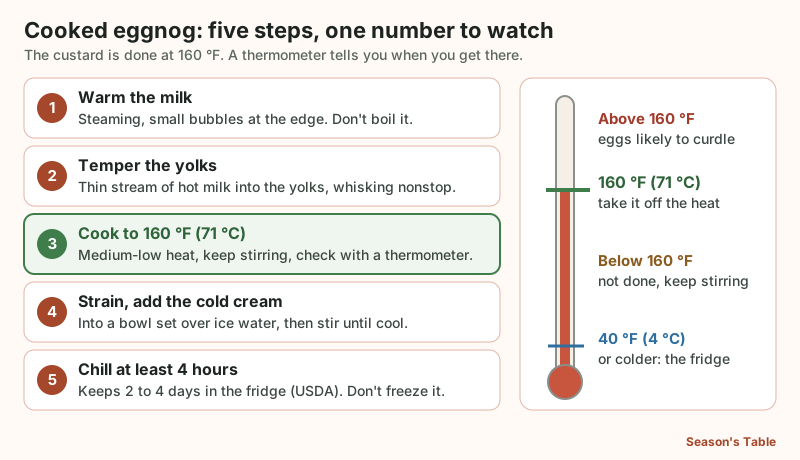
Short answer: whisk 6 yolks with sugar, temper them with 2 cups of hot milk, and cook over medium-low heat, stirring, until a thermometer reads 160 °F (71 °C). Strain, stir in 1 cup of cold cream and the vanilla, cool over ice water, and chill for at least 4 hours. Add spirits just before serving if you like. It keeps 2 to 4 days in the fridge, and USDA says not to freeze homemade eggnog.
Cooked Custard-Style Eggnog
Total time includes 4 hours of chilling. The spirits are optional: leave them out for an alcohol-free batch.
Ingredients
Eggnog
- 6 large egg yolks
- 2/3 cup (135 g) granulated sugar
- 1/8 teaspoon salt
- 2 cups (480 ml) whole milk
- 1/2 teaspoon freshly grated nutmeg, plus more for serving
- 1 cup (240 ml) heavy cream, cold
- 2 teaspoons vanilla extract
Optional
- 1/2 cup (120 ml) bourbon, dark rum or brandy, or a mix
Instructions
- Get set up first, because the last step moves fast. Fill a large bowl with ice and a little cold water, set a smaller clean bowl inside it, and rest a fine-mesh strainer over the smaller bowl. Keep the cream in the fridge until you need it.
- In a medium bowl, whisk the egg yolks, sugar and salt for 1 to 2 minutes, until pale and a little thicker.
- Warm the milk and nutmeg in a heavy medium saucepan over medium heat until steaming, with small bubbles at the edge, about 5 minutes. Don't let it boil.
- Whisking the yolks constantly, pour in about 1 cup of the hot milk in a thin stream. Then whisk this warmed yolk mixture back into the saucepan.
- Cook over medium-low heat, stirring constantly and scraping the bottom and corners of the pan, until a thermometer in the middle of the liquid (not touching the pan) reads 160 °F (71 °C), about 4 to 8 minutes. Never let it boil.
- Right away, pour the custard through the strainer into the bowl set over ice. Stir in the cold cream and the vanilla, then stir now and then for about 5 minutes, until cool.
- Cover and refrigerate for at least 4 hours, until completely cold. It will thicken as it chills.
- Whisk before serving. Stir in the spirits, if using, and thin with a splash of milk if you like. Pour into small glasses and grate a little nutmeg on top.
Why cook the eggs?
Raw eggs can carry Salmonella. Iowa State University Extension says eggs must reach 160 °F to kill bacteria that may be present, and the method here is the cooked egg base it describes: hot milk, slowly combined with beaten yolks and sugar, then stirred over gentle heat until it hits that temperature. K-State Research and Extension gives the same number. Both say to make the cooked base even if you start with pasteurized eggs.
What the heat does for the texture
The same gentle heat thickens the yolks, which is where eggnog gets its body. Don't expect pudding. Hot from the pan it pours like heavy cream, and it thickens more as it chills.
Who should be extra careful
FDA lists children, older adults, pregnant women and people with weakened immune systems as being at greater risk of severe illness from Salmonella. Iowa State says a cooked base matters most when you're serving those guests, and points to non-alcoholic eggnog for young children and anyone pregnant. If you're pregnant and have questions about what's right for you, ask your doctor.
Does the alcohol make it safe?
Don't count on it. Iowa State says alcohol slows bacterial growth, but the amount in most recipes isn't enough to kill bacteria. NC State University's write-up, with food-safety researcher Ben Chapman, describes a 2010 investigation where ethanol alone cut Salmonella by about 90 to 99 percent over 24 hours, with no reduction in the first hour. Chapman adds that the fat in cream can help protect Salmonella cells. So here the liquor is for flavor, and the heat does the safety work.
What about aged eggnog?
You may see recipes that rest raw eggs and liquor for weeks. The evidence is thin. A 2008 experiment at Rockefeller University called its Salmonella result inconclusive (it used far more Salmonella than a contaminated egg would carry) and said more realistic tests would be needed to call spiked eggnog safe or unsafe. Chapman calls that work anecdotal and not peer-reviewed. Iowa State does pass along a Cook's Illustrated method of 1 1/2 ounces of 80-proof liquor per egg, three weeks in the fridge and the dairy added only at serving, but this recipe doesn't rely on aging.
How to keep it from curdling
- Pour slowly when you temper. A thin stream of hot milk warms the yolks gradually instead of scrambling them.
- Stay at medium-low. Keep stirring and reach into the corners, where eggs catch first.
- Stop at 160 °F. Iowa State warns that above that temperature the eggs are likely to curdle. A double batch takes longer to get there, so go by the thermometer and not the clock.
- Have the ice bath ready. Iowa State uses a bowl of ice water to stop the cooking, and the cold cream in this recipe helps bring the temperature down quickly too.
The spoon test
According to Iowa State, at 160 °F the mixture firmly coats a metal spoon and stays separated when you draw a finger through it. That's a handy visual cue, but let the thermometer make the call.
If it curdles anyway
A few small bits will stay behind in the strainer, and that's the reason for straining. If the whole batch looks grainy, Iowa State's fix is to blend it until smooth. Let it cool a little first and leave the blender's lid vented, because hot liquid in a sealed blender can push the lid off. Then chill as usual.
Thick or thin: getting the texture right
- Looks thin? Chill it completely before you judge, because it thickens as it gets cold.
- Still too thin? Whip 1/2 cup of heavy cream to soft peaks and fold it in just before serving. That adds body and a little froth. Putting the batch back on the stove risks curdling it.
- Too thick? Whisk in cold milk a splash at a time.
- No heavy cream? Half-and-half works in its place, and the eggnog will be thinner.
- Old recipes with whipped egg whites: those whites are usually raw. Iowa State says to use pasteurized egg whites if you want them. The whipped cream above gives you a similar lift without the question.
Which spirits to use
Bourbon, dark rum and brandy are the traditional choices, alone or mixed. Start with 1/2 cup for the batch, taste, and add more if you like it stronger. Stir the spirits in cold, once the eggnog has chilled. Cooking for a mixed crowd? Divide the batch into two pitchers, spike only one, and label them.
The alcohol-free version
Just leave the spirits out, since nothing else in the recipe changes. An extra grating of nutmeg helps fill in the flavor, and some people add a little rum extract. If you're avoiding alcohol entirely, check the labels: vanilla and rum extracts are usually made with alcohol, and it doesn't cook off here because they go in after the heat. Alcohol-free vanilla or the seeds from a vanilla bean get around that.
Make-ahead and storage
You can make this up to 2 days before a party, which still leaves time in USDA's window for leftovers. Chilling overnight also gives the nutmeg time to come through. Get the cooled eggnog into the fridge promptly, keep it covered, and count the days from when you cooked it. The USDA chart has no longer time for spiked eggnog, and Chapman notes that even with alcohol, eggnog can still spoil.
Homemade vs store-bought storage times
| Eggnog | Refrigerator | Freezer |
|---|---|---|
| Homemade | 2 to 4 days | Do not freeze |
| Commercial | 3 to 5 days | Up to 6 months |
From the egg storage chart in USDA FSIS's "Shell Eggs from Farm to Table."
Serving it at a party
Pour it in small glasses, since it's rich, and keep the pitcher in the fridge between rounds. FDA's rule for egg dishes is no more than 2 hours out of the refrigerator, or 1 hour when it's above 90 °F, so a punch bowl should sit in a bigger bowl of ice if it's staying out longer. It goes well with a plate of gingerbread cookies or decorated sugar cookies, or as a small dessert after a Christmas prime rib.
What to do with the leftover whites
You'll have 6 egg whites left over. University of Minnesota Extension lists raw whites at 2 to 4 days in the fridge or up to 1 year in the freezer, so there's no rush. Cook them into omelets or scrambled eggs, or bake them into meringues.
Sources and further reading
- Iowa State University Extension AnswerLine: Homemade Eggnog Made Safe - cooked egg base, 160 °F, curdling, alcohol, pasteurized eggs
- Kansas State University: Tips for Safe Eggnog - 160 °F cooked base, cooling over ice water
- USDA FSIS: Shell Eggs from Farm to Table - egg storage chart, homemade and commercial eggnog
- FDA: What You Need to Know About Egg Safety - 2-hour rule, keeping egg dishes on ice, higher-risk groups
- NC State University News: eggnog food safety, with Ben Chapman - how much alcohol reduces Salmonella, and the limits of the evidence
- Rockefeller University: microbiologist tests the safety of spiked eggnog (2008) - inconclusive Salmonella result
- University of Minnesota Extension: storage times for food in the refrigerator and freezer - raw egg whites
Questions and answers
Is homemade eggnog safe to drink?
Yes, if the egg base is cooked to 160 °F (71 °C), which kills Salmonella that may be in the eggs. Recipes with raw, unpasteurized eggs are the risky ones. Iowa State University Extension and K-State both recommend a cooked base, even with pasteurized eggs.
Does alcohol in eggnog kill the bacteria?
Not reliably. Iowa State University Extension says the amount of alcohol in most recipes can slow bacteria but won't kill them. Cook the base to 160 °F and think of the liquor as flavor.
How long does homemade eggnog last in the fridge?
USDA lists homemade eggnog at 2 to 4 days in the refrigerator. Its chart has no longer time for spiked eggnog, so use the same window. Keep it covered and cold, and throw it out if it smells or looks off.
Can you freeze homemade eggnog?
USDA says not to freeze homemade eggnog. Its chart lists only commercial eggnog for the freezer, for up to 6 months. If you won't finish a full batch in time, make less: the recipe halves easily.
Why did my eggnog curdle?
The eggs got too hot too fast: the milk went in too quickly, the heat was too high, or the custard went past 160 °F. Small bits strain right out. If the whole batch is grainy, Iowa State University Extension says to blend it until smooth, then chill as usual.
How this was written: A classic stirred-custard eggnog using common home-cooking proportions. The cooked-base method and the 160 °F target follow Iowa State University Extension and K-State Research and Extension; storage times come from the USDA FSIS egg storage chart, the 2-hour rule and higher-risk groups from FDA, and the evidence on alcohol from NC State University and Rockefeller University. Texture and spirit suggestions are standard home-cooking practice. No nutrition numbers.