
Base Layers for Winter Motorcycle Riding: Wind, Sweat and Heated Liners
Disclosure: this page contains Amazon affiliate links. As an Amazon Associate we earn from qualifying purchases, at no extra cost to you.
Picture a crisp morning ride with the road humming under you and your chest still toasty at 55 mph, Knight of the Cold Throttle!
Let’s build the layers that make that real.
Your base layer is the quiet hero of a cold ride, because it keeps sweat off your skin while the wind steals heat from everything on top.
Start with a snug merino base layer or a thin synthetic one, then build up to a windproof shell.
Short answer: For winter motorcycle riding, wear a snug, long-cut merino or synthetic base layer, a warm middle layer and a windproof outer layer, with the collar, wrists and knees sealed. At 55 mph, 40°F air feels like 25°F. Near or below freezing, add a 12V heated liner over a thin base layer.
A few facts to set the scene, each from the source named:
- How riders should start
Several layers of clothing are necessary, usually starting with thermal underwear
(Motorcycle Safety Foundation).- What wind chill means
How cold people and animals feel when outside
, worked out for wind at about face height, 5 feet (National Weather Service).- Why it matters on a bike
- Hypothermia
can cause loss of concentration, slowed reactions, and loss of smooth, precise muscle movement
(MSF). - What a heated jacket liner draws
- Gerbing’s 12V Jacket Liner 2.0 is rated 77 watts at 6.4 amps; Warm & Safe’s 90W+ liner is rated 106 watts at 13.8 volts (makers’ spec pages).
How cold does it feel on a motorcycle at highway speed?
On a motorcycle at highway speed, the air feels 15 to 25 degrees colder than the thermometer in typical winter riding weather. At 55 mph with no windscreen, 40°F air feels like 25°F and 32°F air feels like 14°F, by the National Weather Service (NWS) wind chill formula.
The NWS publishes the formula on its wind chill page. We plugged riding speeds in as the wind speed, which is what your chest meets when the air around you is still.
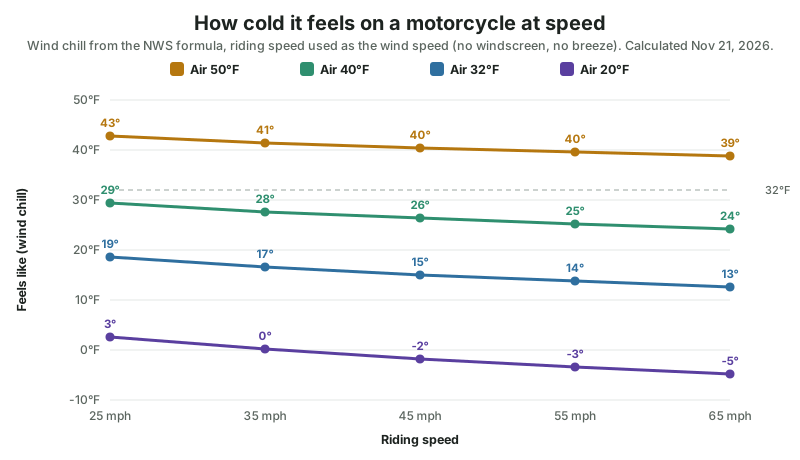
| Air temperature | 25 mph | 35 mph | 45 mph | 55 mph | 65 mph |
|---|---|---|---|---|---|
| 50°F | 43°F | 41°F | 40°F | 40°F | 39°F |
| 40°F | 29°F | 28°F | 26°F | 25°F | 24°F |
| 32°F | 19°F | 17°F | 15°F | 14°F | 13°F |
| 20°F | 3°F | 0°F | -2°F | -3°F | -5°F |
Here’s the catch: most of the chill arrives at town speeds. Going from standing still to 25 mph takes 40°F air down to 29°F, while going from 25 to 65 mph only takes off 5 more degrees.
So a 30 mph commute in 40°F weather needs nearly the same layers as a highway run. The NWS defines wind chill only for air at or below 50°F and wind above 3 mph.
Wind chill can’t freeze skin by itself in above-freezing air. The NWS puts it plainly: you will not get frostbite; however, you might get hypothermia from exposure to cold.
On a motorcycle, that slow heat loss is the real risk. The Motorcycle Safety Foundation (MSF) warns that even in relatively warm weather, moving air is cooler
and steady wind can bring on a chill that leads to hypothermia.
Does a windscreen change how cold you get?
A windscreen or fairing makes you warmer because it turns some of the wind blast away from your chest, so the air on your body moves slower than the bike does. Our table assumes no windscreen, so it shows the worst case for a naked bike.
Knees, shoulders and hands often stay in the wind even behind a screen, which is why those are the spots riders seal first.
What base layer should you wear for winter motorcycle riding?
The best base layer for winter motorcycle riding is a snug, long-sleeved top and full-length bottoms in merino wool or a wicking synthetic, cut long enough to stay covered in a riding crouch. The MSF’s Personal Protective Gear leaflet says cold-weather layers usually start with thermal underwear
.
Riding asks a few things a walk doesn’t. Here’s what to look for in a motorcycle base layer set:
- A long back hem. Leaning toward the bars pulls a short top up and opens a cold strip at the kidneys, right where the wind gets under the jacket.
- Long sleeves, ideally with thumbholes. Your arms reach forward, so the cuff should still sit under the glove gauntlet.
- Full-length bottoms that reach the ankle bone and tuck into socks, so your boot tops don’t leave a bare gap.
- Flat seams, because seams pressed by armor and a snug riding jacket can rub over a long day.
- No cotton. A cotton T-shirt holds sweat from the warm-up and the gas station stop, then chills you at speed.
Is merino wool or synthetic better under motorcycle gear?
Merino wool and synthetic base layers both work under motorcycle gear; merino suits long or multi-day rides, synthetic suits short commutes and heated liners.
A merino base layer stays warm when a little damp and resists smells, so it’s the easy pick for a long tour where you wear it two days running. It needs a gentle wash.
A synthetic (polyester) base layer dries fast and handles a hot wash. Gerbing, the heated-clothing maker, designs its jacket liner to go over a thin polyester base layer
, so synthetic is the natural partner for heated gear.
How tight should a motorcycle base layer be?
A motorcycle base layer should sit close to the skin everywhere without squeezing, because a snug layer moves sweat away and holds a thin film of warm air. Wrinkles and loose fabric under armor become pressure points.
Don’t confuse snug with tight. The MSF says gear should fit comfortably without binding
, and it warns that gloves that are too tight restrict circulation so your hands get cold. The same goes for any cuff that leaves a deep mark on your wrist or ankle.
How do you layer for a cold motorcycle ride?
Layer for a cold motorcycle ride with three jobs in order: a base layer that handles sweat, a middle layer that traps warm air, and a windproof outer layer that stops the wind. The MSF puts the last step simply: Topping your clothing with a windproof outer layer will prevent the cold wind from reaching your body.
- Base layer: snug merino or synthetic top and bottoms.
- Middle layer: a thin fleece or wool sweater, or a heated liner on cold days. Bulk is the enemy here, because a stuffed riding jacket squeezes out the air that keeps you warm.
- Outer layer: your riding jacket and pants with their thermal liners in, or a windproof shell over them.
The MSF’s leaflet also lists what makes a jacket windproof: A jacket with a zippered front will be more wind-resistant than a jacket with buttons or snaps
, a flap over the zipper helps, and sleeves should taper to fitted cuffs and waists.
Plan for stops too. The MSF notes that Riding gear that is just right for cold-weather riding may be too hot once you stop
, so dress in layers you can open or take off at a coffee break.
How do you keep your neck, wrists and knees warm on a motorcycle?
Keep your neck, wrists and knees warm on a motorcycle by sealing every gap where wind can get in: a close collar and a neck tube, gauntlet gloves over your sleeves, and wind-blocking pants or a pant liner over your base layer bottoms.
- Neck: the MSF’s cold-weather drawing shows a
high, close collar
. A fitted windproof neck gaiter or a thin riding balaclava under the helmet fills the gap between helmet and collar. - No long scarves. The MSF says flowing scarves should be avoided because they could become entangled in the motorcycle, and a large, loose collar will flap.
- Wrists:
Gauntlets will keep cold air from going up your sleeves
, says the MSF. Base layer cuff under the glove, gauntlet over the jacket sleeve. Look for insulated winter motorcycle gauntlet gloves that still let you work the levers. - Knees and thighs: they meet the wind first on most bikes. Riding pants with their thermal liner in, a wind-blocking pant liner, or rain pants over everything keep the wind off your base layer bottoms.
- Feet: merino thermal socks in boots with room to wiggle your toes; the MSF’s cold-weather gear list says heavy boots with insulation.
Hands need the most thought. On a bike you can’t wear mittens, so riders lean on insulated gauntlets, liners and heat.
If cold fingers turn white or numb even in good gloves, our guide to dressing for Raynaud’s covers liners, heated gloves and when to see a doctor.
What do you wear under a heated jacket liner?
Under a heated jacket liner, wear a thin base layer, ideally polyester, and nothing bulky. Gerbing’s Jacket Liner 2.0 page says the liner is designed to be worn close to the body, under your outer jacket, and over a thin polyester base layer
, for the fastest and warmest heat.
Warm & Safe builds its Generation WaterProof liner with stretch panels to keep it tight against your body for optimal heat transfer
.
A thick sweater between you and the heat panels wastes the heat; a thick layer goes over the liner, if anywhere.
The thin base layer also keeps the heat panels off bare skin. That matters with any heated product: the manuals we read for our wheelchair warmth guide all warned about skin with reduced feeling.
How much power does heated motorcycle gear draw?
A heated jacket liner draws about 6.4 to 7.8 amps at full heat, and a full kit of jacket, pants, gloves and socks draws about 14 to 15 amps, by the makers’ own spec pages. That’s roughly 180 to 190 watts on top of everything else your bike powers.
Confession: adding up amps on two heated kits made us way happier than it should have. There’s something deeply satisfying about knowing your jacket liner and your headlight can share the bike without a fight.
We added up two complete 12V kits from the makers’ published figures, read November 21, 2026.
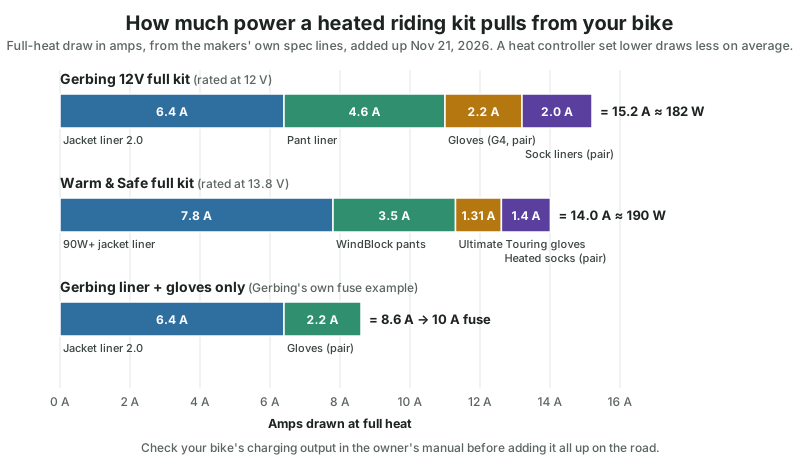
| Piece | Gerbing 12V (rated at 12 V) | Warm & Safe 12V (rated at 13.8 V) |
|---|---|---|
| Jacket liner | Jacket Liner 2.0: 6.4 A, 77 W | Generation WaterProof 90W+: 7.8 A, 106 W |
| Pants | Pant liner: 4.6 A (listed as 77 W) | WindBlock heated pants: 3.5 A, 48 W |
| Gloves | G4 gloves: 1.1 A each, 2.2 A a pair | Ultimate Touring gloves: 1.31 A, 18.14 W as listed |
| Socks | Sock liners: 1.0 A each, 2.0 A a pair | Heated socks: 0.7 A each, 1.4 A a pair |
| Full kit | 15.2 A, about 182 W at 12 V | 14.0 A, about 190 W at 13.8 V |
Two notes on the numbers. Gerbing prints 77 W and 4.6 A for its pant liner, which don’t match at 12 V (4.6 A × 12 V = 55 W), so we added up the amps.
Warm & Safe rates its gear at 13.8 V, close to a running bike’s charging voltage. It says its 65W liner gives more like 75 Watts when the bike is running
.
Lighter options draw less. Gerbing’s heated vest liner is rated 4.5 A and 54 W. Warm & Safe’s Women’s Heat Layer Shirt is rated 2.8 A and 38 W.
The simple math for any piece: watts = volts × amps. Gerbing UK’s FAQ works an example: jacket liner 6.4 A plus gloves 2.2 A is 8.6 A, Therefore the 10 amp fuse is the one to use.
Can your motorcycle run a heated jacket liner?
Most motorcycles can run a heated jacket liner, but check your bike’s charging output first, because the lights, fuel injection and ignition already use part of it. Your owner’s manual or service manual lists the alternator (or generator) output; your dealer can tell you how much is spare.
Gerbing UK’s FAQ advises checking with your motorcycles manufacturer as to what amperage you can put through your own bikes system
, especially before running gear through an accessory socket, which often has a low limit.
Start small if you’re unsure: a liner alone, or a vest, before a full kit. A 12V heated jacket liner is the usual first piece.
Both makers sell their gear without a controller and say to use one. Gerbing’s pages say all installations need a battery harness and temperature controller, and that skipping the controller may cause discomfort & burns
. Warm & Safe says all its 12V gear need to be used with a Heat Controller
.
Do you need a heated liner or just better base layers?
For short rides in cool weather, better base layers and a windproof shell are usually enough; for long highway rides near or below freezing, a heated liner adds the warmth that layers alone can’t.
Look at the table again: at 65 mph, 32°F air feels like 13°F. Hour after hour, no amount of fleece makes heat; it only slows the loss. A heated liner puts heat back in.
The MSF lists a winter riding suit or an electrically warmed suit or vest
as options and says These items can be quite effective.
Heated grips warm your palms, too.
A rough way to choose:
- Cool commute, around 45 to 50°F: a midweight base layer, a thin fleece, your jacket’s liner in, a neck gaiter.
- Cold commute, around 35 to 45°F: add a windproof shell or rain suit, gauntlet gloves and thicker socks.
- Long rides near freezing: a thin base layer under a heated liner (or vest), heated gloves, and the full wind layer.
How do you stay visible on a winter ride?
Stay visible on a winter ride with bright or reflective gear on the outside of all your layers, because short winter days put more of your riding near dusk and dark. The MSF says: Choose brightly colored gear when possible.
The MSF’s leaflet notes that Only two riders of the 900 crash cases studied by “The Hurt Report” were wearing brightly colored clothing.
The Hurt Report is the federally funded crash study led by Harry Hurt of the University of Southern California.
If your warmest jacket is dark, the MSF suggests a retroreflective vest over it, and reflective tape on gear you wear often.
Use a clear face shield at night, the MSF adds. A fogged or tinted shield on a dark evening is the last thing you need.
What are the signs you’re too cold to ride?
You’re too cold to ride when you’re shivering hard, feel very tired, fumble the controls or start to lose focus: those are early signs of hypothermia, and the MSF says hypothermia slows your reactions and your ability to react to traffic.
The CDC’s winter weather page lists these warning signs of hypothermia in adults:
- Shivering
- Exhaustion or feeling very tired
- Confusion
- Fumbling hands
- Memory loss
- Slurred speech
- Drowsiness
Fumbling hands is the one riders notice first, at the clutch lever. If it happens, pull over somewhere warm, get a hot drink, swap damp layers for dry ones, and add a layer to your core before you ride on.
What should you put on before a cold ride?
Before a cold ride, dress fully indoors in this order, so you start warm and dry instead of warming up on the road.
- Snug merino or synthetic base layer, top and bottoms, with the top tucked in.
- Merino socks pulled over the base layer cuffs, boots with room for your toes.
- A thin middle layer, or a heated liner plugged into its controller.
- Riding jacket and pants with liners in, zippers and flaps closed.
- Neck gaiter or balaclava, then helmet; the collar should meet it with no gap.
- Gauntlet gloves over your sleeves, and a bright or reflective layer on the very outside.
- In the tank bag: a spare base layer top and dry socks.
Want more warm ideas as we write them? Our free newsletter sends the layering tips we dig up ourselves, before the cold snaps arrive.
Now gear up and roll out, Knight of the Cold Throttle: snug base layer, sealed collar, gauntlets over the sleeves and maybe a little heat humming along. Here’s to bright, crisp miles all winter.
Sources and further reading
- National Weather Service: Understanding Wind Chill — the wind chill formula, defined at or below 50°F and above 3 mph, wind at face height, frostbite vs hypothermia
- Motorcycle Safety Foundation: Personal Protective Gear for the Motorcyclist (revised April 2013, PDF) — thermal underwear, layers and windproof outer layer, hypothermia, gauntlets, collars and scarves, bright and reflective gear, the Hurt Report figure
- CDC: Preventing Hypothermia (reviewed August 25, 2026) — warning signs of hypothermia in adults, 95°F emergency
- Gerbing: 12V Heated Jacket Liner 2.0 — 77 W, 6.4 A; worn over a thin polyester base layer; harness and controller required
- Gerbing: Heated Pant Liner — 12V Motorcycle — 4.6 A (listed as 77 W); controller recommended
- Gerbing: G4 Heated Gloves — 12V Motorcycle — 1.1 A and 13 W each
- Gerbing: 12V Heated Sock Liners — 1.0 A and 12 W each
- Gerbing: Heated Vest Liner — 12V Motorcycle — 4.5 A, 54 W
- Gerbing UK: FAQs — jacket 6.4 A + gloves 2.2 A = 8.6 A on a 10 A fuse; check your bike’s amperage with its manufacturer
- Warm & Safe: Generation WaterProof 90W+ Men’s Heated Liner — 7.8 A, 106 W at 13.8 V; heat controller required
- Warm & Safe: Generation WaterProof 65W Men’s Heated Liner — 6.5 A, 75 W at 13.8 V; tight against the body
- Warm & Safe: Generation WindBlock Men’s Heated Base Layer Pants — 3.5 A, 48 W at 13.8 V
- Warm & Safe: Ultimate Touring Heated Gloves — 1.31 A, 18.14 W at 13.8 V as listed
- Warm & Safe: Heated Socks 12V — 0.7 A and 9 W per sock
- Warm & Safe: Women’s 12V Heat Layer Shirt — 2.8 A, 38 W at 13.8 V
Questions and answers
What is the best base layer for motorcycle riding in winter?
A snug, long-sleeved merino wool or synthetic base layer with full-length bottoms, cut long in the back so it stays tucked in a riding crouch. Avoid cotton, which holds sweat. Under a heated liner, Gerbing recommends a thin polyester base layer.
What do you wear under a heated motorcycle jacket liner?
A thin base layer and nothing bulky. Gerbing says its liner is designed to be worn close to the body, under your outer jacket and over a thin polyester base layer, so the heat reaches you quickly. Any thick layer goes over the liner, not under it.
How many amps does a heated jacket liner draw?
About 6.4 to 7.8 amps at full heat, by the makers’ own figures: Gerbing’s 12V Jacket Liner 2.0 is rated 6.4 A (77 W) and Warm & Safe’s 90W+ liner 7.8 A (106 W at 13.8 V). Add gloves, pants and socks and a full kit reaches about 14 to 15 amps.
How cold does it feel riding a motorcycle at 60 mph?
Much colder than the thermometer. By the National Weather Service wind chill formula, with riding speed as the wind speed and no windscreen, 40°F air feels like about 25°F at 60 mph, and 32°F air feels like about 13°F. A windscreen or fairing cuts the wind on your body.
How cold is too cold to ride a motorcycle?
There’s no single number; it depends on your gear, the roads and how long you ride. Ice or frost on the road is a reason to wait. The other limit is you: if you’re shivering hard, fumbling the controls or losing focus, those are hypothermia warning signs, so stop and warm up.