Thermal Underwear for Seniors: Easy On, Soft and Warm — and What Helps With Arthritis
Disclosure: this page contains Amazon affiliate links. As an Amazon Associate we earn from qualifying purchases, at no extra cost to you.
Hello, Honored Keeper of the Warm Armchair!
Let’s find thermals that slip on easily, feel soft all day and keep the chill out of every room.
Thermal underwear for an older adult only helps if it’s easy to put on, because the cozy set that fights back at the shoulders ends up in the drawer.
Start with soft, stretchy thermal underwear for seniors that has a wide neckline and a gentle waistband.
Short answer: The best thermal underwear for seniors is soft, warm and easy to get on: a wide or front-opening neckline, a wide soft waistband, some stretch, a tag-free label and tumble-dry care. Merino, modal or brushed polyester all work. Lightweight or midweight is plenty indoors, with the heat at 68°F or warmer, as the NIA advises.
A few facts to set the scene, each from the source named:
- Why it’s harder with age
Parkinson’s disease and arthritis can make it challenging to put on more clothes, use a blanket, or get out of the cold
(National Institute on Aging).- How warm to keep the home
- At least 68°F.
Even mildly cool homes with temperatures from 60 to 65°F can lead to hypothermia in older adults
(NIA). - Where cold injuries happen
- About 20% of injuries related to exposure to cold occur in the home (NIA).
- What hypothermia means
- A core body temperature below 95°F, and a medical emergency (NIA and CDC).
Why do older adults feel the cold more?
Older adults feel the cold more because aging changes make it harder to notice the body getting too cold, and common conditions get in the way of staying warm. The National Institute on Aging (NIA) says older adults have a higher chance of being affected by cold weather.
The NIA’s cold weather safety page names the usual culprits:
- Diabetes can keep blood from flowing normally to provide warmth.
- Thyroid problems can affect how the body holds a normal temperature.
- Parkinson’s disease and arthritis can make it hard to put on more clothes or use a blanket.
- Memory problems can mean forgetting to dress for the weather.
- Some medicines, including some over-the-counter cold medicines, can affect body heat.
That arthritis line is the reason this guide exists. A warm layer that takes two hands and a struggle to pull on often isn’t worn at all.
The home matters too. The NIA says even a 60 to 65°F room can lead to hypothermia in older adults, which is why a thermal layer under everyday clothes earns its place indoors, not just on winter walks.
What makes thermal underwear easy to put on?
Thermal underwear is easy to put on when it has a wide or front-opening neckline, a wide soft waistband with no drawcord to tie, some stretch in the fabric, and nothing fiddly like small buttons or back fastenings. Tag-free labels and flat seams make it comfortable to wear all day.
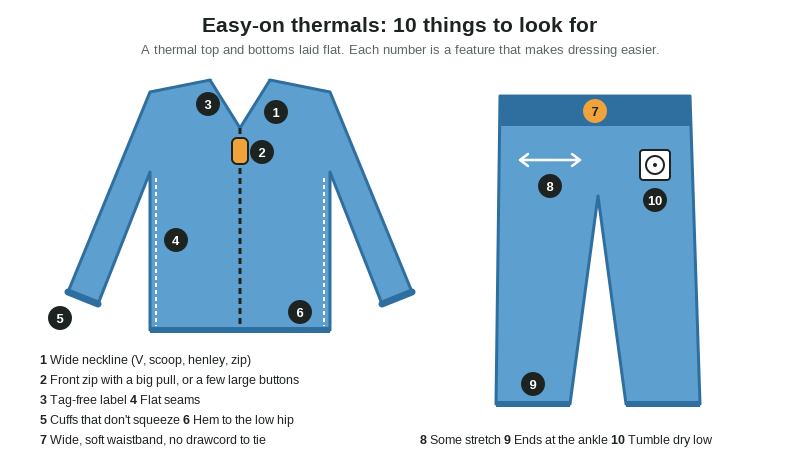
Here’s what each number in the drawing means, and why it helps:
- A wide neckline (V-neck, scoop, henley or zip neck) slides over the head without a tug at stiff shoulders.
- A front zip with a big pull, or a few large buttons, means the top can go on like a jacket, one arm at a time.
- A tag-free label, printed on the fabric, so nothing scratches the back of the neck.
- Flat seams that don’t press into skin when sitting for hours.
- Cuffs that don’t squeeze the wrists or ankles.
- A hem to the low hip, so the top stays tucked when reaching or bending.
- A wide, soft waistband that pulls up with a loose grip, instead of a drawcord that needs tying.
- Some stretch (a few percent spandex) so the fabric gives as an arm goes in.
- Legs that end at the ankle, so fabric doesn’t bunch over slippers.
- Tumble dry low on the care label, because nobody wants to lay thermals flat to dry every week.
What helps when arthritis makes dressing hard?
When arthritis makes dressing hard, choose looser or slightly larger sizes, elastic waists and easy fastenings, and sit down to dress. Those are the tips occupational therapist Christina MacLeod gives in Arthritis UK’s dressing guide.
When shopping for clothes, it’s worth picking looser-fitting or slightly larger sizes.
MacLeod also suggests clothes with an elasticated waist, fewer buttons, and Velcro or snap fastenings for people who prefer them. If balance is a problem, she asks, why not sit down and get dressed when putting your clothes on?
Small dressing aids help with thermals too. A dressing stick can ease a cardigan over the shoulders, and a zipper pull aid gives stiff fingers something bigger to hold.
For thermal bottoms, a sock aid and a long-handled shoehorn save bending at the end.
How do you help someone with dementia put on thermals?
Help someone with dementia put on thermals by laying the layers out in the order they go on, handing over one piece at a time, and choosing loose, comfortable clothes without buttons. Those steps come from the NIA’s Alzheimer’s caregiving page on dressing.
The NIA suggests laying out underwear first, then pants, then a shirt, and then a sweater.
A thermal top and bottoms simply join the front of that line.
Two more NIA tips fit thermals well. Use fasteners or large zipper pulls instead of buttons or buckles.
And if the person wants the same clothes every day, buy three or four sets of the same thing. That works nicely with thermals, because one set can be in the wash while another is worn.
Which thermals actually list easy-on features?
Of 10 thermal tops and bottoms we read on the makers’ own pages, 3 open at the front, 5 of the 6 tops have a wide neckline, and 5 say they’re tag-free. Only 2 of the 4 bottoms describe a waistband softer or wider than plain elastic.
We picked pieces families often look at, from Cuddl Duds, 32 Degrees and Minus33, plus a Cuddl Duds camisole sold by the adaptive-clothing store Buck & Buck. A dot means the page says so in words; a dash means the page doesn’t mention it, which doesn’t prove the garment lacks it.
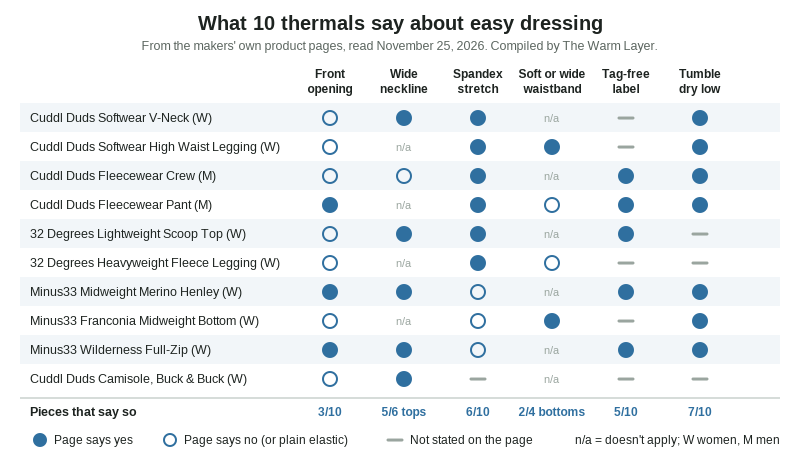
| Piece | Fabric | Opening and neckline | Waistband | Tag-free | Care |
|---|---|---|---|---|---|
| Cuddl Duds Softwear with Stretch Long Sleeve V-Neck (women) | 93% modal, 7% spandex; lightweight | V-neck, pullover | n/a | Not stated | Wash cold, tumble dry low |
| Cuddl Duds Softwear with Stretch High Waist Legging (women) | 93% modal, 7% spandex; lightweight | Pull-on | Wider waistband, fits above the waist | Not stated | Wash cold, tumble dry low |
| Cuddl Duds Fleecewear Long Sleeve Crew (men) | 94% recycled polyester, 6% spandex; heavyweight | Crew neck, thumbholes | n/a | Yes | Wash cold, tumble dry low |
| Cuddl Duds Fleecewear Pant (men) | 94% recycled polyester, 6% spandex; heavyweight | Functional fly | Elastic | Yes | Wash cold, tumble dry low |
| 32 Degrees Women’s Lightweight Baselayer Scoop Top | 90% polyester, 10% spandex; lightweight | Scoop neck, pullover | n/a | Yes | Not stated |
| 32 Degrees Women’s Heavyweight Fleece Baselayer Legging | 94% polyester, 6% spandex; heavyweight fleece | Pull-on | Elastic | Not stated | Not stated |
| Minus33 Women’s Midweight Merino Wool Henley | 100% merino, 18.5 micron; midweight, 245 g/m² | 3-button henley front | n/a | Yes | Machine wash cold, tumble dry low |
| Minus33 Franconia Women’s Midweight Wool Bottom | 100% merino, 18.5 micron; midweight, 245 g/m² | Pull-on, flyless | Covered waistband, merino next to the skin | Not stated | Machine wash cold, tumble dry low |
| Minus33 Wilderness Women’s Heavyweight Wool Full-Zip | 100% merino, 21 micron; heavyweight, 380 g/m² | Full zip, locking zipper pull | n/a | Yes | Machine wash cold, tumble dry low |
| Cuddl Duds V-Neck Camisole (sold by Buck & Buck) | Pima cotton inside, smooth nylon outside | V-neck, sleeveless | n/a | Not stated | Not stated |
Here’s the surprise: the easiest tops to get into weren’t the soft everyday layers. They were the two Minus33 merino pieces made for the outdoors, a henley with a 3-button front and a full-zip with a locking zipper pull.
The full-zip is a heavyweight mid layer rather than underwear, but for stiff shoulders a zip-front layer over a thin thermal can be the kindest pair.
Buttons cut both ways. Minus33’s henley opens at the front, but Arthritis UK notes small buttons are hard for some people, so a zip with a big pull may suit stiff fingers better.
Watch the waistband line. Cuddl Duds’ women’s Fleecewear with Stretch Legging, for example, has an elastic drawcord in the waistband, which is one more knot for stiff fingers. The Softwear High Waist Legging lists a wider waistband instead.
Which thermals suit elderly women?
Elderly women often do best with thin, soft thermals that hide under everyday clothes: a V-neck or scoop-neck top, a camisole, and high-waist leggings with a wide waistband. They add warmth without changing how a favorite blouse or pair of slacks looks.
Buck & Buck sells the Cuddl Duds V-Neck Camisole with a pima cotton layer next to the skin and a Smooth nylon outer layer lets clothes glide on easily
. It says the camisole Will not show under a V-neck top
.
For legs, Buck & Buck’s Cuddl Duds High Waist Leggings have a Wider, non-binding waistband
and are made for warmth under slacks, dresses or skirts.
Shopping for her? Look at soft women’s thermal underwear sets and thermal camisoles in her usual size or one up.
Which fabric is best for seniors’ thermal underwear?
The best fabric for seniors’ thermal underwear depends on the day: merino wool for warmth that stays warm when a little damp, modal for silky everyday softness, brushed polyester fleece for the most warmth for the least care, and cotton-lined layers for sitting at home.
- Merino wool. Minus33’s midweight pieces are 100% merino at 245 g/m² and, per the maker, machine wash and tumble dry low. Merino resists odors, so a top can be worn more than once between washes.
- Modal. Cuddl Duds’ Softwear with Stretch line is 93% modal and 7% spandex, a smooth, thin layer that suits wearing under everyday clothes.
- Brushed polyester fleece. Cuddl Duds’ Fleecewear and 32 Degrees’ heavyweight fleece are polyester and spandex, soft inside and easy to wash.
- Cotton-lined. The Cuddl Duds camisole puts pima cotton against the skin. Fine for an armchair afternoon.
Cotton holds moisture, so for a walk to the mailbox or a day out, pick merino or polyester instead. The NIA says to change out of damp or wet clothes as soon as you can.
If you’d like more choice, browse merino base layers and fleece-lined thermal sets side by side.
Will merino wool itch older skin?
Fine merino wool usually doesn’t itch the way an old wool sweater does, because its fibers are much thinner. Minus33 lists its midweight base layers at 18.5 micron, and its tops are tagless.
Skin is personal, though. If wool of any kind bothers someone, a modal or polyester thermal is just as practical, and a thin modal layer under a wool sweater keeps the wool off the skin.
What weight of thermal underwear do seniors need?
Most seniors need lightweight or midweight thermal underwear indoors and heavyweight only for long spells outside in real cold. A thin layer under everyday clothes is easier to put on, and a home kept at 68°F doesn’t need expedition gear.
Minus33 gives its own ranges for sitting still, which is useful because an older adult at home is mostly inactive:
- Midweight merino (245 g/m²)
- 30 to 60°F while inactive, by Minus33’s product pages.
- Heavyweight merino (Wilderness, 380 g/m²)
- 0 to 30°F while inactive, by Minus33.
Those are a maker’s guides, not rules. Someone who always feels cold, or who sits near a drafty window, may like a midweight top indoors, and a heavyweight layer for a winter church service or a football game.
How should thermal underwear fit an older adult?
Thermal underwear for an older adult should sit close without squeezing anywhere, and one size up is often kinder than a snug fit when shoulders or hands are stiff. The NIA advises warm and loose layers of clothing
, because the air between the layers helps to keep you warm.
Confession: reading ten product pages just to count tag-free labels made us happier than a mug of cocoa. It’s the little things, like a scratchy tag or a stubborn waistband, that decide whether a warm layer gets worn or stays folded in the drawer.
The CDC gives the same advice for going outside: wear several layers of loose-fitting clothing.
A sporty compression fit is the wrong idea here. If a thermal top takes a struggle at the shoulders, it won’t get worn, and that’s the coldest outcome of all.
Check three spots when it arrives: the neckline should pass over the head easily, cuffs shouldn’t leave a deep mark, and the waistband should pull up without a fight.
How do seniors stay warm at home and in bed?
Seniors stay warm at home by keeping the heat at 68°F or above, wearing a thermal layer under everyday clothes, and adding socks, slippers and throws. At night, the NIA puts it simply: Wear long underwear under your pajamas and consider wearing a head covering.
The NIA’s other indoor tips, from its cold weather page:
- Set the heat to at least 68°F.
- Roll a towel in front of doors to stop drafts, and keep blinds and curtains closed.
- Dress warmly on cold days, even when staying inside.
- Wear socks and slippers, and use throw blankets.
- Use extra covers in bed.
- Ask someone to check in during cold weather.
Thermal socks round it out. Soft non-binding thermal socks and slippers with a non-slip sole keep feet warm on cold floors.
For outdoor walks, the NIA recommends nonskid, rubber-soled, low-heeled footwear.
Are heated vests, hand warmers and heating pads safe for seniors?
Heated vests, hand warmers and heating pads can help some seniors, but ask a doctor first if feeling in the hands, feet or legs is reduced, because skin that can’t feel heat well can burn. The NIA does suggest considering disposable or rechargeable hand- and foot-warming products for going out.
Keep a layer of clothing between any heat product and the skin, start on the lowest setting, and never fall asleep with heat against the body.
When we read five heating products’ manuals for our guide to staying warm in a wheelchair, all five warned about skin with reduced feeling.
Diabetes, neuropathy and Raynaud’s need extra care. Our guide to dressing for Raynaud’s covers mittens, socks and heated gloves.
Space heaters are a separate risk. The NIA notes some are fire hazards or can raise the risk of carbon monoxide poisoning, and points to the Consumer Product Safety Commission’s safety tips.
What are the signs an older person is too cold?
An older person may be getting too cold if they have cold hands and feet, a puffy or swollen face, pale skin, shivering, slowed or slurred speech, or seem sleepy, angry or confused. Those are the NIA’s early warning signs of hypothermia, which is a core temperature below 95°F.
The NIA lists these early signs:
- Cold feet and hands
- Puffy or swollen face
- Pale skin
- Shivering or shaking
- Slowed or slurred speech
- Feeling sleepy, angry or confused
Hypothermia affects the brain, the NIA explains, so the person may not realize what’s happening. That’s why family members, neighbors and caregivers are often the first to notice.
The CDC adds that older adults with inadequate food, clothing or heating are among those most at risk, on its hypothermia prevention page.
What thermal gift suits an older parent or grandparent?
The best thermal gift for an older parent or grandparent is a soft, easy-on set in their usual size or one up, with care they can manage themselves: tag-free, stretchy, wide at the neck and waist, and safe in the dryer. Two sets beat one, so one can be in the wash.
A simple checklist before you order:
- Peek at the size label of clothes they wear now, and size up if dressing is a struggle.
- Pick a wide neckline, or a front zip with a big pull, for stiff shoulders or hands.
- Choose a wide, soft waistband with no drawcord.
- Read the care label: “tumble dry low” saves a lot of fuss.
- Match the weight to their day: lightweight under clothes at home, midweight if they’re always cold.
- Add the small comforts: thermal socks, non-slip slippers, a throw blanket.
- Include a gift receipt, so trading for a bigger size is easy.
A thermal underwear gift set with a pair of warm socks makes a lovely, useful holiday present.
Want more warm ideas as we write them? Our free newsletter sends the layering tips we dig up ourselves, before the cold snaps arrive.
Now go get cozy, Honored Keeper of the Warm Armchair: soft layers on, slippers on, the heat at 68 degrees and something warm to sip within reach. Here’s to your snuggest winter yet.
Sources and further reading
- National Institute on Aging: Cold Weather Safety for Older Adults (reviewed January 3, 2024) — conditions and medicines, 95°F, at least 68°F, 60-65°F homes, 20% of cold injuries at home, long underwear under pajamas, warning signs, call 911, hand and foot warmers, space heaters
- National Institute on Aging: Alzheimer’s Caregiving: Bathing, Dressing, and Grooming (reviewed July 18, 2024) — clothes laid out in order, one item at a time, three or four sets, loose clothing, large zipper pulls
- CDC: Preventing Hypothermia (reviewed August 25, 2026) — older adults at risk, loose-fitting layers, 95°F emergency
- Arthritis UK: Getting dressed with arthritis: tips to make it easier (January 18, 2024) — occupational therapist Christina MacLeod: larger sizes, elasticated waists, fastenings, sitting to dress, dressing stick
- Cuddl Duds: Softwear with Stretch Long Sleeve V-Neck — 93% modal, 7% spandex; tumble dry low
- Cuddl Duds: Softwear with Stretch High Waist Legging — wider waistband, fits above the waist
- Cuddl Duds: Fleecewear with Stretch Legging — elastic drawcord in the waistband
- Cuddl Duds: Fleecewear Long Sleeve Crew (men) — heavyweight, thumbholes, flat seams, tag free
- Cuddl Duds: Fleecewear Pant (men) — heavyweight, functional fly, elastic waistband, tag free
- 32 Degrees: Women’s Lightweight Baselayer Scoop Top — 90% polyester, 10% spandex, tag-free label
- 32 Degrees: Women’s Heavyweight Fleece Baselayer Legging — 94% polyester, 6% spandex, elastic waistband
- Minus33: Women’s Midweight Merino Wool Henley — 100% merino, 245 g/m², 18.5 micron, 3-button front, tagless, 30-60°F inactive
- Minus33: Franconia Women’s Midweight Wool Bottom — covered waistband, ribbed ankle cuffs, machine wash and dry
- Minus33: Wilderness Women’s Heavyweight Wool Full-Zip — 380 g/m², full zip, locking zipper pull, 0-30°F inactive
- Buck & Buck: Cuddl Duds V-Neck Camisole — pima cotton underlayer, smooth nylon outer, won’t show under a V-neck
- Buck & Buck: Cuddl Duds High Waist Leggings — wider, non-binding waistband
- Silverts: Women’s & Men’s Cable Knit Leg Warmers & Protectors — finger grip loops for pulling on, dryer friendly
Questions and answers
What is the best thermal underwear for seniors?
Soft thermal underwear that’s easy to put on: a wide or front-opening neckline, a wide soft waistband, some stretch, a tag-free label and tumble-dry care. Merino, modal and brushed polyester all work. For most older adults, lightweight or midweight is plenty indoors.
Should elderly people wear thermal underwear indoors?
It can help, especially for anyone who feels the cold. The National Institute on Aging says to dress warmly even when staying inside, keep the heat at least 68°F, and notes that even a 60 to 65°F home can lead to hypothermia in older adults.
What thermal underwear is easiest to put on with arthritis?
Look for a front zip with a big pull, a henley or a wide V or scoop neck, stretch fabric and a wide waistband with no drawcord. Arthritis UK’s occupational therapist also suggests looser or slightly larger sizes and sitting down to dress.
Can seniors wear thermal underwear to bed?
Yes. The National Institute on Aging advises wearing long underwear under your pajamas, considering a head covering and using extra covers. Choose a soft, non-binding set that doesn’t twist or bunch while you sleep.
What temperature should an elderly person’s house be?
At least 68°F, according to the National Institute on Aging, which warns that even mildly cool homes of 60 to 65°F can lead to hypothermia in older adults. Close curtains and block drafts to help the heat do its job.