
AI Voice Check Calls for Freight Brokers: What the Call Says and Costs
Every broker who hears “AI voice” asks the same thing first: will the driver pick up, and will it say it is a robot?
Every broker thread about AI phone calls ends with the same question: did it say it was a robot?
I spent an afternoon reading Keelway’s AI phone call page, the FCC’s February 2, 2024 ruling on AI voices, and the Twilio and Retell AI price sheets, to see what a voice check call really does and costs.
Three things stood out: a call is 45 to 90 seconds long, the voice has to say what it is, and one vendor’s page shows a 71% pickup rate next to the line no production customer deployment to point at yet.
Short answer: AI voice check calls ring the driver, open by saying they are an AI assistant, ask for location, ETA and problems, and a cloud server saves the answer in your TMS as JSON. Calls cost roughly $0.07 to $0.31 a minute. Get consent first, skip resting drivers, and keep a person for trouble.
What are AI voice check calls for freight brokers?
AI voice check calls are phone calls placed by software instead of a dispatcher, using a synthetic voice that talks with the driver and understands the answer.
They sit on top of the same loop described in our guide to automated driver check calls software: a tracking ping first, a text second, and a voice call when neither answers or a person-like conversation is needed.
- Who calls
- A voice agent running on a cloud server, triggered by a load in your TMS.
- Who answers
- The driver, or the carrier’s dispatcher, on the number on the rate con.
- What is asked
- Where the truck is, the ETA at the next stop, loaded or empty, and any trouble such as detention or a breakdown.
- Where it lands
- A check-call record on the load, written through the TMS API.
What does an AI voice check call actually say?
An AI voice check call runs about 45 to 90 seconds, the typical outbound length Keelway lists on its page, and follows a short script of five lines.
| Line | What the voice says | Why |
|---|---|---|
| 1. Disclose | This is an AI assistant calling for [broker name] about load 48213. | Says what it is first; Keelway’s page uses the same opening |
| 2. Ask location | Where are you right now? | One question at a time suits a driver on a headset |
| 3. Ask ETA | What’s your ETA to Dallas? | The field the customer cares about most |
| 4. Ask trouble | Any delays, detention or problems? | Catches a missed appointment while it can still be fixed |
| 5. Repeat and close | Got it: Memphis, ETA 3:40 p.m. Thanks. Say ‘person’ any time to reach a dispatcher. | Repeating the ETA catches mishearing; the exit keeps drivers calm |
In plain words: the call states what it is, asks three questions, repeats the answer, and offers a human. Keelway’s page adds that a carrier can opt out, after which future calls route to a coordinator.
The answer is saved in the same four fields our text version fills, so one record format serves both channels.
Will carriers and drivers talk to an AI voice?
Some will and some will hang up, so the design has to work for both, and the call should never be the only way to answer.
In an r/FreightBrokers thread, as summarized by FreightCaviar on August 14, 2025, a person in freight payments said an AI voice agent from a major brokerage sounded natural and was recognized only because it said it was an AI. Another commenter, a carrier, said:
I always ask if it’s AI or human.Carrier comment in an r/FreightBrokers thread, as summarized by FreightCaviar, August 14, 2025
The summary says that carrier hangs up on AI unless they are desperate, and that other commenters expected carriers to decide whether AI calls stick. That is one thread, and a summary of it, so treat it as a mood, not a measurement.
Three habits help: call at sensible hours, ask little, and take the first I’d rather talk to a person
as a hand-off, not a retry.
The text-first approach in automated SMS tracking for truck drivers keeps voice for the drivers who do not answer texts.
Is it legal to use an AI voice to call truck drivers?
It can be, with consent: the FCC ruled that AI-generated voices are “artificial” voices under the Telephone Consumer Protection Act (TCPA), which needs the called person’s prior express consent in most cases.
That is Declaratory Ruling FCC 24-17, adopted February 2, 2024. The practical answer for a broker is to collect consent for automated texts and AI calls in the carrier packet, and to open each call by saying it is an AI.
- Consent: a line in the carrier packet or rate con, kept on file with the driver’s number.
- Disclosure: the first sentence names the AI and the broker.
- Opt-out: “stop” or “person” ends AI calls and routes future ones to a human.
- Hands-free: FMCSA bans hand-held phone use while driving under 49 CFR 392.82, so a voice call suits a headset or a parked truck better than a text does.
We are not lawyers. Have an attorney who knows the TCPA confirm your wording before the first call goes out.
How much do AI voice check calls cost compared with a dispatcher?
AI voice check calls cost about $0.07 to $0.31 per minute on Retell AI’s public page, which is roughly $0.11 to $0.47 for a 1.5-minute call, against about four dispatcher minutes per manual call.
Retell lists $0.07-$0.31 / min for AI Voice Agents,
with one example configuration at $0.11 a minute: $0.04 for the language model, $0.055 for voice infrastructure and $0.015 for text-to-speech, with telephony at $0 because it assumes your own. Twilio’s page lists outbound US local calls at $0.0140 a minute and a local number at $1.15 a month.
| Way to make 120 calls a day | Cost a day | Cost a month (21 workdays) | Dispatcher time a day |
|---|---|---|---|
| Dispatcher, 4 minutes a call (our assumption from our check-call guide) | Wages | Wages | 8.0 hours |
| Voice agent at $0.07 a minute | $12.60 | $264.60 | Only escalations |
| Voice agent at $0.11 a minute | $19.80 | $415.80 | Only escalations |
| Voice agent at $0.31 a minute | $55.80 | $1,171.80 | Only escalations |
| Keelway Voice seat at $399 a month | About $19 | $399 | Only escalations |
The math: 120 calls times 1.5 minutes is 180 minutes a day; 180 times the per-minute price gives the daily cost. Retell bills to the nearest second, bills silence, and adds fees for features such as quality checks, so a real bill can sit above the low end.
In plain words: at this volume the voice costs hundreds of dollars a month and replaces about eight hours a day of calling. The setup, the TMS connection and a person reviewing escalations are the costs the table leaves out.
Where do the sources disagree about AI voice check calls?
The sources disagree on proof: vendors publish big numbers, and the same pages sometimes say the product is still early.
Here’s the quiet win: when the voice makes the routine call, says what it is, and hands the hard ones to a person, your dispatchers get their afternoon back.
| Claim | Source | What to check |
|---|---|---|
| 71% AI pickup rate against 38% for human-placed calls (Q1 2026 call log) | Keelway | The same page says the voice agents are in early access with no production customer deployment yet |
| 73% less coordinator time on tracking calls | Keelway, “customer cohort” | Ask which customers, and how many loads |
| “100%” elimination of manual check calls | Descartes MacroPoint | A marketing figure; run a week of your own loads |
| Carriers hang up on AI unless desperate | One r/FreightBrokers commenter, via FreightCaviar | One comment, not a survey |
The gap none of these pages fills is your own pickup rate: your drivers, your lanes, your hours. A one-lane pilot with a count of answered, escalated and unanswered calls answers it better than any vendor table.
What AI voice check call tools can a freight broker use?
A broker can buy AI voice check calls from a freight-focused vendor, get them inside a tracking network, or assemble them from a voice platform, a phone line and the TMS API.
| Option | What the maker says | Fits a broker who |
|---|---|---|
| Keelway | Scheduled ETA check calls every 4, 2 or 1 hours or on exception; each call opens with an AI disclosure; JSON into Tai, McLeod, Aljex, Revenova, Turvo or Rose Rocket; $399 a month per Voice seat; early access. | Wants calls plus TMS write-back and will pilot |
| Descartes MacroPoint | Tracking first; its OpsForce AI agent calls when a shipment goes quiet. | Already tracks in MacroPoint |
| HappyRobot | Lists Carrier sales · track & traceamong its logistics use cases; its page gives platform-wide numbers, not check-call ones. | Wants one platform for many call types |
| DIY: Retell AI or similar, plus Twilio | Per-minute voice platform and phone minutes; you write the script, the rules and the TMS connection. | Has odd rules or a TMS no vendor covers |
The summary above: Keelway and MacroPoint sell the finished call, HappyRobot sells a platform, and the DIY route trades a lower per-minute price for build time. Ask any vendor for a per-load price.
How does an AI voice check call connect to your TMS?
A cloud server reads loads from the TMS, places the call, turns the spoken answer into JSON and posts it back to the TMS API, then pages a dispatcher only for exceptions.
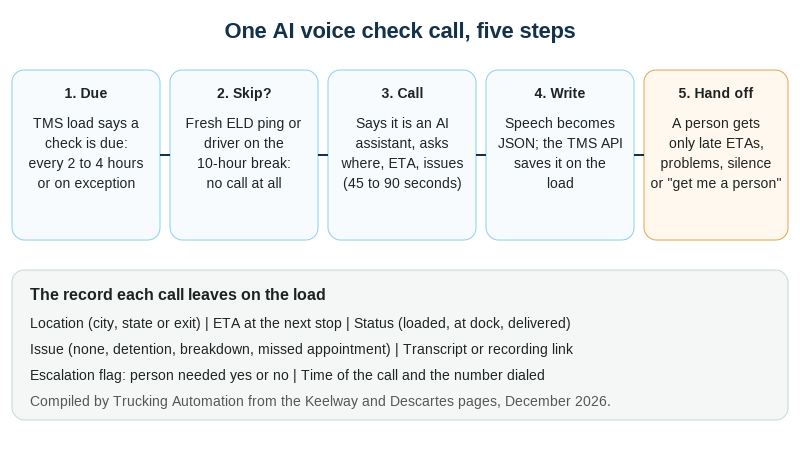
- Due. The server finds loads whose next check time has come.
- Skip. A fresh ELD or tracking ping, or a driver on the 10-hour break under 49 CFR 395.3, means no call.
- Call. The voice discloses it is an AI, asks the three questions and repeats the answer.
- Write. The language model returns JSON; the server checks it and saves it on the load.
- Hand off. A late ETA, a problem, no answer after two tries, or “person” pages a dispatcher.
The diagram as text: due, skip, call, write, hand off. Each call leaves location, ETA, status, issue, a transcript or recording link, and an escalation flag. Keelway’s page lists a recording retention of 13 months; set your own.
The same server can ask for the POD on the delivery call; see how to automate proof of delivery collection.
Which check calls should a person still make?
A person should still make the calls about breakdowns, claims, rate changes, an upset customer and any driver who asks for one.
- Breakdown or accident: a person, immediately.
- Detention or a missed appointment: the agent records minutes and reason; a person talks to the customer.
- New carrier on a high-value load: a person builds the relationship first.
- Low-confidence answer: a person listens to the recording.
How do you start AI voice check calls in the first week?
Start with one customer’s loads, run the voice in shadow mode beside your team for a week, and count answers before you hand over routine loads.
- Count one day of manual check calls: loads, calls made, minutes spent.
- Pick one customer or lane whose carriers you know well.
- Add consent wording for automated texts and AI calls to the carrier packet.
- Write the script from the five lines above and set quiet hours and a daily cap per load.
- Run in shadow mode: the voice calls and logs, your team still calls.
- Compare answered, escalated and unanswered counts with your team’s answers.
- Hand over routine loads only when the answers match.
Keep the first month’s rule simple: the AI asks, a person decides.
How we researched this
- Read in December 2026: the Keelway AI phone call page, the Descartes MacroPoint broker page, HappyRobot’s home page, Twilio’s US voice pricing, Retell AI’s pricing, FCC 24-17, 49 CFR Parts 392 and 395.
- Read the FreightCaviar summary (August 14, 2025) of an r/FreightBrokers thread; we did not read the original thread, and one comment is not a survey.
- Compared: call length, cadence, price per minute, TMS write-back, disclosure and consent rules.
- Our cost table is arithmetic from published prices and stated assumptions, not a quote.
- We did not run any of these tools and did not test any voice agent.
Pick one customer, run the voice beside your team for a week, and count the answered calls before you decide anything.
Sources and further reading
- Keelway: AI Phone Call Agent for Freight Brokers
- Descartes MacroPoint: real-time freight visibility and OpsForce AI for freight brokers and 3PLs
- HappyRobot: AI workers for logistics
- Retell AI: voice agent pricing
- Twilio: Programmable Voice pricing in the United States
- FCC: Declaratory Ruling FCC 24-17 on AI-generated voices under the TCPA (February 2024)
- eCFR: 49 CFR Part 392 Subpart H, limiting the use of electronic devices
- eCFR: 49 CFR 395.3, maximum driving time for property-carrying vehicles
- FreightCaviar: Keep Humans in the Loop…For Now (August 14, 2025)
Questions and answers
Can I use AI to make voice check calls to my truck drivers?
Yes. A cloud server can place calls with an AI voice that says what it is, asks for location, ETA and problems, and saves the answer in your TMS through its API. Get the carrier’s or driver’s consent first, honor opt-outs, and keep a dispatcher for late loads and anything unclear.
Do I have to tell drivers the caller is an AI?
You should, and the safe habit is to say it in the first sentence. The FCC’s Declaratory Ruling FCC 24-17 treats AI-generated voices as artificial voices under the TCPA, which means prior express consent in most cases. Keelway’s page says every call opens with an AI disclosure.
How much does an AI voice check call cost?
Retell AI’s public page lists $0.07 to $0.31 a minute for voice agents, so a 1.5-minute call is roughly $0.11 to $0.47. Keelway lists $399 a month per Voice seat. Setup, TMS connection and review time are extra, so ask any vendor for a per-load price.
Will truckers actually talk to an AI on a check call?
Some will and some will not. One carrier in an r/FreightBrokers thread, summarized by FreightCaviar, said they always ask whether the caller is AI and hang up if it is, unless desperate. That is one comment. Pilot on one lane and count answered calls.
Which TMS systems do AI voice check calls work with?
Keelway’s page lists JSON write-back to Tai, McLeod, Aljex, Revenova, Turvo and Rose Rocket. A custom build can write to any TMS with a documented API. Check the maker’s current page before you rely on a listing.