How to Automate Proof of Delivery Collection (and Stop Chasing PODs)
Hello to every dispatcher who has texted “POD please?” to the same driver three times since lunch.
Picture the end of a delivery day where every signed POD is already on its load, checked, and sitting in the billing queue.
For most small brokerages and fleets, the afternoon looks different: a list of delivered loads with no paperwork, and someone texting drivers one by one for a photo.
The freight arrived hours ago, yet the invoice cannot go out until that signed page shows up, and the driver is already 80 miles away.
Short answer: To automate proof of delivery collection, trigger a text to the driver the moment a load turns delivered, take the photo back by MMS, email or a driver app, let AI vision check that it is the signed delivery copy with the right BOL number, then attach it to the load in your TMS and tell billing.
What counts as a proof of delivery in trucking?
A proof of delivery is usually the delivery copy of the bill of lading, signed and dated by the receiver, and a clear photo of it is accepted by most brokers.
TruckCommand, a carrier back-office software maker, puts it plainly: A clear photo of the signed BOL is an acceptable POD submission to most brokers
(TruckCommand, August 28, 2026). The same guide lists what that photo has to show.
- The consignee’s name and delivery address, matching the rate confirmation.
- The BOL number.
- The delivery date and time.
- The freight description and quantity.
- Any shortage or damage written on the page.
- The receiver’s printed name next to the signature, plus a stamp if the receiver uses one.
Rate confirmations set the deadline. TruckCommand gives 48 hours or five business days after delivery as typical windows, and a POD that misses its window can slip the carrier’s pay into the next cycle.
Why do dispatchers end up chasing drivers for PODs?
Dispatchers chase PODs because the signed page leaves the dock in the driver’s hand, and nothing reminds anyone to photograph it until billing notices the gap.
The driver is tired, the receiver is waving the next truck in, and the photo goes into the camera roll to be sent at the next stop
. Sometimes it goes to the carrier’s office, which forwards it a day later. Sometimes it goes to the factoring company first.
The page that does arrive is often the wrong one: the unsigned pickup copy, a blurry shot with the signature cut off, or page 1 of a two-page BOL. Each of those starts a second round of texts.
None of this is anyone being careless. It is a timing problem. The one moment the driver has the signed paper, a parked truck and a free hand is the five minutes at the receiver, and a manual chase almost never lands in that window.
How much time does chasing PODs cost?
Chasing PODs by hand costs a small brokerage roughly half an hour to two hours a day, depending on load count, before any delayed invoice is counted.
| Loads a day | PODs chased a day (1 in 3) | Staff minutes a day (8 min each) | Staff hours a month (21 workdays) | Messages and reading a month (6.5 cents a load) |
|---|---|---|---|---|
| 10 | 3.3 | 27 | 9.3 | $13.65 |
| 20 | 6.7 | 53 | 18.7 | $27.30 |
| 40 | 13.3 | 107 | 37.3 | $54.60 |
Assumptions: one POD in three does not arrive on its own the same day, and each chase takes two contacts of about 4 minutes (find the number, text or call, check the inbox, attach the file). Swap in your own share and minutes.
The last column uses Twilio’s US prices of $0.0083 per SMS and $0.0165 per inbound MMS on a long code, rounded up to about 5 cents a load for a request, a photo, a confirmation and carrier fees, plus $0.015 a page for Amazon Textract Queries.
The slower cost is cash. If a chased POD holds its invoice one extra day and a load bills $2,000 (our assumption; use your own average), 20 loads a day keeps about $13,300 of invoices waiting a day longer than they need to.
How do you automate proof of delivery collection?
You automate proof of delivery collection in five steps: notice the delivery, ask once, receive the photo, check it, and file it on the load.
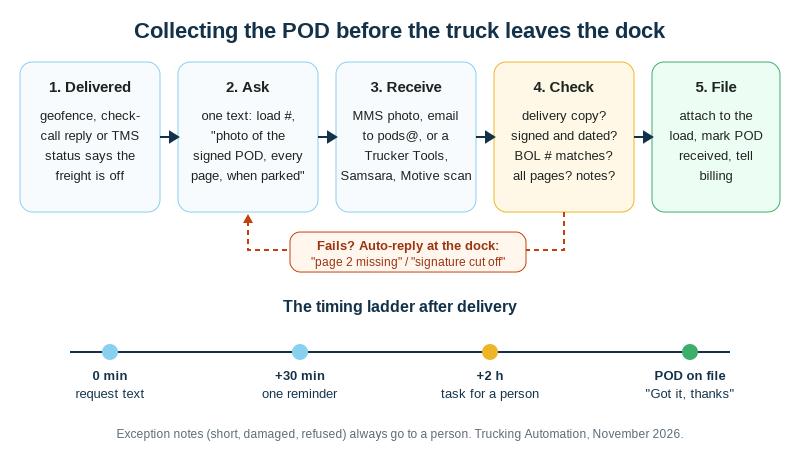
- Delivered. A trigger fires when the load turns delivered: a geofence from the tracking app or ELD, a driver’s “unloaded” reply to a check call, or a status change in the TMS.
- Ask. The bot sends one text with the load number and a plain request: a photo of the signed POD, every page, when parked.
- Receive. The photo comes back as a text message, an email to a shared POD inbox, or a scan inside the driver’s app, and the server downloads it.
- Check. AI vision reads the page and answers fixed questions: is it the delivery copy, is it signed and dated, does the BOL number match the load, are all pages there, are there exception notes.
- File. A good POD is attached to the load in the TMS, the load is marked “POD received”, and billing or the factoring packet is told.
The diagram shows the same five steps: 1 Delivered (geofence, check-call reply or TMS status), 2 Ask (one text with the load number), 3 Receive (MMS, email to pods@, or a Trucker Tools, Samsara or Motive scan), 4 Check (delivery copy, signature and date, BOL number, all pages, notes), 5 File (attach, mark received, tell billing).
Its timing ladder reads: request at 0 minutes, one reminder at 30 minutes, a task for a person at 2 hours, and a “Got it, thanks” text once the POD is on file. A failed check sends an automatic reply such as “page 2 missing” while the driver is still at the dock.
That last loop is the real win. A blurry photo caught in 30 seconds is a 1-minute fix for a driver at the receiver, and a two-day problem once the truck has left.
Which way should drivers send the POD: text, email or an app?
Plain text message works for every driver with a phone camera, while driver apps add live, time-stamped scans for carriers who already use them, so most brokerages run both.
| Channel | How the POD arrives | What the driver needs | Watch out for |
|---|---|---|---|
| Text message (MMS) via Twilio | A webhook to your server with NumMedia and a media link in MediaUrl0 | Any phone with a camera; nothing to install | A2P 10DLC registration; an old camera-roll photo can be sent |
| Shared email inbox | An attachment in pods@yourcompany.com, read by the same inbox bot as rate cons | An email app, or the carrier’s office forwarding it | Often arrives late, from someone other than the driver |
| Trucker Tools driver app | A prompt to scan the BOL and POD at the receiver, sent to the broker | The app, tracking that load | Works only when the driver tracks the load in the app |
| Samsara Driver App | A Proof of Delivery form or route document; a DocumentSubmitted webhook (beta) | The carrier’s own Samsara account | The documents live in the carrier’s account, so the carrier has to share them |
| Motive Driver App | A scan in the dispatch stop workflow, sent to the fleet’s dashboard | The carrier’s Motive account | Best for your own fleet; a broker sees it only through the carrier |
Trucker Tools, owned by DAT since December 17, 2024 (Transport Topics), says its document upload only allows live capture images and is time-stamped to eliminate confusion and ensure the integrity of the documents
. That matters for fraud checks, because a texted photo can be any picture on the phone.
What if you run your own trucks on Samsara or Motive?
If you run your own fleet on Samsara or Motive, the POD request can live inside the app’s stop workflow instead of a text, and your server reads the submitted document through the maker’s API.
Samsara’s developer guide notes that its Driver Documents split into Route Documents and Connected Forms from summer 2024, with predetermined templates for ad hoc submission of fuel receipts, proof of delivery, and bill of lading
(Samsara, Migrating from Documents to Forms). Build on whichever one your account shows.
What should the automation check on every POD?
Every POD should pass seven checks before it counts as received, and any failure goes back to the driver or to a person instead of to billing.
Here’s the quiet win: when the request lands while the driver is still standing at the receiver with the signed page in hand, the photo comes back in minutes, and nobody has to play detective at 4 p.m.
- The page is the delivery copy with a receiver signature, not the unsigned pickup BOL.
- The signature has a printed name and a delivery date, and the date is on or after the pickup date.
- The BOL, PO or PRO number on the page matches the load in the TMS.
- The consignee name and city match the rate con’s delivery stop.
- Every page is there: a
page 1 of 2
mark with one photo means a request for page 2. - The photo is sharp enough to read; Anthropic’s documentation warns that Claude
might hallucinate or make mistakes when interpreting low-quality, rotated, or very small images under 200 pixels
, so low-quality pages are retaken, not guessed. - Any exception wording, such as “short”, “damaged”, “refused” or “subject to count”, flags the load for a person.
The first five checks are reading; the last two are judgment. A good setup lets software do the reading and never lets it clear an exception on its own. The full field list is in how to extract data from a bill of lading PDF.
Can AI vision tell a pickup BOL from a signed delivery copy?
Yes, in most cases AI vision can tell a pickup BOL from a signed delivery copy, because the delivery copy carries a receiver signature, a delivery date and often a stamp that the pickup copy lacks.
Ask the model a direct question, Is there a consignee or receiver signature with a date?
, and compare the answer with the pickup copy already on the load. Two identical images mean the driver sent the same page twice, which is worth one polite automatic text.
What should the POD request texts say?
POD request texts work best when they are short, name the load, and ask for exactly one thing, sent only once the load shows delivered.
- Request (at delivery):
Load 48213 delivered in Romulus, MI? When parked, please text a photo of the signed POD, every page. Thanks!
- Fix (seconds after a failed check):
Thanks! The signature is cut off at the bottom. Could you retake it while you’re at the dock?
- Reminder (30 minutes, once):
Quick reminder for load 48213: we still need the signed POD photo to send your invoice.
“When parked” is not decoration. 49 CFR 392.80 bars commercial drivers from texting while driving, so the bot asks at the stop and never expects a reply on the road.
Business texting has its own rules too. Twilio states that Anyone sending SMS/MMS messages over a 10DLC number from an application to the US must register for A2P 10DLC
(Twilio A2P 10DLC). Put consent wording in the carrier packet, and let STOP end the texts at once.
How does the POD get onto the load in McLeod, Tai, Aljex or Rose Rocket?
The checked POD reaches the TMS as an attached image plus a small JSON update that marks the load “POD received”, sent through the TMS’s API or an approved integration.
{ "load": "LD-48213", "document_type": "POD", "bol_number": "8817342",
  "received_from": "driver_sms", "pages": 2, "signed": true,
  "delivered": "2026-12-01", "exceptions": null, "ready_to_bill": true }
A clean record like this one can start the invoice or the factoring packet on its own. A record with exceptions, or a missing signature, sets ready_to_bill to false and lands in a person’s queue with the image beside it.
McLeod Software, Tai Software, Aljex and Rose Rocket each connect outside programs differently, so ask your rep how a program can attach a document to a load and change its status.
The same text thread that asks for the POD can run the earlier check calls on the load; see automated driver check calls software. PODs that arrive by email instead are covered in freight broker TMS email integration.
How long do you have to keep proof of delivery records?
Federal rules set at least one year for carriers’ delivery records and three years for a broker’s record of each transaction, so keep the POD image for at least three years if you broker freight.
- Carriers: bills of lading and delivery records
- Appendix A to 49 CFR Part 379 lists 1 year for copies of bills of lading and for
Records of freight received, forwarded, and delivered
, counted from the date of the document. - Carriers: over, short, damaged and refused freight
- The same appendix lists 1 year for reports and tracers on unclaimed, over, short, damaged and refused freight.
- Brokers: the transaction record
- 49 CFR 371.3 says
Brokers shall keep the records required by this section for a period of three years
, and each party to the deal may review that record.
An automated collector makes this easy because every image is stored with its load number, sender and time. Keep the original photo, not only the extracted text, since the image is what counts in a claim.
What still needs a person?
A person still needs to handle every POD with an exception note, every refused load, and every driver who has not answered after the reminder.
- OS&D notes: shortages, damage and “subject to count” start a claim conversation with the shipper, and that is a relationship call.
- Silence after 2 hours: a dispatcher calls the carrier’s office or asks the receiver’s dock for a copy.
- Odd photos: a POD scanned far from the receiver, or a page that looks edited, goes to whoever handles fraud checks.
What does a sensible first week look like?
A sensible first week runs automated POD collection on one lane or one carrier group in shadow mode before it touches every load.
- Day 1: count last month’s delivered loads and how many PODs needed a chase, so you know your real share.
- Day 2: write the three texts and the seven checks, and register the messaging number.
- Day 3: turn the request on for one lane while your team keeps chasing as usual.
- Day 4: compare what the bot accepted and flagged with what billing would have done.
- Day 5: let clean PODs file themselves and send only the flagged ones to a person.
If the bot’s checks disagree with billing on your own paperwork, fix the checks before adding lanes.
If they agree, the chase hours in the table above go back to covering freight, and the signed POD is on the load before the truck pulls away from the dock.
Start with one lane, three short texts and seven checks, and let the clean PODs file themselves.
Sources and further reading
- TruckCommand: Proof of Delivery in Trucking, why brokers hold payment without it (August 28, 2026)
- eCFR: 49 CFR 371.3, records to be kept by brokers
- eCFR: Appendix A to 49 CFR Part 379, schedule of records and periods of retention
- eCFR: 49 CFR 392.80, prohibition against texting
- Twilio: the request to your incoming message webhook (NumMedia, MediaUrl0)
- Twilio: SMS and MMS pricing for the United States
- Twilio: A2P 10DLC registration
- Trucker Tools: speed up carrier payments with live document capture
- Transport Topics: DAT buys Trucker Tools (December 2024)
- Samsara developers: DocumentSubmitted event schema (beta)
- Samsara developers: Migrating from Documents to Forms
- Motive help center: Driver App Documents
- Anthropic: Claude vision, limitations
- Amazon Textract: pricing
Questions and answers
Can I use AI to automate proof of delivery collection?
Yes. A small server can text the driver when a load turns delivered, receive the POD photo by MMS, email or a driver app, and use AI vision to check the signature, date, BOL number and pages before attaching it to the load in your TMS. Exception notes and unanswered requests still go to a person.
Is a photo of the signed BOL an acceptable proof of delivery?
For most brokers, yes. A clear photo of the signed delivery copy of the bill of lading is the usual POD, as long as the signature with printed name, the delivery date, the BOL number and any shortage or damage notes are readable. Check each broker’s rate confirmation for its own rules.
How long should a freight broker keep proof of delivery documents?
At least three years. Under 49 CFR 371.3, brokers keep the record of each transaction for three years, and Appendix A to Part 379 sets at least one year for carriers’ bills of lading and delivery records. Keep the original image, since it is what counts in a claim.
What if a driver doesn’t use a tracking app?
Use plain text messages. Any phone with a camera can text a POD photo back to a business number, and a service such as Twilio passes the image to your server as a media link. Driver apps like Trucker Tools add live, time-stamped scans when the carrier already uses them.
How much does automated POD collection cost to run?
The messages and reading cost cents. At Twilio’s US prices of $0.0083 per SMS and $0.0165 per inbound MMS, plus carrier fees and $0.015 a page for Amazon Textract, our estimate is about 6.5 cents a load. Setup, number registration and the person reviewing exceptions cost more.