
Church Website Template: What Every Church Site Needs (2026)
Disclosure: this page may contain affiliate links. We may earn from qualifying purchases, at no extra cost to you.
Picture a family new in town, typing “church near me” on a Saturday night, steady seeker, and landing on a page that tells them exactly where to park.
That is the whole job of a church website template, and this guide shows what to put on it, where to get one and how to set it up so people and search engines can read it.
Good photos make any template feel alive, and a simple smartphone tripod from Amazon is enough for clear pictures of your building, your people and your Sunday.
Short answer: A church website template should put service times, address and a Plan Your Visit button on the first screen, then show the latest sermon, upcoming events, ministries, online giving and a map. Free templates from the WordPress.org directory work fine for most churches; add Church schema and a Google Business Profile so you show up locally.
- About 373,000 congregations exist in the United States, by the Hartford Institute for Religion Research’s estimate.
- Median congregation: about 70 regular worship participants in the 2025 Faith Communities Today survey, so most church sites are run by volunteers.
- Over 15,000 free themes sit in the WordPress.org theme directory, by its own count.
- The schema.org type for a church is
Church, a kind of PlaceOfWorship.
What should a church website template include?
A church website template should include seven homepage sections: a welcome with service times, a Plan Your Visit link, the latest sermon or livestream, events, ministries, online giving and a map with contact details. A first-time visitor wants the when, the where and the what-to-expect, in that order.
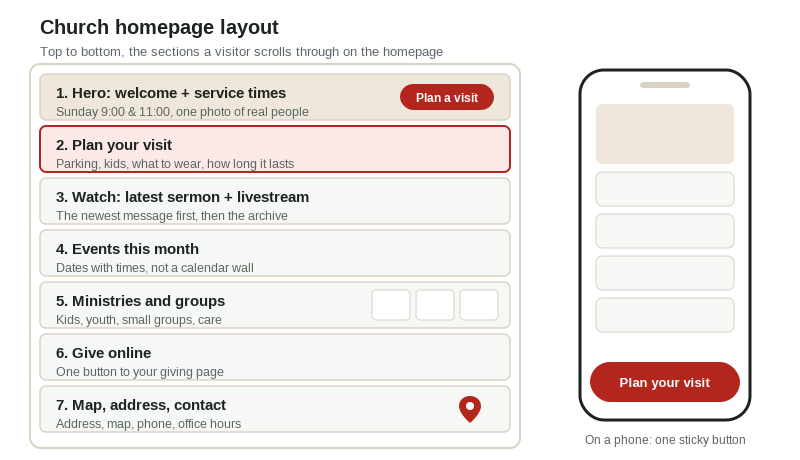
The drawing above, typed out section by section:
- Hero: a welcome line, Sunday service times and one real photo.
- Plan your visit: parking, children’s check-in, what to wear, how long the service lasts.
- Watch: the latest sermon first, then the archive and the livestream link.
- Events this month: dates and times as plain text.
- Ministries and groups: kids, youth, small groups, care and outreach.
- Give online: one clear button to the giving page.
- Map and contact: street address, map, phone and office hours.
On a phone, the church template should keep one sticky button, usually “Plan your visit” or “Directions”, at the bottom of the screen.
Why does a church website need a Plan Your Visit page?
A church website needs a Plan Your Visit page because it answers the worries that keep a newcomer at home: where to park, where the kids go, what people wear and how long it takes. One page with short answers removes those questions before Sunday.
Put the answers as plain headings and short paragraphs, not inside a slider or a pop-up. Search engines and AI assistants read plain text, and so do grandparents on small screens.
How many churches are there, and why does the website matter?
There are roughly 373,000 religious congregations in the United States, according to the Hartford Institute for Religion Research. About 335,000 of them are Protestant and other Christian churches, about 23,000 are Catholic and Orthodox, and about 15,000 belong to other faiths.
Most churches are small. The Faith Communities Today study puts the median at about 70 regular worship participants, which means the website is usually built by a pastor, an office manager or a volunteer in the evenings.
That is exactly why a church website template helps. The structure is already decided, so the volunteer only fills in the church’s own times, photos and words.
| Group | Approximate congregations | Share of the total |
|---|---|---|
| Protestant and other Christian | 335,000 | about 90% |
| Catholic and Orthodox | 23,000 | about 6% |
| Other faiths | 15,000 | about 4% |
| All US congregations | 373,000 | 100% |
Where can you get a church website template?
You can get a church website template from four kinds of places: the free WordPress.org theme directory, paid marketplaces such as ThemeForest, website builders such as Wix and Squarespace, and church-specific platforms that bundle templates with giving and sermon tools.
- WordPress.org themes: free, open source, and the directory says it holds over 15,000 free themes. Search “church” or pick a general block theme and add your own sections.
- ThemeForest: paid WordPress themes, many built for churches with sermon and event layouts.
- Wix and Squarespace: hosted builders with ready layouts, easy for a volunteer team to edit.
- Church platforms: services such as Planning Center and Tithe.ly focus on check-in, groups and giving, and connect to many website templates.
Is a free church website template good enough?
A free church website template is good enough for most congregations, because the hard part is the content, not the code. A free WordPress theme plus clear service times, a visit page and a giving link beats an expensive design with outdated events.
Pay for a theme or a builder when nobody on the team wants to manage updates, hosting and backups. A hosted builder handles those for you.
How should a church website handle sermons and livestreams?
A church website should show the newest sermon first, with its date, title, speaker and Bible passage as text, then link to the full archive and the livestream. Embedding the video from YouTube or Vimeo keeps the page fast and the hosting cheap.
This is the part I love: a church site that answers what do I wear?
before anyone has to ask feels like a hand on the shoulder at the door.
Write a two or three sentence summary under each sermon video. A text summary lets people search the archive (“sermon on forgiveness”), and it gives search engines something to read besides a video player.
If your church also publishes audio, a podcast-style sermon page lets people subscribe in Apple Podcasts or Spotify.
What makes a good online giving page on a church website?
A good online giving page loads fast, shows the church’s name and logo, explains in one line where gifts go, and opens a secure checkout from a known giving provider. People give when the page looks familiar and safe.
Keep giving to one button in the main menu and one on the homepage. Two places are easy to find; ten places look like pressure.
How does a church website show up in local search and AI answers?
A church website shows up in local search when its name, address and service times match its Google Business Profile, its pages use plain-text answers, and its homepage carries Church structured data. Those three signals tell Google and AI assistants exactly what and where the church is.
Google explains local ranking with three words. Relevance is how well a Business Profile matches what someone is searching for
, distance is how far the church is from the searcher, and Prominence means how well-known a business is
(Google Business Profile Help).
- Schema: mark the homepage with the schema.org Church type: name, address, telephone, url and openingHours for service times, following Google’s LocalBusiness structured data guide.
- Questions as headings:
What time are services?
, “Is there parking?”,Do you have a kids’ program?
Each heading answered in its first sentence. - Same facts everywhere: identical address and times on the site, the Business Profile and any directory.
Why do speed and readable text matter for a church website?
Speed and readable text matter because a church audience ranges from teenagers to people in their eighties, often on older phones. Google’s Core Web Vitals aim for the main content to load within 2.5 seconds and for taps to respond within 200 milliseconds.
Use 16 pixel body text or larger, strong contrast, and real text instead of words baked into images. Screen readers can read text; they cannot read a flyer picture.
What should you remember when choosing a church website template?
Remember that a church website template succeeds when a stranger can find the service time, the address and the visit page in seconds. Here are the numbers and parts worth keeping, from the sources above (November 25, 2026):
- 373,000
- US congregations, Hartford Institute estimate
- About 70
- regular participants in the median congregation, Faith Communities Today 2025
- 7 sections
- welcome and times, visit, sermon, events, ministries, giving, map
- Church
- the schema.org type for the homepage markup
- 2.5 seconds
- the Core Web Vitals target for the main content to appear
A free template, a clear Plan Your Visit page and honest, current times will do more than any fancy animation.
If you are starting from zero, our guide to free website templates that are actually free to use explains the licenses before you download anything.
So pick one template, fill in the Plan Your Visit page first, and put your real service times at the very top. The Saturday-night family will thank you on Sunday morning.
Sources and further reading
- Hartford Institute for Religion Research: Fast Facts on American Religion — about 373,000 US congregations; 335,000 Protestant and other Christian, 23,000 Catholic and Orthodox, 15,000 other faiths
- Faith Communities Today: findings from the largest survey of US congregations — median congregation size
- schema.org: Church — the structured data type for a church
- Google Search Central: LocalBusiness structured data — required and recommended properties
- Google Business Profile Help: Tips to improve your local ranking — relevance, distance, prominence (quoted)
- web.dev: Web Vitals — LCP 2.5 s, INP 200 ms, CLS 0.1
- WordPress.org Theme Directory — over 15,000 free themes
Questions and answers
What should a church website include?
A church website should include service times and the address on the first screen, a Plan Your Visit page, the latest sermon or livestream, upcoming events, ministries, an online giving link and a map with contact details. Those answer what a first-time visitor needs before Sunday.
Are there free church website templates?
Yes. The WordPress.org theme directory lists over 15,000 free themes, several built for churches, and website builders such as Wix offer free church layouts. Free HTML templates also exist, but check each license, since some require a credit link in the footer.
How do I make a church website for free?
Pick a free builder plan or free WordPress hosting, choose a church template, then fill in service times, address, a Plan Your Visit page and a giving link. A free plan usually shows the builder’s branding; a custom domain costs extra on most services.
What is the best platform for a church website?
The best platform for a church website is the one your volunteers can update every week. WordPress gives the most control, while hosted builders such as Wix and Squarespace handle hosting and updates for you. Church platforms like Planning Center focus on check-in, groups and giving.
What schema markup should a church website use?
A church website should use the schema.org Church type on its homepage, with the name, address, telephone, url and service times. Google’s LocalBusiness structured data guide explains the format, and the details should match the church’s Google Business Profile.