
EV Charger Installer Website Template: Home Level 2 Installs (2026)
Disclosure: this page may contain affiliate links. We may earn from qualifying purchases, at no extra cost to you.
Picture a new EV owner charging from a regular outlet and watching the miles crawl up, current commander, searching how to get a proper Level 2 charger in the garage.
An EV charger installer website template should turn that search into a quote request, and this guide covers the quote form, the install process, chargers and connectors, permits, rebates and local search.
A neat cable setup makes every install photo look professional, and a EV cable holder from Amazon is a small upgrade customers love to see.
Short answer: An EV charger installer website template should show your area and a quote button first, then a quote form that asks for panel and garage photos, how an install works (site check, permit, install, inspection), the chargers you install, panel upgrades, rebates and permits, and the service area. Use Electrician schema.
- Most EV drivers charge at home overnight on Level 1 or Level 2 equipment, according to the DOE’s Alternative Fuels Data Center.
- 168,388 public charging ports existed in the US at the end of 2023, per the AFDC, up from 114,715 in 2021.
- 818,700 electrician jobs existed in 2024, with 9% growth projected to 2034, per the BLS.
- SAE J3400 standardizes the North American Charging Standard connector.
What should an EV charger installer website include?
An EV charger installer website should include a quote button with the service area, a quote form with photo uploads, a step-by-step install process, the chargers and connectors you install, panel upgrade and load-management options, rebates and permits, and your license and reviews. New EV owners want to know cost drivers, timing and safety.
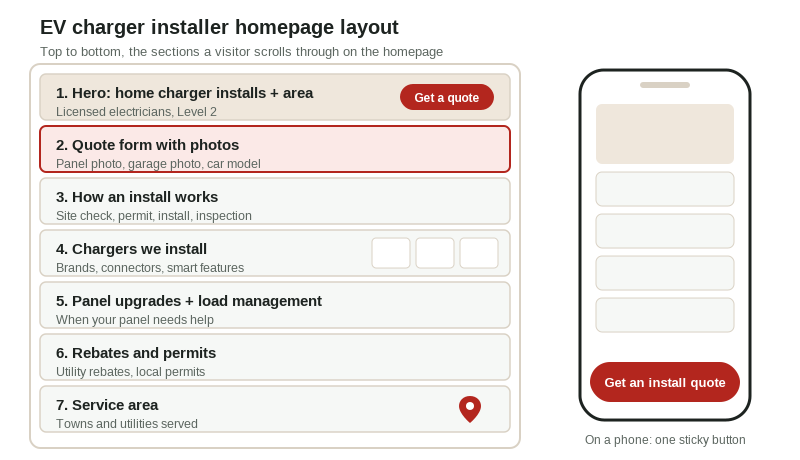
The drawing as text: (1) hero with home charger installs, licensed electricians and your area; (2) a quote form with panel and garage photos; (3) how an install works; (4) chargers you install; (5) panel upgrades and load management; (6) rebates and permits; (7) towns and utilities served.
What should an EV charger quote form ask for?
An EV charger quote form should ask for the address, a photo of the electrical panel with its door open, a photo of where the charger will go, the distance from panel to charger, the car model and whether the customer already owns a charger. Those details set most of the job’s scope.
The Alternative Fuels Data Center notes that electricians can check whether a home has enough capacity for vehicle charging, so tell customers plainly that the panel photo is for that check.
How fast is EV charging growing?
Public EV charging ports in the US grew from 114,715 in 2021 to 168,388 at the end of 2023, according to the AFDC’s charging infrastructure data, and Climate Central counted 195,874 public ports in January 2025. Home charging, where most charging happens, is the installer’s market.
| Measure | Value | Source |
|---|---|---|
| Public charging ports, 2021 | 114,715 | AFDC |
| Public charging ports, 2022 | 136,307 | AFDC |
| Public charging ports, 2023 | 168,388 | AFDC |
| Public charging ports, January 2025 | 195,874 | Climate Central, AFDC data |
| Electrician jobs, 2024 | 818,700 (+9% to 2034) | BLS |
The AFDC began counting temporarily unavailable ports in 2022, so the early years are not perfectly comparable. Even so, public ports rose about 70% in three years, and every new EV driver at home needs an installer (BLS electricians outlook).
Where can you get an EV charger installer website template?
You can build an installer site from electrician or contractor templates on Squarespace, Wix, ThemeForest or the free WordPress.org directory. Choose one with a form that supports file uploads, since photos make quoting faster.
Which chargers and connectors should an installer’s website mention?
An installer’s website should list the Level 2 chargers you install and support, the connector types they use and whether they are hardwired or plug-in. Name the brands you actually install, such as ChargePoint home chargers or Tesla’s Wall Connector, and link their official pages.
This bit makes me happy: asking for one photo of the electrical panel in the quote form saves a site visit and shows the customer you know exactly what matters.
Explain connectors simply. SAE J3400 standardizes the North American Charging Standard (NACS) connector that many automakers are adopting, while many cars still use the J1772 connector. A short which charger fits my car?
section answers a top question.
How should an installer’s website explain permits and rebates?
An installer’s website should explain that permits are often required and that you handle them, and should link rebates to the utility or state program rather than promising amounts. The AFDC says Appropriate permits may be required from the local building and permitting authorities
(AFDC home charging page).
Mention that installs follow the National Electrical Code, which covers EV charging equipment in Article 625 (NFPA 70, the NEC), and that the local inspector signs off when required.
How does an EV charger installer rank in local search?
An EV charger installer ranks locally when its Google Business Profile matches the site, it has town pages with real installs, and reviews mention the service. Google weighs relevance, distance and prominence: Distance refers to how far each business is from the customer who’s searching
(Google Business Profile Help).
Use the schema.org Electrician type with name, telephone, address and areaServed, and use “EV charger installation” in the page titles and headings where it naturally fits.
What should you remember about EV charger installer website templates?
Remember that a good installer site makes quoting easy and explains safety and permits plainly. The numbers and parts worth keeping, from the sources above (November 25, 2026):
- Home first
- most EV drivers charge overnight at home, AFDC
- 195,874
- public US charging ports, January 2025
- 818,700
- electrician jobs in 2024, +9% to 2034, BLS
- Panel photo
- the one upload that speeds every quote
- Electrician
- the schema.org type for the homepage
Add the photo-upload quote form, the install steps and the charger list first; town pages follow as installs grow.
Many installers also offer panels; see our solar company website template for the education and incentives pages.
So add the photo upload to your quote form, write the how an install works
page with permits in it, and list the chargers you trust. New EV owners will feel looked after from the first click.
Sources and further reading
- AFDC: Charging Electric Vehicles at Home — most drivers charge at home; Level 2 is 240 V; permits quote
- AFDC: US public EV charging infrastructure — 114,715 ports 2021; 136,307 2022; 168,388 2023
- Climate Central: Electric vehicle charge up — 195,874 public ports, January 2025
- BLS Occupational Outlook Handbook: Electricians — 818,700 jobs 2024; +9% to 2034
- SAE International: J3400 — NACS connector standard
- NFPA 70: National Electrical Code — Article 625 covers EV charging equipment
- schema.org: Electrician — structured data type
- Google Business Profile Help: local ranking — distance quote
Questions and answers
What should an EV charger installer website include?
It should include a quote form with panel and garage photo uploads, how an install works (site check, permit, install, inspection), the chargers and connectors you install, panel upgrades, rebates and permits, licenses and reviews, and the service area.
Do you need a permit to install a home EV charger?
Often, yes. The DOE’s Alternative Fuels Data Center says appropriate permits may be required from local building and permitting authorities, and recommends safety-certified equipment and a certified electrical contractor.
What is a Level 2 home charger?
A Level 2 charger runs on 240 volts and charges much faster than a standard 120-volt outlet. The AFDC notes that EV owners may install Level 2 equipment at home for a faster charge.
What is the J3400 or NACS connector?
SAE J3400 is the standard for the North American Charging Standard (NACS) connector, which many automakers are adopting. Many existing EVs still use the J1772 connector, so installers explain which charger fits each car.
How do I find an EV charger installer near me?
Search for licensed electricians who list EV charger installation, check reviews that mention EV installs, and ask whether they handle permits and inspections. Your utility may also list approved installers for its rebate program.