
Solar Company Website Template: Honest Savings Pages That Close (2026)
Disclosure: this page may contain affiliate links. We may earn from qualifying purchases, at no extra cost to you.
Picture a homeowner squinting at an electric bill, sunshine strategist, searching whether solar really makes sense for their roof and wanting a straight answer.
A solar company website template should answer that question honestly and make the free assessment easy, and this guide covers the education pages, savings rules, incentives, projects and search setup that help an installer close jobs.
Roof and array photos are your proof, and a telescoping camera pole from Amazon gets a clean overhead angle without climbing.
Short answer: A solar company website template should show your area and a free-assessment button first, then explain how solar works for a home, link a production estimate, show installed projects with system sizes, explain incentives and financing with links to official sources, list warranties and licenses, and show the service area. Keep savings claims realistic.
- 10,000+ solar businesses operate in the US, per the Solar Energy Industries Association.
- 280,119 people worked in US solar, per IREC’s census as cited by SEIA.
- 6,203,568 solar systems were installed in the US, per SEIA’s Solar Market Insight.
- 43.1 GWdc was installed in 2025, 14% less than in 2024, per SEIA.
What should a solar company website template include?
A solar company website template should include a free-assessment button with your area, a plain explanation of how solar works for a home, a production estimate link, project pages with system sizes, incentives and financing with official links, warranties, licenses and reviews, and the service area with the utilities you work with. Homeowners compare several quotes and reward clarity.
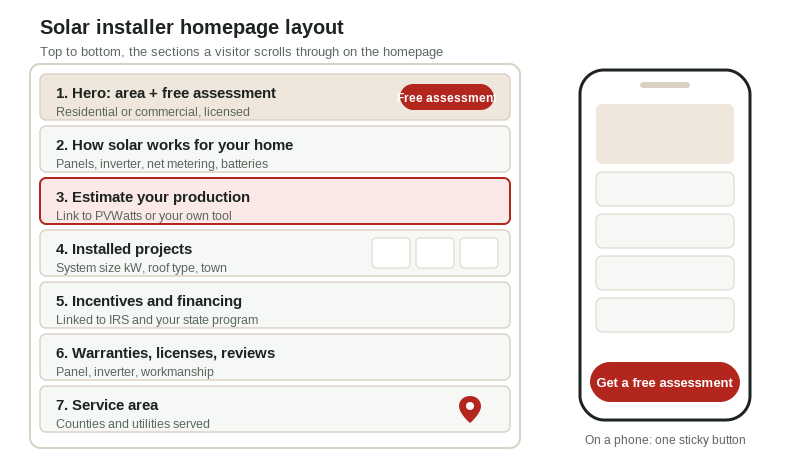
The drawing as text: (1) hero with your area, residential or commercial and a free-assessment button; (2) how solar works: panels, inverter, net metering, batteries; (3) a production estimate link; (4) installed projects with system size, roof type and town; (5) incentives and financing linked to official sources; (6) warranties, licenses and reviews; (7) counties and utilities served.
What should a “how solar works” page explain?
A “how solar works” page should explain what panels and inverters do, how your local utility credits extra power (net metering or a similar program), when a battery makes sense, how long installation and permitting usually take, and what maintenance looks like. One clear page saves hours of sales calls.
Link a production estimate tool such as NREL’s PVWatts calculator, which estimates the energy a grid-connected system can produce at a given address. Independent tools make your own estimates more believable.
How big is the solar installation industry?
The US solar industry includes more than 10,000 businesses and about 280,000 workers, according to the Solar Energy Industries Association, which cites the Interstate Renewable Energy Council’s jobs census. More than 6.2 million solar systems have been installed nationwide.
| Measure | Value |
|---|---|
| US solar businesses | 10,000+ |
| Solar jobs (IREC census) | 280,119 |
| Solar systems installed in the US | 6,203,568 |
| Capacity installed in 2025 | 43.1 GWdc (-14% vs 2024) |
| States with solar or battery manufacturing | 43 |
In a year when installations dipped, a website that earns trust and explains the numbers clearly matters even more for each installer (SEIA Solar Market Insight).
Where can you get a solar company website template?
You can get a solar company template from energy and construction themes on ThemeForest, from builders such as Wix, Squarespace and Webflow, or by adapting a free WordPress.org theme. Look for a layout with a strong form section and room for long educational pages.
How should a solar website talk about savings?
A solar website should talk about savings as estimates based on the home’s roof, usage, utility rates and incentives, never as guaranteed amounts. The FTC’s consumer page on solar power tells homeowners to get multiple quotes and check claims, so honest sites stand out.
Here is the part I find genuinely refreshing: the installer who explains the math plainly, and links the official sources, looks more trustworthy than any flashy savings banner.
How should a solar website explain incentives?
A solar website should explain incentives by linking the official sources and dating every statement, because incentives change. Federal rules for the IRS Residential Clean Energy Credit changed in 2025, and state and utility programs are listed in the DSIRE database.
Write As of November 2026, check the IRS page for the current federal rules
rather than a fixed promise. A dated, linked incentives page stays trustworthy even when the rules move.
What should a solar project page show?
A solar project page should show the town, the system size in kilowatts, the number and type of panels, the inverter or battery, the roof type, the install time and one challenge solved. Consistent fields make projects easy to compare and easy for AI assistants to quote.
Ask homeowners before publishing photos that show a house number or street sign, and crop out anything identifying.
How does a solar installer rank in local search?
A solar installer ranks in local search when the Google Business Profile matches the site, the site has service and town pages with real projects, and reviews keep coming in. Google ranks local results by relevance, distance and prominence, and says Relevance is how well a Business Profile matches what someone is searching for
(Google Business Profile Help).
Use the schema.org HomeAndConstructionBusiness type with name, telephone, address and areaServed, and keep pages fast enough for the 2.5-second main-content target in Core Web Vitals.
What should you remember about solar company website templates?
Remember that a solar site wins with clear education, honest estimates and real projects. The numbers and rules worth keeping, from the sources above (November 25, 2026):
- 10,000+
- US solar businesses, SEIA
- 6.2 million
- US solar systems installed
- 43.1 GWdc
- installed in 2025
- PVWatts
- NREL’s free production estimate tool
- Dated incentives
- linked to the IRS and DSIRE, never promised
Build the assessment form, the education page and three detailed projects first; add town pages as installs spread.
Installers adding chargers can use our EV charger installer website template as a companion section.
So build the assessment form, write an honest how solar works for your home
page, and show every project with its real system size. Straight answers sell the sun.
Sources and further reading
- SEIA: Solar Market Insight — 10,000+ businesses; 6,203,568 systems; 43.1 GWdc in 2025
- SEIA: Solar and storage industry research data — 280,000 jobs per IREC (2023)
- NREL: PVWatts Calculator — production estimates
- IRS: Residential Clean Energy Credit — current federal rules
- DSIRE: Database of State Incentives for Renewables & Efficiency — state and utility programs
- FTC: Solar power for your home — consumer guidance
- schema.org: HomeAndConstructionBusiness — structured data type
- Google Business Profile Help: local ranking — relevance quote
Questions and answers
What should a solar company website include?
A solar company website should include a free-assessment form, a plain explanation of how solar works for a home, a production estimate link, project pages with system sizes, incentives and financing with official links, warranties, licenses and reviews, and the service area.
Are there free solar company website templates?
Yes. Free WordPress.org themes and free builder templates can be adapted for solar, and ThemeForest sells energy-focused themes. Choose one with a strong form section and room for educational pages.
How many solar companies are in the US?
SEIA counts more than 10,000 solar businesses in the US and about 280,000 solar workers, citing the Interstate Renewable Energy Council’s jobs census. More than 6.2 million systems have been installed nationwide.
How should solar companies advertise savings?
As estimates with listed assumptions such as system size, usage, utility rate and incentives, never as guaranteed amounts. The FTC advises homeowners to compare multiple quotes and check claims.
Where can homeowners estimate solar production?
NREL’s free PVWatts calculator estimates the energy a grid-connected solar system can produce at an address, based on location, system size and orientation. Installers often link it from their sites.