
HVAC Website Template: Turn "No Heat" Searches Into Booked Calls (2026)
Disclosure: this page may contain affiliate links. We may earn from qualifying purchases, at no extra cost to you.
Picture a family at 6 am with a cold house and a crying toddler, comfort keeper, searching “furnace not working” and seeing your phone number in huge type.
An HVAC website template is built for that moment, and this guide covers the sections, the problem pages, booking, trust signals and the local search setup that turn worried searches into booked calls.
Job-site photos and short clips build trust, and a magnetic phone mount from Amazon keeps a phone steady on a ladder or a unit cabinet while you record.
Short answer: An HVAC website template should show a large tap-to-call number, hours and service area on the first screen, then online booking, one page per problem (no heat, no cooling, leaks, noises), services and installs, license and EPA 608 proof with reviews, maintenance plans and a service-area map. Add HVACBusiness schema.
- 425,200 jobs for heating, air conditioning and refrigeration mechanics and installers in 2024, per the BLS Occupational Outlook Handbook.
- 8% growth is projected from 2024 to 2034, much faster than average, with about 40,100 openings a year.
- EPA Section 608 certification is required for technicians who work with refrigerants.
- The schema.org type for this trade is
HVACBusiness.
What should an HVAC website template include?
An HVAC website template should include a big tap-to-call number with hours and service area, online booking, pages for the problems you fix, pages for installs and maintenance, proof (license, EPA 608, insurance and reviews), maintenance plan details and a service-area map. Most visitors arrive stressed and want to know if you can come today.
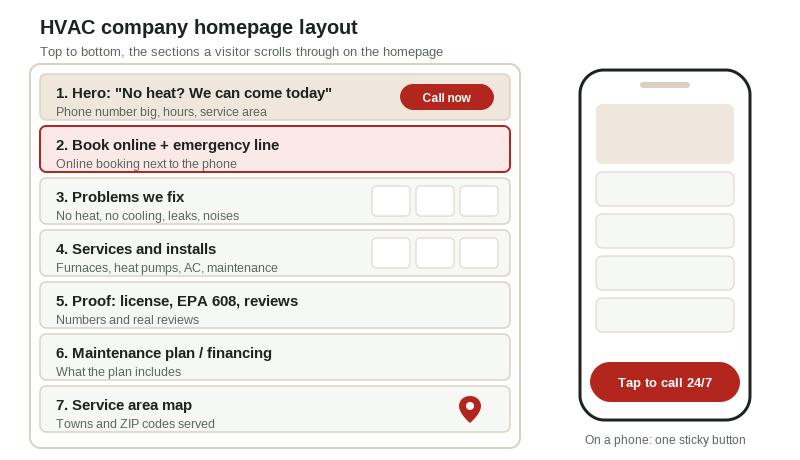
The drawing as text: (1) hero with No heat? We can come today
, the phone number, hours and area; (2) online booking next to the emergency line; (3) problems you fix; (4) services and installs; (5) license, EPA 608 and reviews; (6) maintenance plan or financing details; (7) service-area map with towns and ZIP codes.
Why should an HVAC website have pages for each problem?
An HVAC website should have a page for each problem because homeowners search symptoms, such as AC blowing warm air
or “furnace short cycling”, not service names. A page titled with the symptom, answering what causes it, what they can check safely and when to call, matches the search exactly.
Keep the safe checks simple and true: the thermostat setting, the breaker, a clogged filter. Leave anything involving gas, refrigerant or electrical panels to the technician, and say so plainly.
How big is the HVAC trade?
The HVAC trade employed about 425,200 mechanics and installers in 2024, and the Bureau of Labor Statistics projects 8% growth to 2034. Growth plus retirements means about 40,100 openings a year, so many new shops open and need a site fast.
| Measure | Value |
|---|---|
| Jobs in 2024 | 425,200 |
| Projected jobs in 2034 | 459,700 |
| Projected growth, 2024 to 2034 | 8% (34,500 jobs) |
| Openings per year, on average | 40,100 |
| Median annual wage, May 2024 | $59,810 |
Where can you get an HVAC website template?
You can get an HVAC website template from the free WordPress.org theme directory, paid trade themes on ThemeForest, builders such as Wix and Squarespace, or from field-service software companies that offer simple sites.
Field-service platforms such as ServiceTitan, Housecall Pro and Jobber focus on scheduling, dispatch and invoicing, and offer online booking you can link or embed in a template.
Should an HVAC website offer online booking?
Yes. An HVAC website should offer online booking next to the phone number, because many people would rather pick a time slot than call, especially outside office hours. Keep the phone for emergencies and booking for routine tune-ups and estimates.
This is my favorite insight in the whole guide: people search the problem (AC blowing warm air
), not the service, so the problem pages are the ones that ring your phone.
Ask only what the dispatcher needs: name, address, phone, the problem in a few words and a preferred window. A short form gets finished on a phone.
Which trust signals matter most on an HVAC website?
The trust signals that matter most on an HVAC website are the state license number, proof of insurance, EPA Section 608 certification for technicians, real reviews and clear guarantees. Homeowners are letting a stranger into their home, so proof near the booking button matters.
The US Environmental Protection Agency requires technicians who maintain, service, repair or dispose of equipment that could release refrigerants to be certified under Section 608. Saying EPA 608 certified technicians
is a true, specific signal when it applies to your team.
How does an HVAC website rank in local search?
An HVAC website ranks in local search when its name, address and phone match the Google Business Profile, it has a page for each main service and town, and its homepage uses HVACBusiness structured data. Google weighs relevance, distance and prominence: Distance refers to how far each business is from the customer who’s searching
(Google Business Profile Help).
- Schema: the schema.org HVACBusiness type with name, telephone, address, areaServed and openingHours, per Google’s LocalBusiness guide.
- Town pages: one per main town, each with a real job you did there and local details, not copied text.
- Speed: aim for the 2.5-second main-content target in Core Web Vitals; emergency searchers do not wait.
Phones dominate emergency searches; StatCounter showed about 59.9% of worldwide web traffic on mobile in October 2026.
What should you remember about HVAC website templates?
Remember that an HVAC template is a phone-call machine: the number, the problem pages and the proof do most of the work. The numbers worth keeping, from the sources above (November 25, 2026):
- 425,200
- HVAC mechanic and installer jobs in 2024, BLS
- 8%
- projected growth, 2024 to 2034
- 40,100
- openings a year on average
- EPA 608
- refrigerant certification worth naming when it applies
- HVACBusiness
- the schema.org type for the homepage
Start with the call button, three problem pages and your proof strip; add town pages as you finish jobs in each area.
Many HVAC companies also install heat pumps with solar or EV chargers; see our solar company template and EV charger installer guide.
So write one page for each problem you fix most, put the phone number in the biggest type on the site, and test the call button from your own phone. The next cold morning is coming.
Sources and further reading
- BLS Occupational Outlook Handbook: Heating, Air Conditioning, and Refrigeration Mechanics and Installers — 425,200 jobs 2024; 8% growth to 2034; 40,100 openings a year; $59,810 median wage
- EPA: Section 608 Technician Certification — certification for technicians working with refrigerants
- schema.org: HVACBusiness — structured data type
- Google Search Central: LocalBusiness structured data — format
- Google Business Profile Help: local ranking — distance quote
- StatCounter: platform market share — mobile about 59.9%, October 2026
- web.dev: Web Vitals — LCP 2.5 s
Questions and answers
What should an HVAC website include?
An HVAC website should include a large tap-to-call number, hours and service area, online booking, pages for common problems like no heat or no cooling, service and install pages, license, insurance and EPA 608 proof, reviews, maintenance plans and a service-area map.
Are there free HVAC website templates?
Yes. Free WordPress themes and free HTML business templates can be adapted for HVAC, and builders such as Wix include free trade layouts. Paid trade themes add ready-made service and booking sections.
What is the best website builder for an HVAC company?
The best builder for an HVAC company is one that keeps the phone number visible on phones and connects to your scheduling software. WordPress offers the most flexibility for service and town pages; Wix and Squarespace are simpler to run.
How do HVAC companies get more calls from their website?
HVAC companies get more calls with a big tap-to-call number, pages named after real problems people search, fast-loading pages, online booking for routine jobs, and matching details on their Google Business Profile with steady real reviews.
What schema should an HVAC website use?
An HVAC website should use the schema.org HVACBusiness type with the business name, phone, address, service area and hours, formatted per Google’s LocalBusiness structured data guide.