
Where Do the Big AI Copyright Lawsuits Stand? Our Tracker, Checked November 2026
Disclosure: this page contains Amazon affiliate links. As an Amazon Associate we earn from qualifying purchases, at no extra cost to you.
Pull up a chair, docket watcher — authors, newspapers, record labels, artists and Hollywood studios are all in court with the AI companies at once, and the news comes out in such tiny scraps that I gathered every big case onto one board, straight from the court records, so you can see the whole game at a glance! No court has given the final word on AI training yet: the biggest AI copyright lawsuits in November 2026 are split between one $1.5 billion settlement (authors and Anthropic), one appeals-court loss for an AI company (Thomson Reuters v. Ross), two 2025 wins for AI companies, and a pile of cases still waiting, led by the New York Times against OpenAI. If you’d like the background in a book, there are plain-English copyright books for writers, artists and musicians on Amazon, but the dated tracker below is the part that changes every month.
Short answer: AI copyright lawsuits are still mostly unresolved. Anthropic settled with authors for $1.5 billion (final approval July 20, 2026), an appeals court ruled against Ross Intelligence on September 29, 2026, and two 2025 rulings favoured Anthropic and Meta. The New York Times case against OpenAI awaits a fair-use ruling.
The six facts that sum up the AI copyright fight in November 2026:
- $1.5 billion: the Bartz v. Anthropic class settlement for pirated books, about $3,000 per book, given final approval on July 20, 2026 (Authors Guild; official settlement site).
- September 29, 2026: the U.S. Court of Appeals for the Third Circuit ruled that Ross Intelligence’s copying of 2,243 Westlaw headnotes to train its AI was not fair use.
- June 23 and June 25, 2025: two federal judges in San Francisco ruled for Anthropic and Meta on training — but each with a big catch.
- November 20, 2026: reply briefs are due in the New York Times and authors’ fair-use fight with OpenAI and Microsoft (IPWatchdog, November 2, 2026).
- Two outside the U.S.: a Munich court ruled against OpenAI over song lyrics (November 11, 2025), and the UK’s Court of Appeal heard Getty Images v. Stability AI on November 11-12, 2026.
- Music is settling: Universal Music and Warner Music settled with Udio, and Warner with Suno, each with a licence deal; Sony is still suing both.
Which AI copyright lawsuits matter most, and where do they stand?
The AI copyright lawsuits that matter most in November 2026 are the twelve below: they cover books, news, legal research, song lyrics, music recordings, photos, art and film characters, and between them they hold every court ruling on AI training so far. Four have a decision, parts of three are settled, and the rest are waiting on a judge.
| Case | Court | What it’s about | Status on Nov 17, 2026 | Next step |
|---|---|---|---|---|
| Bartz v. Anthropic | U.S. District Court, N.D. California | Authors’ books, including pirated copies, used to train Claude | Settled: $1.5 billion class settlement, final approval | First payments on or before November 15, 2026(settlement site) |
| Thomson Reuters v. Ross Intelligence | U.S. Court of Appeals, 3rd Circuit | Westlaw headnotes used to train a legal-research AI | Decided: not fair use, affirmed | Back to the Delaware trial court |
| Kadrey v. Meta | U.S. District Court, N.D. California | 13 authors’ books used to train Llama; torrenting | Training claim: Meta won on summary judgment ; torrenting claim still open | Plaintiffs’ brief Dec 11, 2026; hearing Feb 25, 2027 (scheduling order as posted) |
| In re OpenAI Copyright Infringement Litigation (New York Times, Daily News, authors and others v. OpenAI and Microsoft) | U.S. District Court, S.D. New York (MDL 3143) | News articles and books used to train ChatGPT | Waiting: fair-use cross-motions for summary judgment before Judge Sidney H. Stein | Reply briefs due Nov 20, 2026 (IPWatchdog) |
| Concord Music v. Anthropic | U.S. District Court, N.D. California | Song lyrics used to train Claude | Waiting: hearing held before Judge Eumi K. Lee | Ruling not yet issued |
| Andersen v. Stability AI | U.S. District Court, N.D. California | Artists’ images used by Stability AI, Midjourney, DeviantArt and Runway | Before trial: expert discovery, filed | Summary judgment hearing Feb 17, 2027 (as reported) |
| Disney and Universal v. Midjourney | U.S. District Court, C.D. California | Characters such as Darth Vader, Elsa and the Minions | Before trial, filed (CNN) | No ruling on the merits |
| Record labels v. Udio | U.S. District Court, S.D. New York | Sound recordings used to train an AI music generator | Universal settled and Warner in Nov 2025, each with a licence deal; Sony still suing | Sony’s claims continue |
| Record labels v. Suno | U.S. District Court, D. Massachusetts | Sound recordings used to train an AI music generator | Warner settled (TechCrunch); Universal and Sony still suing (Digital Music News, Apr 9, 2026) | Universal and Sony’s claims continue |
| Getty Images v. Stability AI | High Court, then Court of Appeal (England and Wales) | Getty photos and watermarks, Stable Diffusion | Stability mostly won ; Getty’s appeal heard Nov 11-12, 2026 (as reported) | Court of Appeal judgment |
| GEMA v. OpenAI | Munich I Regional Court, Germany | Lyrics of nine German songs reproduced by ChatGPT | Decided for GEMA, (first-instance court) | Watch for an appeal |
| Canadian news publishers v. OpenAI | Ontario courts, Canada | News articles used to train ChatGPT | Ontario Court of Appeal kept the case in Canada, (The Canadian Press) | The case itself goes ahead in Ontario |
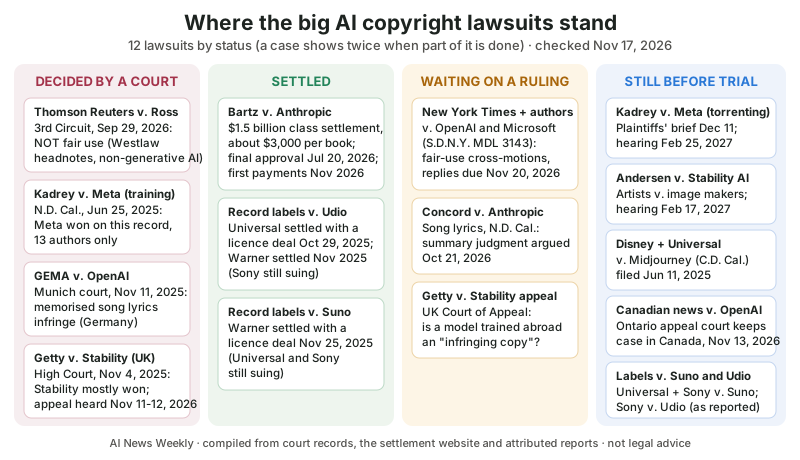
The board as text — decided by a court: Thomson Reuters v. Ross (Third Circuit, September 29, 2026, not fair use, non-generative AI); Kadrey v. Meta, training claim (N.D. California, June 25, 2025, Meta won on that record, 13 authors only); GEMA v. OpenAI (Munich, November 11, 2025, memorised song lyrics infringe); Getty v. Stability AI in the UK (High Court, November 4, 2025, Stability mostly won; appeal heard November 11-12, 2026). Settled: Bartz v. Anthropic ($1.5 billion, about $3,000 per book, final approval July 20, 2026, first payments November 2026); record labels v. Udio (Universal October 29, 2025, Warner November 2025; Sony still suing); record labels v. Suno (Warner November 25, 2025; Universal and Sony still suing). Waiting on a ruling: New York Times and authors v. OpenAI and Microsoft (MDL 3143, replies due November 20, 2026); Concord v. Anthropic (argued October 21, 2026); Getty’s UK appeal. Still before trial: Kadrey v. Meta, torrenting claim (brief December 11, hearing February 25, 2027); Andersen v. Stability AI (hearing February 17, 2027); Disney and Universal v. Midjourney (filed June 11, 2025); Canadian news publishers v. OpenAI (kept in Canada November 13, 2026); Universal and Sony v. Suno and Sony v. Udio.
Has any court decided whether training AI on copyrighted work is fair use?
Yes, but only in pieces: three U.S. courts have ruled on AI training, and they split. An appeals court said no for a legal-research AI that wasn’t generative (Thomson Reuters v. Ross), while two trial judges in San Francisco said yes for training Anthropic’s Claude and Meta’s Llama on books — with limits that keep the big question open.
Fair use is the part of U.S. copyright law (Section 107 of the Copyright Act) that lets people use protected work without permission in some cases, judged on four factors: the purpose of the use, the kind of work, how much was copied, and the harm to the work’s market. Every AI copyright lawsuit in the U.S. comes down to how a judge weighs those four factors for AI training. Courts in the UK and Germany use different rules, so their rulings, below, answer slightly different questions.
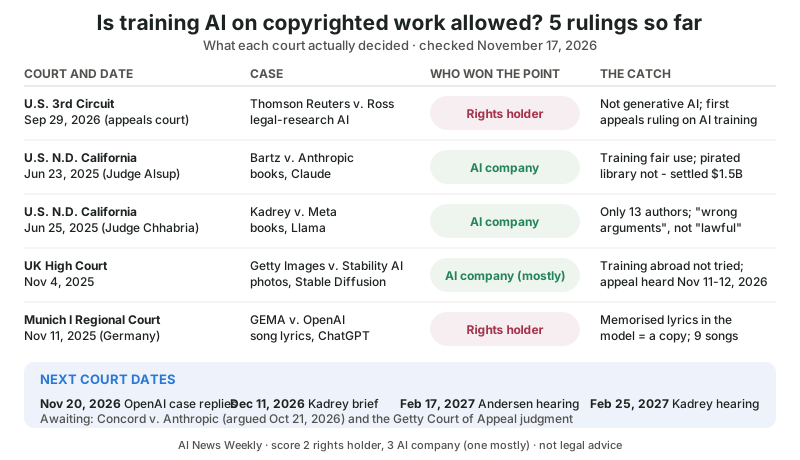
The scoreboard as text — rights holder won: Thomson Reuters v. Ross (U.S. Third Circuit, September 29, 2026; not generative AI; the first U.S. appeals-court ruling on AI training) and GEMA v. OpenAI (Munich I Regional Court, November 11, 2025; memorised lyrics in the model are a copy; nine songs). AI company won: Bartz v. Anthropic (N.D. California, Judge Alsup, June 23, 2025; training was fair use, the pirated library was not; settled for $1.5 billion), Kadrey v. Meta (N.D. California, Judge Chhabria, June 25, 2025; only 13 authors; “wrong arguments”, not “lawful”) and, mostly, Getty Images v. Stability AI (UK High Court, November 4, 2025; training abroad not tried; appeal heard November 11-12, 2026). Next court dates: November 20, 2026, OpenAI case replies; December 11, 2026, Kadrey brief; February 17, 2027, Andersen hearing; February 25, 2027, Kadrey hearing. Awaiting: Concord v. Anthropic (argued October 21, 2026) and the Getty Court of Appeal judgment.
What did the Third Circuit decide in Thomson Reuters v. Ross?
The Third Circuit decided on September 29, 2026 that Ross Intelligence infringed Thomson Reuters’ copyright by using 2,243 Westlaw headnotes to train its AI legal search engine, and that this was not fair use. The appeals court affirmed Judge Stephanos Bibas’s February 2025 ruling in the District of Delaware.
The Third Circuit’s opinion (No. 25-2153), written by Judge Montgomery-Reeves for a panel with Judges Restrepo and Bove, found Ross aimed to be a direct competitor to Westlaw, which made its use minimally transformative, at best
. The court stressed what kind of AI this was: ROSS’s AI was not a generative AI, meaning it would not create any new expression
. In a footnote, the court set the chatbot cases aside, noting that unlike the AI models in Bartz and the OpenAI litigation, ROSS’s AI platform cannot generate original expression
. So the Ross ruling is a loss for an AI company at the appeals level, but it doesn’t decide the fate of ChatGPT, Claude or Llama.
Why did Anthropic and Meta win their 2025 fair-use rulings?
Anthropic and Meta won their 2025 fair-use rulings because both judges found that training a generative AI model on books changes their purpose, but each ruling came with a catch: Anthropic’s pirated library wasn’t covered, and Meta won only because the 13 authors made weak arguments about market harm.
In Bartz v. Anthropic’s Order on Fair Use (June 23, 2025), Judge William Alsup wrote that using the books to train Claude was exceedingly transformative and was a fair use
. But the same order found Anthropic had pirated over seven million copies of books
from sites such as Library Genesis and the Pirate Library Mirror, and refused to treat that central library as a fair use. That piracy question is what Anthropic then settled for $1.5 billion.
Two days later, in Kadrey v. Meta (June 25, 2025), Judge Vince Chhabria granted Meta summary judgment on training — and then spelled out how narrow that win was:
This ruling does not stand for the proposition that Meta’s use of copyrighted materials to train its language models is lawful. It stands only for the proposition that these plaintiffs made the wrong arguments and failed to develop a record in support of the right one.
The Kadrey case isn’t over. A separate claim, that Meta shared pirated books with others while downloading them by BitTorrent, is still open: under the court’s March 2026 scheduling order, as posted by the court-docket blog ChatGPT Is Eating the World (March 27, 2026), the authors’ opening brief is due December 11, 2026 and the hearing is set for February 25, 2027.
What is in the $1.5 billion Anthropic settlement?
The Anthropic settlement in Bartz v. Anthropic is a $1.5 billion class settlement for authors and publishers whose books Anthropic downloaded from pirate sites, worth about $3,000 per book. Judge Araceli Martínez-Olguín of the Northern District of California gave it final approval on July 20, 2026; the case had been reassigned from Judge Alsup, who approved the deal preliminarily on September 25, 2025.
The Authors Guild reported on July 21, 2026 that the order dealt with 54 objections and comments, and that notices reached nearly 595,000 potential class members
. The Guild also points out the approximately $3,000 per-work award is four times the $750 statutory minimum for ordinary infringement — by our arithmetic, $3,000 divided by $750 is exactly 4. The settlement covers past conduct with these books; it doesn’t settle anything about what Claude writes today, and it doesn’t make a legal ruling that AI training is allowed or banned.
From the Bartz fair-use order (June 23, 2025) to final approval (July 20, 2026) took 392 days, by our count. The Bartz settlement is the largest known in an AI copyright case, and it set a real-world number — about $3,000 a book — that the other book cases will be measured against.
When do authors get paid from the Anthropic settlement?
Authors in the Anthropic settlement are being paid from November 2026: the official settlement website says We currently expect to send the first round of payments on or before November 15, 2026
. Works with an open dispute or missing information get paid in a later round, from money held in escrow.
The official Bartz v. Anthropic settlement website lists the deadlines that have already passed: opting out or objecting (February 9, 2026), re-including excluded works (March 9, 2026) and filing a claim (March 30, 2026). The site also says the parties told the court the settlement’s Effective Date has passed, assuming that no late-filed appeal is permitted to go forward
. If you co-own a book with a publisher or co-author, the site asks for your split within 60 days of getting access to the consolidated claim information.
Where does the New York Times lawsuit against OpenAI stand?
The New York Times lawsuit against OpenAI and Microsoft is waiting on a fair-use ruling: it’s now part of In re OpenAI Copyright Infringement Litigation (MDL 3143) in New York, where the news and book plaintiffs and the companies have filed cross-motions for summary judgment before Judge Sidney H. Stein, with reply briefs due November 20, 2026. No trial date has been set.
The New York Times sued OpenAI and Microsoft in December 2023 (S.D.N.Y. No. 1:23-cv-11195). In 2025 its case was gathered with the other copyright lawsuits against OpenAI — from the Daily News, The Intercept, the Center for Investigative Reporting, Ziff Davis and author groups including the Authors Guild — into one multidistrict litigation (MDL), so a single judge handles the shared questions. According to IPWatchdog (Rose Esfandiari, November 2, 2026), Cross-motions for summary judgment on fair use are pending before Judge Sidney H. Stein
, outside groups filed friend-of-the-court briefs by an October 30 deadline, and The deadline for the parties’ reply briefs in the case is November 20
.
The U.S. government has taken a side. The Third Circuit’s Ross opinion records that the U.S. Department of Justice (DOJ) filed a statement of interest in the OpenAI MDL on September 1, 2026, relying on the Bartz ruling to argue that training a large language model is a transformative use. That’s a filing, not a ruling: Judge Stein decides. The U.S. Copyright Office, for its part, released a pre-publication version of its report on generative AI training on May 9, 2025, and says a final version will follow.
Can news publishers outside the U.S. sue OpenAI at home?
Yes, at least in Canada: on November 13, 2026, the Court of Appeal for Ontario dismissed OpenAI’s appeal and let Canadian news publishers sue it in Ontario rather than in a U.S. court. The ruling decides where the case is heard, not whether OpenAI infringed.
The publishers — The Canadian Press, Torstar, The Globe and Mail, Postmedia and CBC/Radio-Canada — say OpenAI used their news to train ChatGPT without permission or payment. The Canadian Press reported (November 13, 2026) that the court upheld the finding that the fair and efficient working of the Canadian legal system favoured allowing Canadian authors to bring claims
against foreign companies under Canadian law, and called it the first Canadian case on training generative AI with copyrighted content. Canada uses “fair dealing”, not U.S. fair use, so the outcome could differ from the New York case.
What is happening with the AI music lawsuits?
The AI music lawsuits are splitting into settlements and fights: Universal Music and Warner Music settled with the AI song generator Udio, Warner settled with Suno, each in exchange for licensed versions of the services, while Sony keeps suing both and Universal keeps suing Suno. Music publishers’ song-lyrics case against Anthropic is waiting on a ruling.
Here’s the bit that made me laugh out loud: a judge handed Meta a win and, in the very same order, wrote that his ruling does not mean Meta’s training is lawful. Imagine winning a race and the referee announcing you only won because everyone else ran the wrong way. That’s copyright law in 2026.
- Universal Music v. Udio: settled on October 29, 2025, with licence deals for Universal’s recordings and publishing and a new licensed Udio service for 2026 (Music Business Worldwide, October 30, 2025).
- Warner Music v. Suno: settled on November 25, 2025; Suno agreed to launch licensed models and to let artists opt in to the use of their names, voices and likenesses (TechCrunch, November 25, 2025). Warner also settled with Udio that month.
- Universal and Sony v. Suno, Sony v. Udio: still going; settlement talks between Suno, Universal and Sony hit an impasse, Digital Music News reported on April 9, 2026.
- Concord, Universal Music Publishing and ABKCO v. Anthropic: the music publishers’ case over song lyrics used to train Claude. The court’s case page (No. 5:24-cv-03811) lists a hearing before Judge Eumi K. Lee on October 21, 2026; trade reports describe it as the summary judgment hearing on fair use, and no ruling had been posted when we checked.
What did the German court decide in GEMA v. OpenAI?
The Munich I Regional Court decided on November 11, 2025 that OpenAI infringed the copyright in the lyrics of nine German songs, because ChatGPT’s models had memorised them and reproduced them almost word for word from simple prompts. It’s the clearest court win so far for rights holders against a chatbot maker.
According to the court’s press release (unofficial English translation), the 42nd Civil Chamber upheld GEMA’s claims for an injunction, information and damages against two OpenAI companies (reference 42 O 14139/24). The songs included “Atemlos” by Kristina Bach and Rolf Zuckowski’s Wie schön, dass du geboren bist
. The court rejected the claim about lyrics wrongly credited to the authors. GEMA is the German music rights society that collects for songwriters. This is a first-instance ruling, so it isn’t the last word in Germany either.
Are artists and Hollywood studios winning against AI image generators?
Not yet, in either direction: the artists’ class action Andersen v. Stability AI and the studios’ case against Midjourney are both still before trial in California, with no ruling on fair use, and in the UK Getty Images lost most of its case against Stability AI in 2025 and is now appealing.
Andersen v. Stability AI was the first of these cases, filed on January 13, 2023 by illustrators including Sarah Andersen, Karla Ortiz and Grzegorz Rutkowski against Stability AI, Midjourney, DeviantArt and Runway. The court’s case page shows discovery orders as recent as November 16, 2026. At the artists’ request, the summary judgment hearing moved from November 4, 2026 to February 17, 2027, ChatGPT Is Eating the World reported (February 3, 2026). By that hearing the case will be 1,496 days old, by our count.
Disney and Universal v. Midjourney was filed in federal court in Los Angeles on June 11, 2025, the first time major Hollywood studios sued a generative AI company; the studios called Midjourney a bottomless pit of plagiarism
and pointed to images of characters such as Darth Vader, Elsa and the Minions (CNN, June 11, 2025). The Midjourney case hasn’t reached a ruling on the merits.
What happened in Getty Images v. Stability AI in the UK?
In Getty Images v. Stability AI, the High Court of England and Wales ruled on November 4, 2025 that Stable Diffusion wasn’t an “infringing copy” of Getty’s photos, so Getty’s secondary copyright claim failed; Getty won only a narrow trade mark point about old versions that produced Getty watermarks. Getty’s appeal was heard in the Court of Appeal on November 11-12, 2026.
The judgment, [2025] EWHC 2863 (Ch), by Mrs Justice Joanna Smith, never decided whether training itself infringes UK copyright, because Getty dropped that claim: there was no evidence the training happened in the UK. The appeal asks whether a model trained abroad becomes an infringing copy when it’s brought into the UK. Trade reports of the hearing, including the BPI’s intervention for the music industry, say the court hasn’t yet given judgment.
What do the AI copyright lawsuits mean for writers, artists and musicians?
For writers, artists and musicians, the AI copyright lawsuits mean three practical things today: settlements and licence deals are where money is actually moving, registering your copyright still matters in the U.S., and you can ask AI crawlers to skip your own website — but no court has yet said that training on your work is illegal everywhere.
- Watch for settlements that include you. The Bartz settlement paid by the book. Future class settlements will have their own official site and deadlines; only trust the site named in court papers.
- Register your work in the U.S. Under 17 U.S.C. § 412, statutory damages and attorney’s fees generally need the work to be registered before the infringement started or within three months of publication. You can register with the U.S. Copyright Office online.
- Use the crawler controls on your own site. OpenAI documents its GPTBot crawler and how to block it in robots.txt, and Google documents the Google-Extended token for keeping content out of Gemini training. This covers future crawling of your site, not copies already made.
- Know your own words from the AI’s. If you write with AI help, the U.S. Copyright Office protects only the human part — our guide to writing a life story with AI shows how to keep the words yours.
- In Europe, look at the EU rules. The EU’s General-Purpose AI Code of Practice asks the big model makers to respect copyright opt-outs; our EU AI Act dates guide explains what applies when.
Say you’re an illustrator who finds your style all over an AI image site. Today, the honest answer is that the Andersen case will be the first U.S. test of that, and its summary judgment hearing is February 17, 2027. Until then, registering your best pieces and using your site’s crawler controls are the moves you control.
What are the key numbers in the AI copyright lawsuits?
The key numbers in the AI copyright lawsuits, gathered from court records, the settlement site and named reports:
| Finding | Number | Source |
|---|---|---|
| Anthropic settlement | $1.5 billion, about $3,000 per book | Authors Guild; settlement site |
| Per-book payment vs the $750 statutory minimum | 4 times | Authors Guild; our arithmetic |
| Potential class members reached by notice | Nearly 595,000 | Authors Guild |
| Pirated book copies Anthropic downloaded | Over 7 million | Bartz Order on Fair Use |
| Days from the Bartz fair-use order to final approval | 392 (June 23, 2025 to July 20, 2026) | Our count |
| Westlaw headnotes Ross copied | 2,243 | Third Circuit opinion |
| Authors bound by the Kadrey v. Meta training ruling | 13 | Kadrey order |
| German songs in GEMA v. OpenAI | 9 | Munich I Regional Court |
| Court rulings on AI training so far (U.S., UK, Germany) | 5: 2 for rights holders, 3 for AI companies | Our scoreboard |
| Days to the next deadline (OpenAI MDL replies, Nov 20) | 3, from Nov 17, 2026 | IPWatchdog; our count |
| Days to the Kadrey torrenting hearing (Feb 25, 2027) | 100, from Nov 17, 2026 | Our count |
The short version: one big settlement, one appeals-court loss for a non-generative AI, two narrow trial wins for AI companies, and the chatbot cases still waiting. Put November 20, 2026, February 17, 2027 and February 25, 2027 in your calendar — we’ll update this tracker as each ruling lands.
So here’s the plan, docket watcher: if you’re owed Anthropic settlement money, only trust the official site; register your best work; switch on the crawler controls on your own website; and circle November 20, February 17 and February 25 — we’ll be back here with every ruling the day it lands.
Sources and further reading
- Thomson Reuters Enterprise Centre GmbH v. ROSS Intelligence Inc., No. 25-2153 (U.S. Court of Appeals for the Third Circuit) — argued June 11, 2026; filed Sept 29, 2026; 2,243 headnotes, not fair use; footnote 7 on the DOJ statement in MDL 3143
- Bartz v. Anthropic PBC, Order on Fair Use, No. C 24-05417 WHA, Dkt. 231 (N.D. Cal.) — June 23, 2025; training "exceedingly transformative"; over 7 million pirated copies
- Kadrey v. Meta Platforms, Order on cross-motions for partial summary judgment, No. 23-cv-03417-VC, Dkt. 598 (N.D. Cal.) — June 25, 2025; Judge Chhabria; 13 authors; "does not stand for the proposition" quote
- Bartz v. Anthropic Settlement (official settlement website) — final approval July 20, 2026; first payments on or before Nov 15, 2026; past deadlines
- Court Grants Final Approval of $1.5 Billion Anthropic Copyright Settlement (Authors Guild) — July 21, 2026; Judge Martínez-Olguín; about $3,000 per work; 54 objections; nearly 595,000 notified
- OpenAI Touts Briefs Backing Fair Use for AI Training (IPWatchdog, Rose Esfandiari) — Nov 2, 2026; cross-motions before Judge Stein; replies due Nov 20
- Copyright and Artificial Intelligence (U.S. Copyright Office) — Part 3, Generative AI Training: pre-publication version May 9, 2025
- Concord Music Group, Inc. et al v. Anthropic PBC, No. 5:24-cv-03811-EKL (N.D. Cal. case page) — Judge Eumi K. Lee; Oct 21, 2026 hearing transcript ordered; related-case order Nov 16, 2026
- Andersen et al v. Stability AI Ltd. et al, No. 3:23-cv-00201-WHO (N.D. Cal. case page) — Judge Orrick; filed Jan 13, 2023; discovery order Nov 16, 2026
- Kadrey v. Meta gets scheduling order (ChatGPT Is Eating the World) — Mar 27, 2026; brief Dec 11, 2026; hearing Feb 25, 2027
- Sarah Andersen’s copyright lawsuit gets pushed back again (ChatGPT Is Eating the World) — Feb 3, 2026; summary judgment hearing moved to Feb 17, 2027
- Getty Images v. Stability AI [2025] EWHC 2863 (Ch) (Courts and Tribunals Judiciary) — Nov 4, 2025; Mrs Justice Joanna Smith
- Munich I Regional Court press release on GEMA v. OpenAI, 42 O 14139/24 (unofficial translation, hosted by IFRRO) — Nov 11, 2025; nine songs; injunction, information, damages
- Court allows news publishers’ copyright lawsuit against OpenAI to go ahead (The Canadian Press via BNN Bloomberg) — Nov 13, 2026; Court of Appeal for Ontario
- Universal Music settles Udio lawsuit, strikes deal for licensed AI music platform (Music Business Worldwide) — Oct 30, 2025; settlement announced Oct 29
- Warner Music signs deal with AI music startup Suno, settles lawsuit (TechCrunch) — Nov 25, 2025
- Universal Music Group and Suno hit settlement talk impasse (Digital Music News) — Apr 9, 2026
- Disney and Universal team up to sue AI photo generator Midjourney (CNN) — June 11, 2025
- Copyright Act, Chapter 4, including 17 U.S.C. § 412 (U.S. Copyright Office) — registration and statutory damages
- Overview of OpenAI crawlers (OpenAI) — GPTBot and robots.txt
- Google’s common crawlers (Google Search Central) — Google-Extended
Questions and answers
Did Anthropic settle the copyright lawsuit with authors?
Yes. Anthropic settled Bartz v. Anthropic for $1.5 billion, about $3,000 per book, over books it downloaded from pirate sites. Judge Araceli Martínez-Olguín gave final approval on July 20, 2026, and the official settlement site expected first payments on or before November 15, 2026.
Is training AI on copyrighted material fair use?
Courts haven’t settled it. Two federal judges in San Francisco found training Claude and Llama on books was fair use in June 2025, with limits, while the Third Circuit found Ross Intelligence’s training on Westlaw headnotes was not fair use on September 29, 2026. The chatbot cases against OpenAI are still waiting.
What is the status of the New York Times lawsuit against OpenAI?
The New York Times case is part of In re OpenAI Copyright Infringement Litigation (MDL 3143) before Judge Sidney H. Stein in New York. Both sides have asked him to decide fair use on summary judgment; reply briefs are due November 20, 2026, and no trial date has been set.
Is it too late to claim money from the Anthropic settlement?
For most people, yes: the claim deadline in Bartz v. Anthropic was March 30, 2026, and opting out closed on February 9, 2026. Claimants with disputed or incomplete works are paid in a later round. Check only the official site, anthropiccopyrightsettlement.com.
Has any court ruled against an AI company for copyright infringement?
Yes. The Third Circuit ruled against Ross Intelligence on September 29, 2026 over Westlaw headnotes, and the Munich I Regional Court ruled against OpenAI on November 11, 2025 over memorised lyrics of nine German songs. Both are narrower than the big chatbot training cases.