
Too Much News? How AI Summaries Can Help (and When They Get It Wrong)
Disclosure: this page contains Amazon affiliate links. As an Amazon Associate we earn from qualifying purchases, at no extra cost to you.
Good morning, headline sifter — pour the coffee and keep the crossword nearby, because AI can now boil the whole morning’s news down to a few lines, and I’ve dug into exactly when those few lines are a gift and when they quietly get a fact wrong! Yes — AI summaries can help with news overload, as long as you treat them as a table of contents rather than the story itself. If you’d rather read the full stories in comfort, large-screen tablets for reading the news are worth a look.
Short answer: Yes, AI summaries can shrink the daily news pile to a few minutes, but check before you trust them: in a 2025 study of ChatGPT, Copilot, Gemini and Perplexity, 45% of news answers had at least one significant issue. Use a summary to pick what to read, then open the original story before believing or sharing it.
The six facts that sum up AI news summaries for older readers in November 2026:
- Filtering news is one of the top three jobs older adults want AI to do, according to AARP Research (January 13, 2026).
- 38% of adults 65 and older say they read the AI summaries at the top of search results, against 72% of adults 18-29 (Pew Research Center, June 17, 2026).
- 42% of adults 65 and older feel worn out by the amount of news — fewer than any younger age group, where the share runs 49% to 58% (Pew, February 11, 2026).
- 45% of AI assistants’ news answers had at least one significant issue in the European Broadcasting Union (EBU) and BBC study of ChatGPT, Copilot, Gemini and Perplexity (October 22, 2025).
- 8% vs 15%: Google users clicked a regular search result on 8% of visits when an AI summary appeared, against 15% without one (Pew, July 22, 2025).
- Labels are now standard: Google says
AI Overviews can and will make mistakes
, and Apple marks iPhone news summariesSummarized by Apple Intelligence
since iOS 26 (MacRumors, July 22, 2025).
Why do so many people feel overwhelmed by the news?
About half of Americans feel overwhelmed by the news: 52% say they are worn out by the amount of news these days, according to Pew Research Center’s December 2025 survey. Older adults feel it less than younger ones — 42% of adults 65 and older are worn out, against 58% of adults 30-49 — partly because older adults go looking for the news on purpose.
Pew’s The age divide in how Americans think about news
(February 11, 2026; 3,560 adults surveyed December 8-14, 2025) found that 73% of adults 65 and older mostly get news because they look for it, against just 27% of adults 18-29, who mostly bump into it. Of adults 65 and older, 65% say getting news regularly is extremely or very important, and only 18% say they don’t have enough time to follow it.
So the problem for many older readers isn’t too little interest — it’s too much to read. That’s why AARP Research’s Older Adults Want AI to Show Up in Practical Ways
(Brittne Kakulla, January 13, 2026; 1,148 adults over 50 among 1,661 surveyed) lists news among the top three jobs: the overall top jobs for AI are managing one’s health support network, filtering news and simplifying health information
.
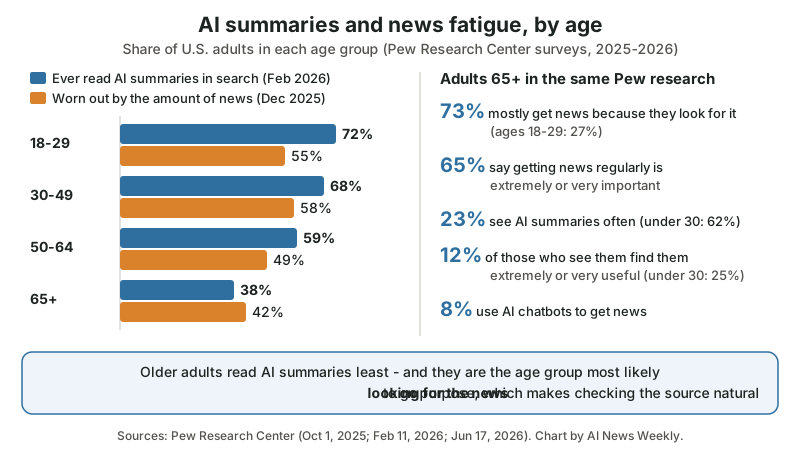
The chart as text — ever read AI summaries in search results (Pew, survey February 17-23, 2026) and worn out by the amount of news (Pew, survey December 8-14, 2025), by age: 18-29, 72% and 55%; 30-49, 68% and 58%; 50-64, 59% and 49%; 65+, 38% and 42%. Adults 65+ only: 73% mostly get news because they look for it (18-29: 27%); 65% say getting news regularly is extremely or very important; 23% see AI summaries in search extremely often or often (under 30: 62%; Pew, August 2025); 12% of those who have seen them find them extremely or very useful (under 30: 25%); 8% use AI chatbots to get news (Pew, February 2026).
Do older adults read AI summaries?
Fewer older adults read AI summaries than any other age group: 38% of adults 65 and older say they ever read the AI summaries at the top of search results, against 60% of all U.S. adults and 72% of adults 18-29. Another 47% of adults 65 and older say they don’t read them, and 14% aren’t sure.
Those numbers come from Pew’s How Americans’ opinions and use of AI differ by age
(June 17, 2026; 5,119 adults surveyed February 17-23, 2026). Pew sums it up: While majorities of Americans ages 18 to 64 say they ever read these, that share drops substantially for those 65 and older.
The same report found that 8% of adults 65 and older use AI chatbots to get news, against 15% of adults 18-29 and 17% of adults 30-49.
An earlier Pew short read, Americans have mixed feelings about AI summaries in search results
(Kirsten Eddy, October 1, 2025; 5,153 adults surveyed August 18-24, 2025), found that 23% of adults 65 and older see AI summaries extremely often or often, against 62% of adults under 30. Among everyone who had seen them, 53% had at least some trust in the information and only 6% trusted it a lot; 12% of adults 65 and older found AI summaries extremely or very useful, half the 25% of adults under 30.
Around the world, the picture is similar. The Reuters Institute Digital News Report 2026 (June 16, 2026; 97,520 people in 48 markets) found that 10% of people use AI chatbots for news, up from 7% last year
, that use hasn’t grown in the U.S. or the UK over the past year, and that Trust in answers from AI chatbots is 20% globally
, against 37% for news overall.
What changed in AI news summaries from 2024 to 2026?
AI news summaries went from an experiment to a default between 2024 and 2026: Google put AI Overviews above search results, Apple added AI summaries to iPhone notifications, Microsoft and Amazon launched spoken news briefings, and after public mistakes, the makers added labels and warnings.
- — Google explains AI Overviews’ mistakes. Google’s vice president of Search, Liz Reid, wrote
AI Overviews: About last week
after odd answers spread online, including advice drawn from a forum jokelike using glue to get cheese to stick to pizza
. Google said it would limit satire and user-posted content and aimed to keep AI Overviews off hard news. - — Copilot Daily. TechCrunch (Kyle Wiggers, October 1, 2024) reported that Microsoft’s Copilot Daily
gives users a spoken summary of the weather and current events
, with launch partners including Reuters, USA Today Network and the Financial Times, in the U.S. and UK at first. - — The false BBC alert. Gizmodo (Thomas Maxwell, December 14, 2024) reported that an Apple Intelligence summary of BBC News alerts read
Luigi Mangione shoots himself
— which had not happened. The BBC complained to Apple. - — Apple pauses news summaries. MacRumors (Juli Clover, July 22, 2025) reports that Apple removed notification summaries for News and Entertainment apps in January 2025, after criticism of misleading headlines.
- — Alexa+ and its news partners. Amazon’s announcement said it partnered with
the Associated Press, Reuters, The Washington Post, TIME, Forbes
and more than 200 other outletsso Alexa+ can deliver accurate, real-time news and information
. - — Apple’s summaries return, labelled. In the iOS 26 betas, news summaries came back in italics marked
Summarized by Apple Intelligence
(MacRumors), and turning them on shows a red warning:Summarization may change the meaning of original headlines. Verify information.
(9to5Mac, Chance Miller, July 22, 2025). - — The EBU-BBC study. 22 public service broadcasters in 18 countries found significant issues in 45% of AI assistants’ news answers (details below).
- — The newest numbers. The Reuters Institute (June 16) counted 10% of people using AI chatbots for news each week, and Pew (June 17) found 38% of adults 65 and older read AI search summaries.
Where do AI news summaries show up in 2026?
AI news summaries show up in four places most older adults already use: Google Search (AI Overviews), iPhone notifications (Apple Intelligence summaries), smart speakers and voice assistants (Alexa+, Copilot Daily), and chatbots you ask directly (ChatGPT, Gemini, Copilot, Claude). Each one labels and sources its summaries differently.
| Where | What you see | The label or warning | How to reach the original |
|---|---|---|---|
| Google AI Overviews (Search) | An AI answer above the search results | AI responses may include mistakes. | Tap the source links in the overview, or pick the Web filter for plain links |
| Apple Intelligence notification summaries (iPhone) | A short summary of a stack of news alerts on the Lock Screen | Italic text, Summarized by Apple Intelligence; a red warning when you turn news summaries on | Tap the notification to open the news app’s own alert |
| Microsoft Copilot Daily | A spoken summary of news and weather | Microsoft says it uses only authorized content sources(per TechCrunch) | Ask Copilot for the article it drew on |
| Amazon Alexa+ | Spoken news answers on Echo devices | Amazon names its news partners (AP, Reuters, The Washington Post, TIME and 200+ more) | Ask Alexa which outlet the story came from |
| ChatGPT, Gemini, Copilot or Claude chat | A briefing on any topic you ask about | Each app shows its own “can make mistakes” line | Ask for links and dates in your question (our prompts below) |
Can you turn off Google’s AI Overviews?
No — Google’s AI Overviews can’t be switched off, but you can hide them search by search. Google Search Help’s AI Overviews page says Features cannot be turned off
, and suggests you select the Web filter after you perform a search
, which shows only text links without AI Overviews. The same page says plainly: AI Overviews can and will make mistakes
, and advises: Always check important info in more than one place.
Can you turn off news summaries on an iPhone?
Yes — Apple Intelligence asks separately whether to summarize News and Entertainment notifications, so you can keep summaries for messages and switch them off for news. MacRumors reports that iOS 26 lets you opt in or out by category and report a summary that got something wrong. If an iPhone news summary ever sounds shocking, tap it and read the news app’s own alert before you believe it.
How often do AI summaries get the news wrong?
AI assistants get the news wrong often enough to matter: in the largest study so far, 45% of answers from ChatGPT, Copilot, Gemini and Perplexity had at least one significant issue that could mislead a reader, 31% had serious sourcing problems and 20% had major accuracy issues, including made-up details and outdated facts.
Can I tell you the detail that made me laugh out loud? Google’s vice president of Search once had to write a whole blog post explaining why its AI had passed along a forum joke about using glue to keep cheese on pizza. Please don’t glue your pizza — but what a perfect reminder that a summary is only as good as the page it read.
The study, News Integrity in AI Assistants
, was led by the BBC and coordinated by the European Broadcasting Union, and was published October 22, 2025. Journalists at 22 public service media organisations in 18 countries, including the U.S. and Canada, graded more than 3,000 answers in 14 languages. Google’s Gemini did worst, with significant issues in 76% of its answers, more than double the other assistants
, largely because of poor sourcing. The EBU says the problems were consistent across languages and countries.
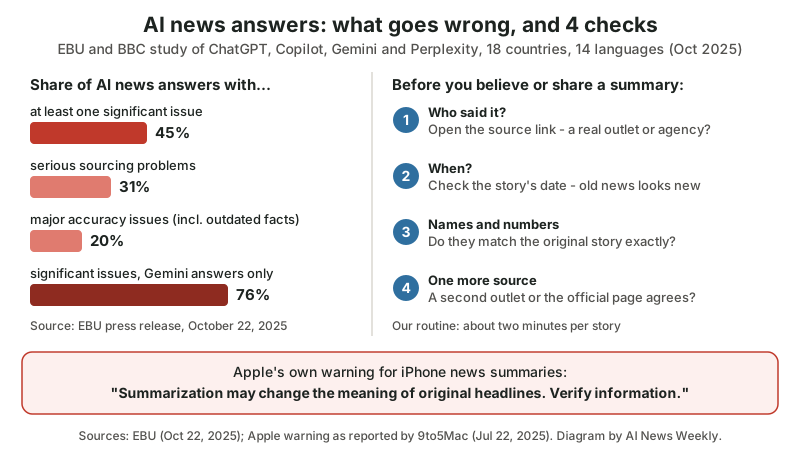
The diagram as text — share of AI assistants’ news answers with at least one significant issue, 45%; with serious sourcing problems, 31%; with major accuracy issues including outdated information, 20%; Gemini’s answers with significant issues, 76% (EBU, October 22, 2025). The four checks: 1. Who said it? Open the source link. 2. When? Check the story’s date. 3. Do the names and numbers match the original? 4. Does one more source agree? Apple’s warning: Summarization may change the meaning of original headlines. Verify information.
Jean Philip De Tender, the EBU’s Media Director and Deputy Director General, explained why this matters beyond one wrong answer:
When people don’t know what to trust, they end up trusting nothing at all, and that can deter democratic participation.
What are some real AI news summary mistakes?
Three well-documented AI news mistakes show the main ways summaries go wrong — an old fact presented as current, a joke read as advice, and a headline changed in the squeeze:
- Out of date
- The Register (Owen Hughes, October 24, 2025) reported that in the EBU-BBC study ChatGPT was
incorrectly stating that Pope Francis was still pontificating weeks after his death
. - A joke taken seriously
- Google’s Liz Reid wrote on May 30, 2024 that some AI Overviews drew on sarcastic forum posts, such as glue for pizza cheese. Google says it found a content-policy violation on fewer than one in every 7 million unique queries with an AI Overview — its own measure, not an accuracy test.
- Meaning changed
- An Apple Intelligence summary of BBC News alerts said a murder suspect had shot himself; he hadn’t (Gizmodo, December 14, 2024). The other two summarized headlines in the same alert were correct.
Notice the pattern: each mistake is easy to catch by opening the original story. That’s the whole idea behind the next section.
How do you check an AI news summary in two minutes?
Check an AI news summary by asking four questions before you believe or share it: who reported it, when, whether the names and numbers match the original, and whether one more trusted source agrees. If the summary gives no source you can open, treat it as a tip to look up, not as news.
- Who said it? Tap the source link. A real outlet (the Associated Press, Reuters, your local paper) or an official page (a .gov agency, the company’s own newsroom) is a good sign; a forum post, a joke site or no source at all is not.
- When? Look at the date on the original story. The EBU study counted outdated information among its accuracy problems — last year’s story can come back sounding like today’s.
- Do the names and numbers match? Compare the summary’s names, dates, amounts and quotes with the original, word for word if it matters. Summaries squeeze, and squeezing is where meaning shifts.
- Does one more source agree? For anything you plan to act on or forward, find a second outlet or the official page saying the same thing.
Why does clicking the source link matter?
Clicking the source link matters because AI summaries make it easy to stop at the summary — and most people do. Pew Research Center tracked the Google searches of 900 U.S. adults in March 2025 and found that people clicked a regular search result on 8% of visits when an AI summary appeared, against 15% when none appeared; they clicked a link inside the AI summary on just 1% of visits.
By our arithmetic, that’s about half as many clicks (8 divided by 15 is 0.53) when an AI summary is on the page. The study, Google users are less likely to click on links when an AI summary appears in the results
(Athena Chapekis and Anna Lieb, July 22, 2025), also found that 88% of AI summaries cited three or more sources, and that government (.gov) sites made up 6% of AI summary sources against 2% of regular results — so the good sources are often right there, one tap away.
The Reuters Institute’s 2026 report points the same way for chatbots: 42% of AI chatbot users for news say they always or often click through from chatbot answers
. Older adults, who mostly go looking for news on purpose, are well placed to be in that group.
How do you ask ChatGPT, Gemini, Copilot or Claude for a news briefing?
Ask an AI chatbot for a news briefing by naming the topics you care about, asking for a few stories only, and requiring a link and a publication date for each one. A briefing with sources and dates turns the AI into a table of contents you can check, instead of a voice you have to trust.
Our own prompt for a short morning briefing:
Give me 5 news stories from the last 24 hours
about: my state (Ohio), Medicare and Social
Security, and the weather this week.
For each story:
- one plain sentence on what happened
- the outlet that reported it, with a link
- the date it was published
Only use stories you can link to. If you're
not sure something is confirmed, say so.
And our prompt for a headline that worries you:
I saw this headline: [paste it].
1. Is it from a real news outlet? Which one?
2. What does the original story actually say?
3. What is confirmed, and what is not yet known?
4. Link me to the original and one other source.
Use simple words. Don't guess.
Ask the follow-up questions, too: the Reuters Institute found that the most popular chatbot feature for news, used by 42% of respondents, is the ability to ask follow-up questions. What does that word mean?
or Why does this matter to someone on Medicare?
are exactly the questions a summary can answer well.
Can Alexa+ or Copilot read you the news?
Yes — Amazon’s Alexa+ and Microsoft’s Copilot Daily both read news summaries aloud. Amazon says Alexa+ draws on news partners including the Associated Press, Reuters, The Washington Post and TIME and more than 200 other outlets, and TechCrunch reported that Copilot Daily will only pull from authorized content sources
. A spoken briefing is easy on tired eyes; if a story matters to you, ask the assistant which outlet reported it, then read that outlet’s own story.
For a step-by-step version with one assistant, our sister site How To With Claude AI is publishing a matching seniors series with screens and prompts for Claude. For the bigger picture, part 1 covers what older adults want from AI and what worries them, and part 6 how to ask AI for help with your phone.
What are the key numbers on AI news summaries?
The key numbers on news fatigue, AI summaries and their accuracy, gathered from Pew Research Center, AARP Research, the Reuters Institute, the European Broadcasting Union and Google:
| Finding | Number | Source |
|---|---|---|
| Worn out by the amount of news, all adults / 65+ | 52% / 42% | Pew, Feb 2026 |
| Adults 65+ who mostly get news because they look for it | 73% (18-29: 27%) | Pew, Feb 2026 |
| Ever read AI summaries in search, all adults / 65+ | 60% / 38% | Pew, Jun 2026 |
| Adults 65+ who use AI chatbots to get news | 8% (18-29: 15%) | Pew, Jun 2026 |
| Trust AI summary information at least somewhat / a lot | 53% / 6% | Pew, Oct 2025 |
| Clicks on a regular result, with / without an AI summary | 8% / 15% of visits (about half; our arithmetic) | Pew, Jul 2025 |
| AI news answers with a significant issue | 45% (Gemini: 76%) | EBU-BBC, Oct 2025 |
| AI news answers with serious sourcing problems | 31% | EBU-BBC, Oct 2025 |
| People using AI chatbots for news weekly, worldwide | 10% (7% a year earlier) | Reuters Institute, Jun 2026 |
| Trust in AI chatbot answers vs news overall | 20% vs 37% | Reuters Institute, Jun 2026 |
| Filtering news among older adults’ top AI jobs | Top 3 | AARP Research, Jan 2026 |
The surveys measure different things — Pew asked Americans about habits and feelings, the Reuters Institute asked people in 48 markets, and the EBU graded AI answers rather than people — so read each row on its own.
The short version for older readers and the families who help them: let an AI summary sort the morning’s news, but let the original story have the final word. Pick the one or two stories that matter, open them, run the four checks, and you’ll get the best of both — less overload and fewer surprises.
So here’s your morning routine, headline sifter: let the AI pick out five stories, open the one that matters most, and run the four checks — who, when, names and numbers, one more source. Two minutes, coffee still hot, and you’ll know more than the summary did.
Sources and further reading
- How Americans’ opinions and use of AI differ by age (Pew Research Center) — Jun 17, 2026; 5,119 adults, Feb 17-23, 2026; read AI search summaries 72/68/59/38% by age, 60% overall; chatbots for news 15/17/13/8%
- The age divide in how Americans think about news (Pew Research Center) — Feb 11, 2026; 3,560 adults, Dec 8-14, 2025; worn out 55/58/49/42% by age; 65+ seek news 73%
- Americans’ Complicated Relationship With News (Pew Research Center) — Feb 11, 2026; 52% worn out by the amount of news
- Americans have mixed feelings about AI summaries in search results (Pew Research Center, Kirsten Eddy) — Oct 1, 2025; 5,153 adults, Aug 18-24, 2025; 65+ see them often 23%, very useful 12%; 53% some trust
- Google users are less likely to click on links when an AI summary appears in the results (Pew Research Center) — Jul 22, 2025; 900 adults, March 2025; 8% vs 15% clicks, 1% in-summary links
- Older Adults Want AI to Show Up in Practical Ways (AARP Research, Brittne Kakulla) — Jan 13, 2026; filtering news among the top three AI jobs
- Largest study of its kind shows AI assistants misrepresent news content 45% of the time (European Broadcasting Union) — Oct 22, 2025; 45% significant issue, 31% sourcing, 20% accuracy, Gemini 76%; 22 organisations, 18 countries, 14 languages
- News Integrity in AI Assistants, full report (EBU and BBC, PDF) — October 2025
- Digital News Report 2026: overview and key findings (Reuters Institute) — Jun 16, 2026; 10% use AI chatbots for news; trust 20% vs 37%; 42% click through; avoidance 42%
- AI Overviews in Google Search (Google Search Help) — "AI Overviews can and will make mistakes"; cannot be turned off; Web filter
- AI Overviews: About last week (Google, Liz Reid) — May 30, 2024; glue-on-pizza forum joke; fewer than one in 7 million queries with a policy violation
- iOS 26 Beta 4 Reintroduces Notification Summaries for News Apps (MacRumors, Juli Clover) — Jul 22, 2025; "Summarized by Apple Intelligence"; paused January 2025
- iOS 26 beta 4 re-enables Apple Intelligence notification summaries for news apps (9to5Mac, Chance Miller) — Jul 22, 2025; red warning text
- Apple’s AI rewrote a BBC headline (Gizmodo, Thomas Maxwell) — Dec 14, 2024; the false notification text
- AI chatbots flub news nearly half the time, BBC study finds (The Register, Owen Hughes) — Oct 24, 2025; the Pope Francis example
- Microsoft starts paying publishers for content in Copilot (TechCrunch, Kyle Wiggers) — Oct 1, 2024; Copilot Daily, authorized content sources, U.S. and UK
- How Amazon rebuilt Alexa with generative AI (Amazon) — Feb 26, 2025; news partners AP, Reuters, The Washington Post, TIME and 200+ outlets
Questions and answers
Are Google AI Overviews accurate?
Mostly useful, but not always right. Google’s own help page says AI Overviews can and will make mistakes
and advises checking important information in more than one place. Open the source links before you rely on an overview, especially for news, health or money.
Can I turn off AI Overviews in Google?
No. Google Search Help says AI Overviews can’t be turned off, but you can select the Web filter after a search to see plain text links without AI Overviews.
Can ChatGPT summarize the news?
Yes, ChatGPT, Gemini, Copilot and Claude can summarize news when you ask, but check what they say: in the EBU-BBC study published October 22, 2025, 45% of AI assistants’ news answers had at least one significant issue. Ask for a link and a date for every story, and open the original.
Why did Apple stop AI news summaries?
Apple paused notification summaries for news and entertainment apps in January 2025 after misleading summaries, including a false BBC News alert, as MacRumors and Gizmodo reported. They returned in iOS 26 in italics, labelled Summarized by Apple Intelligence
, with a warning to verify information.
How do I stop feeling overwhelmed by the news?
Pick a few topics and one or two times a day to check them, rather than following every alert; Pew found 52% of Americans feel worn out by the amount of news. An AI briefing with sources can shorten the list, as long as you open the original for any story that matters.