
Are AI Voice-Clone Scams Calling Families? What the FTC and FBI Say, Plus a Safe-Word Plan
Disclosure: this page contains Amazon affiliate links. As an Amazon Associate we earn from qualifying purchases, at no extra cost to you.
Hello, safe-word keeper — grab a pen and maybe a slice of pie, because I’ve lined up every official FTC, FBI and FCC warning about AI voice-clone calls in one dated list, and the fix is so simple it fits on a card by the phone! Yes — AI voice-clone scams are calling families, and the FTC, the FBI and the FCC have all put that in writing. The call sounds like a grandchild, a son or a daughter, scared and asking for money right now. If an older relative still picks up every call on a landline, call-blocking cordless phones on Amazon can screen unknown callers before anyone answers.
Short answer: Yes. The FTC, FBI and FCC have all warned that scammers clone a relative’s voice with AI and call asking for urgent money; the FBI counted over $5 million lost to these calls in 2025. Agree on a family safe word, hang up and call back on a number you know, and never pay by gift card, crypto or wire.
The six facts that sum up AI voice-clone scams in November 2026:
- 3 seconds: Microsoft researchers’ VALL-E model made speech in a new person’s voice from a 3-second recording (arXiv paper, January 5, 2023).
- Over $5 million was reported lost to voice-cloning “distress” scams, including grandparent scams, in 2025 (FBI IC3, 2025 Internet Crime Report, April 2026).
- 13 official items on AI voice-clone and impersonation scams were published by the FTC, the FCC and the FBI between March 2023 and September 2026 (our dated table below).
- 9 of 9 family-facing alerts tell you to check a caller on a number you already know; 3 of 9 (all FBI) say to agree on a secret word (our count).
- February 8, 2024: the FCC ruled that AI-generated voices in robocalls count as “artificial” voices under the Telephone Consumer Protection Act.
- Nearly 61,000 complaints of law enforcement or government impersonation reached the FBI between January 2025 and July 2026, with losses over $1.6 billion (FBI, September 17, 2026).
Are AI voice-clone scams real?
Yes, AI voice-clone scams are real: the Federal Trade Commission first warned about them on March 20, 2023, and the FBI’s 2025 Internet Crime Report counted over $5 million lost to voice-cloning “distress” scams, including grandparent scams, in 2025. The scam copies a loved one’s voice and uses it to ask for money in a hurry.
The FTC’s first alert, Scammers use AI to enhance their family emergency schemes
(Alvaro Puig, March 20, 2023), set out the whole trick in two sentences: A scammer could use AI to clone the voice of your loved one.
All he needs is a short audio clip of your family member’s voice
— the kind of clip that sits in a public video or post. The FTC’s advice in the same alert: Don’t trust the voice.
The FBI’s Internet Crime Complaint Center (IC3) followed with a public service announcement, I-120324-PSA (December 3, 2024), which says criminals generate short audio clips containing a loved one’s voice to impersonate a close relative in a crisis situation
, asking for immediate financial assistance or demanding a ransom
. The FBI IC3 2025 Internet Crime Report (published April 2026), the first IC3 annual report to track an “AI related” descriptor, counted 22,364 AI-related complaints and $893,346,472 in AI-related losses across all scam types.
How much audio does a scammer need to clone a voice?
A scammer needs only seconds of someone’s voice: the FTC says a short audio clip
is enough, and Microsoft researchers’ VALL-E paper (January 5, 2023) reported speech in a new speaker’s voice from a 3-second enrolled recording
. A voicemail greeting or a short video on social media can be enough raw material.
The VALL-E paper, Neural Codec Language Models are Zero-Shot Text to Speech Synthesizers
(Chengyi Wang and 12 other authors, arXiv, January 5, 2023), also found the model could preserve the speaker’s emotion
— which is exactly what makes a crying “grandchild” convincing. Microsoft’s research model is a paper, not a scam tool, but consumer voice-cloning apps are easy to reach. Consumer Reports’ assessment of AI voice cloning products (March 10, 2025) looked at six companies — Descript, ElevenLabs, Lovo, PlayHT, Resemble AI and Speechify — and found that four of them (ElevenLabs, Speechify, PlayHT and Lovo) had no technical check that the speaker agreed, only a checkbox or similar self-attestation; Descript and Resemble AI had taken steps to make non-consensual clones harder. Grace Gedye, a policy analyst at Consumer Reports, said:
AI voice cloning tools have the potential to supercharge impersonation scams.
That’s why the FBI’s December 2024 PSA suggests you limit online content of your image or voice, make social media accounts private, and limit followers to people you know
. It won’t make a family clone-proof — the safe word and the call-back rule below do the real work — but it shrinks the pile of clips a stranger can grab.
What have the FTC, FBI and FCC said about AI voice-clone scams?
The FTC, the FBI and the FCC published at least 13 alerts, rulings and reports on AI voice-clone and impersonation scams between March 2023 and September 2026, and the family-facing alerts agree on one rule: check the caller on a number you already know before you pay anything. Three FBI alerts, starting in December 2024, add a family secret word.
| Date | Agency and item | What it warns about | What it tells families to do |
|---|---|---|---|
FTC consumer alert Scammers use AI to enhance their family emergency schemes | A cloned voice of a family member in a fake emergency, made from a short audio clip | Don’t trust the voice; call the person on a number you know; wire, crypto and gift card requests are red flags | |
| FTC Voice Cloning Challenge announced | Cloning could make it easier for scammers to impersonate family, friends, or business executives | (A call for detection ideas, not a consumer alert) | |
| FCC Declaratory Ruling on AI-generated voices | AI voices in robocalls used to extort vulnerable family members | (A ruling: AI voices count as “artificial” under the TCPA) | |
| FTC Impersonation rule finalized; individuals proposed | AI deepfakes and voice cloning used to impersonate individuals | (A rule for government and business impersonation; the individuals part is still a proposal) | |
FTC Challenge winners and alert Fighting back against harmful voice cloning | A cloned family member who calls pretending to be in trouble | Call the person on a number you know is theirs; if you can’t reach them, try another relative or their friends | |
| FBI I-120324-PSA | Cloned voices of relatives in a crisis; cloned voices used to get into bank accounts | Create a secret word or phrase; hang up and call back; limit public voice clips; never send money, gift cards or crypto to people you know only by phone | |
| FBI I-051525-PSA | AI voice messages pretending to be senior U.S. officials or personal relations | Find the person’s number yourself and call; verify a new number; secret word with family; no money or crypto | |
| FBI I-120525-PSA | Virtual kidnappings with altered “proof-of-life” photos and videos | Code word; stop and think; screenshot the photo; contact your loved one before paying | |
| FBI IC3 2025 Internet Crime Report | Over $5 million lost to voice-cloning “distress” scams in 2025 | (An annual report) | |
| FBI I-051526-PSA | Scammers sending victims to cryptocurrency kiosks: 13,400+ complaints, $388M+ lost in 2025 | Don’t send crypto to a caller who says they’re someone you know; contact the person or company directly | |
| FBI I-061526-PSA | Couriers who collect cash in person — a method used in grandparent scams, among others | Never hand cash to a stranger; verify who you’re dealing with through third parties | |
| FBI I-072026-PSA | Scammers posing as the IC3 itself, with AI video and voices that masquerade as a known contact | Type ic3.gov yourself; IC3 never charges to recover money; no money, gift cards or crypto to strangers | |
| FBI I-091726-PSA | Fake police and officials, helped by new technologies, such as artificial intelligence: ~61,000 complaints, $1.6B+ lost | Officials never demand payment by phone; call the agency on its public number, not the one you were given |
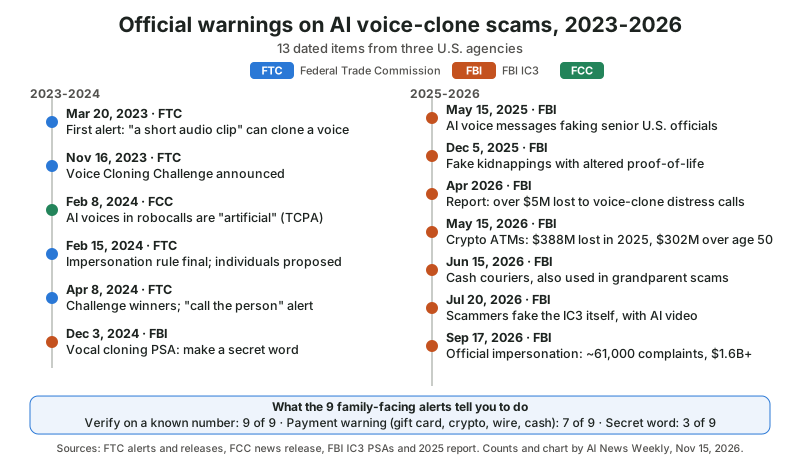
The timeline as text — 2023-2024: March 20, 2023, FTC, first alert, a short audio clip
can clone a voice; November 16, 2023, FTC, Voice Cloning Challenge announced; February 8, 2024, FCC, AI voices in robocalls are “artificial” under the TCPA; February 15, 2024, FTC, impersonation rule final, individuals proposed; April 8, 2024, FTC, challenge winners and a “call the person” alert; December 3, 2024, FBI, vocal cloning PSA, make a secret word. 2025-2026: May 15, 2025, FBI, AI voice messages faking senior U.S. officials; December 5, 2025, FBI, fake kidnappings with altered proof-of-life; April 2026, FBI, 2025 report, over $5 million lost to voice-clone distress calls; May 15, 2026, FBI, crypto ATMs, $388 million lost in 2025, $302 million by people over 50; June 15, 2026, FBI, cash couriers, also used in grandparent scams; July 20, 2026, FBI, scammers fake the IC3 itself with AI video; September 17, 2026, FBI, official impersonation, about 61,000 complaints and over $1.6 billion.
What the nine family-facing alerts (the FTC alerts of March 2023 and April 2024 and the seven FBI PSAs) tell you to do, by our count:
- Check the caller on a number you already know
- 9 of 9 alerts.
- Never pay by gift card, cryptocurrency, wire transfer or cash courier
- 7 of 9 alerts name one or more of these.
- Agree on a family secret word or code word
- 3 of 9 alerts — the FBI’s of December 3, 2024, May 15, 2025 and December 5, 2025.
Is AI voice cloning illegal?
Using a cloned voice to cheat someone is fraud, and since February 8, 2024 the FCC treats AI-generated voices in robocalls as “artificial” voices under the Telephone Consumer Protection Act, so those calls need the consent the law already required. Voice cloning in itself isn’t banned, and the FTC’s proposal to outlaw impersonating individuals isn’t final.
The FCC’s February 8, 2024 news release says the unanimous ruling makes voice cloning technology used in common robocall scams targeting consumers illegal
and gives state attorneys general new tools against the callers. At the FTC, the Rule on Impersonation of Government and Businesses (16 CFR Part 461) took effect on April 1, 2024; in the eCFR as of November 1, 2026 it has three sections — definitions, government impersonation and business impersonation — and nothing yet on impersonating private people. The FTC proposed adding individuals on February 15, 2024, when then-Chair Lina M. Khan said:
Fraudsters are using AI tools to impersonate individuals with eerie precision and at a much wider scale.
How does an AI voice-clone scam call work?
An AI voice-clone scam call works in four moves: the scammer copies a voice from public clips, invents an emergency, rushes you and asks for secrecy, then demands money in a form that’s hard to get back. The voice is new; the script is the old grandparent scam.
- The voice. A short clip from a public video, post or voicemail is fed into a cloning tool (FTC, March 20, 2023; FBI, December 3, 2024).
- The emergency. A car accident, an arrest, a hospital — or a “kidnapping”, sometimes with an altered photo or video as “proof of life” (FBI, December 5, 2025). Caller ID can be faked too: the FBI’s July 20, 2026 PSA warns of
AI-generated video and caller ID spoofing
. - The pressure. Scammers use
urgent and aggressive tones
, keep victims on the phone and urge themnot to tell family, friends, financial institutions, or law enforcement
(FBI, September 17, 2026). - The payment. Gift cards, wire transfers, cryptocurrency, a crypto kiosk or cash handed to a courier who comes to the door (FBI, June 15 and September 17, 2026).
The same voice trick shows up in four costumes, according to the FBI’s PSAs: the grandparent or “distress” call, the virtual kidnapping, the fake official (from senior U.S. officials in May 2025 to the IC3 itself in July 2026), and the text from a “new number”. For that last one, the FBI’s May 15, 2025 PSA says: If contacted by someone you know well via a new platform or phone number, verify the new contact information through a previously confirmed platform or trusted source.
Can you hear the difference? Often not. The FBI says to listen to tone and word choice, but adds that a real call and AI voice cloning can sound nearly identical
. That’s why the defenses below don’t depend on your ears.
How do you set up a family safe word against AI voice scams?
Set up a family safe word by choosing a word or short phrase together, in person, that never appears online, and agreeing that anyone who calls asking for money in a hurry must say it. The FBI has recommended this since December 3, 2024: Create a secret word or phrase with your family to verify their identity.
Can I just say how much I love that the best defense against a futuristic AI trick is a word like ‘purple pancake’ and a phone call back? The fanciest voice clone in the world still can’t answer the real grandkid’s phone. Low-tech wins this round, and I’m cheering.
Our suggestions for a safe word that works:
- Pick it face to face. Not by text or email, where an account break-in could expose it.
- Make it unguessable. Not a pet’s name, a street, a team or anything in old social posts — those are the first things a scammer looks up. A silly pairing (“purple pancake”) is easy to remember and hard to guess.
- Tell everyone who might get the call. Grandparents, parents, teens at college, the neighbor who checks on Grandma.
- Agree on the rule, not just the word.
No word, no money — even if it really sounds like me.
- Don’t feed it. If a caller asks
what’s our word again?
, that’s your answer: hang up. - Change it if it’s ever used or shared. Pick a new one at the next family get-together.
Thanksgiving, on , is a natural moment: everyone’s at one table, and it takes two minutes between the pie and the dishes. Print the card below, fill in the date and the call-back numbers, and keep it by the phone.
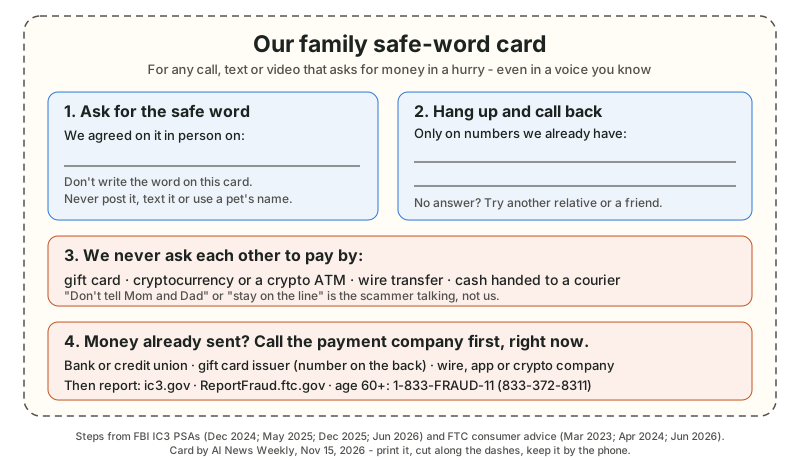
The card as text — Our family safe-word card, for any call, text or video that asks for money in a hurry, even in a voice you know. 1. Ask for the safe word: we agreed on it in person on (date); don’t write the word on this card; never post it, text it or use a pet’s name. 2. Hang up and call back, only on numbers we already have (two lines for numbers); no answer? Try another relative or a friend. 3. We never ask each other to pay by gift card, cryptocurrency or a crypto ATM, wire transfer, or cash handed to a courier; don’t tell Mom and Dad
or stay on the line
is the scammer talking. 4. Money already sent? Call the payment company first, right now: bank or credit union, gift card issuer (number on the back), wire, app or crypto company. Then report: ic3.gov, ReportFraud.ftc.gov, age 60+: 1-833-FRAUD-11 (833-372-8311).
What is the call-back rule, and what if you can’t reach them?
The call-back rule means you hang up on any urgent money call and phone the person yourself on a number you already have — never the number that called you. If you can’t reach them, the FTC says to try to get in touch with them through another family member or their friends
(April 8, 2024).
It works even when the safe word is forgotten, because the scammer can borrow a voice and fake a caller ID, but can’t answer your call to the real phone. The FTC’s April 8, 2024 alert puts it as call the person who supposedly contacted you using a phone number you know is theirs, and verify the story
. For a “kidnapping” call, the FBI’s December 5, 2025 PSA says: Always attempt to contact your loved one before considering paying any ransom demand.
The same rule covers a caller who claims to be the police, a court or the IC3: the FBI says to use official, publicly available information
to call the agency, and never the contact details the caller gave you.
Which payment requests are red flags in a voice-clone scam?
Gift cards, cryptocurrency (including crypto kiosks), wire transfers and cash handed to a courier are the red flags: real family members and real officials don’t need them, and scammers want them because they’re hard to reverse. The FTC says it flatly: Only scammers will tell you to buy a gift card.
| Payment asked for | What the agencies say | If you already paid, call first |
|---|---|---|
| Gift cards | FTC: No real business or government agency will ever tell you to buy a gift card to pay them. | The gift card issuer, on the number on the back of the card; keep the card and receipt |
| Cryptocurrency or a crypto kiosk | FBI: Do not respond to a caller from an unknown telephone number who identifies as a person you know and requests cryptocurrency. | The crypto exchange or ATM operator: say it was fraud and ask for a reversal |
| Wire transfer | FTC: wires are a sign of a scam because the money is hard to get back | The wire company (such as Western Union or MoneyGram) or your bank, right away |
| Payment app or bank transfer | FBI: if someone you know asks for money, independently confirm contact information prior to taking action | The app (such as Venmo, Cash App or PayPal) or your bank: ask them to reverse it |
| Cash to a courier or in the mail | FBI: in-person cash pickup is used across many scams, including grandparentscams | Mailed cash: U.S. Postal Inspection Service, 1-877-876-2455; FedEx or UPS: that company |
The crypto kiosk numbers show why that row matters for older relatives. The FBI’s May 15, 2026 PSA counted more than 13,400 complaints involving cryptocurrency kiosks in 2025, with losses over $388 million — up 23% in complaints and 58% in losses from 2024 — and more than half of the complaints came from people over 50, with losses over $302 million. By our arithmetic, that’s about 78% of the kiosk losses from people over 50, and roughly $29,000 lost per kiosk complaint on average.
What if the voice on the phone says it’s your bank?
Hang up and call your bank on the number printed on your card or statement. The FBI warns that criminals also obtain access to bank accounts using AI-generated audio clips of individuals and impersonating them
, so a voice — yours or a banker’s — is no longer proof on its own (FBI I-120324-PSA, December 3, 2024).
The FBI’s advice in that PSA is to verify the identity of the person calling you by hanging up the phone, researching the contact of the bank or organization purporting to call you, and call the phone number directly
. If an older relative banks by phone, it’s worth one call together to ask the bank which extra security steps it offers on the account.
Where do you report an AI voice-clone scam?
Report an AI voice-clone scam to the FBI at ic3.gov and to the FTC at ReportFraud.ftc.gov, after you’ve called your bank or payment company. People 60 and older can get help filing from the Department of Justice’s Elder Justice Hotline, 1-833-FRAUD-11 (833-372-8311), which the FBI lists in its June 15, 2026 PSA.
- FBI Internet Crime Complaint Center
- File at ic3.gov — type the address yourself; the FBI warns of fake IC3 sites in sponsored search results (July 20, 2026).
- Federal Trade Commission
- Report at ReportFraud.ftc.gov, as every FTC alert above asks.
- DOJ Elder Justice Hotline (60+)
- 1-833-FRAUD-11 (833-372-8311), for help filing an IC3 complaint.
- Local police
- The FBI’s September 17, 2026 PSA says to contact your local law enforcement agency and file a report for impersonation scams.
- Mailed cash
- U.S. Postal Inspection Service, 1-877-876-2455 — for a fee, it can intercept the package (FTC).
What to have ready, from the FBI’s PSAs: the caller’s phone numbers and any usernames, the amounts, dates and payment method, bank account or crypto wallet details you were given, and screenshots of texts or “proof-of-life” photos. Even a call that cost nothing is worth reporting — each report helps the agencies spot the next wave.
What are the key numbers on AI voice-clone scams?
The key numbers on AI voice-clone scams, gathered from the FBI, the FTC, the FCC, Microsoft’s research paper and Consumer Reports:
| Finding | Number | Source |
|---|---|---|
| Recording a research model needed to copy a new voice | 3 seconds | VALL-E paper, Jan 2023 |
| Voice-cloning products with no technical consent check | 4 of 6 assessed | Consumer Reports, Mar 2025 |
| Lost to voice-cloning “distress” scams in 2025 | Over $5 million | FBI IC3, 2025 report |
| AI-related complaints / losses, all scam types, 2025 | 22,364 / $893,346,472 | FBI IC3, 2025 report |
| Crypto kiosk complaints / losses, 2025 | 13,400+ / $388M+ (about $29,000 per complaint) | FBI, May 15, 2026 |
| Crypto kiosk losses from people over 50 | $302M+ (about 78%) | FBI, May 15, 2026 |
| Law enforcement or government impersonation, Jan 2025-Jul 2026 | ~61,000 complaints, $1.6B+ (about $26,000 each) | FBI, Sep 17, 2026 |
| Official items on voice-clone and impersonation scams, Mar 2023-Sep 2026 | 13 (FTC 4, FCC 1, FBI 8: 7 PSAs + the 2025 report) | Our table above |
| Family-facing alerts that say to call back on a known number | 9 of 9 | Our count |
| Family-facing alerts that recommend a secret word | 3 of 9 (FBI, since Dec 2024) | Our count |
| FCC ruling on AI voices in robocalls | February 8, 2024 | FCC |
The numbers come from different kinds of counts — complaints people chose to file with the FBI, a lab paper, a product review — so read each row on its own. Reported losses are a floor, not the whole picture: many people never report.
The short version for families: a cloned voice can sound exactly right, so don’t ask your ears to do the checking. A safe word agreed in person, a call back on a number you already have, and a firm never by gift card, crypto, wire or courier
stop the scam no matter how good the voice is.
So here’s your homework, safe-word keeper: pick the word at the table this Thanksgiving, write the call-back numbers on the card, and say the rule out loud together — no word, no money. It takes two minutes, and it might be the kindest thing you do for your family all year.
Sources and further reading
- Scammers use AI to enhance their family emergency schemes (FTC consumer alert, Alvaro Puig) — Mar 20, 2023; ‘a short audio clip’, ‘Don’t trust the voice’, wire/crypto/gift card red flags
- FTC Announces Exploratory Challenge to Prevent the Harms of AI-enabled Voice Cloning (FTC) — Nov 16, 2023
- FCC Makes AI-Generated Voices in Robocalls Illegal (FCC news release) — Feb 8, 2024; Declaratory Ruling under the TCPA, unanimous, effective immediately
- FTC Proposes New Protections to Combat AI Impersonation of Individuals (FTC) — Feb 15, 2024; Lina M. Khan quote; government and business rule finalized
- 16 CFR Part 461 — Rule on Impersonation of Government and Businesses (eCFR) — checked as of Nov 1, 2026: sections 461.1-461.3, no individuals provision
- FTC Announces Winners of Voice Cloning Challenge (FTC) — Apr 8, 2024; "no single solution"
- Fighting back against harmful voice cloning (FTC consumer alert, Alvaro Puig) — Apr 8, 2024; call back on a known number, then other family or friends
- Criminals Use Generative Artificial Intelligence to Facilitate Financial Fraud (FBI IC3, I-120324-PSA) — Dec 3, 2024; vocal cloning, bank account access, secret word, limit public voice
- Senior US Officials Impersonated in Malicious Messaging Campaign (FBI IC3, I-051525-PSA) — May 15, 2025; "can sound nearly identical", new-number rule, secret word
- Criminals Using Altered Proof-of-Life Media to Extort Victims in Virtual Kidnapping for Ransom Scams (FBI IC3, I-120525-PSA) — Dec 5, 2025; code word, contact your loved one before paying
- FBI Internet Crime Complaint Center 2025 Internet Crime Report (FBI IC3, PDF) — Apr 2026; 22,364 AI-related complaints, $893,346,472; over $5M in voice-cloning distress scams
- IC3 Cryptocurrency Kiosk Complaint Data By State (FBI IC3, I-051526-PSA) — May 15, 2026; 13,400+ complaints, $388M+ in 2025; over-50s $302M+
- Scammers Use Couriers to Collect Cash in Cryptocurrency Investment Scams (FBI IC3, I-061526-PSA) — Jun 15, 2026; couriers in grandparent scams; Elder Justice Hotline 833-372-8311
- FBI Warns of Scammers Impersonating the IC3 (FBI IC3, I-072026-PSA) — Jul 20, 2026; AI video, caller ID spoofing, IC3 never charges to recover funds
- Scammers Impersonating Law Enforcement and Government Officials in Fraud Schemes (FBI IC3, I-091726-PSA) — Sep 17, 2026; ~61,000 complaints, $1.6B+, Jan 2025-Jul 2026
- What To Do if You Were Scammed (FTC Consumer Advice) — June 2026; who to call first for each payment method; USPIS 1-877-876-2455
- Avoiding and Reporting Gift Card Scams (FTC Consumer Advice) — "Only scammers will tell you to buy a gift card"
- Neural Codec Language Models are Zero-Shot Text to Speech Synthesizers — VALL-E (Chengyi Wang et al., Microsoft, arXiv) — Jan 5, 2023; 3-second enrolled recording
- Consumer Reports’ Assessment of AI Voice Cloning Products (Consumer Reports) — Mar 10, 2025; 4 of 6 companies without meaningful consent checks; Grace Gedye quote
Questions and answers
How can you tell if a voice is AI cloned?
Often you can’t by ear — the FBI says a real call and AI voice cloning can sound nearly identical. Instead of listening for flaws, ask for your family’s safe word and hang up and call the person back on a number you already have.
What is a family safe word for scam calls?
A family safe word is a secret word or phrase your family agrees on in person, so anyone calling in an emergency can prove who they are. The FBI has recommended one since December 2024; keep it offline, never use a pet’s name, and agree that no word means no money.
Can scammers clone your voice from a voicemail or social media video?
Yes, a few seconds can be enough. The FTC says a scammer needs only a short audio clip, often from online posts, and Microsoft researchers’ VALL-E paper (2023) copied a new voice from a 3-second recording. The FBI suggests limiting public clips and keeping social media accounts private.
Is AI voice cloning illegal?
Cloning a voice to cheat someone is fraud, and since February 8, 2024 the FCC treats AI-generated voices in robocalls as artificial voices under the Telephone Consumer Protection Act. The FTC’s proposal to ban impersonating individuals was not final as of November 2026; this isn’t legal advice.
What should I do if I sent money to a voice-clone scammer?
Call your bank or the payment company — gift card issuer, wire service, app or crypto exchange — immediately and ask them to reverse the payment. Then report it at ic3.gov and ReportFraud.ftc.gov; people 60 and older can call the Elder Justice Hotline at 833-372-8311 for help.