
How Are AI Models Ranked? Leaderboards and Benchmarks Explained
Disclosure: this page contains Amazon affiliate links. As an Amazon Associate we earn from qualifying purchases, at no extra cost to you.
Ever looked at three AI rankings in one morning and found three different winners, benchmark detective?
Same here, so I opened every leaderboard on the same day and wrote down who sits on top, and why.
On November 22, 2026, Claude Fable 5.2 tops the Artificial Analysis and Epoch AI rankings, Gemini 4 Carbon tops Arena’s human-vote board, and Meta’s Muse Spark 1.1 leads the SWE-bench Pro coding board.
If you’d like the slow, deep version of how AI is built and tested, there are books on building and evaluating AI models on Amazon, but the dated snapshot below is what moves every week.
Short answer: AI models are ranked two ways: people vote between two anonymous answers (Arena), or testers run the same set of test questions on every model and score the results (Artificial Analysis, Epoch AI, SWE-bench). Each board measures something different, so each crowns a different #1. Pick the board that matches your task, then try the top three yourself.
The five facts that sum up AI rankings right now:
- Three different #1s on four live boards: Gemini 4 Carbon (Arena), Claude Fable 5.2 (Artificial Analysis and Epoch AI) and Muse Spark 1.1 (SWE-bench Pro).
- Two models make the top 5 on all three general boards: Gemini 4 Carbon and Claude Opus 5.5, on Arena, Artificial Analysis and Epoch AI (our count).
- Arena runs on votes: 9,213,799 votes across 426 models on its text board.
- A famous coding test was dropped: OpenAI stopped reporting SWE-bench Verified on February 23, 2026, after finding flawed tests in 59.4% of the 138 problems it audited.
- Hugging Face’s Open LLM Leaderboard is retired: it closed on March 13, 2025, after evaluating more than 13,000 models.
Which AI model is ranked #1 right now?
Which AI model is ranked #1 depends on the leaderboard: on November 22, 2026, it’s Gemini 4 Carbon on Arena’s text board, Claude Fable 5.2 on the Artificial Analysis Intelligence Index and the Epoch Capabilities Index, and Muse Spark 1.1 on SWE-bench Pro.
The table lists the top 5 on each of the four boards that still update, one row per rank.
| Rank | Arena text (human votes, score) | Artificial Analysis (Intelligence Index, 0-100) | Epoch AI ECI (score) | SWE-bench Pro (% of coding tasks solved) |
|---|---|---|---|---|
| 1 | Gemini 4 Carbon (High), 1,527 | Claude Fable 5.2 (max), 65 | Claude Fable 5.2, 173.4 | Muse Spark 1.1, 61.5% |
| 2 | Gemini 4 Argon (High), 1,520 | GPT-6.2 Astra (max), 62 | GPT-6.2 Astra, 172.8 | GPT-5.4 (xHigh), 59.1% |
| 3 | Gemini 4 Neon (High), 1,513 | Gemini 4 Neon (xhigh), 61 | Gemini 4 Carbon, 169.7 | Muse Spark, 55.0% |
| 4 | Muse Wonder (Max), 1,511 | Gemini 4 Carbon (high), 60 | GPT-6 Astra, 169.2 | Claude Opus 4.6 (thinking), 51.9% |
| 5 | Claude Opus 5.5 (High), 1,506 | Claude Opus 5.5 (max), 59 | Claude Opus 5.5, 168.7 | Gemini 3.1 Pro (thinking), 46.1% |
Words like “max”, “xhigh” and “High” are effort settings: how long the AI model is allowed to think before it answers. The same model can rank lower at a lower setting, and the free version of a chatbot doesn’t always use the top setting.
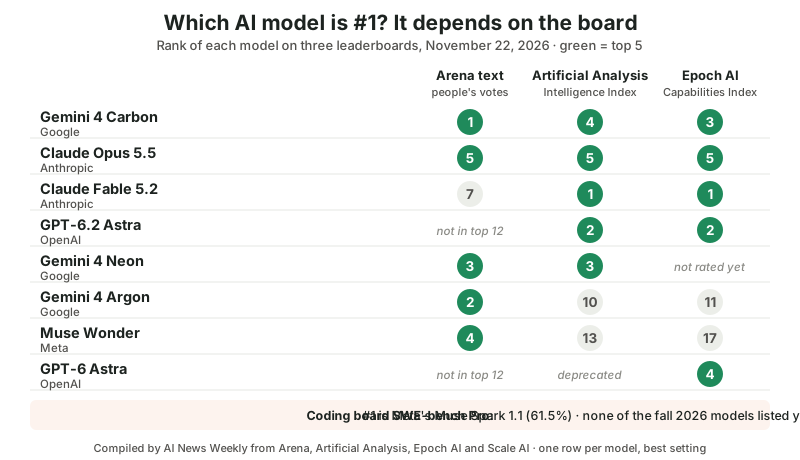
The chart’s ranks as text (Arena text / Artificial Analysis / Epoch AI), one row per model at its best setting:
- Gemini 4 Carbon (Google): 1 / 4 / 3
- Claude Opus 5.5 (Anthropic): 5 / 5 / 5
- Claude Fable 5.2 (Anthropic): 7 / 1 / 1
- GPT-6.2 Astra (OpenAI): not in Arena’s top 12 / 2 / 2
- Gemini 4 Neon (Google): 3 / 3 / not rated by Epoch AI yet
- Gemini 4 Argon (Google): 2 / 10 / 11
- Muse Wonder (Meta): 4 / 13 / 17
- GPT-6 Astra (OpenAI): not in Arena’s top 12 / marked deprecated by Artificial Analysis / 4
- Coding (SWE-bench Pro): #1 is Meta’s Muse Spark 1.1 at 61.5%; none of the fall 2026 models is listed yet.
Why is a different AI model #1 on each leaderboard?
A different AI model is #1 on each leaderboard because each board asks a different question.
Arena asks which answer people like more. Artificial Analysis and Epoch AI ask how many hard test questions a model gets right. SWE-bench Pro asks whether a model can fix real code. A model can be loved in chat and still trail on a maths exam, or the other way round.
Timing matters too. GPT-6.2 Astra came out on November 17, and in the top 12 rows of Arena’s text board on November 22 we found no GPT-6 model; Arena’s changelog shows the GPT-6.2 models going onto its WebDev and coding boards first (November 18-19). Votes take time to pile up.
What is the difference between an AI benchmark and a leaderboard?
An AI benchmark is a fixed set of test questions or tasks with known right answers; a leaderboard is the ranked table that shows how each AI model scored.
An index, like the Artificial Analysis Intelligence Index or the Epoch Capabilities Index, rolls several benchmarks into one number so you can compare models at a glance.
There’s one more kind: a preference leaderboard like Arena, which has no answer key at all. People compare two answers and pick the one they’d rather have, and the votes become the ranking.
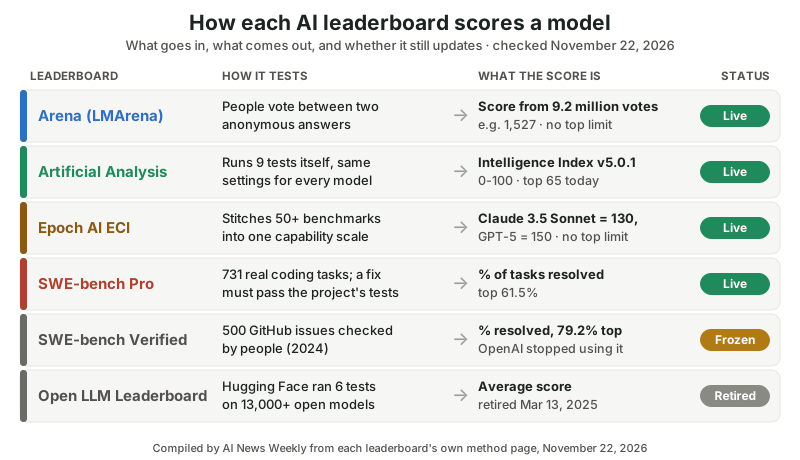
The diagram as text:
- Arena (LMArena)
- People vote between two anonymous answers; a score such as 1,527 comes from 9,213,799 votes. Live.
- Artificial Analysis
- Runs 9 evaluations itself with the same settings for every model; Intelligence Index v5.0.1, 0-100, top score 65. Live.
- Epoch AI Capabilities Index
- Stitches 50+ benchmarks into one scale where Claude 3.5 Sonnet = 130 and GPT-5 = 150, with no top limit. Live.
- SWE-bench Pro
- 731 public coding tasks; a fix only counts if it passes the project’s tests; top score 61.5%. Live.
- SWE-bench Verified
- 500 GitHub issues checked by people in 2024; top score 79.2%; newest leaderboard entry February 26, 2026; OpenAI stopped reporting it. Frozen.
- Hugging Face Open LLM Leaderboard
- Six tests run on more than 13,000 open models; retired March 13, 2025.
How does LMArena (now Arena) rank AI models?
LMArena, now at arena.ai, ranks AI models by human preference: you type a prompt, two anonymous AI models answer, you vote for the better one, and the votes become a score.
Arena’s How it works page puts it simply: In battle mode, you’ll be served 2 anonymous models.
After voting, the model identities are revealed.
The score is a Bradley-Terry rating, the same idea as a chess rating: beating a strong model counts for more than beating a weak one. The method is in the team’s Chatbot Arena paper (arXiv, March 2024).
Arena’s text board, dated November 20, 2026, holds 9,213,799 votes across 426 models. The top five sit within 21 points of each other (1,527 to 1,506), and ranks 7, 8 and 9 all score 1,503, so neighbouring ranks are often a near-tie.
Arena also offers a “style control” adjustment, introduced in an LMSYS post in August 2024. It tries to stop a model from winning votes just by writing longer answers with more headings and bold text.
Can AI companies game the Arena leaderboard?
AI companies can tilt the Arena leaderboard in their favour, according to The Leaderboard Illusion, a paper by Shivalika Singh and co-authors posted on April 29, 2025.
The paper found that some providers test many private versions and publish only the best. At an extreme, we identify 27 private LLM variants tested by Meta in the lead-up to the Llama-4 release.
Arena’s own changelog shows it keeps adjusting the method, for example a Bradley-Terry correction for its text, vision, search and document boards on May 12, 2026. The fair reading: an Arena rank is a strong signal of what people enjoy, not proof that one AI model is smarter.
What is the Artificial Analysis Intelligence Index?
The Artificial Analysis Intelligence Index is a 0-100 score that Artificial Analysis, an independent benchmarking company, calculates by running the same nine evaluations on every AI model itself.
Its methodology page says All models are evaluated under identical conditions with consistent prompting strategies, temperature settings, and evaluation criteria.
Version 5.0.1 (November 2026) weighs four categories at 25% each:
- Knowledge work: AA-Briefcase v1.1 (15%), AutomationBench-AA (5%), GDP.pdf (5%).
- Coding: FrontierCode-AA 2.0 (15%), Terminal-Bench 4.0 (10%).
- Science: Terminal-Bench-Science 0.1 (15%), CritPt v2 Hard Subset (10%).
- General: AA-Omniscience v1.1 (15%), HLE-Diamond (10%).
Here’s the catch: the recipe changes. Version 5.0 (October 2026) added three tests and removed four, including Humanity’s Last Exam, so an Intelligence Index score from September can’t be compared with one from November.
What is Epoch AI’s Capabilities Index (ECI)?
The Epoch Capabilities Index (ECI) is Epoch AI’s single “general capability” score for AI models, built by stitching together results from more than 50 benchmarks.
Epoch AI, a non-profit research group, sets the scale so that Claude 3.5 Sonnet = 130 and GPT-5 = 150, and says there is no maximum score. A model scores higher by doing better on harder benchmarks.
Epoch AI publishes a confidence range for every model, and that’s worth a look. Claude Fable 5.2 (173.4, range 170.0 to 177.2) and GPT-6.2 Astra (172.8, range 169.4 to 176.9) overlap almost completely: on the ECI the top two are effectively tied.
For the benchmarks Epoch AI runs itself (GPQA Diamond, MATH Level 5, Mock AIME 2024-2025, FrontierMath and SWE-bench Verified), its Benchmarking Hub says we are confident that the evaluation results are accurate as we ran the evaluations ourselves
. Other results come from outside sources.
What does SWE-bench measure?
SWE-bench measures whether an AI model can fix real software bugs: it hands the model an actual GitHub issue and its code, and counts the fix only if the project’s tests pass.
Here’s what tickled me: Claude Fable 5.2 is number one on two boards and number seven on the third, all on the same weekend. It’s like a singer who wins the judges’ vote and comes seventh in the phone-in. Both results are real; they just asked different people a different question.
It started as a Princeton research benchmark (the SWE-bench paper, October 2023). Today there are several versions, and the two that matter are SWE-bench Verified and SWE-bench Pro.
Scale AI’s SWE-Bench Pro has 1,865 tasks from 41 professional code repositories. The public set of 731 tasks is drawn from copyleft (GPL-style) projects, a licence Scale AI says acts as a legal deterrent against the code’s inclusion in model training data
.
On the public SWE-Bench Pro leaderboard, Muse Spark 1.1 leads at 61.5% (plus or minus 3.1 points), just ahead of GPT-5.4 at 59.1%. Those margins overlap, so the top two are close to a tie.
Why did OpenAI stop using SWE-bench Verified?
OpenAI stopped using SWE-bench Verified on February 23, 2026, because it found broken tests and signs that AI models had seen the answers during training.
OpenAI audited the 138 problems its o3 model couldn’t solve reliably, out of 500. In its post Why we no longer evaluate SWE-bench Verified, it wrote:
We found that 59.4% of the 138 problems contained material issues in test design and/or problem description.
OpenAI now recommends the public split of SWE-bench Pro. The official SWE-bench Verified leaderboard still shows a top score of 79.2%, but its newest entry is dated February 26, 2026, 269 days before this check.
What happened to the Hugging Face Open LLM Leaderboard?
Hugging Face retired its Open LLM Leaderboard on March 13, 2025, after two years and more than 13,000 open models evaluated.
In the retirement post, the team wrote The leaderboard is slowly becoming obsolete
: newer models had outgrown its tests, and chasing those old scores could pull research the wrong way.
On February 4, 2026, Hugging Face launched Community Evals, where benchmark datasets on the Hub host their own leaderboards and anyone can submit a model’s results. If you see an “Open LLM Leaderboard” ranking quoted today, it’s at least 619 days old.
Why do AI leaderboards disagree with each other?
AI leaderboards disagree because they measure different skills, test at different speeds and settings, and often separate models by less than their own margin of error.
- Different questions: Arena measures which answer people prefer; Artificial Analysis and Epoch AI measure test accuracy; SWE-bench measures working code fixes.
- Different speeds: Gemini 4 Neon (released November 18) is already ranked by Arena and Artificial Analysis but not yet by Epoch AI, and SWE-bench Pro’s newest listed model, Muse Spark 1.1, came out July 9 (136 days earlier).
- Different settings: a model at “max” effort can beat the same model at “medium” by several points, and boards don’t always test the same setting.
- Near-ties: the Epoch AI top two overlap within their ranges, the SWE-bench Pro top two overlap within their margins, and three Arena models share 1,503 points.
- Leaked tests: once a benchmark’s questions are public, AI models may train on them, which is why OpenAI dropped SWE-bench Verified and why Scale AI keeps part of SWE-Bench Pro private.
How should you choose an AI model for your own use?
Choose an AI model by matching the leaderboard to your task, shortlisting the top three there, and then trying them yourself on five real questions from your own week.
- Everyday chat and writing: start with Arena’s text board, because it reflects what people prefer reading.
- Hard reasoning, research and work tasks: look at the Artificial Analysis Intelligence Index and the Epoch Capabilities Index.
- Coding: look at SWE-bench Pro and Arena’s WebDev board, and treat old SWE-bench Verified scores with care.
- Your own test: ask each of your three finalists the same five questions you really need answered, and keep the one whose answers you’d actually use.
- Check what your plan includes: the app you use may run a smaller or lower-effort model than the one on the leaderboard.
New models arrive about every six days, so a ranking ages fast. Our month-by-month timeline of AI models released in 2026 shows which models are new enough to be missing from a board.
When a news summary or a social post claims the smartest AI ever
, our two-minute check for AI news summaries works on rankings too: find the original leaderboard and read its date.
What are the key numbers behind AI leaderboards?
The key numbers behind AI leaderboards on November 22, 2026, from each board’s own pages:
| Finding | Number | Source |
|---|---|---|
| Different #1 models on four live boards | 3 | Our count |
| Models in the top 5 of Arena, Artificial Analysis and Epoch AI | 2 (Gemini 4 Carbon, Claude Opus 5.5) | Our count |
| Votes on Arena’s text board | 9,213,799 across 426 models | Arena, dated Nov 20, 2026 |
| Gap between Arena #1 and #5 | 21 points (1,527 vs 1,506) | Arena; our arithmetic |
| Evaluations in the Intelligence Index | 9, in 4 categories of 25% | Artificial Analysis v5.0.1 |
| Benchmarks behind the ECI | More than 50 | Epoch AI |
| Gap between ECI #1 and #2 | 0.6 points, ranges overlap | Epoch AI; our arithmetic |
| SWE-Bench Pro tasks (public set) | 1,865 (731) | Scale AI |
| SWE-bench Verified problems with flawed tests or descriptions | 59.4% of 138 audited | OpenAI, Feb 23, 2026 |
| Models the Open LLM Leaderboard evaluated | More than 13,000 | Hugging Face, Mar 13, 2025 |
The short version: there is no single “best AI”. There’s a best AI for votes, for tests and for code, and the gaps at the top are often smaller than the margins of error.
We’ll refresh the top-5 snapshot every month, and as new models arrive.
So here’s the plan, benchmark detective: when a headline shouts about the smartest AI ever, ask which board, which date and which setting. Then grab five real questions from your own week and let the top three models fight it out for you. I’ll be back next month with a fresh snapshot.
Sources and further reading
- Text leaderboard (Arena) — dated Nov 20, 2026; 9,213,799 votes, 426 models; read Nov 22, 2026
- How it works (Arena) — anonymous battle mode quotes
- Leaderboard changelog (Arena) — GPT-6.2 added to WebDev and coding boards Nov 18-19, 2026; Bradley-Terry correction May 12, 2026
- Chatbot Arena: An Open Platform for Evaluating LLMs by Human Preference (arXiv) — March 2024; the voting and rating method
- Does style matter? Disentangling style and substance in Chatbot Arena (LMSYS) — August 2024; style control
- The Leaderboard Illusion (arXiv) — Singh et al., Apr 29, 2025; 27 private Meta variants quote
- AI models leaderboard (Artificial Analysis) — Intelligence Index scores read Nov 22, 2026
- Intelligence Benchmarking methodology (Artificial Analysis) — Intelligence Index v5.0.1, weights and version history
- Epoch Capabilities Index (Epoch AI) — method, 130/150 calibration, scores file updated Nov 22, 2026
- AI Benchmarking Hub (Epoch AI) — which benchmarks Epoch runs itself; accuracy quote
- SWE-Bench Pro public leaderboard (Scale AI) — 1,865 tasks, 41 repositories, 731 public; read Nov 22, 2026
- SWE-bench: Can Language Models Resolve Real-World GitHub Issues? (arXiv) — October 2023
- SWE-bench leaderboards (SWE-bench) — Verified: newest entry Feb 26, 2026
- Why we no longer evaluate SWE-bench Verified (OpenAI) — Feb 23, 2026; 59.4% of 138 problems
- End of the Open LLM Leaderboard (Hugging Face) — Mar 13, 2025; over 13,000 models
- Community Evals (Hugging Face blog) — Feb 4, 2026
Questions and answers
What is the best AI model right now?
There’s no single best AI model; it depends on the leaderboard. On November 22, 2026, Claude Fable 5.2 leads the Artificial Analysis Intelligence Index and the Epoch Capabilities Index, Gemini 4 Carbon leads Arena’s human-vote text board, and Muse Spark 1.1 leads the SWE-bench Pro coding board.
Which AI leaderboard is the most accurate?
No AI leaderboard is the most accurate for everything, because each measures something different. Arena is best for what people prefer in chat, Artificial Analysis and Epoch AI for test accuracy across many skills, and SWE-bench Pro for coding. Checking two boards and trying the models yourself beats trusting one number.
What is LMArena?
LMArena, now at arena.ai, is a public AI leaderboard built from people’s votes: two anonymous AI models answer the same prompt, you pick the better answer, and the votes become a Bradley-Terry score. Its text board held 9,213,799 votes across 426 models on November 20, 2026.
What does SWE-bench measure?
SWE-bench measures whether an AI model can fix real GitHub issues: a fix counts only if the project’s tests pass. OpenAI stopped reporting the SWE-bench Verified version on February 23, 2026, over flawed tests, and recommends Scale AI’s SWE-Bench Pro (1,865 tasks) instead.
Are AI benchmarks reliable?
AI benchmarks are useful but imperfect. Test questions can leak into training data, tests can be flawed (OpenAI found issues in 59.4% of 138 audited SWE-bench Verified problems), and top models often sit within each other’s margin of error. Treat a benchmark as a shortlist, not a verdict.