
Which AI Models Came Out in 2026? The Release Timeline, Month by Month
Disclosure: this page contains Amazon affiliate links. As an Amazon Associate we earn from qualifying purchases, at no extra cost to you.
Picture every AI launch of 2026 laid out on one long kitchen table, model spotter, each new model in its own spot with its date beside it!
That’s what I wanted to see, because this year a new model seemed to land almost every week, so I lined them all up straight from the makers’ own pages.
We counted 49 AI model releases from eight makers between January 1 and November 19, 2026, and the newest are Google’s Gemini 4 Neon (November 18), OpenAI’s GPT-6.2 Astra and Sol (November 17) and Alibaba’s Qwen4-Max (November 16).
If you want the bigger picture in a book, there are plain-English AI books on Amazon, but the dated timeline below is the part that changes every week.
Short answer: Eight AI makers released 49 models in 2026, about one every six days. The newest on November 19 are Google’s Gemini 4 Neon, OpenAI’s GPT-6.2, Alibaba’s Qwen4-Max and Anthropic’s Claude Fable 5.2. Anthropic released the most (12), September was the busiest month (10), and 11 of the 49 have open weights.
The six facts that sum up AI model releases in 2026 so far:
- 49 releases from 8 makers: Anthropic 12, Google 10, OpenAI 9, Meta 5, xAI 4, Alibaba Qwen 4, Mistral AI 3 and DeepSeek 2 (our count, January 1 to November 19, 2026).
- One every 6 days: from the first release (February 5) to the latest (November 18) is 286 days, with 48 gaps between 49 releases, so about 6.0 days apart on average.
- September was the busiest month with 10 releases, including OpenAI’s GPT-6 Astra (September 3) and Anthropic’s Claude Opus 5.5 (September 22); January had none on our list.
- New generations: OpenAI moved from GPT-5.3 to GPT-6.2, Anthropic from Claude Opus 4.6 to the Claude 5 family and Fable 5.2, and Google from Gemini 3.1 to the four Gemini 4 models.
- 11 of 49 (22%) have open weights you can download: from Alibaba Qwen, Mistral AI, DeepSeek, Meta and Google (Gemma 4).
- Meta changed names: Meta’s 2026 models are the Muse family from Meta Superintelligence Labs, starting with Muse Spark on April 8.
Which AI models came out in 2026, month by month?
The AI models that came out in 2026 are the 49 below, from OpenAI, Anthropic, Google, Meta, xAI, Alibaba Qwen, Mistral AI and DeepSeek, each dated to the day its maker announced it. Every model name links the maker’s own page, and the “Open weights” column says whether you can download the model to run yourself.
| Date (2026) | Maker | Model | Open weights? | What the maker says it is |
|---|---|---|---|---|
| Anthropic | Claude Opus 4.6 | No | Anthropic’s top Opus model at launch, with a 1M-token context window | |
| OpenAI | GPT-5.3-Codex | No | A Codex-native agent model for long coding and technical work | |
| Alibaba Qwen | Qwen3.5 (397B-A17B) | Yes | First Qwen3.5 model; more sizes followed on Feb 24 and Mar 2 | |
| Anthropic | Claude Sonnet 4.6 | No | The mid-size Claude model, updated | |
| Gemini 3.1 Pro (preview) | No | Preview in the Gemini API | ||
| OpenAI | GPT-5.4 | No | Frontier model for professional work, with a 1M-token context | |
| xAI | Grok 4.20 and Grok 4.20 Multi-agent | No | Live on the xAI API | |
| Mistral AI | Mistral Small 4 | Yes (Apache 2.0) | 119B parameters in total, 6B active per token | |
| Gemma 4 | Yes (Apache 2.0) | Open models in four sizes, from phone-sized E2B to 31B | ||
| Meta | Muse Spark | No | First Muse model from Meta Superintelligence Labs; powers Meta AI | |
| Anthropic | Claude Opus 4.7 | No | Opus update; brought in Anthropic’s current tokenizer | |
| Alibaba Qwen | Qwen3.6-35B-A3B | Yes | Agentic coding model; Qwen3.6-27B followed on Apr 22 | |
| OpenAI | GPT-5.5 | No | Built for complex tasks like coding, research and data analysis | |
| DeepSeek | DeepSeek-V4 Preview (V4-Pro, V4-Flash) | Yes | V4-Pro: 1.6T parameters, 49B active; V4-Pro reached general release Aug 13 | |
| Gemini 3.5 Flash | No | Announced at Google I/O; Gemini 3.5 Pro to follow | ||
| Mistral AI | Mistral Medium 3.5 | Yes (modified MIT) | 128B dense model, Mistral’s first merged flagship | |
| Anthropic | Claude Opus 4.8 | No | Opus update | |
| Anthropic | Claude Fable 5 and Claude Mythos 5 | No | A new top tier; Mythos only for verified organisations | |
| Anthropic | Claude Sonnet 5 | No | Mid-size Claude, new generation | |
| xAI | Grok 4.5 | No | Model for coding, agentic tasks and knowledge work | |
| OpenAI | GPT-5.6 | No | Sol version previewed Jun 26; Luna and Terra versions too | |
| Meta | Muse Spark 1.1 | No | Came with a public preview of the Meta Model API | |
| Gemini 3.6 Flash | No | Released with Gemini 3.5 Flash-Lite | ||
| Anthropic | Claude Opus 5 | No | Opus, new generation | |
| Meta | Muse Glimmer | Yes (Apache 2.0) | 30B model that runs on your own hardware | |
| xAI | Grok 4.6 | No | Frontier model on the xAI API, 500k context | |
| Alibaba Qwen | Qwen3.8 (2.4T-A95B) | Yes | Qwen’s first Max-class open release; Qwen3.8-27B on Aug 14 | |
| Gemini 3.7 Flash | No | Flash update in the Gemini API | ||
| Gemini 3.8 Flash | No | Flash update in the Gemini API | ||
| OpenAI | GPT-6 Astra | No | OpenAI’s new generation, for computer use, coding, cybersecurity and science | |
| DeepSeek | DeepSeek-V4.1-Flash | Yes | 552B parameters in total; replaced V4-Flash in the API | |
| Anthropic | Claude Fable 5.1 and Claude Mythos 5.1 | No | Fable and Mythos update | |
| xAI | Grok 4.7 | No | xAI’s most capable model for coding and knowledge work | |
| OpenAI | GPT-6 Sol and GPT-6 Luna | No | Two everyday GPT-6 models with different balances of capability and cost | |
| Anthropic | Claude Opus 5.5 | No | Anthropic’s suggested starting model for most work | |
| Anthropic | Claude Sonnet 5.5 | No | Mid-size Claude update | |
| OpenAI | GPT-6.1 Sol | No | Near-Astra intelligence for coding, computer use and professional work | |
| Gemini 4 Argon | No | First to trusted cyber defenders; in the Gemini API Oct 13 | ||
| Mistral AI | Mistral Large 4 | Yes (from Oct 29, Mistral Ecosystem Open-Weight license) | About 1 trillion parameters; public preview first | |
| Anthropic | Claude Haiku 5.5 | No | The smallest and fastest Claude | |
| Meta | Muse Wonder and Muse Wonder Full | No | Meta’s “most capable models”, built for AI agents | |
| Meta | Muse Spark Open | Yes (Muse Model License) | Open-weight Muse Spark: 816B parameters, 42B active | |
| OpenAI | GPT-6.1 Terra | No | Fast computer use at scale | |
| Anthropic | Claude Fable 5.2 and Claude Mythos 5.2 | No | Fable offered to all Claude users; Mythos for vetted organisations | |
| Gemini 4 Carbon | No | In the Gemini API; tested first with the U.S. government and cyber defenders | ||
| Gemini 4 Hydrogen | No | Fast everyday Gemini 4; free users get it through auto model selection | ||
| Alibaba Qwen | Qwen4-Max | No | 2.4T parameters, 71B active, 1M-token context; cloud only | |
| OpenAI | GPT-6.2 Astra and GPT-6.2 Sol | No | Better professional outputs, coding and computer use | |
| Gemini 4 Neon | No | Sits between Carbon and Hydrogen; in the Gemini app for AI Pro and Ultra |
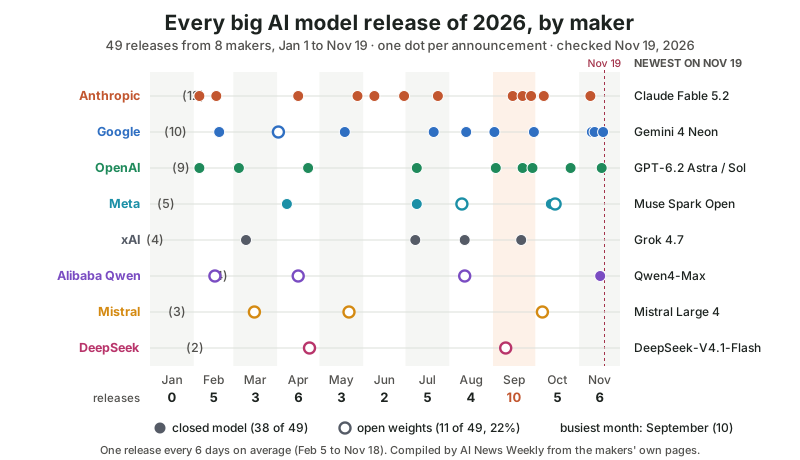
The timeline strip as text — releases per month in 2026: January 0, February 5, March 3, April 6, May 3, June 2, July 5, August 4, September 10, October 5, November (to the 19th) 6. Releases per maker: Anthropic 12, Google 10, OpenAI 9, Meta 5, xAI 4, Alibaba Qwen 4, Mistral AI 3, DeepSeek 2. Closed models 38 of 49; open weights 11 of 49 (22%). Newest per maker on November 19: Claude Fable 5.2, Gemini 4 Neon, GPT-6.2 Astra and Sol, Muse Spark Open, Grok 4.7, Qwen4-Max, Mistral Large 4, DeepSeek-V4.1-Flash.
What came out in January 2026?
No new general-purpose language model from these eight makers came out in January 2026, by our check of their release pages; the year’s first releases were Anthropic’s Claude Opus 4.6 and OpenAI’s GPT-5.3-Codex, both on February 5. xAI’s release notes do list new video and image generation on January 28, which our language-model table leaves out.
The year started where late 2025 left off. Anthropic’s newsroom shows Claude Opus 4.5 on November 24, 2025; DeepSeek’s change log shows DeepSeek-V3.2 on December 1, 2025; and Google’s Gemini API changelog shows Gemini 3 Flash in preview on December 17, 2025. Those were the newest models going into January.
What is the newest AI model right now?
The newest AI model on November 19, 2026 is Google’s Gemini 4 Neon, released on November 18, followed by OpenAI’s GPT-6.2 Astra and Sol (November 17), Alibaba’s Qwen4-Max (November 16) and Anthropic’s Claude Fable 5.2 and Mythos 5.2 (November 9). Four of the eight makers shipped a new model in November.
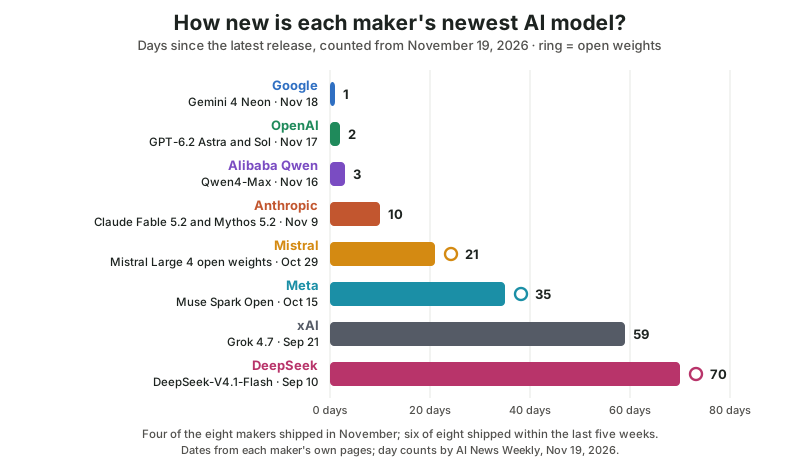
The chart as text — days since each maker’s newest release, counted from November 19, 2026: Google, Gemini 4 Neon (November 18), 1 day; OpenAI, GPT-6.2 Astra and Sol (November 17), 2 days; Alibaba Qwen, Qwen4-Max (November 16), 3 days; Anthropic, Claude Fable 5.2 and Mythos 5.2 (November 9), 10 days; Mistral AI, Mistral Large 4 open weights (October 29), 21 days; Meta, Muse Spark Open (October 15), 35 days; xAI, Grok 4.7 (September 21), 59 days; DeepSeek, DeepSeek-V4.1-Flash (September 10), 70 days. Six of the eight makers released something in the last five weeks.
“Newest” isn’t the same as “best for you”. Anthropic, for example, says its newest model, Claude Fable 5.2, is for the hardest technical work, and points most people to a different one. From Anthropic’s models overview:
If you’re unsure which model to use, start with Claude Opus 5.5 for most workloads.
What is the most capable model from each AI company?
Each AI company names its own most capable model, and it’s often not the newest one. Here is what each maker says on its own pages, as of November 19, 2026:
- OpenAI: the GPT-6 Astra line. OpenAI introduced GPT-6 Astra on September 3, 2026 as
our most intelligent and aligned model yet
, and updated it to GPT-6.2 Astra on November 17. - Anthropic: Claude Fable 5.2 and Claude Mythos 5.2, which the November 9 announcement calls models
designed to tackle the most daunting technical challenges
. Mythos is only for vetted organisations; Fable is offered to all Claude users. - Google: Gemini 4 Carbon, which Google’s October recap calls
our strongest model yet for long-horizon engineering and cybersecurity defense
; Gemini 4 Neon and Hydrogen are the faster, lighter Gemini 4 models. - Meta: Muse Wonder and Muse Wonder Full (October 12), which Meta’s research blog calls its
most capable models
; they have no downloadable weights. - xAI: Grok 4.7 (September 21), which xAI calls its most capable model for coding and knowledge work (xAI’s own pages now carry the name SpaceXSI). xAI’s release notes list no Grok 5.
- Alibaba Qwen: Qwen4-Max (November 16), the first Qwen4 model, with 2.4 trillion parameters and 71 billion active per token, available only in the cloud.
- Mistral AI and DeepSeek: Mistral Large 4 (about 1 trillion parameters, open weights since October 29) and DeepSeek’s V4 line, led by DeepSeek-V4-Pro (1.6 trillion parameters, 49 billion active).
Which 2026 AI models have open weights?
Eleven of the 49 AI models released in 2026 have open weights you can download and run on your own hardware: three from Alibaba Qwen, three from Mistral AI, two from DeepSeek, two from Meta and one from Google. None of the 2026 flagship models from OpenAI, Anthropic or xAI on our list has downloadable weights.
| Model | Maker | Released | Size (maker’s figures) | License |
|---|---|---|---|---|
| Qwen3.5 (397B-A17B, plus smaller sizes) | Alibaba Qwen | 397B total, 17B active (largest) | On Hugging Face and ModelScope | |
| Mistral Small 4 | Mistral AI | 119B total, 6B active | Apache 2.0 | |
| Gemma 4 | E2B, E4B, 26B MoE, 31B | Apache 2.0 | ||
| Qwen3.6 (35B-A3B, 27B) | Alibaba Qwen | 35B total, 3B active; 27B | On Hugging Face and ModelScope | |
| DeepSeek-V4 (Pro, Flash) | DeepSeek | 1.6T total, 49B active (Pro); 284B, 13B (Flash) | On Hugging Face | |
| Mistral Medium 3.5 | Mistral AI | 128B dense | Modified MIT | |
| Muse Glimmer | Meta | 30B | Apache 2.0 | |
| Qwen3.8 (2.4T-A95B, 27B) | Alibaba Qwen | 2.4T total, 95B active; 27B | On Hugging Face and ModelScope | |
| DeepSeek-V4.1-Flash | DeepSeek | 552B total | On Hugging Face | |
| Muse Spark Open | Meta | 816B total, 42B active | Muse Model License | |
| Mistral Large 4 | Mistral AI | (weights) | About 1T | Mistral Ecosystem Open-Weight license |
OpenAI did release one small open-weight model in 2026 that sits outside our general-purpose table: OpenAI Privacy Filter (April 22), which OpenAI describes as an open-weight model for detecting and redacting personally identifiable information
. And Alibaba says the smaller Qwen4 models will get open weights later; on November 19, Qwen4-Max is cloud-only.
What does “open weights” mean for an AI model?
“Open weights” means the maker publishes the trained model file, so anyone with the right computer can download it, run it offline and adapt it. It doesn’t always mean “open source”: each model comes with its maker’s license, and some makers use licenses of their own (the Mistral Ecosystem Open-Weight license, Meta’s Muse Model License) with their own terms.
How often do new AI models come out?
New AI models came out about once every six days in 2026: 49 releases between February 5 and November 18, a span of 286 days. The pace picked up in the autumn, with 21 of the 49 releases (43%) landing between September 1 and November 19.
Here’s the part that made me laugh: Anthropic shipped Claude Sonnet 5.5 on September 28, OpenAI shipped GPT-6.1 Sol on September 29, and Google announced Gemini 4 Argon on September 30. Three companies, three days, three new models. September wasn’t a month, it was a relay race where nobody stopped to pass the baton.
| Measure | Number |
|---|---|
| Releases per month, Jan to Nov | 0, 5, 3, 6, 3, 2, 5, 4, 10, 5, 6 |
| Busiest month | September: 10 releases |
| Average gap, all makers | 6.0 days (286 days / 48 gaps) |
| Average gap between Anthropic releases | 25 days (12 releases) |
| Average gap between Google releases | 30 days (10 releases) |
| Average gap between OpenAI releases | 36 days (9 releases) |
| Three makers on three straight days | Sep 28 to Sep 30: Claude Sonnet 5.5, GPT-6.1 Sol, Gemini 4 Argon |
The biggest three makers, Anthropic, Google and OpenAI, account for 31 of the 49 releases (63%). Their naming also moved fastest: OpenAI went through GPT-5.3, 5.4, 5.5, 5.6, 6, 6.1 and 6.2 in one year, and Google’s Gemini went from 3.1 to 4.
What changed for everyday users of ChatGPT, Gemini, Claude and Meta AI?
For everyday users, 2026’s AI model releases changed which model answers you by default: ChatGPT moved to GPT-6, the Gemini app picked up Gemini 3.5 and then Gemini 4 models, Claude added the Fable tier for all users, and Meta AI switched to Meta’s new Muse Spark.
- ChatGPT: OpenAI retired GPT-4o, GPT-4.1, GPT-4.1 mini and o4-mini from ChatGPT on February 13, 2026 (OpenAI, January 29). On October 7, OpenAI said GPT-6 is rolling out globally in ChatGPT with “Intelligent UI”, answers that can include visuals and interactive pieces.
- Gemini: Gemini 3.5 Flash came to the Gemini app and AI Mode in Google Search on May 19; Gemini 4 Hydrogen reaches free users through auto model selection, and Gemini 4 Neon is in the Gemini app’s model menu for Google AI Pro and Ultra subscribers.
- Claude: Anthropic says Claude Fable 5.2 is offered to all claude.ai users, with limits that depend on the plan; Claude Opus 5.5 is the suggested everyday choice.
- Meta AI: Muse Spark now powers the Meta AI app and meta.ai, and Meta’s newsroom said it would roll out to WhatsApp, Instagram, Facebook, Messenger and Meta’s AI glasses.
How can I tell which AI model my chatbot is using?
Most chatbots show the model’s name in a menu near the top of the chat or beside the message box; tap it to see the choices on your plan. If the app picks a model for you automatically, as the Gemini app does for free users, the menu usually says so. Knowing the model name helps when you read a headline like the ones in this timeline and wonder whether it affects you. If you’re helping an older relative get started, our look at how seniors use AI in 2026 is a gentle first read.
How do we keep this AI release timeline accurate?
We keep this AI release timeline accurate by using only the makers’ own pages: each row links the company announcement, API changelog or release notes, and we date it to the day the maker announced the model. Rumours and leaks stay out until a maker posts them.
- One source per row, from the maker: Anthropic’s newsroom, OpenAI’s news feed, Google’s blog and Gemini API changelog, Meta’s AI and research blogs, xAI’s release notes, Mistral AI’s news, DeepSeek’s API news and Qwen’s official repository and blog.
- Announcement day first: when a model is announced one day and reaches developers later (Gemini 4 Argon on September 30, in the API on October 13), the row uses the announcement date and notes the later one.
- Language models only: image, video, voice and specialist models (like OpenAI’s GPT-6 Cyber or Google’s Genie 4) are left out of the count so the months compare fairly.
- Re-checked monthly: we add each new release as it’s announced and re-read every row once a month, with corrections dated at the bottom.
The rules for AI companies are changing too: the EU’s obligations for general-purpose AI models are explained in our EU AI Act dates guide, and the court fights over the data these models were trained on are in our AI copyright lawsuits tracker.
What are the key numbers for AI model releases in 2026?
The key numbers for AI model releases in 2026, from our timeline of the makers’ own announcements:
| Finding | Number | Source |
|---|---|---|
| Language-model releases, Jan 1 to Nov 19, 2026 | 49, from 8 makers | Our timeline |
| Average time between releases | About 6 days | Our arithmetic |
| Busiest month | September, 10 releases | Our count |
| Most releases by one maker | Anthropic, 12 | Anthropic newsroom; our count |
| Share from Anthropic, Google and OpenAI | 31 of 49 (63%) | Our count |
| Open-weight releases | 11 of 49 (22%) | Makers’ pages; our count |
| Largest open-weight model | Qwen3.8: 2.4 trillion parameters, 95 billion active | Qwen model name and repository |
| Newest model on Nov 19 | Gemini 4 Neon, 1 day old | Google blog; our count |
| Makers that released in November | 4 of 8 | Our count |
The short version: a new AI model about every six days, a busy September, new generations from OpenAI (GPT-6), Anthropic (Claude 5 and Fable) and Google (Gemini 4), and one in five models open to download. We’ll add December’s releases here as each maker announces them.
So here’s the plan, model spotter: bookmark this timeline, check the newest-model chart before you believe a headline about the latest AI, and come back in December, when I’ll add every new release as soon as its maker posts it.
Sources and further reading
- Models (Anthropic newsroom) — every Claude launch with its date, Opus 4.6 (Feb 5, 2026) to Fable 5.2 (Nov 9, 2026)
- Models overview (Claude documentation) — current and older Claude models; "start with Claude Opus 5.5" quote
- Introducing Claude Fable 5.2 and Claude Mythos 5.2 (Anthropic) — Nov 9, 2026
- OpenAI News (official feed) — dates and summaries for every 2026 OpenAI launch
- GPT-6 Astra: A new generation of intelligence (OpenAI) — Sep 3, 2026; "most intelligent and aligned model yet"
- Introducing GPT-6.2 Astra and Sol (OpenAI) — Nov 17, 2026
- GPT-6 and Intelligent UI for everyone (OpenAI) — Oct 7, 2026
- Retiring GPT-4o, GPT-4.1, GPT-4.1 mini, and OpenAI o4-mini in ChatGPT (OpenAI) — Jan 29, 2026; retirement Feb 13, 2026
- Introducing OpenAI Privacy Filter (OpenAI) — Apr 22, 2026; open-weight PII model
- Gemini API changelog (Google AI Studio) — model release dates, Gemini 3.1 Pro to Gemini 4 Neon
- Introducing Gemini 4 Neon (Google) — Nov 18, 2026
- Introducing Gemini 4 Hydrogen (Google) — Nov 12, 2026
- Introducing Gemini 4 Argon (Google) — Sep 30, 2026; Koray Kavukcuoglu
- Google AI news: October 2026 updates (Google) — Nov 2, 2026; Gemini 4 Carbon "strongest model yet"
- Gemini 3.5: frontier intelligence with action (Google) — May 19, 2026
- Gemma 4: Byte for byte, the most capable open models (Google) — Apr 2, 2026
- Introducing Muse Spark: Scaling Towards Personal Superintelligence (Meta AI) — Apr 8, 2026
- Introducing Muse Spark 1.1 (Meta AI) — Jul 9, 2026; Meta Model API preview
- Introducing Muse Glimmer (Meta) — Aug 10, 2026; 30B, Apache 2.0
- Muse Wonder: A Frontier Model For Personal and Professional AI Agents (Meta) — Oct 12, 2026
- Build with Muse Spark Open (Meta Model API) — Oct 15, 2026; 816B, Muse Model License
- Release Notes (xAI API documentation) — Grok 4.20 Mar 10, Grok 4.5 Jul 8, Grok 4.6 Aug 12, Grok 4.7 Sep 21, 2026
- Introducing Grok 4.7 (xAI) — Sep 21, 2026
- Change Log (DeepSeek API docs) — V3.2 Dec 1, 2025 to V4.1-Flash-1017 Oct 17, 2026
- DeepSeek-V4 Preview Release (DeepSeek) — Apr 24, 2026; open-sourced
- DeepSeek-V4.1-Flash release (DeepSeek) — Sep 10, 2026
- Introducing Mistral Small 4 (Mistral AI) — Mar 16, 2026; Apache 2.0
- Remote agents in Vibe, powered by Mistral Medium 3.5 (Mistral AI) — May 22, 2026
- Introducing Mistral Large 4 (Mistral AI) — Oct 6, 2026
- Le Chonk: Mistral Large 4 open weights (Mistral AI) — Oct 29, 2026; Mistral Ecosystem Open-Weight license
- Qwen3.5 / Qwen3.6 / Qwen3.8 official repository (Alibaba Qwen) — release dates Feb 16 to Aug 14, 2026
- Qwen4-Max: Your New Teammate Has Arrived (Qwen blog) — Nov 16, 2026
- Alibaba launches Qwen4-Max (SiliconANGLE) — Nov 16, 2026; same-day report
Questions and answers
What is the newest AI model?
On November 19, 2026, the newest AI model is Google’s Gemini 4 Neon, released November 18. OpenAI’s GPT-6.2 Astra and Sol (November 17), Alibaba’s Qwen4-Max (November 16) and Anthropic’s Claude Fable 5.2 (November 9) came out in the days before it.
What is the latest version of ChatGPT?
OpenAI’s latest models are GPT-6.2 Astra and GPT-6.2 Sol, announced November 17, 2026 for ChatGPT Work, Codex and the API. GPT-6 began rolling out globally in ChatGPT on October 7, 2026, and the older GPT-4o left ChatGPT on February 13, 2026.
What is the latest Claude model?
Anthropic’s latest Claude models are Claude Fable 5.2 and Claude Mythos 5.2, released November 9, 2026; Mythos is for vetted organisations only. Anthropic suggests starting with Claude Opus 5.5 (September 22) for most work, and Claude Haiku 5.5 (October 7) is the fastest.
What is the latest Gemini model?
Google’s latest Gemini model is Gemini 4 Neon, released November 18, 2026. It’s one of four Gemini 4 models: Argon (announced September 30), Carbon (in the API November 10), Hydrogen (November 12) and Neon. Google calls Carbon its strongest.
Is Grok 5 out yet?
No. As of November 19, 2026, xAI’s own API release notes list Grok 4.7, released September 21, 2026, as its newest model, and there is no Grok 5 announcement. Before that came Grok 4.20 (March), Grok 4.5 (July) and Grok 4.6 (August).