
AI Medication Reminders and Health Organizers: What Works in 2026
Disclosure: this page contains Amazon affiliate links. As an Amazon Associate we earn from qualifying purchases, at no extra cost to you.
Ahoy, pill-box captain — pour yourself a glass of water (perfect timing, right?), because your phone, your speaker and your chatbot all want to help you remember your medicines now, and I’ve sorted out which ones actually earn the job! Four in ten adults 65 and older take five or more prescription medicines, according to the CDC — and in 2026 almost every AI assistant can now set a reminder for them. The humble helper that still does the job no app can, showing at a glance whether today’s dose is gone, is one of the weekly pill organizers with big AM/PM compartments on Amazon.
Short answer: The AI medication reminders that work best in 2026 are the plain ones: a phone or smart-speaker alarm tied to one written medicine list. Apple’s Health app adds taken/skipped logging and a follow-up nudge after 30 minutes; ChatGPT, Gemini and Alexa+ set timed reminders, but none of their makers describes a missed-dose follow-up.
The five facts that sum up medication reminders and older adults in 2026:
- 43.0% of adults 65+ took five or more prescription drugs in the past 30 days in 2017 — March 2020, up from 33.3% in 2001-2004 (CDC National Center for Health Statistics).
- 10% of adults 50+ who use AI for their health care use it to track or manage their treatment or medication — the least common of the six uses AARP measured (AARP Research, June 11, 2026).
- 30 minutes: Apple’s Health app can send a follow-up reminder if a medication hasn’t been logged 30 minutes after the first notification (Apple Support).
- February 4, 2026: Alexa+ became available to everyone in the U.S., with reminders you can aim at one named family member (Amazon).
- 1 of the six tools we compared — Apple’s Health app — reminds you, records Taken or Skipped and nudges again if a dose isn’t logged (our comparison table below).
How many older adults take several medicines a day?
About four in ten adults 65 and older take five or more prescription medicines: 43.0% in the CDC’s 2017 — March 2020 survey data, and 67.7% take three or more. Both numbers have climbed since the early 2000s, which is why a reliable reminder routine matters more than any single app.
The figures come from the National Health and Nutrition Examination Survey (NHANES), as published on the CDC National Center for Health Statistics page Health, United States: Prescription Drug Use
, which counts prescription drugs used in the past 30 days. Over-the-counter medicines and supplements aren’t included, so the real number of daily pills is often higher.
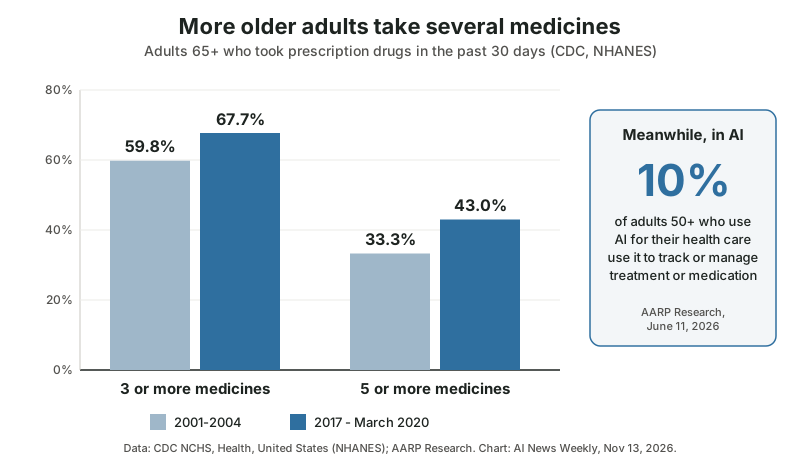
The chart as text — adults 65+ who took prescription drugs in the past 30 days: three or more drugs 59.8% (2001-2004) and 67.7% (2017 — March 2020); five or more drugs 33.3% (2001-2004) and 43.0% (2017 — March 2020). Side note: 10% of adults 50+ who use AI for their health care use it to track or manage treatment or medication (AARP Research, June 11, 2026).
Our arithmetic on those CDC numbers: the five-or-more group grew by 9.7 percentage points, about 1.3 times its early-2000s size, and the three-or-more group by 7.9 points. A simple example of why reminders matter: five medicines taken once a day add up to 1,825 doses a year, and twice-a-day medicines double that.
Are older adults already using AI to manage their medicines?
Only a few are so far: 10% of adults 50+ who used AI to navigate their health care used it to track or manage treatment or medication, in AARP Research’s AI and Health Care Providers
survey published June 11, 2026. Far more used AI to look things up — 62% researched a medication that was mentioned or prescribed.
The interest is there, though. In AARP Research’s January 13, 2026 report Older Adults Want AI to Show Up in Practical Ways
, the top “job” adults 50+ named for AI was managing their health support network — the doctors, pharmacies, appointments and family who keep care on track. And Pew Research Center found that 23% of Americans 65 and older use AI chatbots, as part 1 of this series explains.
Which AI assistants can remind you to take your medicine in 2026?
Apple’s Health app, Alexa+, Gemini (through Google Tasks) and ChatGPT (through scheduled tasks) can all remind you at a set time in 2026. Only Apple’s Health app also records whether you tapped Taken or Skipped and nudges you again if you didn’t; the newer AI health spaces from Microsoft and Anthropic organize records rather than send dose reminders.
| Tool | Reminds you at a set time | Records taken or skipped | Nudges again if not logged | Family can see it |
|---|---|---|---|---|
| Apple Health Medications (iPhone, iPad, Apple Watch) | Yes — from the schedule you set | Yes — Taken or Skipped | Yes — follow-up 30 minutes after the first notification | Yes — medications can be included when you share health data |
| Alexa+ (Echo devices, Alexa app) | Yes — by voice or in the Alexa app, for a named person | Not described | Not described | Within the household: Alexa+ can deliver a reminder to the person it’s meant for |
| Gemini (reminders saved to Google Tasks) | Yes — Remind me on [date] at [time] | You can mark the task done | Not described | Not described |
| ChatGPT scheduled tasks | Yes — push alert, email or both (TechDay) | Not described | Not described | Not described |
| Copilot Health (Microsoft) | Not described — reads medication lists from health records | Not described | Not described | Not described |
| Claude health connectors (Anthropic) | Not described — summarizes records and explains results | Not described | Not described | Not described |
How do medication reminders work in Apple’s Health app?
Apple’s Health app has a built-in Medications feature on iPhone, iPad and Apple Watch: you add each medicine with its strength and schedule, get a notification at each dose time, and tap Taken or Skipped. It works with iOS 16 and watchOS 9 or later; schedules on specific days of the week or in cycles need iOS 18 or later.
Per Apple Support’s page Add and log medications with iPhone, iPad, and Apple Watch
(published September 14, 2026), the Health app’s medication feature also:
- sends follow-up reminders that
alert you if you haven’t logged a medication 30 minutes after the initial notification
, once you turn them on under Options; - lets people in the United States add a medication with the iPhone camera and check drug interactions between their medicines (U.S. only);
- exports a PDF of your current medications to save or share — handy for a pharmacist or a new doctor;
- can include your medications when you share health data with family and friends.
Can Alexa remind you to take your pills?
Yes, Alexa can announce a medication reminder at a set time, and since February 4, 2026, Alexa+ — available to everyone in the U.S. — lets you aim a reminder at one family member. Amazon’s Getting started with Alexa+
says you can easily create reminders by voice or in the Alexa app and just specify who they’re intended for
, and that with Visual ID, Alexa+ identifies who’s present and delivers the intended message.
Alexa’s medication history goes back further: on November 26, 2019, Amazon launched pharmacy-linked reminders for Giant Eagle Pharmacy customers with the phrase Alexa, manage my medication.
One caregiving change worth knowing: Amazon’s Alexa Together service, which let caregivers set reminders remotely, ended — Amazon’s update note of May 21, 2025 says Alexa Together is no longer available
and points caregivers to Alexa Emergency Assist.
Can ChatGPT or Gemini remind you to take your medication?
Yes, both chatbots can send a reminder at a set time: ChatGPT through scheduled tasks and Gemini by saving the reminder to Google Tasks. Neither maker describes a follow-up when a dose is missed, so a chatbot reminder works best as one more nudge on top of a pill organizer or a logging app, not as the whole system.
OpenAI launched scheduled tasks on January 14, 2025; TechCrunch’s Maxwell Zeff reported that ChatGPT sends a push notification on whatever platform you have tasks enabled
. On June 19, 2026, TechDay reported a new Scheduled page in the ChatGPT sidebar where you can pause, edit or delete tasks, with notifications by push alert, email or both, and tasks that can’t run more than once an hour. OpenAI’s own help pages refused our fetch, so we cite those reports; active-task limits differ by plan.
Google’s Gemini Apps Help page says Gemini can add, edit and show reminders from Google Tasks and Samsung Reminder, with prompts such as Remind me on [date] at [time] to [task].
It needs Keep Activity turned on and Google Workspace connected to Gemini. The same page carries a fair warning for anything health-related:
Gemini Apps can hallucinate responses or provide outdated information.
Google’s separate scheduled actions, announced June 6, 2025 for Google AI Pro and Ultra subscribers, run a prompt at a set time — better suited to a weekly what’s my refill schedule?
summary than to a daily pill alarm.
What about Copilot Health, Claude and the Google Health app?
Copilot Health, Claude’s health connectors and the Google Health app are health organizers, not pill alarms: they gather records and explain them, and none of their makers’ pages we read describes dose reminders. They’re useful for building the medicine list itself.
- Copilot Health (Microsoft, March 12, 2026) connects to records from over 50,000 U.S. hospitals and provider organizations through HealthEx,
including your visit summaries, medication lists, and test results
, per Microsoft AI. - Claude (Anthropic, January 11, 2026) can connect lab results and health records for U.S. Pro and Max subscribers, opt-in, to summarize history and explain results, per Anthropic.
- The Google Health app replaced the Fitbit app on May 19, 2026, bringing
health, fitness, and medical records in one place
with a Gemini-built coach for Premium users over 18 who have a Fitbit or Pixel Watch, per the Google Health Help Center. Its help page doesn’t list medication reminders.
What’s the best way to set up a medication routine with AI?
The best medication routine with AI has three layers: one written medicine list, one reminder tool for each dose time, and one way to check the dose really happened. AI is handy for the first two — tidying the list and setting the reminders — while a pill organizer or a family member handles the third.
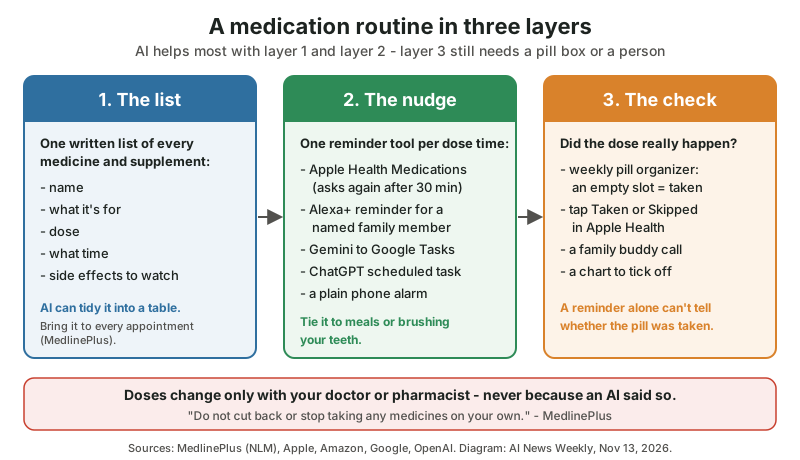
The diagram as text — 1. The list: one written list of every medicine and supplement with name, what it’s for, dose, time and side effects to watch; AI can tidy it into a table; bring it to every appointment. 2. The nudge: one reminder tool per dose time — Apple Health Medications (asks again after 30 minutes), an Alexa+ reminder for a named family member, Gemini reminders in Google Tasks, a ChatGPT scheduled task, or a plain phone alarm — tied to meals or brushing your teeth. 3. The check: a weekly pill organizer (an empty slot means taken), Taken or Skipped in Apple Health, a family buddy call, or a chart to tick off; a reminder alone can’t tell whether the pill was taken. Doses change only with your doctor or pharmacist.
Seven steps that work with any of the assistants above:
- Write one list. MedlinePlus suggests a list with each medicine’s name, purpose, dose, timing and side effects, including medicines bought without a prescription.
- Let AI tidy it, not change it. Ask an AI chatbot to turn the list into a morning / noon / evening / bedtime table (prompt below), then check every line against the bottles.
- Pick one reminder tool per dose time. Two apps nagging about the same pill is how doses get double-counted.
- Tie each time to a habit. MedlinePlus suggests taking medicines at meals or with another daily habit, such as brushing your teeth.
- Add a check. A weekly pill organizer or Apple Health’s Taken button shows whether the dose is done.
- Add a person. MedlinePlus suggests a buddy system with a friend, or a family member who stops by or calls.
- Review the list with your pharmacist whenever a medicine is added, stopped or changed, and bring it to every appointment.
What prompt turns a pill list into a clear daily schedule?
A good prompt for a pill schedule asks the AI chatbot to reorganize your list without changing anything and to flag questions for the pharmacist. Our own example prompt for ChatGPT, Gemini, Copilot or Claude:
Here is my medicine list. Please turn it into a simple daily
table with four rows - morning, noon, evening, bedtime - in
large, plain words. Do NOT change any dose, time or medicine.
If something looks unclear (for example "take with food" or
"twice daily" with no times), list it as a question for my
pharmacist instead of guessing.
I removed my name and ID numbers.
[paste: medicine name - strength - how many - when]Do pill organizers and automatic dispensers still beat apps?
Pill organizers don’t beat apps so much as do a different job: a reminder app tells you it’s time, while a pill organizer shows whether the dose is already gone. Most older adults get the most reliable routine by using both — an alarm or assistant for the nudge, and an organizer for the check.
Can I confess my favorite bit of this whole story? The best partner for the fanciest AI reminder is a plastic box with seven little lids. The AI does the nagging, the box does the proving — an empty Tuesday slot is the most honest status update in the house.
MedlinePlus’s Keeping your medicines organized
(reviewed July 15, 2026) describes the options:
- Pill organizers
- 7-, 14- or 28-day sizes, with 1, 2, 3 or 4 compartments a day; a pharmacist can help you pick one
- Automatic dispensers
- Dispense pills automatically up to 4 times a day, with a light and an alarm; they run on batteries, so change them regularly
- Color coding
- Mark each bottle with a color for its time of day, such as green for breakfast or orange for bedtime
- A medicine chart
- Each medicine and its time, with a space to check off each dose
For someone whose biggest risk is taking a dose twice, the visible empty slot of an organizer, or a locked automatic pill dispenser with an alarm, does something no chatbot reminder can.
How can family help with medication reminders from far away?
Family can help from far away by sharing the medicine list, setting reminders that go to the right person and adding a daily human check-in. Apple’s Health app can include medications when you share health data with family, Alexa+ can deliver a reminder to one named family member at home, and MedlinePlus suggests a friend or relative who calls to help you remember.
MedlinePlus’s Caregiving — medication management
(reviewed April 9, 2026) adds four habits for caregivers:
- Use meal times and bedtimes as reminders, and a watch alarm or phone notification for in-between medicines.
- Keep all the medicines in their original bottles.
- Use weekly pill organizers to keep track of what needs to be taken each day.
- Get to know your loved one’s pharmacist, and bring a list of all medicines — prescribed and bought without a prescription — to each appointment.
For a step-by-step version with one assistant, our sister site How To With Claude AI is publishing a matching seniors series with screens and prompts for Claude.
What are the key numbers on medication reminders and older adults?
The key numbers on older adults, their medicines and AI reminder tools, gathered from the CDC, AARP and the makers’ own pages:
| Finding | Number | Source |
|---|---|---|
| Adults 65+ taking five or more prescription drugs (2017 — March 2020) | 43.0% (33.3% in 2001-2004; +9.7 points) | CDC NCHS |
| Adults 65+ taking three or more prescription drugs (2017 — March 2020) | 67.7% (59.8% in 2001-2004; +7.9 points) | CDC NCHS |
| Adults 50+ using AI for health care who use it to track or manage medication | 10% | AARP Research |
| Adults 50+ using AI for health care who research a mentioned or prescribed medication | 62% | AARP Research |
| Apple Health follow-up reminder if a dose isn’t logged | 30 minutes after the first notification | Apple Support |
| Alexa+ available to everyone in the U.S. | February 4, 2026 | Amazon |
| Alexa Together (remote caregiver reminders) ended | May 21, 2025 | Amazon |
| Fitbit app became the Google Health app | May 19, 2026 | |
| Doses a year for five once-a-day medicines | 1,825 | Our arithmetic |
The surveys measure different groups — the CDC counts adults 65+, AARP adults 50+ — so compare numbers within a row, not across sources.
The short version for families: in 2026 any phone or smart speaker can remind you to take a pill, and the AI assistants are genuinely good at turning a messy list into a clear schedule. What keeps doses right is still the old trio — one list, one organizer, one person who checks in — with the AI doing the nagging.
So here’s your mission, captain: write the one list this week, let any AI assistant tidy it into a morning-to-bedtime table, set one reminder per dose time, and fill a weekly pill organizer on the same day every week — with a family member on the phone if you can. One list, one nudge, one check, and the whole routine just hums.
Sources and further reading
- Health, United States: Prescription Drug Use (CDC National Center for Health Statistics) — NHANES; adults 65+ 3+ drugs 59.8% -> 67.7%, 5+ drugs 33.3% -> 43.0% (2001-2004 to 2017-March 2020); last reviewed Aug 6, 2024; read Nov 13, 2026
- Adults Age 50-Plus AI and Health Care Providers Survey (AARP Research, Brittne Kakulla) — June 11, 2026; top uses 64/62/45/41/21/10%; 10% track or manage treatment or medication
- Older Adults Want AI to Show Up in Practical Ways (AARP Research, Brittne Kakulla) — January 13, 2026; top job: managing one’s health support network
- Add and log medications with iPhone, iPad, and Apple Watch (Apple Support) — published Sep 14, 2026; follow-up reminders 30 minutes, U.S. camera add and drug interactions, Export PDF, sharing, iOS 18 cyclical schedules; read Nov 13, 2026
- Getting started with Alexa+ (Amazon) — Feb 4, 2026; available to everyone in the U.S., reminders for a named person, Visual ID; read Nov 13, 2026
- Alexa can remind you to take your medication (Amazon) — Nov 26, 2019; Giant Eagle Pharmacy, "Alexa, manage my medication"
- Alexa Together launches to help customers remotely care for loved ones (Amazon) — update note May 21, 2025: Alexa Together no longer available; Alexa Emergency Assist
- Capture your tasks and reminders with Gemini Apps (Google Gemini Apps Help) — Google Tasks and Samsung Reminder, Keep Activity and Workspace required, example prompts, hallucination warning; read Nov 13, 2026
- Scheduled actions in the Gemini app (Google, Dave Citron) — June 6, 2025; Google AI Pro and Ultra
- What is new with the redesigned Google Health app (Google Health Help Center) — Fitbit app became Google Health on May 19, 2026; Gemini-built coach; read Nov 13, 2026
- ChatGPT now lets you schedule reminders and recurring tasks (TechCrunch, Maxwell Zeff) — Jan 14, 2025; push notification
- OpenAI expands ChatGPT scheduled tasks with new hub (TechDay, Mark Tarre) — June 19, 2026; Scheduled page, push/email, once-an-hour limit, Pulse withdrawn
- Scheduled tasks in ChatGPT (OpenAI Help Center) — the maker’s own page; it refused our fetch on Nov 13, 2026, so details here come from TechCrunch and TechDay
- Introducing Copilot Health (Microsoft AI) — Mar 12, 2026; medication lists via HealthEx records
- Advancing Claude in healthcare and the life sciences (Anthropic) — Jan 11, 2026; health record connectors, U.S. Pro and Max, opt-in
- Taking medicine at home — create a routine (MedlinePlus, U.S. National Library of Medicine) — reviewed Jul 15, 2026; alarms, buddy system, medicine chart, do not cut back on your own
- Keeping your medicines organized (MedlinePlus) — reviewed Jul 15, 2026; 7/14/28-day organizers, automatic dispensers up to 4 times a day, color coding
- Caregiving — medication management (MedlinePlus) — reviewed Apr 9, 2026; original bottles, weekly organizers, pharmacist
Questions and answers
What is the best medication reminder app for seniors?
For iPhone users, the free Medications feature in Apple’s Health app is the most complete built-in option: it reminds you at each dose time, records Taken or Skipped and can nudge you again 30 minutes later. On other phones, a Gemini reminder in Google Tasks or a plain alarm works, best paired with a weekly pill organizer.
Does the iPhone have a medication reminder?
Yes. The Health app on iPhone (iOS 16 or later) has a Medications feature: add each medicine and its schedule, get a notification at each time, and tap Taken or Skipped. You can turn on follow-up reminders that alert you if a dose isn’t logged 30 minutes after the first notification, per Apple Support.
Can Alexa remind me to take my pills?
Yes. You can create a reminder by voice or in the Alexa app, and since February 4, 2026, Alexa+ — available to everyone in the U.S. — lets you say who the reminder is for and uses Visual ID to deliver it to that person. Amazon doesn’t describe Alexa recording whether the dose was taken.
Can ChatGPT remind me to take my medication?
Yes, ChatGPT’s scheduled tasks can send a reminder at a set time by push notification, email or both, per TechCrunch and TechDay reports. ChatGPT doesn’t track whether you took the pill, so use it alongside a pill organizer, and never let a chatbot change a dose.
How can I remind my elderly parent to take medication remotely?
Share the medicine list, set a reminder on the device your parent already uses — an iPhone’s Health app or an Alexa+ reminder aimed at them — and add a regular phone call, as MedlinePlus suggests. Filling a weekly pill organizer together makes missed doses easy to spot.